2014 VOLVO S80 towing
[x] Cancel search: towingPage 299 of 380
08 Wheels and tires
Vehicle loading
08
297
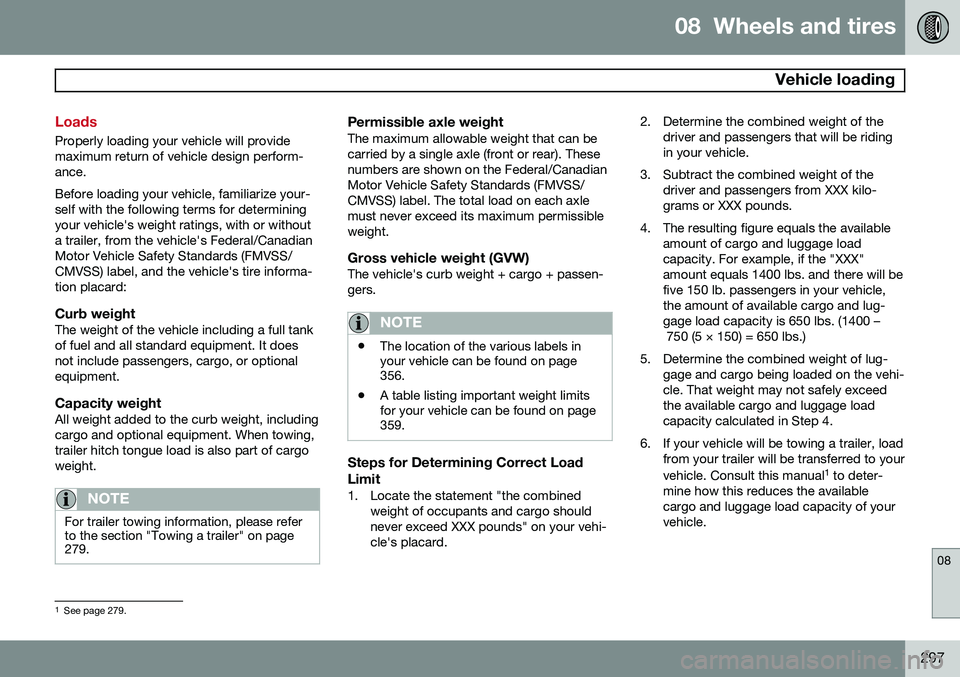
Loads
Properly loading your vehicle will provide maximum return of vehicle design perform-ance. Before loading your vehicle, familiarize your- self with the following terms for determiningyour vehicle's weight ratings, with or withouta trailer, from the vehicle's Federal/CanadianMotor Vehicle Safety Standards (FMVSS/CMVSS) label, and the vehicle's tire informa-tion placard:
Curb weightThe weight of the vehicle including a full tankof fuel and all standard equipment. It doesnot include passengers, cargo, or optionalequipment.
Capacity weightAll weight added to the curb weight, includingcargo and optional equipment. When towing,trailer hitch tongue load is also part of cargoweight.
NOTE
For trailer towing information, please refer to the section "Towing a trailer" on page279.
Permissible axle weightThe maximum allowable weight that can be carried by a single axle (front or rear). Thesenumbers are shown on the Federal/CanadianMotor Vehicle Safety Standards (FMVSS/CMVSS) label. The total load on each axlemust never exceed its maximum permissibleweight.
Gross vehicle weight (GVW)The vehicle's curb weight + cargo + passen-gers.
NOTE
•The location of the various labels in your vehicle can be found on page356.
• A table listing important weight limitsfor your vehicle can be found on page359.
Steps for Determining Correct Load Limit
1. Locate the statement "the combined
weight of occupants and cargo should never exceed XXX pounds" on your vehi-cle's placard. 2. Determine the combined weight of the
driver and passengers that will be ridingin your vehicle.
3. Subtract the combined weight of the driver and passengers from XXX kilo-grams or XXX pounds.
4. The resulting figure equals the available amount of cargo and luggage loadcapacity. For example, if the "XXX"amount equals 1400 lbs. and there will befive 150 lb. passengers in your vehicle,the amount of available cargo and lug-gage load capacity is 650 lbs. (1400 – 750 (5 × 150) = 650 lbs.)
5. Determine the combined weight of lug- gage and cargo being loaded on the vehi-cle. That weight may not safely exceedthe available cargo and luggage loadcapacity calculated in Step 4.
6. If your vehicle will be towing a trailer, load from your trailer will be transferred to your vehicle. Consult this manual 1
to deter-
mine how this reduces the available cargo and luggage load capacity of yourvehicle.
1 See page 279.
Page 307 of 380
08 Wheels and tires
Tire Sealing System*
08
* Option/accessory, for more information, see Introduction.305
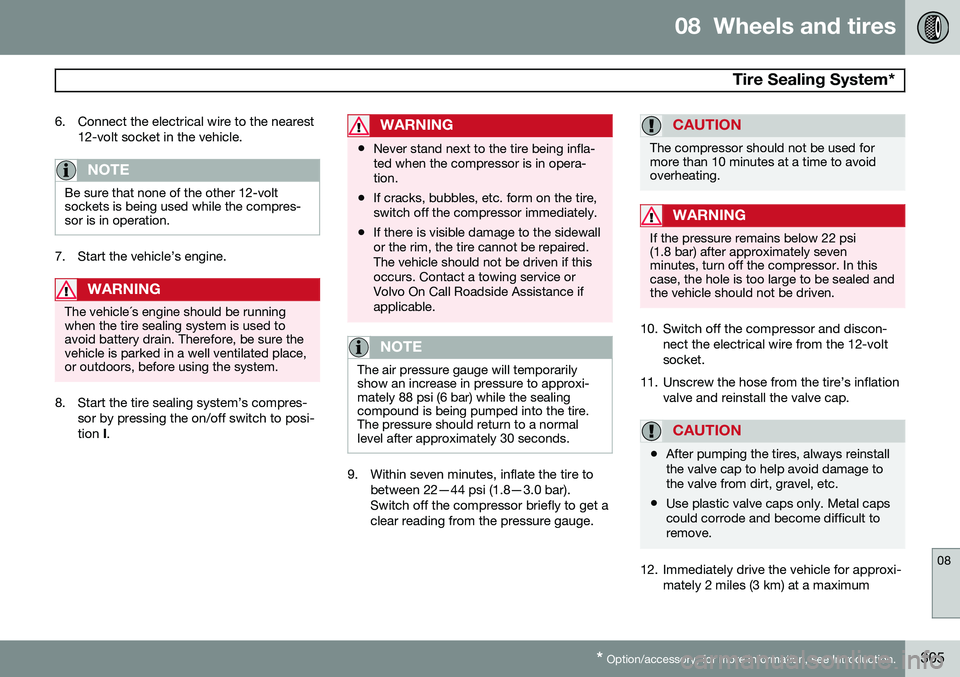
6. Connect the electrical wire to the nearest
12-volt socket in the vehicle.
NOTE
Be sure that none of the other 12-volt sockets is being used while the compres-sor is in operation.
7. Start the vehicle’s engine.
WARNING
The vehicle´s engine should be running when the tire sealing system is used toavoid battery drain. Therefore, be sure thevehicle is parked in a well ventilated place,or outdoors, before using the system.
8. Start the tire sealing system’s compres- sor by pressing the on/off switch to posi- tion I.
WARNING
• Never stand next to the tire being infla- ted when the compressor is in opera-tion.
• If cracks, bubbles, etc. form on the tire,switch off the compressor immediately.
• If there is visible damage to the sidewallor the rim, the tire cannot be repaired.The vehicle should not be driven if thisoccurs. Contact a towing service orVolvo On Call Roadside Assistance ifapplicable.
NOTE
The air pressure gauge will temporarily show an increase in pressure to approxi-mately 88 psi (6 bar) while the sealingcompound is being pumped into the tire.The pressure should return to a normallevel after approximately 30 seconds.
9. Within seven minutes, inflate the tire to
between 22—44 psi (1.8—3.0 bar). Switch off the compressor briefly to get aclear reading from the pressure gauge.
CAUTION
The compressor should not be used for more than 10 minutes at a time to avoidoverheating.
WARNING
If the pressure remains below 22 psi (1.8 bar) after approximately sevenminutes, turn off the compressor. In thiscase, the hole is too large to be sealed andthe vehicle should not be driven.
10. Switch off the compressor and discon- nect the electrical wire from the 12-volt socket.
11. Unscrew the hose from the tire’s inflation valve and reinstall the valve cap.
CAUTION
•After pumping the tires, always reinstall the valve cap to help avoid damage tothe valve from dirt, gravel, etc.
• Use plastic valve caps only. Metal capscould corrode and become difficult toremove.
12. Immediately drive the vehicle for approxi-
mately 2 miles (3 km) at a maximum
Page 311 of 380

08 Wheels and tires
Changing a wheel
08
309
Lug wrench and towing eyelet5. Screw the towing eyelet into the lug wrench as shown in the illustration.
CAUTION
The towing eyelet must be screwed into the lug wrench as far as possible.
6. With the vehicle still on the ground, usethe lug wrench/towing eyelet to loosen the wheel nuts ½ – 1 turn by exertingdownward (counterclockwise) pressure.
G017465
Jack attachment points
7. There are two jack attachment points on each side of the vehicle. Position the jack correctly in the attachment (see the illus-tration) and crank while simultaneouslyguiding the base of the jack to theground. The base of the jack must be flaton a level, firm, non-slippery surface.Before raising the vehicle, check that thejack is still correctly positioned in theattachment.
8. Raise the vehicle until the wheel to be changed is lifted off the ground.
9. Unscrew the wheel nuts completely and remove the wheel.
Page 372 of 380

11 Index
11
370
E
ECC......................................... 202, 204, 206
Eco guide................................................. 125
Economical driving.................................. 268
Electrically heated steering wheel............. 93
Electric parking brake.............................. 130
Electronic Climate Control....... 202, 204, 206air distribution table............................ 207
Interior Air Quality System.................. 206
ventilated seats................................... 202
Emergency locking retractor...................... 38
Emergency starting.................................. 119
Emergency towing................................... 282
Emission inspection readiness................ 319Engine overheating........................................... 80
specifications...................................... 360
starting................................................ 116
switching off....................................... 119
Engine compartment overview................ 321
Engine oil................................................. 361 checking............................................. 322
low pressure warning light.................... 79
volumes.............................................. 362 Engine remote start (ERS)........................ 118
Environment............................................... 12
Eyelets for anchoring loads..................... 276
F
Federal Clean Air Act............................... 318 Flat tires
repairing with tire sealing system....... 302
Floor mats cleaning.............................................. 351
placing correctly................................. 116
Fluid specifications.................................. 362
Fog lights................................................... 79 rear........................................................ 98
Four C (active chassis system)................ 216
Front airbags.............................................. 22 disconnecting passenger’s side air-
bag.................................................. 26, 27
Front park assist.............................. 176, 178
Front seats........................................... 86, 88 heated................................................. 202
Fuel filler cap........................................... 274
Fuel filler door, opening........................... 273 Fuel level warning light.............................. 79
Fuel requirements............................ 271, 272
Fuel tank volume..................................... 362
Fuses....................... 339, 340, 343, 346, 347G
Garage door opener
HomeLink ®
Wireless Control System. 113
Gasoline requirements............................. 272
Gas tank volume...................................... 362
Gauges...................................................... 75
Geartronic................................................ 122
Geartronic automatic transmission.......... 122
Generator warning light............................. 80
Glossary of tire terminology..................... 296
Grocery bag holder.................................. 277
Gross vehicle weight............................... 297
H
Hazard warning flashers............................ 99
HD digital radio........................................ 236
Page 377 of 380
11 Index
11
375
storing................................................. 290
studded............................................... 300
tire pressure monitoring system......... 311
tire sealing system.............................. 302
tread wear indicator............................ 289
uniform tire quality grading................. 299
Tire sealing system.................................. 302 Top tether anchors (child restraint sys-
tems).......................................................... 49
Touching up paint.................................... 351
Towing a trailer................................ 279, 280
Towing the vehicle................................... 282
Traction control........................................ 136
Trailer towing................................... 279, 280Transmission general description..................... 121, 122
Hill Start Assist................................... 121
oil........................................................ 362
shiftlock override................................ 124
Tread wear indicator................................ 289
Trip computer.......................................... 209
Trip odometers.......................................... 82
Trips, long distance................................. 269 Trunk
changing bulbs................................... 331
driving with it open............................. 268
Tunnel detection........................................ 97
Turn signals............................................... 99 changing bulbs................................... 329
indicator lights...................................... 79
U
Uniform Tire Quality Grading................... 299
Unlocking the vehicle.......................... 57, 67
Upholstery care....................................... 349
V
Valet locking.............................................. 63
Vanity mirror............................................ 219
changing bulbs................................... 331
Vehicle Event Data....................................... 9
Vehicle loading................................ 276, 297 roof loads............................................ 278
Vehicle maintenance................................ 318 performed by the owner..................... 319 Vehicle weights........................................ 359
Ventilated seats....................................... 202Voice control
cell phones......................................... 262
Volvo and the environment........................ 12
Volvo maintenance.................................. 318
Volvo On Call Roadside Assistance........ 367
Volvo programs....................................... 367
Volvo Sensus........................................... 190
W
Warning flashers, hazard........................... 99
Warning lights................................ 75, 77, 79
Warning symbol......................................... 81
Warning system, collision................ 162, 163
Warranties................................................ 318
Washer fluid..................................... 334, 362Washers headlight............................................. 103
windshield........................................... 102
Water, driving through............................. 269
Waxing..................................................... 349