Page 221 of 429
To open, lift up the center armrest as far as it will go in the direction of the arrow ⇒ fig. 117.
To close, put the center armrest down.
There may be an AUX-IN jack in the center armrest storage compartment ⇒ fig. 118,
⇒ booklet Radio, or ⇒ booklet Navigation system.
WARNING
The center armrest can restrict the driver's arm movement and cause crashes and serious personal injury.
x Always keep storage compartments in the center armrest closed while driving.
WARNING
Never let a passenger, especially a child, ride on the center armrest.
A telephone cradle for the mobile phone package may be installed in the upper section of the
storage compartment ⇒ booklet Mobile Phone Package.
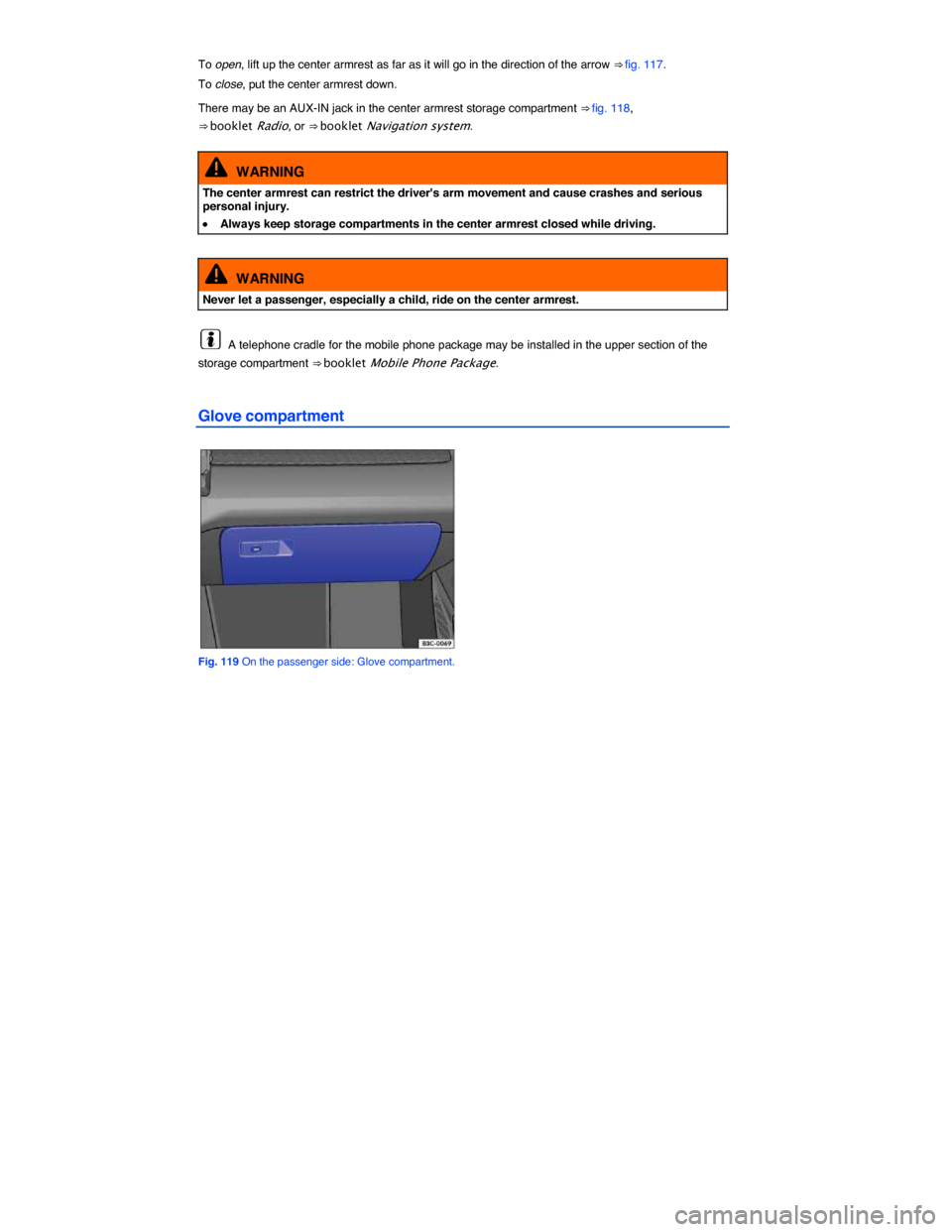
Glove compartment
Fig. 119 On the passenger side: Glove compartment.
Page 286 of 429

When a turn signal is set, unnecessary lines and areas are hidden.
Orientation lines overview
Meaning of the orientation lines and areas projected on screen ⇒ fig. 150. All distances of the orientation lines refer to a vehicle on a level surface.
(1) Red: Safety distance. Area up to about 16 inches (40 cm) behind the vehicle on the road.
(2) Vehicle's width limits.
(3) Point to change steering angle.
When the yellow line touches the curb or any other parking space boundary, the steering wheel must be turned in the opposite direction (close-up view).
(4) The area parallel to the vehicle that is needed for parking. The area shown must fit completely into the parking space.
(5) Parked vehicle at the curb.
Parking
x Position the vehicle about 3 feet (1 meter) away from and parallel to the parking space and shift into Reverse.
x On the screen of the navigation system, activate Mode 2 for parallel parking.
x Back up slowly and steer the vehicle so that the yellow surface on the screen is flush with the side boundary of the parking space (such as the curb) and stops short of any obstacle (5), such as another vehicle.
x Turn the steering wheel as far as it will go into the direction of the parking space and slowly back up.
x Once the yellow line (3) touches the side of the parking space, for example, a marking or the curb (close-up view), turn the steering wheel as far as it will go in the opposite direction.
x Continue backing up until the vehicles is positioned in the parking space parallel to the road. If necessary, correct the parking position.
It may take up to 5 seconds for the area detected by the sensors to be displayed on the factory-installed radio or navigation system screen.
Page 290 of 429

Muting the Park Distance Control volume
You can mute the PDC beeping signals by tapping the + function key on the Radio or Navigation system screen (if applicable). Tap the function key again to reactivate the acoustic signals.
Switching Park Distance Control back on after it was switched off reactivates the volume. System malfunction warning signals cannot be switched off.
If you manually deactivate the display, PDC remains on and the sound is reactivated.
WARNING
Never rely completely on the PDC for information about people and objects that might be in the way of the vehicle and could be struck by the vehicle causing serious personal injury.
x The PDC sensors have blind spots where they cannot detect people or objects.
x Always watch for people, especially small children and animals, because the sensors may not always be able to detect them.
If you hear a long beep lasting about 3 seconds when you first turn PDC on or the indicator light in the button starts blinking, this means there is a malfunction in the Park Distance Control system. Switch off the Park Distance Control system with the button and have it immediately checked by an authorized Volkswagen dealer or an authorized Volkswagen Service Facility.
Page 295 of 429
Changing the temperature unit on the factory-installed Radio or Radio & Navigation system display
The inside and outside temperatures can be displayed in either Fahrenheit (F) or Celsius (C).
Select Units in the instrument cluster display in the Settings main menu, Volkswagen Information System.
You can also press and hold the !
Page 360 of 429

361
human body. Limits and guidelines have been established by governmental authorities and international committees in an effort to keep the electromagnetic radiation from mobile phones at levels that will not cause health problems. However, there is no scientifically based proof that wireless phones are absolutely safe.
Therefore, some experts recommend a precautionary approach regarding the use of mobile phones by taking measures that lower the personal exposure to electromagnetic fields. When using a mobile telephone inside a motor vehicle without a proper connection to an integrated vehicle telephone antenna, the personal exposure to electromagnetic fields will be higher than when using the mobile telephone while properly connected to an integrated or other outside vehicle telephone antenna.
Your vehicle may be equipped with an optional hands-free system that will permit many of the features of compatible Bluetooth® enabled mobile telephones to be used for greater convenience and is consistent with the laws of an increasing number of states and localities that prohibit the use of mobile telephones without some kind of hands-free device.
The hands-free system in your vehicle can be used with certain mobile phones that are connected by wire and hardware connector or via compatible Bluetooth® enabled phones with a cradle that is designed to fit your mobile telephone. The special cradle offers several advantages: The phone cradle must be safely secured to the base plate. Your phone is firmly attached to the instrument panel and is within reach at all times. Placing the phone in its cradle permits it to be charged, but more importantly connects the mobile phone to the vehicle's outside antenna. A mobile telephone that is properly connected to the integrated or other outside vehicle telephone antenna will lower the personal exposure to electromagnetic fields. You should also experience a better quality of service. Although a mobile telephone can be used inside your vehicle without a cradle, the phone will not be securely attached to the vehicle, will not be charged through the cradle wiring, and more importantly will not be connected to the vehicle's integrated telephone antenna. The mobile phone will also not be recharged. You might also experience more dropped calls and an overall impaired quality of the connection.
Therefore we strongly recommend that you use your mobile telephone in your vehicle only when it is properly attached to an appropriate cradle mounted on a base plate on the instrument panel.
Because of the large number and variety of mobile telephones on the market and the frequency with which new models are introduced, Volkswagen does not offer cradles for mobile telephones. Please check with the manufacturer of the mobile telephone that you plan to use.
Bluetooth® is a registered trademark of Bluetooth® SIG, Inc.
WARNING
A mobile phone on the seat, instrument panel or in other places can be thrown around the inside of the vehicle during a sudden braking maneuver, a crash or other accident and injure vehicle occupants.
x Never place or attach accessories or other objects (such as cup holders, telephone brackets, note pads, navigation systems, large, heavy or bulky objects) on the doors, on the windshield, over or near the area marked “AIRBAG” on the steering wheel, instrument panel, backrests or between these areas and the occupant. Such objects could cause serious injury in a collision, especially if an airbag inflates.
Page 363 of 429
x Service may be inadequate due to lack of proper service facilities, tools or testing equipment.
x Replacement parts may not be readily available.
x DVD navigation systems for vehicles built for the United States and Canada will not necessarily work in Europe, and may not work in other countries outside of North America.
NOTICE
Volkswagen is not responsible for mechanical damage that may result from substandard fuel or service or the unavailability of Genuine Volkswagen parts.
x Volkswagen is not responsible if the vehicle does not meet the respective legal requirements in other countries and continents.
Radio antenna and reception