Page 166 of 201
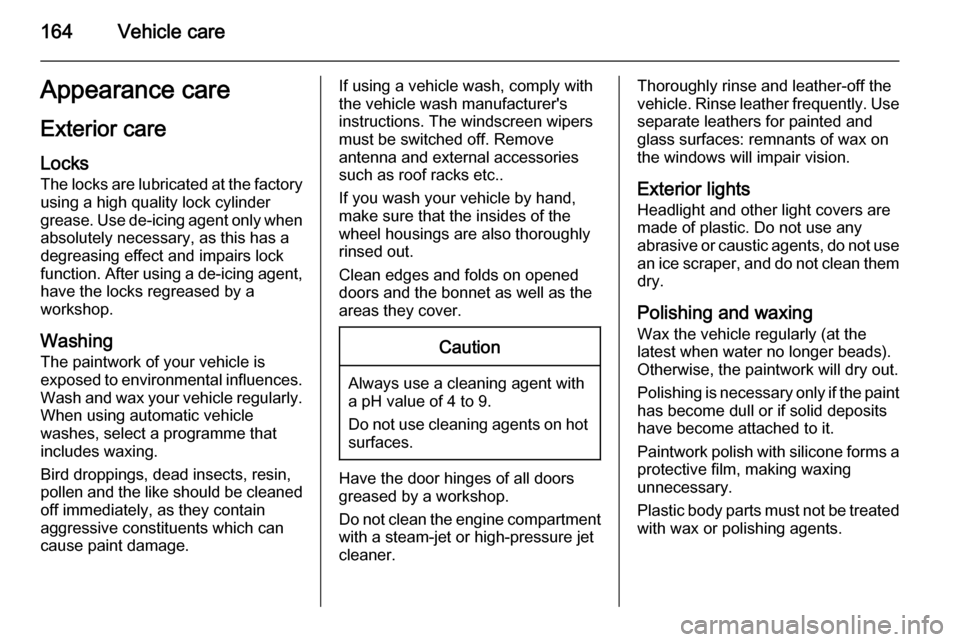
164Vehicle careAppearance care
Exterior care Locks
The locks are lubricated at the factory using a high quality lock cylinder
grease. Use de-icing agent only when absolutely necessary, as this has adegreasing effect and impairs lockfunction. After using a de-icing agent,
have the locks regreased by a
workshop.
Washing The paintwork of your vehicle is
exposed to environmental influences.
Wash and wax your vehicle regularly.
When using automatic vehicle
washes, select a programme that
includes waxing.
Bird droppings, dead insects, resin,
pollen and the like should be cleaned
off immediately, as they contain
aggressive constituents which can
cause paint damage.If using a vehicle wash, comply with
the vehicle wash manufacturer's
instructions. The windscreen wipers
must be switched off. Remove
antenna and external accessories
such as roof racks etc..
If you wash your vehicle by hand, make sure that the insides of the
wheel housings are also thoroughly
rinsed out.
Clean edges and folds on opened
doors and the bonnet as well as the
areas they cover.Caution
Always use a cleaning agent with
a pH value of 4 to 9.
Do not use cleaning agents on hot surfaces.
Have the door hinges of all doors
greased by a workshop.
Do not clean the engine compartment with a steam-jet or high-pressure jet
cleaner.
Thoroughly rinse and leather-off the vehicle. Rinse leather frequently. Use
separate leathers for painted and
glass surfaces: remnants of wax on
the windows will impair vision.
Exterior lights
Headlight and other light covers are
made of plastic. Do not use any
abrasive or caustic agents, do not use an ice scraper, and do not clean them
dry.
Polishing and waxing Wax the vehicle regularly (at the
latest when water no longer beads).
Otherwise, the paintwork will dry out.
Polishing is necessary only if the paint
has become dull or if solid deposits
have become attached to it.
Paintwork polish with silicone forms a
protective film, making waxing
unnecessary.
Plastic body parts must not be treated with wax or polishing agents.
Page 169 of 201

Service and maintenance167Service and
maintenanceGeneral information ...................167
Recommended fluids, lubricants and parts .................................... 168General information
Service information In order to ensure economical and
safe vehicle operation and to
maintain the value of your vehicle, it
is of vital importance that all
maintenance work is carried out at the proper intervals as specified.
The detailed, up-to-date service
schedule for the vehicle is available at
the workshop.
Service display 3 75.
Engine identification 3 171.
Service intervals - except Bus Maintenance of your vehicle is
required every 25,000 miles or after
2 years, whichever occurs first,
unless otherwise indicated by the
service display.
Service intervals - Bus only
Maintenance of your vehicle is
required every 20,000 miles or after
2 years, whichever occurs first,
unless otherwise indicated by the
service display.Confirmations
Confirmation of service is recorded in the Service and Warranty Booklet.The date and mileage is completed
with the stamp and signature of the
servicing workshop.
Make sure that the Service and
Warranty Booklet is completed
correctly as continuous proof of
service is essential if any warranty or
goodwill claims are to be met, and is
also a benefit when selling the
vehicle.
Service display
The service interval is based on
several parameters depending on
usage.
The service display, located in the
Driver Information Centre, indicates
when the next service is due. Seek
the assistance of a workshop.
Service display 3 75.
Engine oil lever monitor 3 74.
Page 170 of 201

168Service and maintenanceRecommended fluids,lubricants and parts
Recommended fluids and
lubricants
Only use products that meet the
recommended specifications.
Damage resulting from the use of
products not in line with these
specifications will not be covered by
the warranty.9 Warning
Operating materials are
hazardous and could be
poisonous. Handle with care. Pay
attention to information given on
the containers.
Engine oil
Engine oil is identified by its quality
and its viscosity. Quality is more
important than viscosity when
selecting which engine oil to use. The oil quality ensures e.g. engine
cleanliness, wear protection and oil
aging control, whereas viscosity
grade gives information on the oil's
thickness over a temperature range.
Dexos is the newest engine oil quality
that provides optimum protection for
diesel engines. If it is unavailable,
engine oils of other listed qualities
have to be used.
Select the appropriate engine oil based on its quality and on the
minimum ambient temperature
3 173.
Topping up engine oil
Engine oils of different manufacturers and brands can be mixed as long as
they comply with the required engine
oil quality and viscosity.
Use of engine oil with only
ACEA A1/B1 or only A5/B5 quality is
prohibited, since it can cause long-
term engine damage under certain
operating conditions.
Select the appropriate engine oil
based on its quality and on the
minimum ambient temperature
3 173.Additional engine oil additives
The use of additional engine oil
additives could cause damage and
invalidate the warranty.
Engine oil viscosity grades
The SAE viscosity grade gives
information of the thickness of the oil.
Multigrade oil is indicated by two
figures, e.g. SAE 5W-30. The first
figure, followed by a W, indicates the
low temperature viscosity and the
second figure the high temperature
viscosity.
Select the appropriate viscosity grade depending on the minimum ambient
temperature 3 173.
All of the recommended viscosity grades are suitable for high ambient
temperatures.
Coolant and antifreeze
Use only silicate-free long life coolant
(LLC) antifreeze approved for the
vehicle, consult a workshop.
The system is factory filled with
coolant designed for excellent
corrosion protection and frost
Page 173 of 201

Technical data171Identification plate
The identification plate is located on
the right hand door pillar.
Information on identification plate 1)
:
1=Vehicle identification number2=Permissible gross vehicle
weight rating in kg3=Permissible gross train weight
in kg4=Maximum permissible front
axle load in kg5=Maximum permissible rear
axle load in kg6=Trim code7=Technical specifications of
vehicle, including: Vehicle
paint code, equipment level
and vehicle type8=Additional equipment
specification9=Fabrication number10=Interior trim code
The combined total of front and rear
axle loads must not exceed the
permissible gross vehicle weight. For
example, if the front axle is bearing its
maximum permissible load, the rear
axle can only bear a load that is equal
to the gross vehicle weight minus the front axle load.
The technical data is determined in
accordance with European
Community standards. We reserve
the right to make modifications.
Specifications in the vehicle
documents always have priority over
those given in this manual.
Engine identifier code and engine number Stamped on the engine cylinder block
and on a label attached to the timing
chain cover, depending on variant.
1) The identification plate on your vehicle may differ from the illustration shown.
Page 174 of 201
172Technical dataEngine identificationThe technical data tables show the
engine identifier code. Engine data
3 174.
To identify the respective engine,
refer to the engine power in the EEC
Certificate of Conformity provided
with your vehicle or other national
registration documents.
Page 175 of 201
Technical data173Vehicle dataRecommended fluids and lubricantsRequired engine oil qualityEngine oil qualitydexos 2✔
In case dexos quality is unavailable you may use max. 1 litre engine oil quality ACEA C3 once between each oil change.
In case dexos quality is unavailable in International countries you may use the oil qualities listed below:
Engine oil qualityGM-LL-A/B-025✔ACEA A3/B4
diesel engines without DPF✔ACEA C3
diesel engines with DPF✔
Engine oil viscosity grades
Ambient temperaturedown to -25 °CSAE 5W-30 or SAE 5W-40below -25 °CSAE 0W-30 or SAE 0W-40
Page 176 of 201
174Technical dataEngine dataSales designation2.3 CDTI2)2.3 CDTI2)2.3 CDTI2)Engine identifier codeM9TM9TM9TNumber of cylinders444Piston displacement [cm 3
]229922992299Engine power [kW] (brake horse power)74 (100)92 (125)107 (146)at rpm350035003500Torque [Nm]285310350at rpm1250 - 20001250 - 25001500 - 2750Fuel typeDieselDieselDiesel2) With or without diesel particle filter.
Page 190 of 201
188Technical data
VanRear-wheel driveLengthL3L4Roof heightH2H3H2H3Gross vehicle weight350045003500450045004500Maximum rear door aperture height [mm]172417241724172417241724Rear door aperture width (at floor) [mm]158015801580158015801580Maximum load area height [mm]179817982048204817982048Maximum load area width [mm]176517651765176517651765Width between wheel arches [mm]138010801380108010801080Maximum load floor length [mm]373337333733373343834383CapacitiesEngineM9TEngine oil including filter [l]Front-wheel drive 8.0
Rear-wheel drive 8.9between MIN and MAX [l]1.5 - 2.0Fuel tank, nominal capacity [l]80 or 105


![VAUXHALL MOVANO_B 2014 Owners Manual 174Technical dataEngine dataSales designation2.3 CDTI2)2.3 CDTI2)2.3 CDTI2)Engine identifier codeM9TM9TM9TNumber of cylinders444Piston displacement [cm 3
]229922992299Engine power [kW] (brake horse po](/manual-img/38/19551/w960_19551-175.png "VAUXHALL MOVANO_B 2014 Owners Manual 174Technical dataEngine dataSales designation2.3 CDTI2)2.3 CDTI2)2.3 CDTI2)Engine identifier codeM9TM9TM9TNumber of cylinders444Piston displacement [cm 3
]229922992299Engine power [kW] (brake horse po")
![VAUXHALL MOVANO_B 2014 Owners Manual 188Technical data
VanRear-wheel driveLengthL3L4Roof heightH2H3H2H3Gross vehicle weight350045003500450045004500Maximum rear door aperture height [mm]172417241724172417241724Rear door aperture width (at](/manual-img/38/19551/w960_19551-189.png "VAUXHALL MOVANO_B 2014 Owners Manual 188Technical data
VanRear-wheel driveLengthL3L4Roof heightH2H3H2H3Gross vehicle weight350045003500450045004500Maximum rear door aperture height [mm]172417241724172417241724Rear door aperture width (at")