2014 VAUXHALL MOVANO_B display
[x] Cancel search: displayPage 118 of 201
116Driving and operating
Rocking the vehicleRocking the vehicle is only
permissible if the vehicle is stuck in
sand, mud, snow or a hole.Move the
selector lever between R and A/M (or
between + and -) in a repeat pattern,
while applying light pressure to the
accelerator pedal.Do not race the
engine and avoid sudden
acceleration.
Parking
Apply the parking brake.The most recently engaged gear (see
transmission display) remains
engaged.With N, no gear is engaged.
When the ignition is switched off, the
transmission no longer responds to
movement of the selector lever.
If the ignition is not switched off, or the
parking brake has not been applied, a warning chime will sound upon
opening the driver's door.
Manual mode If a higher gear is selected when the
engine speed is too low, or a lower
gear when the speed is too high, theshift is not executed. This prevents
the engine from running at too low or
too high an engine speed.
If engine speed is too low, the
transmission automatically shifts to a
lower gear.
If engine speed is too high, the
transmission only switches to a higher gear via kickdown.
Electronic driving
programmes
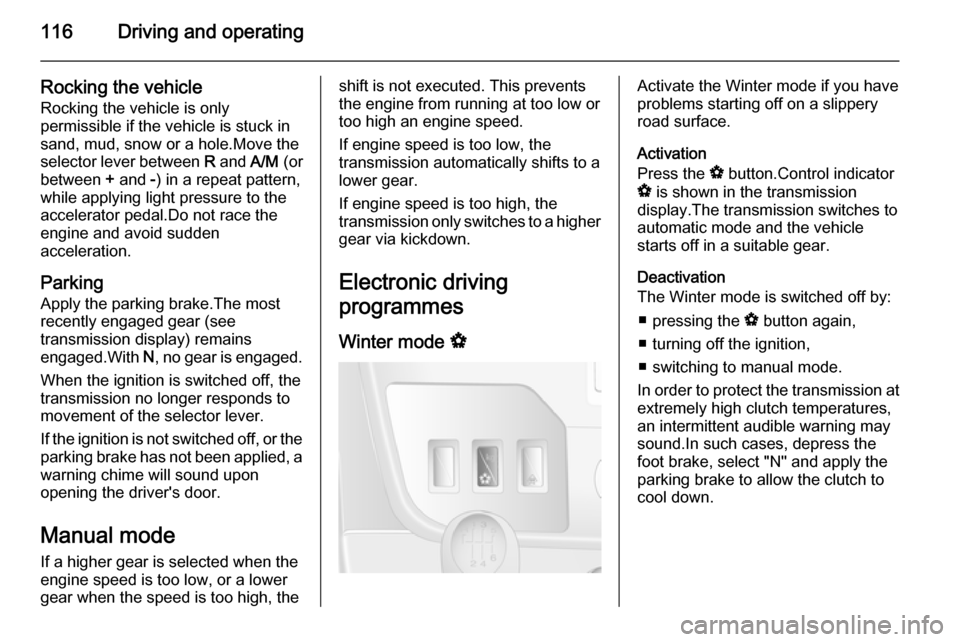
Winter mode VActivate the Winter mode if you have
problems starting off on a slippery
road surface.
Activation
Press the V button.Control indicator
V is shown in the transmission
display.The transmission switches to
automatic mode and the vehicle
starts off in a suitable gear.
Deactivation
The Winter mode is switched off by:
■ pressing the V button again,
■ turning off the ignition,
■ switching to manual mode.
In order to protect the transmission at extremely high clutch temperatures,
an intermittent audible warning may
sound.In such cases, depress the
foot brake, select "N" and apply the
parking brake to allow the clutch to
cool down.
Page 119 of 201
Driving and operating117
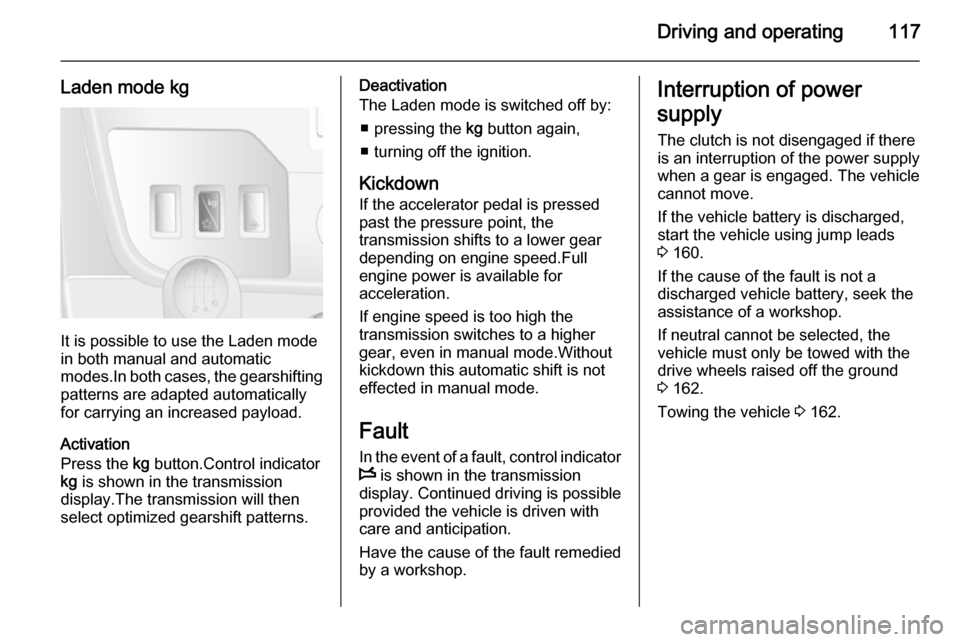
Laden mode kg
It is possible to use the Laden mode
in both manual and automatic
modes.In both cases, the gearshifting
patterns are adapted automatically
for carrying an increased payload.
Activation
Press the kg button.Control indicator
kg is shown in the transmission
display.The transmission will then
select optimized gearshift patterns.
Deactivation
The Laden mode is switched off by:
■ pressing the kg button again,
■ turning off the ignition.
Kickdown If the accelerator pedal is pressedpast the pressure point, the
transmission shifts to a lower gear
depending on engine speed.Full
engine power is available for
acceleration.
If engine speed is too high the
transmission switches to a higher
gear, even in manual mode.Without
kickdown this automatic shift is not
effected in manual mode.
Fault In the event of a fault, control indicator
W is shown in the transmission
display. Continued driving is possible
provided the vehicle is driven with
care and anticipation.
Have the cause of the fault remedied
by a workshop.Interruption of power
supply The clutch is not disengaged if there
is an interruption of the power supply
when a gear is engaged. The vehicle
cannot move.
If the vehicle battery is discharged,
start the vehicle using jump leads
3 160.
If the cause of the fault is not a discharged vehicle battery, seek the
assistance of a workshop.
If neutral cannot be selected, the
vehicle must only be towed with the drive wheels raised off the ground
3 162.
Towing the vehicle 3 162.
Page 128 of 201

126Driving and operating
FaultIf the system detects an operatingfault, a continuous acoustic alarm will sound for approx. 5 seconds when
selecting reverse gear. Consult a
workshop to have the cause of the
fault remedied.Caution
When reversing, the area should
be free from obstacles which could impact on the underside of the
vehicle.
Impact to the rear axle, which may
not be visible, could lead to
uncharacteristic changes in the
vehicle handling. In the event of
such an impact, consult a
workshop.
Rear view camera
The camera is typically installed
under the number plate moulding with a display monitor fitted to the driver's
sun visor.
Functionality
The rear view camera system
enables the driver to view the rear of
the vehicle in the display monitor
whilst reversing.
The system can be activated or
deactivated by selecting the
Start/Stop button located on the right-
hand side of the display monitor.
The remaining buttons on the monitor enable the user to select source
AV1 or AV2 and adjust the brightness
and contrast of the display monitor.
To achieve the optimum visibility, the
rear view camera must not be
obscured by dirt, snow or ice.9 Warning
The system is intended as a
reversing aid and does not replace
driver vision.
Do not let this feature tempt you
into take risks when reversing.
Failure to use proper care when
reversing may result in damage to
the vehicle, injury, or death.
Always check the outside,
rearview mirrors and glance over
your shoulder before reversing.
The driver assistance systems do not relieve the driver from full
responsibility for vehicle
operation.
Page 152 of 201
150Vehicle care
SymbolCircuitZInfotainment system, seat
heating, vehicle display
screen, audio connections,
alarm?Power outletÌCigarette lightereInstrument panelUCentral lockingOTurn signals, rear fog lights, body control moduleDIAGDiagnostic connectoruABS, Electronic stability
programdInterior lights, brake lightsZBody control moduleSTOPBrake lightIBody control module, power windows, air conditioningmLeft heated rear windowSymbolCircuitnRight heated rear windowRWindscreen washerMElectronic immobiliserUHeated seatsFBLCornering lightlHands-free connection&TachographPTOPower take-offjHornÍPreheating, diesel fuel filterxClimate control fanADPAdditional adaptations,Power windows, body
control moduleVehicle tools
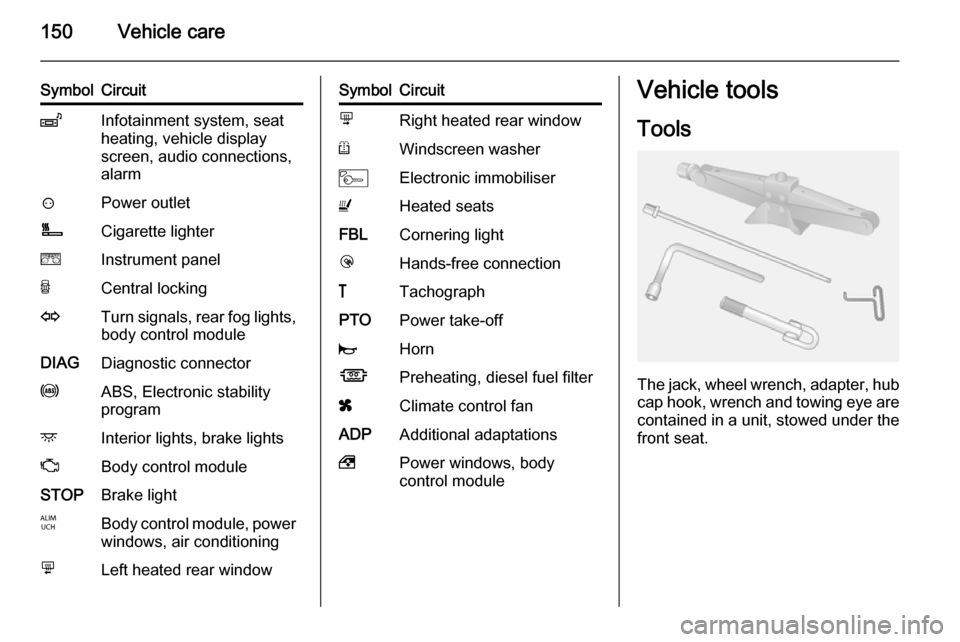
Tools
The jack, wheel wrench, adapter, hubcap hook, wrench and towing eye are
contained in a unit, stowed under the front seat.
Page 167 of 201

Vehicle care165
Windows and windscreen wiperblades
Use a soft lint-free cloth or chamois
leather together with window cleaner
and insect remover.
When cleaning the rear window from
inside, always wipe in parallel to the
heating element to prevent damage.
For mechanical removal of ice, use a
sharp-edged ice scraper. Press the
scraper firmly against the glass so
that no dirt can get under it and
scratch the glass.
Clean smearing wiper blades with a
soft cloth and window cleaner.
Wheels and tyres
Do not use high-pressure jet
cleaners.
Clean rims with a pH-neutral wheel
cleaner.
Rims are painted and can be treated
with the same agents as the body.Paintwork damage
Rectify minor paintwork damage with
a touch-up pen before rust forms.
Have more extensive damage or rust areas repaired by a workshop.
Underbody Some areas of the vehicle underbody
have a PVC undercoating while other
critical areas have a durable
protective wax coating.
After the underbody is washed, check the underbody and have it waxed if
necessary.
Bitumen/rubber materials could
damage the PVC coating. Have
underbody work carried out by a
workshop.
Before and after winter, wash the
underbody and have the protective
wax coating checked.
Towing equipment Do not clean the coupling ball bar with
a steam-jet or high-pressure jet
cleaner.Interior care
Interior and upholsteryOnly clean the vehicle interior,
including the instrument panel fascia
and panelling, with a dry cloth or
interior cleaner.
Clean leather upholstery with clear
water and a soft cloth. In case of
heavy soiling, use leather care.
The instrument cluster and the
displays should only be cleaned using
a soft damp cloth. If necessary use a
weak soap solution.
Clean fabric upholstery with a
vacuum cleaner and brush. Remove
stains with an upholstery cleaner.
Clothing fabrics may not be
colourfast. This could cause visible
discolourations, especially on light- coloured upholstery. Removable
stains and discolourations should be
cleaned as soon as possible.
Clean seat belts with lukewarm water or interior cleaner.
Page 169 of 201

Service and maintenance167Service and
maintenanceGeneral information ...................167
Recommended fluids, lubricants and parts .................................... 168General information
Service information In order to ensure economical and
safe vehicle operation and to
maintain the value of your vehicle, it
is of vital importance that all
maintenance work is carried out at the proper intervals as specified.
The detailed, up-to-date service
schedule for the vehicle is available at
the workshop.
Service display 3 75.
Engine identification 3 171.
Service intervals - except Bus Maintenance of your vehicle is
required every 25,000 miles or after
2 years, whichever occurs first,
unless otherwise indicated by the
service display.
Service intervals - Bus only
Maintenance of your vehicle is
required every 20,000 miles or after
2 years, whichever occurs first,
unless otherwise indicated by the
service display.Confirmations
Confirmation of service is recorded in the Service and Warranty Booklet.The date and mileage is completed
with the stamp and signature of the
servicing workshop.
Make sure that the Service and
Warranty Booklet is completed
correctly as continuous proof of
service is essential if any warranty or
goodwill claims are to be met, and is
also a benefit when selling the
vehicle.
Service display
The service interval is based on
several parameters depending on
usage.
The service display, located in the
Driver Information Centre, indicates
when the next service is due. Seek
the assistance of a workshop.
Service display 3 75.
Engine oil lever monitor 3 74.
Page 172 of 201
170Technical dataTechnical dataVehicle identification..................170
Vehicle data ............................... 173Vehicle identification
Vehicle Identification
Number
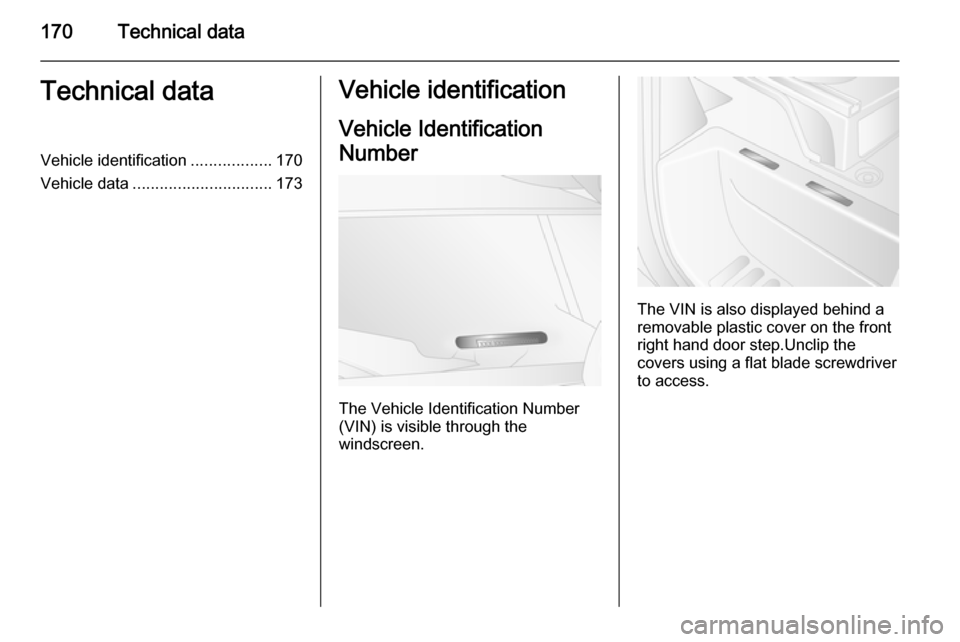
The Vehicle Identification Number
(VIN) is visible through the
windscreen.
The VIN is also displayed behind a
removable plastic cover on the front
right hand door step.Unclip the
covers using a flat blade screwdriver
to access.
Page 198 of 201

196
HHand brake - see Parking brake. 119
Hazard warning flashers ..............89
Headlight flash ............................. 88
Headlight range adjustment ........88
Headlights ...................... 87, 88, 140
Headlights when driving abroad ..88
Head restraint adjustment .............8
Head restraints ............................ 35
Heated mirrors ............................. 31
Heated rear window ..................... 33
Heating ........................................ 40
Heating and ventilation system ...94
High beam ............................. 82, 88
Horn ....................................... 13, 69
I
Identification plate .....................171
Idle speed control ......................108
Ignition switch positions .............107
Immobiliser .................................. 29
Indicators ...................................... 73
Information displays...................... 83
Instrument cluster ........................73
Instrument panel fuse box .........149
Instrument panel illumination .....147
Instrument panel overview ........... 10
Instrument panel storage .............60
Interior care ............................... 165Interior lighting.............................. 90
Interior lights ........................ 90, 146
Interior mirrors .............................. 31
Interruption of power supply ......117
Introduction .................................... 3
ISOFIX child restraint systems ....59
J Jack ............................................ 150
Jump starting ............................. 160
K Keys ............................................. 18
Keys, locks ................................... 18
L
Lashing eyes ............................... 63
Light covers, misted...................... 90
Lighting ......................................... 87
Light switch .................................. 87
Load compartment lighting ..........91
Loading information .....................66
Low fuel ....................................... 81
M Malfunction indicator light ............79
Manual adjustment ......................30
Manual anti-dazzle ......................31
Manual mode ............................. 116
Manual transmission .................. 113Manual transmission automated 114
Manual windows ..........................32
Messages ..................................... 83
Mirror adjustment ........................... 8
Mirrors .................................... 30, 31
Misted light covers .......................90
N New vehicle running-in ..............106
Number plate light .....................146
O
Object detection systems ...........124
Octane rating .............................. 174
Odometer ..................................... 73
Oil ............................................... 134
Oil, engine .......................... 168, 173
Oil level ......................................... 74
Oil pressure .................................. 81
Outside temperature ....................70
Overcab storage ..........................62
Overhead console .......................62
Overrun cut-off ........................... 108
P Parking ................................ 17, 110
Parking assist ............................ 124
Parking brake ............................ 119
Particulate filter ........................... 112
Performing work ........................133