Page 148 of 400

148 2-3. Operating the lights and wipers
■Daytime running light system (if equipped)
●To make your vehicle more visible to other drivers, the headlights turn on
automatically (at a reduced intensity) whenever the engine is started and
the parking brake is released. Daytime running lights are not designed for
use at night.
For type C: Daytime running lights can be turned off by operating the
switch.
● Compared to turning on the headlights, the daytime running light system
offers greater durability and consumes less electricity, so it can help
improve fuel economy.
■ Light reminder buzzer
A buzzer sounds when the engine switch is turned to the “LOCK” or “ACC”
position and the driver’s door is opened while the lights are turned on.
■ Battery-saving function (vehicles with an alarm system or daytime run-
ning light system)
In all following conditions, the headlights and the other remaining lights will
go off automatically after 20 minutes in order to prevent the vehicle battery
from being discharged:
●The engine switch is in the “LOCK” position.
● The headlights and/or tail lights are on.
This function will be canceled in any of the following situations:
● When the engine switch is turned to the “ON” position.
● When the light switch is operated.
● When the door is opened or closed.
NOTICE
■To prevent battery discharge
Do not leave the lights on longer than necessary when the engine is not run-
ning.
Page 150 of 400
150 2-3. Operating the lights and wipers
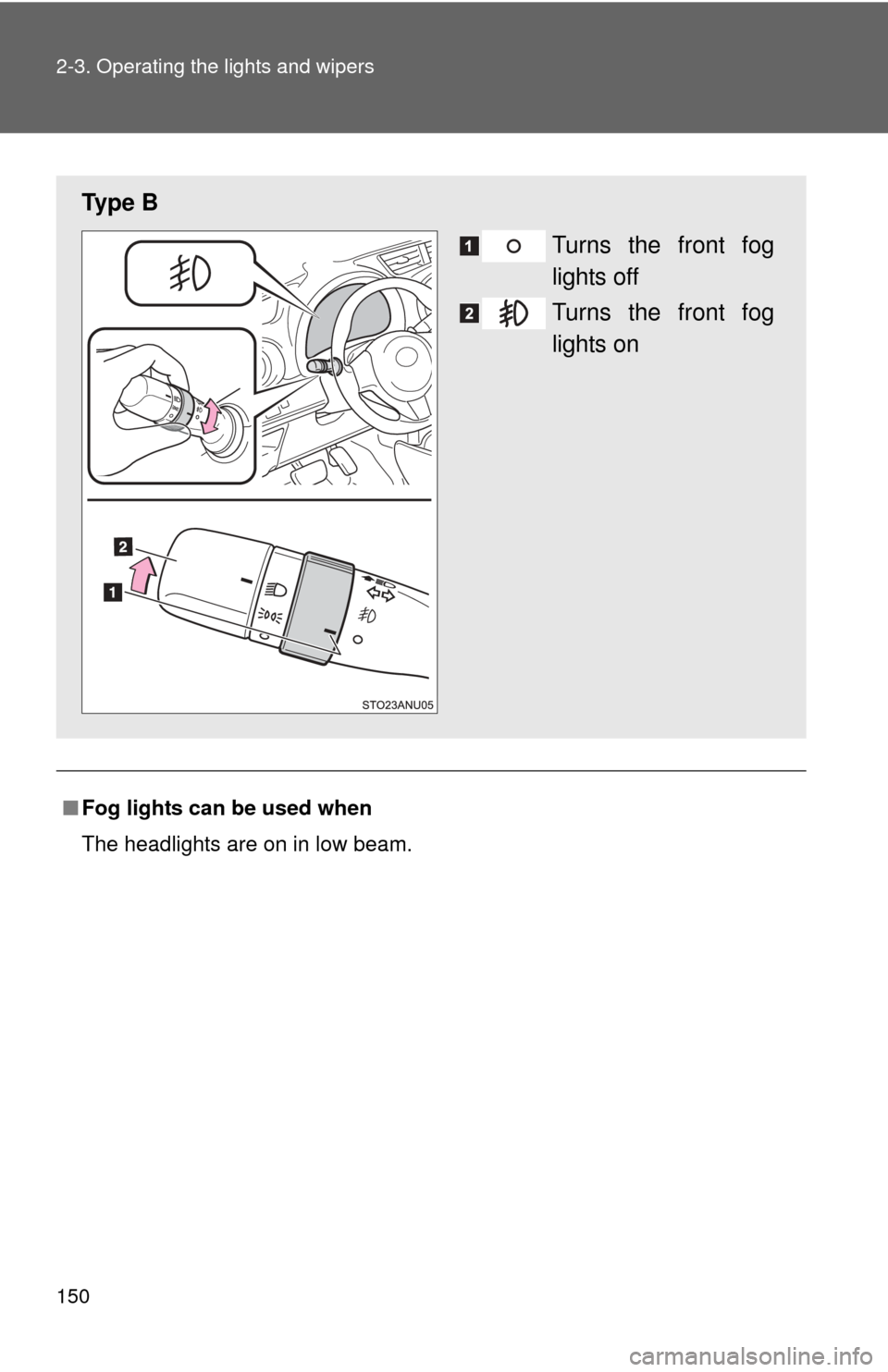
■Fog lights can be used when
The headlights are on in low beam.
Ty p e B
Turns the front fog
lights off
Turns the front fog
lights on
Page 182 of 400

182 2-5. Driving information
●Crosswinds and rough roads will adversely affect handling of your
vehicle and trailer, causing sway . Periodically check the rear to
prepare for being passed by large trucks or buses, which may
cause your vehicle and trailer to sway. If swaying occurs, firmly grip
the steering wheel, reduce speed immediately but gradually, and
steer straight ahead. Never increase speed. If you make no
extreme correction with the stee ring or brakes, your vehicle and
trailer will stabilize.
● Take care when passing other v ehicles. Passing requires consider-
able distance. After passing a vehi cle, do not forget the length of
your trailer, and be sure you hav e plenty of room before changing
lanes.
● To maintain engine braking efficiency and charging system perfor-
mance when using engine braking, do not use the transmission in
D (vehicles with an automatic transmission) or 5 (vehicles with a
manual transmission).
● Due to the added load of the trailer, your vehicle’s engine may
overheat on hot days (at temper atures over 85°F [30°C]) when
driving up a long or steep grade. If the high engine coolant temper-
ature warning light flashes or co mes on overheating, immediately
turn off the air conditioning (if in use), pull your vehicle off the road
and stop in a safe place. ( P. 334)
Page 231 of 400

231
4-2. Maintenance
4
Maintenance and care
Vehicle interior
ItemsCheck points
Accelerator pedal • The accelerator pedal should
move smoothly (without uneven
pedal effort or catching).
Automatic transmission “Park”
mechanism • When parked on a slope and the
shift lever is in P, is the vehicle
securely stopped?
Brake pedal • Does the brake pedal move
smoothly?
• Does the brake pedal have appro- priate clearance from the floor?
(P. 350)
• Does the brake pedal have the correct amount of free play?
(P. 350)
Brakes • The vehicle should not pull to one
side when the brakes are applied.
• The brakes should work effec- tively.
• The brake pedal should not feel spongy.
• The brake pedal should not get too close to the floor when the
brakes are applied.
Clutch pedal • Does the clutch pedal move
smoothly?
• Does the clutch pedal have appropriate clearance from the
floor?
• Does the clutch pedal have the correct amount of free play?
(P. 350)
Head restraints • Do the head restraints move
smoothly and lock securely?
Page 236 of 400
236 4-3. Do-it-yourself maintenance
CAUTION
The engine compartment contains many mechanisms and fluids that may
move suddenly, become hot, or become electrically energized. To avoid death
or serious injury, observe the following precautions:
■When working on the engine compartment:
● Keep hands, clothing and tools away from the moving fan and engine
drive belt.
● Be careful not to touch the engine, radiator, exhaust manifold, etc. right
after driving as they may be hot. Oil and other fluids may also be hot.
● Do not leave anything that may burn easily, such as paper and rags, in the
engine compartment.
● Do not smoke, cause sparks or expose an open flame to fuel or the bat-
tery. Fuel and battery fumes are flammable.
● Be extremely cautious when working on the battery. It contains poisonous
and corrosive sulfuric acid.
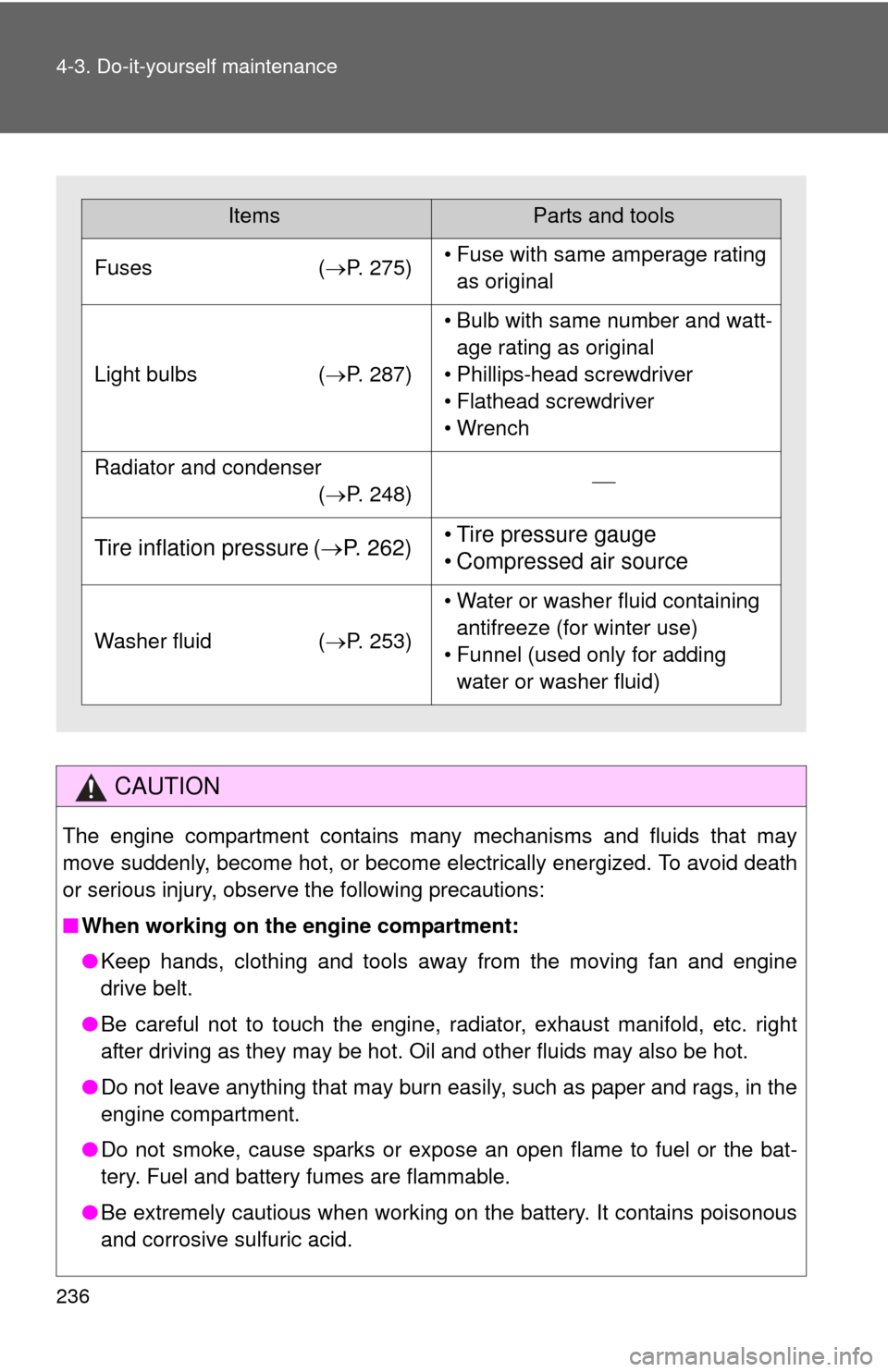
ItemsParts and tools
Fuses (P. 275)• Fuse with same amperage rating
as original
Light bulbs (P. 287)
• Bulb with same number and watt-
age rating as original
• Phillips-head screwdriver
• Flathead screwdriver
• Wrench
Radiator and condenser (P. 248)
Tire inflation pressure ( P. 262)• Tire pressure gauge
• Compressed air source
Washer fluid (P. 253)
• Water or washer fluid containing
antifreeze (for winter use)
• Funnel (used only for adding water or washer fluid)
Page 239 of 400
239
4-3. Do-it-yourself maintenance
4
Maintenance and care
CAUTION
■
Pre-driving check
Check that the hood is fully closed and locked.
If the hood is not locked properly, it may open while the vehicle is in motion
and cause an accident, which may result in death or serious injury.
■ After installing the support rod into the slot
Make sure the rod supports the hood securely from falling down on to your
head or body.
NOTICE
■When closing the hood
Be sure to return the support rod to its clip before closing the hood. Closing
the hood with the support rod up could cause the hood to bend.
Page 271 of 400
271
4-3. Do-it-yourself maintenance
4
Maintenance and care
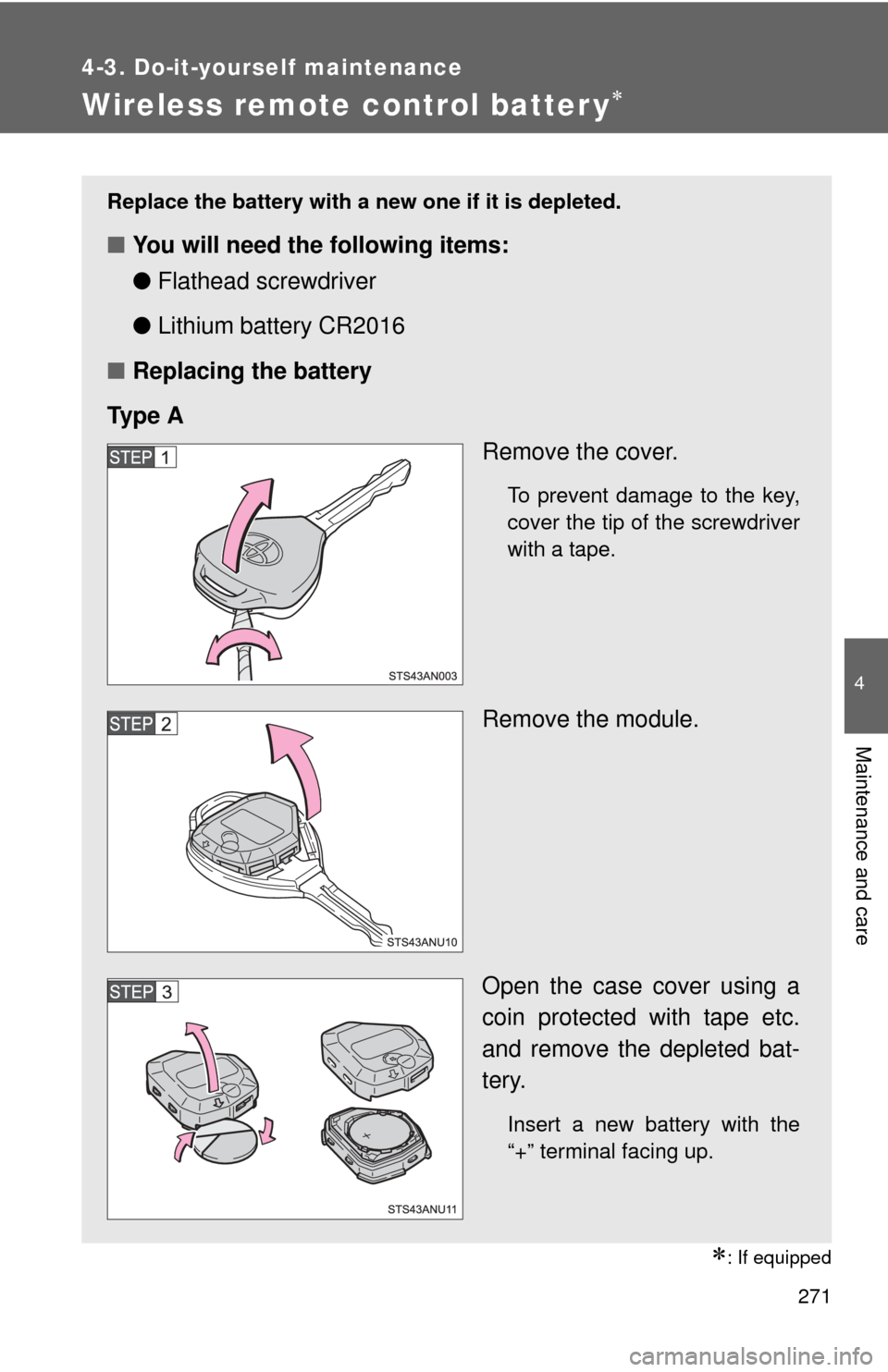
Wireless remote control batter y
: If equipped
Replace the battery with a new one if it is depleted.
■You will need the following items:
●Flathead screwdriver
● Lithium battery CR2016
■ Replacing the battery
Ty p e A Remove the cover.
To prevent damage to the key,
cover the tip of the screwdriver
with a tape.
Remove the module.
Open the case cover using a
coin protected with tape etc.
and remove the depleted bat-
tery.
Insert a new battery with the
“+” terminal facing up.
Page 282 of 400
282 4-3. Do-it-yourself maintenance
Engine compartment (type B fuse box)
*1: NCP131L-AGMRKA, NCP131L-AGPRKA, NCP131L-AHMRKA,
NCP131L-AHPRKA, NCP131L-AGMRKK, NCP131L-AGPRKK,
NCP131L-AHMRKK, NCP131L-AH PRKK, NCP131L-AGMVKK,
NCP131L-AGPVKK, NCP131L-AHMVKK and NCP131L-AHPVKK mod-
els
*2
*2: The model code is indicated on the Certification Label. ( P. 343)
FuseAmpereCircuit
1 EU-DRL 15 A No circuit
2 S-HORN 10 AMultiport fuel injection system/
sequential multiport fuel injection
system
3 H-LP MAIN 7.5 A Headlights
4ST
*140 A No circuit
5 H-LP RH HI 10 A Right-hand headlight (high beam)
6 H-LP LH HI 10 A Left-hand headlight (high beam),
gauges and meters
7 H-LP RH LO 10 A Right-hand headlight (low beam)
8 H-LP LH LO 10 A Left-hand headlight (low beam),
front fog lights