Page 108 of 400
108 1-7. Safety information
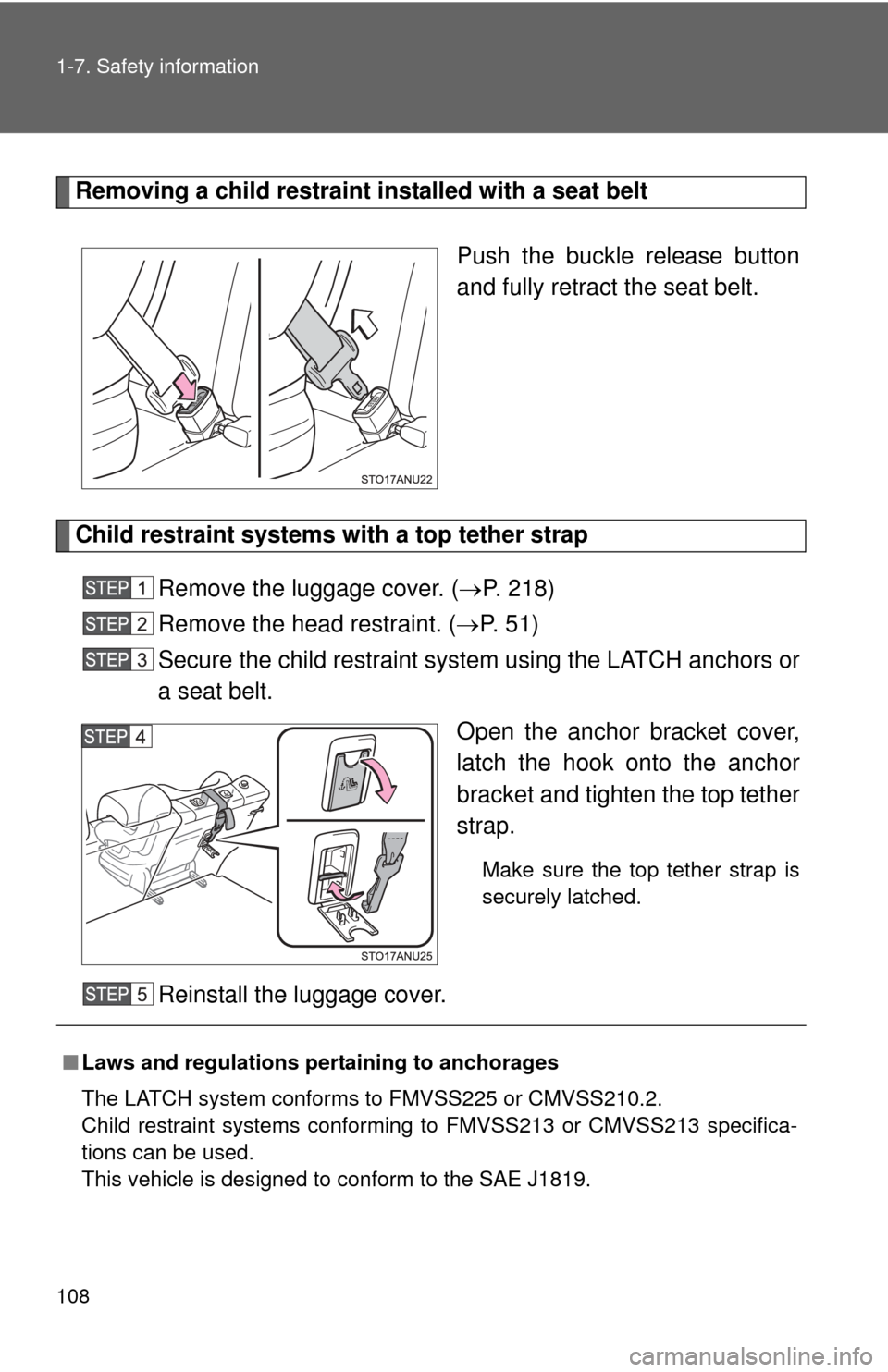
Removing a child restraint installed with a seat beltPush the buckle release button
and fully retract the seat belt.
Child restraint systems with a top tether strapRemove the luggage cover. ( P. 218)
Remove the head restraint. ( P. 5 1 )
Secure the child restraint system using the LATCH anchors or
a seat belt.
Open the anchor bracket cover,
latch the hook onto the anchor
bracket and tighten the top tether
strap.
Make sure the top tether strap is
securely latched.
Reinstall the luggage cover.
■Laws and regulations pertaining to anchorages
The LATCH system conforms to FMVSS225 or CMVSS210.2.
Child restraint systems conforming to FMVSS213 or CMVSS213 specifica-
tions can be used.
This vehicle is designed to conform to the SAE J1819.
Page 110 of 400
110 1-7. Safety information
CAUTION
■When installing a child restraint system
●Push and pull the child restraint system from side to side and forward to be
sure it is secure.
● After securing a child restraint system, never adjust the seat.
● Follow all installation instructions provided by the child restraint system
manufacturer.
● When a child restraint system with a top tether strap is installed, do not
install the head restraint. The head restraint may interfere with the top
tether strap preventing secure installation of the child restraint system.
● Make sure to properly store the removed head restraint in a secure place
when you use the child restraint system on the rear seat.
■ Do not use a seat belt extender
If a seat belt extender is used when installing a child restraint system, the
seat belt will not securely hold the child restraint system, which could cause
death or serious injury to the child or other passengers in the event of sud-
den braking, sudden swerving or an accident.
■ To correctly attach a child r estraint system to the anchors
When using the LATCH anchors, be sure that there are no foreign objects
around the anchors and that the seat belt is not caught behind the child
restraint. Make sure the child restraint system is securely attached, or it may
cause death or serious injury to the child or other passengers in the event of
sudden braking, sudden swerving or an accident.
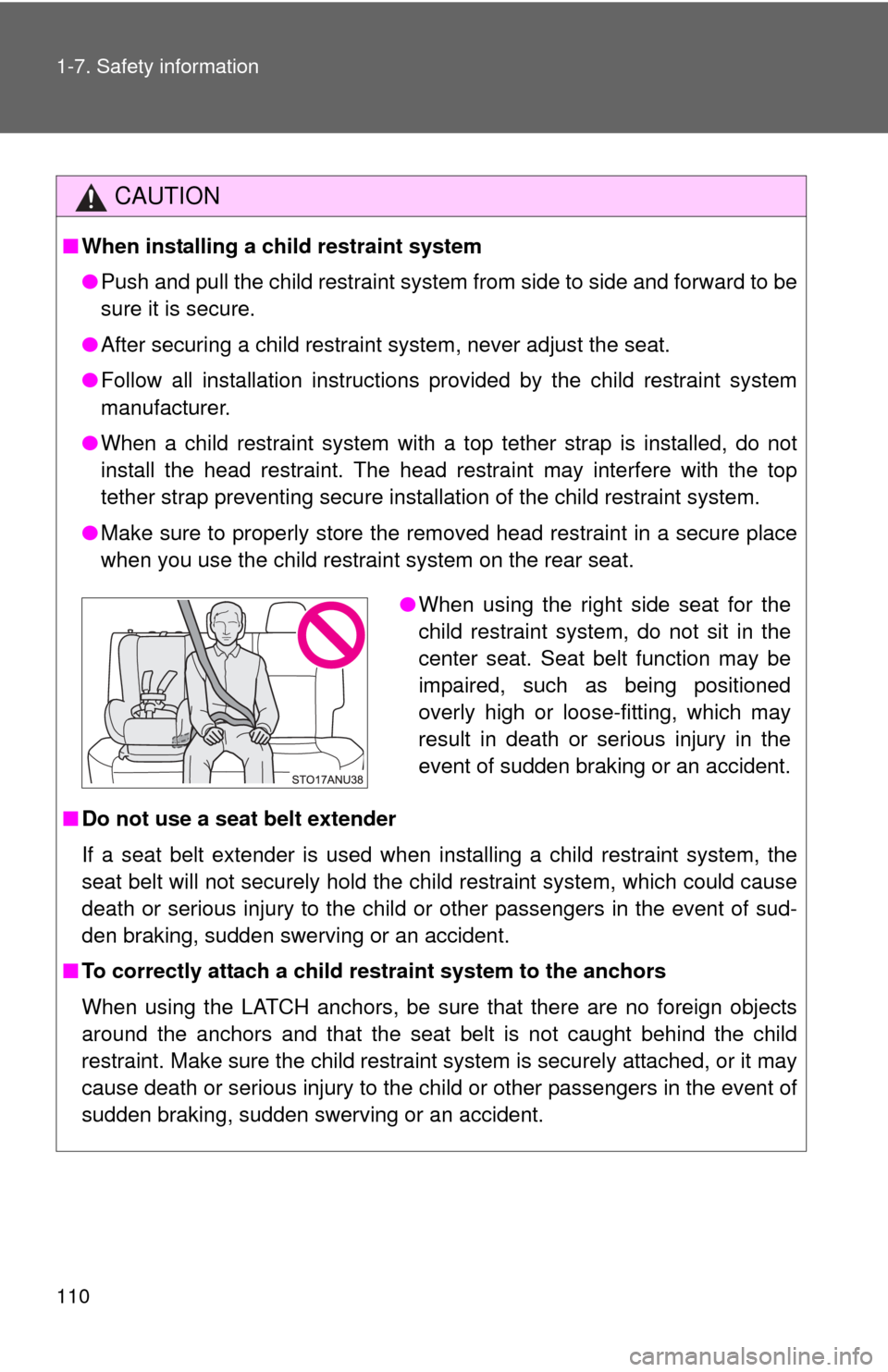
● When using the right side seat for the
child restraint system, do not sit in the
center seat. Seat belt function may be
impaired, such as being positioned
overly high or loose-fitting, which may
result in death or serious injury in the
event of sudden braking or an accident.
Page 111 of 400
When driving2
111
2-1. Driving proceduresDriving the vehicle............ 112
Engine (ignition) switch .... 124
Automatic transmission .... 127
Manual transmission ........ 129
Turn signal lever .............. 130
Parking brake ................... 131
Horn ................................. 132
2-2. Instrument cluster Gauges and meters ......... 133
Indicators and warning lights .............................. 136
Multi-information display............................ 140
2-3. Operating the lights and wipers
Headlight switch ............... 145
Fog light switch ................ 149
Windshield wiper and washer ........................... 151
Rear window wiper and washer ........................... 154 2-4. Using other driving systems
Cruise control ................... 159
Driving assist systems ..... 163
2-5. Driving information Cargo and luggage .......... 168
Vehicle load limits ............ 172
Winter driving tips ............ 173
Trailer towing (except 3-door models
for Canada) .................... 177
Trailer towing (3-door models for Canada) ....... 178
Dinghy towing (vehicles with an automatic
transmission) ................. 188
Dinghy towing (vehicles with a manual
transmission) ................. 189
Page 117 of 400

117
2-1. Driving procedures
2
When driving
CAUTION
●
Do not shift the shift lever to R while the vehicle is moving forward.
Doing so can damage the transmission and may result in a loss of vehicle\
control.
● Do not shift the shift lever to D (vehicles with an automatic transmission) or
1 (vehicles with a manual transmission) while the vehicle is moving back-
ward.
Doing so can damage the transmission and may result in a loss of vehicle\
control.
● Moving the shift lever to N while the vehicle is moving will disengage the
engine from the transmission. Engine braking is not available when N is
selected.
● During normal driving, do not turn off the engine. Turning the engine off
while driving will not cause loss of steering or braking control, but the
power assist to these systems will be lost. This will make it more difficult to
steer and brake, so you should pull over and stop the vehicle as soon as it
is safe to do so.
However, in the event of an emergency, such as if it becomes impossible
to stop the vehicle in the normal way: P. 339
● Use engine braking (downshift) to maintain a safe speed when driving
down a steep hill.
Using the brakes continuously may cause the brakes to overheat and lose
effectiveness. ( P. 127,129)
● When stopped on an inclined surface, use the brake pedal and parking
brake to prevent the vehicle from rolling backward or forward and causing
an accident.
● Do not adjust the positions of the steering wheel, the seat, or the inside or
outside rear view mirrors while driving.
Doing so may result in a loss of vehicle control that can cause accidents,
resulting in death or serious injury.
● Always check that all passengers’ arms, heads or other parts of their body
are not outside the vehicle, as this may result in death or serious injury.
Page 138 of 400

138 2-2. Instrument cluster
■Indicators
The indicators inform the driver of the operating state of the
vehicle’s various systems.
*1: These lights turn on when the engine switch is turned to the “ON”
position to indicate that a system check is being performed. They
will turn off after the engine is started, or after a few seconds. There
may be a malfunction in a system if a light does not come on, or if
the lights do not turn off. Have the vehicle inspected by your Toyota
dealer.
*2: The light flashes to indicate that the system is operating.
Turn signal indicator
(P. 130)
(If equipped)
Cruise control indicator
( P. 159)
Headlight high beam
indicator ( P. 147)
(If equipped)
Cruise control “SET”
indicator ( P. 159)
(If equipped)
Front fog light indicator
(P. 149)*1,2
Slip indicator ( P. 164)
Low engine coolant
temperature indicator
Indicates the engine
coolant temperature is
cool.*1VSC OFF indicator
(P. 165)
*1“TRAC OFF” indicator
(P. 164)
(If equipped)
Engine immobilizer/
alarm system indicator
(P. 72, 74)*1“AIR BAG ON” indicator
( P. 92)
*1Eco Driving Indicator
Light ( P. 115)*1“AIR BAG OFF” indica-
tor (P. 92)
(Vehicles with an automatic transmission)
Shift position and shift
range indicator
(P. 127)
(Vehicles with an automatic transmission)
Page 145 of 400
145
2
When driving
2-3. Operating the lights and wipers
Headlight switch
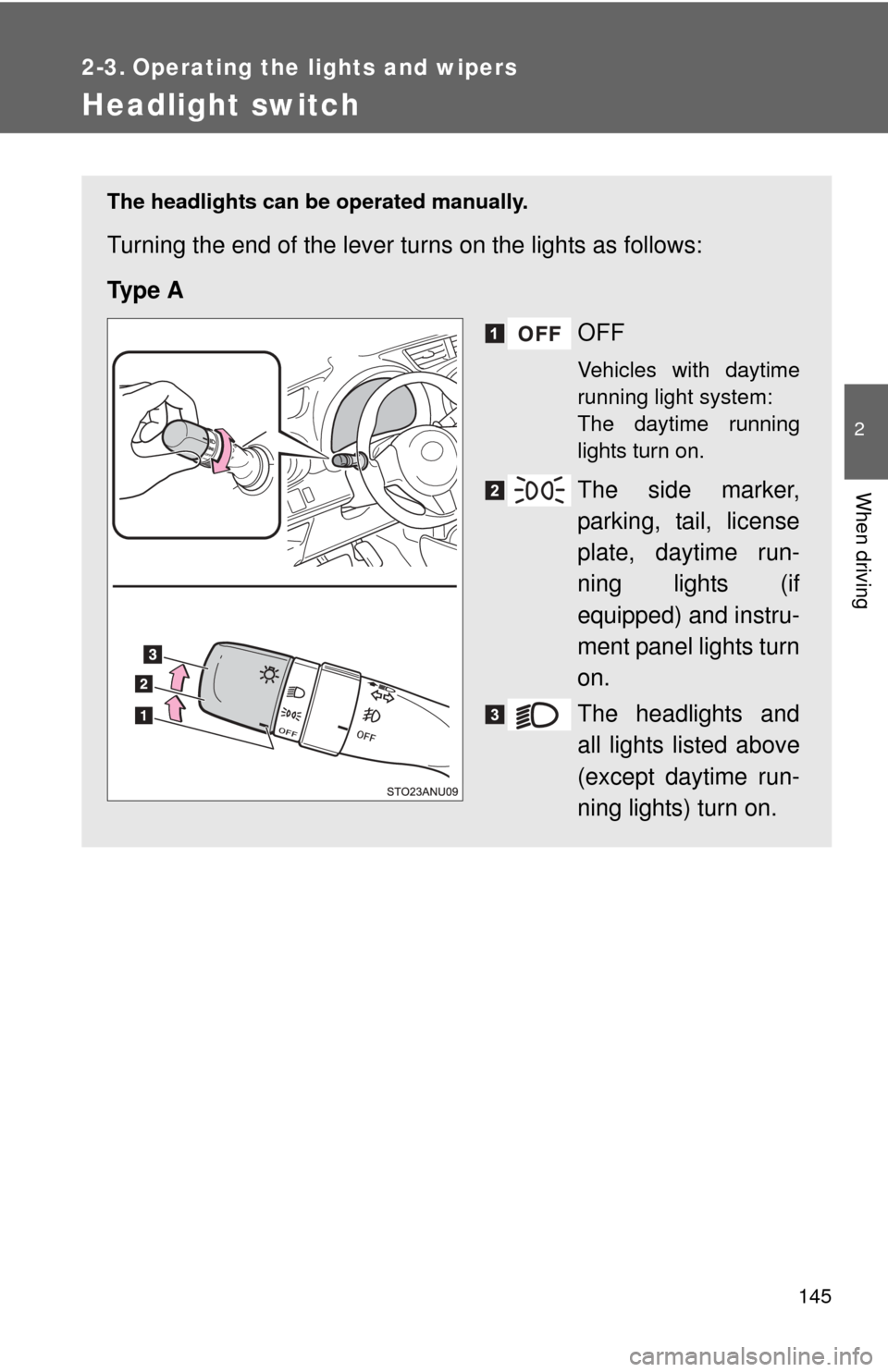
The headlights can be operated manually.
Turning the end of the lever turns on the lights as follows:
Ty p e AOFF
Vehicles with daytime
running light system:
The daytime running
lights turn on.
The side marker,
parking, tail, license
plate, daytime run-
ning lights (if
equipped) and instru-
ment panel lights turn
on.
The headlights and
all lights listed above
(except daytime run-
ning lights) turn on.
Page 146 of 400
146 2-3. Operating the lights and wipers
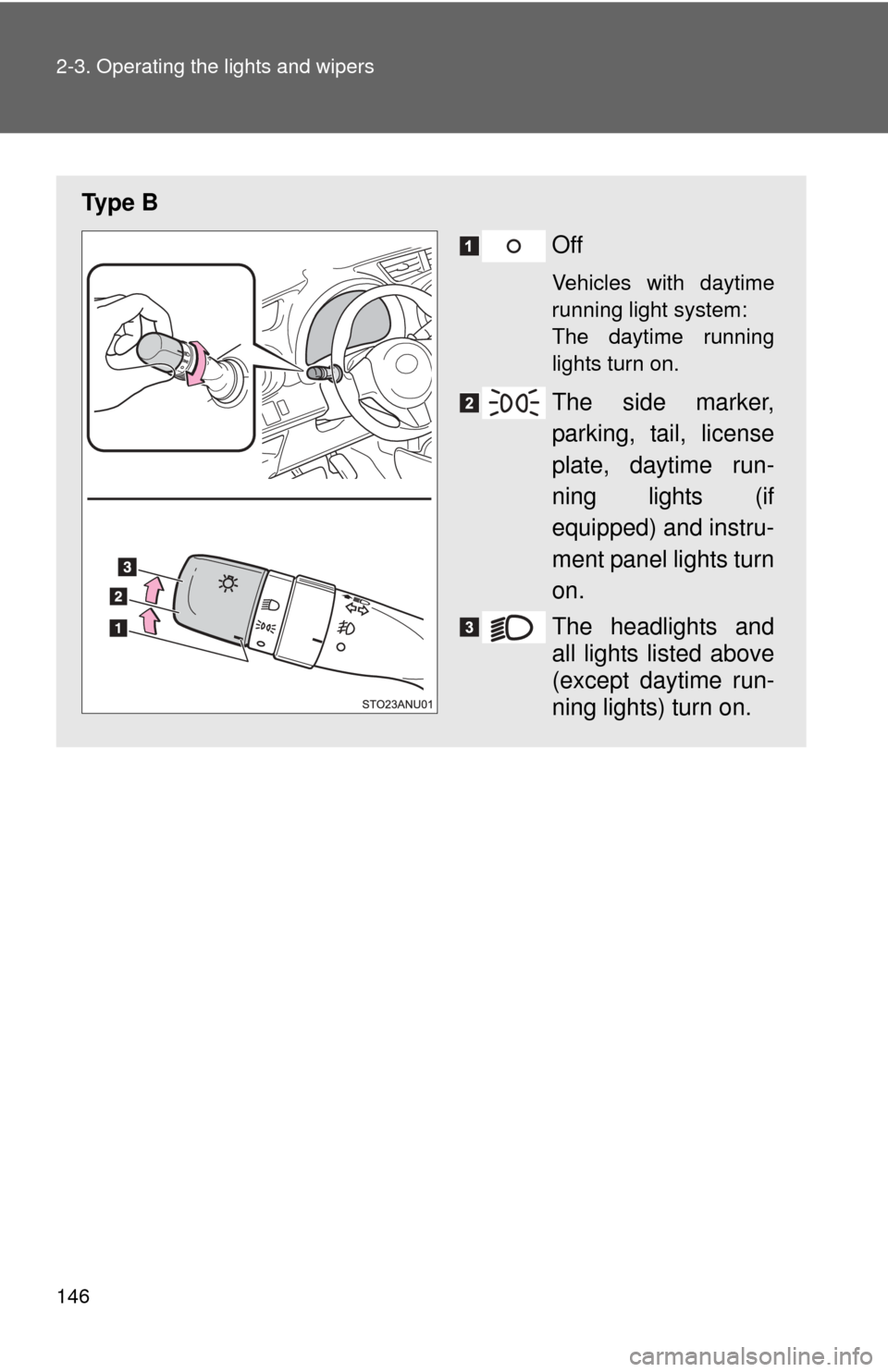
Ty p e BOff
Vehicles with daytime
running light system:
The daytime running
lights turn on.
The side marker,
parking, tail, license
plate, daytime run-
ning lights (if
equipped) and instru-
ment panel lights turn
on.
The headlights and
all lights listed above
(except daytime run-
ning lights) turn on.
Page 147 of 400
147
2-3. Operating the lights and wipers
2
When driving
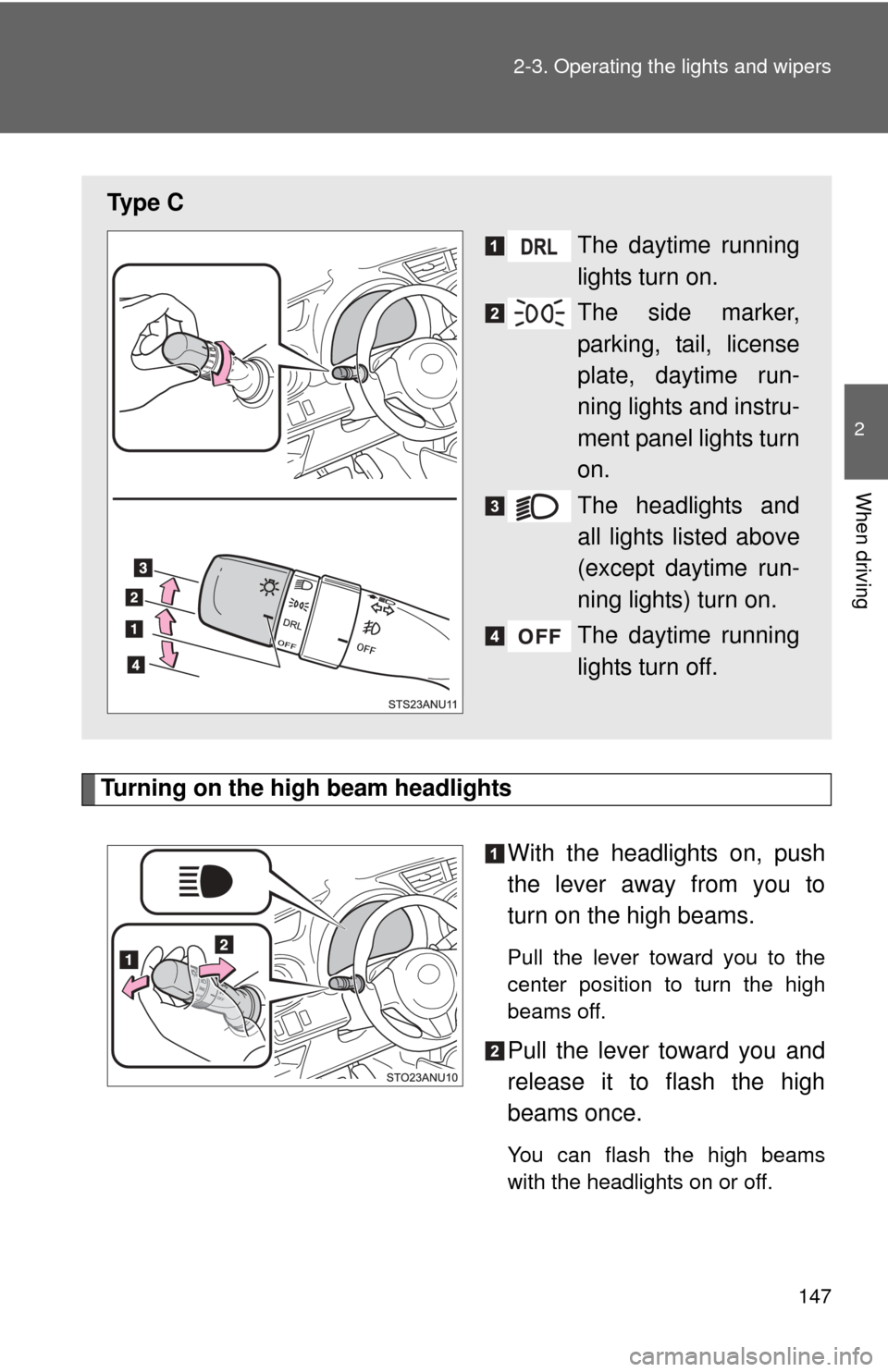
Turning on the high beam headlights
With the headlights on, push
the lever away from you to
turn on the high beams.
Pull the lever toward you to the
center position to turn the high
beams off.
Pull the lever toward you and
release it to flash the high
beams once.
You can flash the high beams
with the headlights on or off.
Ty p e C The daytime running
lights turn on.
The side marker,
parking, tail, license
plate, daytime run-
ning lights and instru-
ment panel lights turn
on.
The headlights and
all lights listed above
(except daytime run-
ning lights) turn on.
The daytime running
lights turn off.