Page 213 of 650
213 2-1. Driving procedures
2
When driving
Selecting a shift position
*1: Shifting to the “D” position allows the system to select a gear suitable
for the driving conditions.
Setting the shift lever to the “D” position is recommended for normal
driving.
*2: If equipped, by selecting shift ranges using paddle shift switches, you
can control engine braking forces.
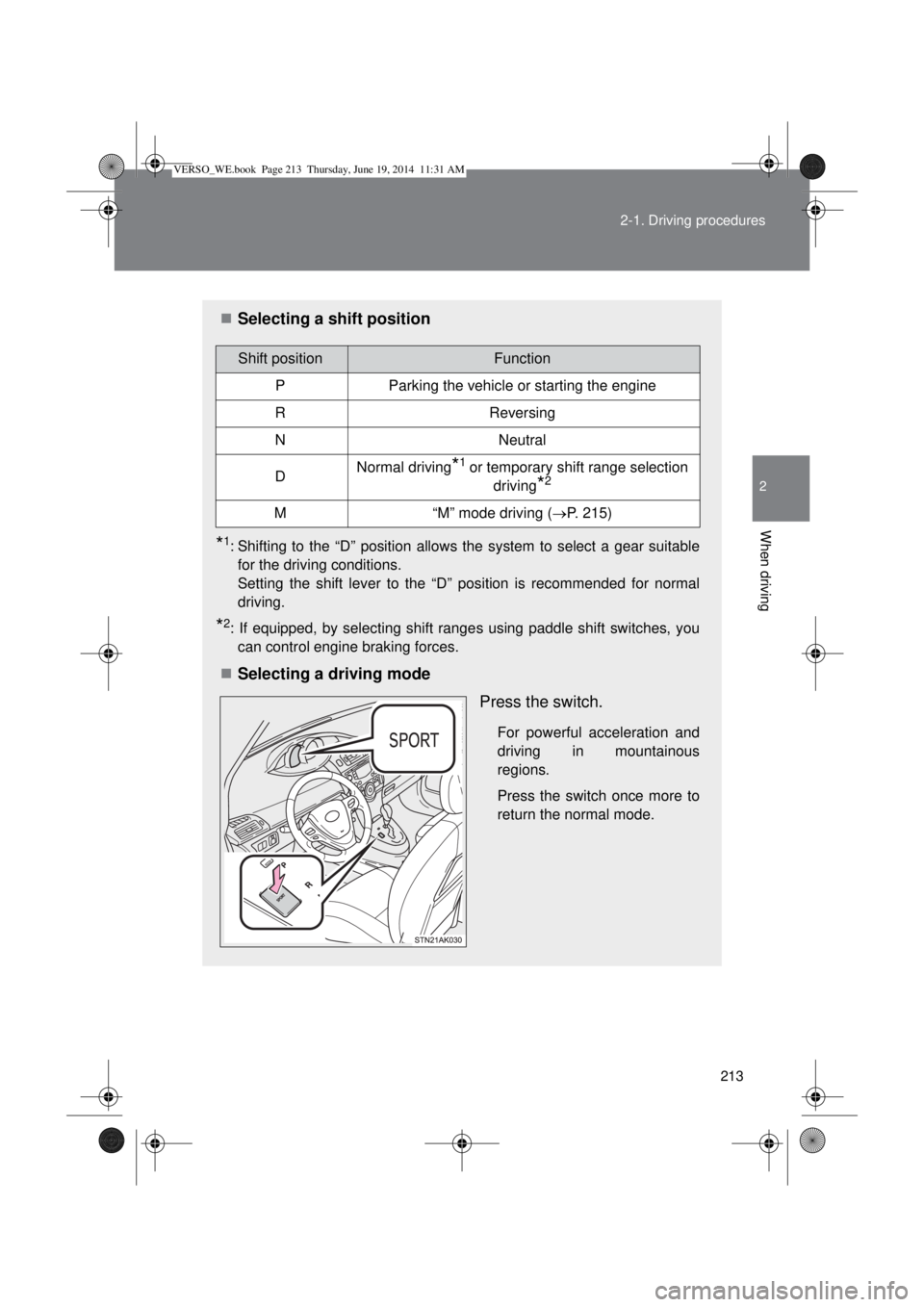
Selecting a driving mode
Press the switch.
For powerful acceleration and
driving in mountainous
regions.
Press the switch once more to
return the normal mode.
Shift positionFunction
PParking the vehicle or starting the engine
RReversing
NNeutral
DNormal driving*1 or temporary shift range selection
driving
*2
M“M” mode driving (P. 215)
VERSO_WE.book Page 213 Thursday, June 19, 2014 11:31 AM
Page 254 of 650
254 2-3. Operating the lights and wipers
Daytime running light system (if equipped)
To make your vehicle more visible to other drivers, the daytime run-
ning lights turn on automatically whenever the engine is started and
then the parking brake is released. (However, the daytime running
light system will be canceled when the headlight switch is operated
manually or the automatic headlight system turns on the tail lights.)
Daytime running lights are not designed for use at night.
Deactivating/reactivating the daytime running light system
Follow the procedure below.
Vehicles without smart entry & start system: Turn the engine
switch to the “ON” position. Turn off the headlights, tail lights
and automatic headlights system, and set the parking brake.
Vehicles with smart entry & start system: Turn the “ENGINE
START STOP” switch to IGNITION ON mode. Turn off the
headlights, tail lights and automatic headlights system, and
set the parking brake.
Start the engine.
You must perform step 3 within 5 seconds of starting the engine.
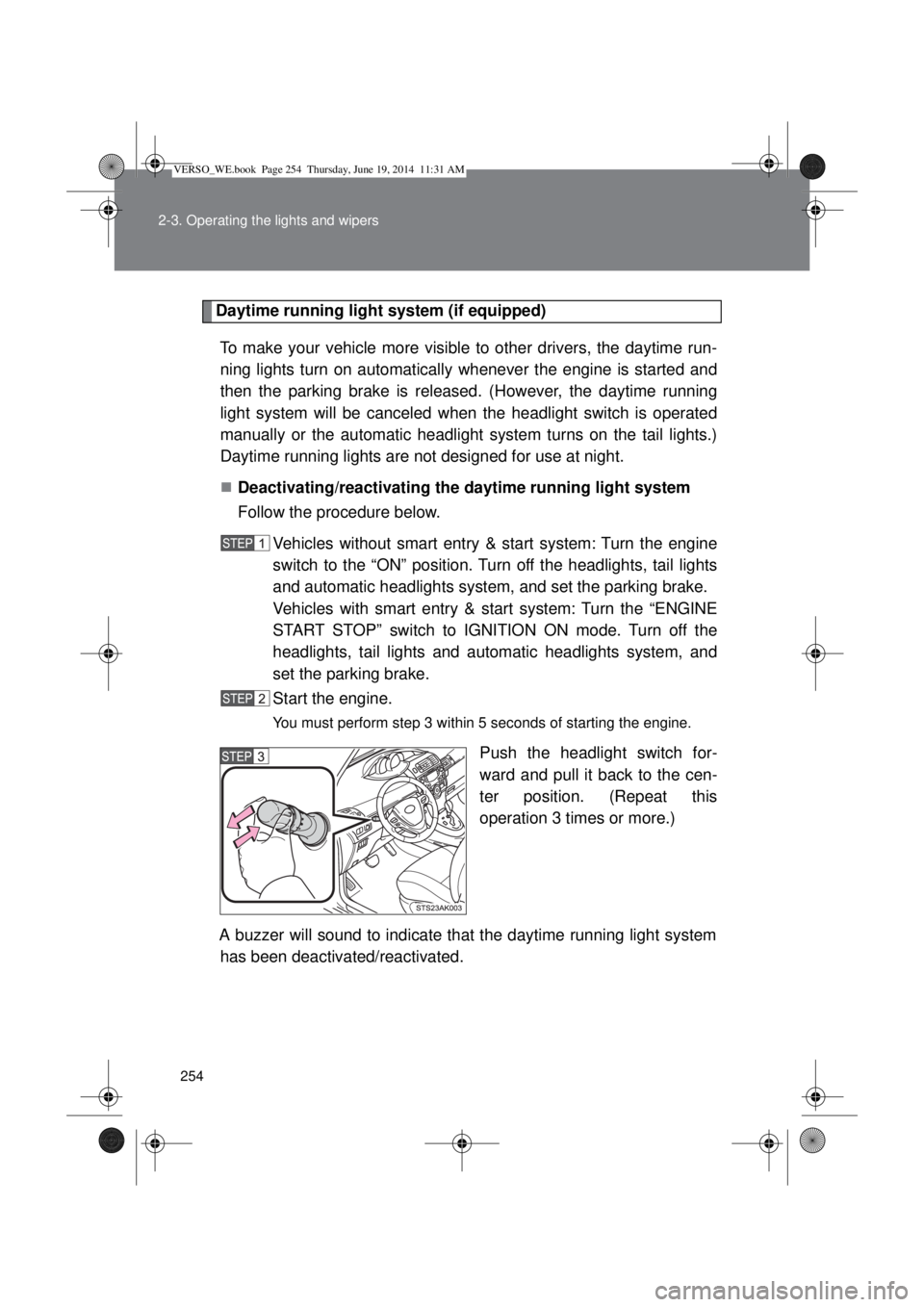
Push the headlight switch for-
ward and pull it back to the cen-
ter position. (Repeat this
operation 3 times or more.)
A buzzer will sound to indicate that the daytime running light system
has been deactivated/reactivated.
VERSO_WE.book Page 254 Thursday, June 19, 2014 11:31 AM
Page 280 of 650
280
2-4. Using other driving systems
Stop & Start system
: If equipped
The Stop & Start system stops and restarts the engine according to
the clutch pedal operation for stopping and starting the vehicle.
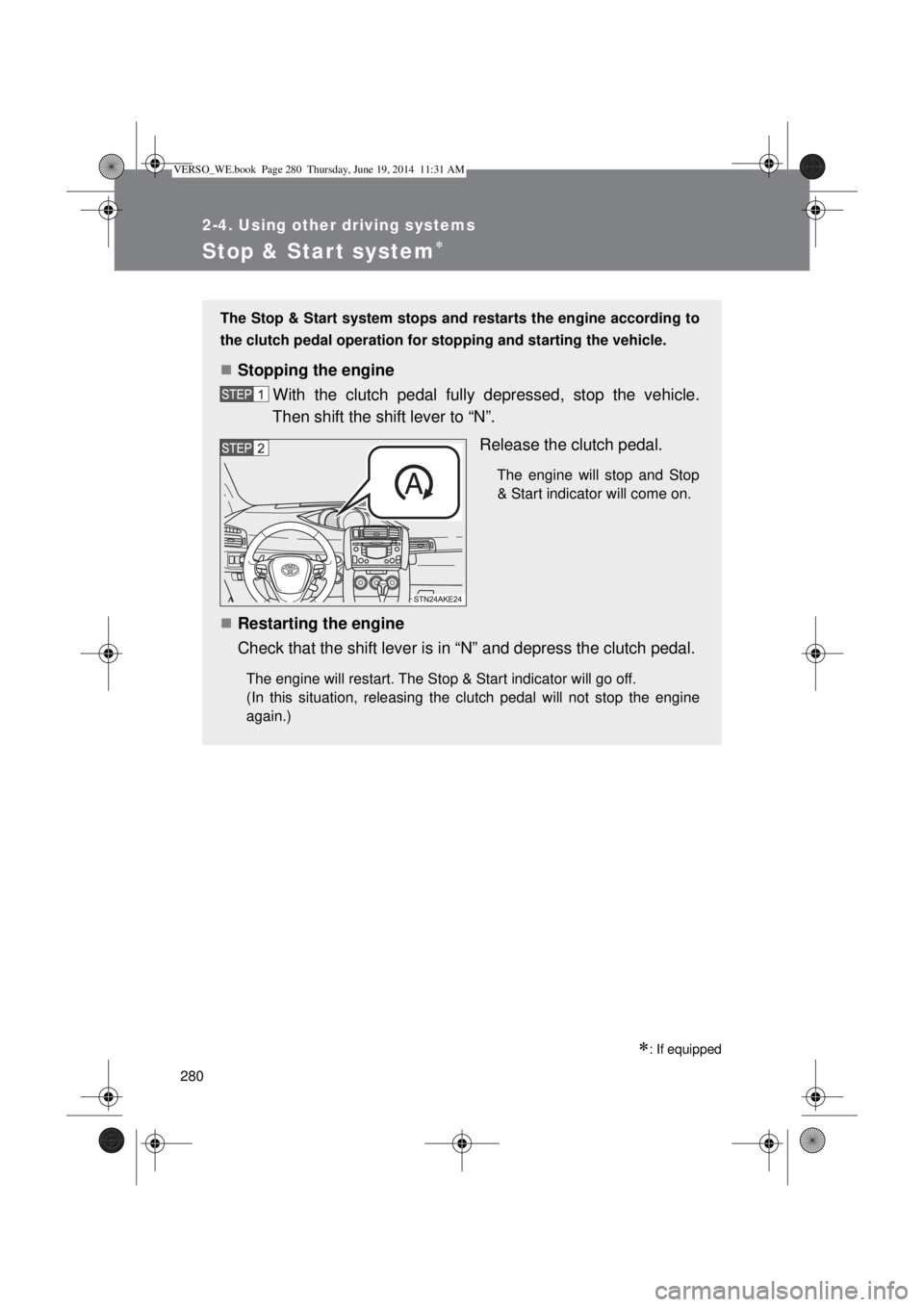
Stopping the engine
With the clutch pedal fully depressed, stop the vehicle.
Then shift the shift lever to “N”.
Release the clutch pedal.
The engine will stop and Stop
& Start indicator will come on.
Restarting the engine
Check that the shift lever is in “N” and depress the clutch pedal.
The engine will restart. The Stop & Start indicator will go off.
(In this situation, releasing the clutch pedal will not stop the engine
again.)
VERSO_WE.book Page 280 Thursday, June 19, 2014 11:31 AM
Page 287 of 650
287
2-4. Using other driving systems
2
When driving
Driving assist systems
To help enhance driving safety and performance, the following sys-
tems operate automatically in response to various driving situations.
Be aware, however, that these systems are supplementary and
should not be relied upon too heavily when operating the vehicle.
ABS (Anti-lock Brake System)
Helps to prevent wheel lock when the brakes are applied suddenly, or if
the brakes are applied while driving on a slippery road surface.
Brake assist
Generates an increased level of braking force after the brake pedal is
depressed, when the system detects a panic stop situation.
VSC+ (Vehicle Stability Control +)
Provides cooperative control of the ABS, TRC, VSC and EPS.
Helps to maintain directional stability when swerving on slippery road
surfaces by controlling steering performance.
TRC (Traction Control)
Helps to maintains drive power and prevents the front wheels from
spinning when starting the vehicle or accelerating on slippery roads.
EPS (Electric Power Steering)
Employs an electric motor to reduce the amount of effort needed to turn
the steering wheel.
Hill-start assist control
P. 293
VERSO_WE.book Page 287 Thursday, June 19, 2014 11:31 AM
Page 293 of 650
293
2-4. Using other driving systems
2
When driving
Hill-star t assist control
Hill-start assist control operating conditions
The hill-start assist control system operates under the following condi-
tions.
• The shift lever is in a position other than “P” (Multidrive or automatic
transmission).
• The parking brake is not applied.
• The accelerator pedal is not depressed.
The hill-start assist control system cannot be operated while the slip indi-
cator light is illuminated.
Hill-start assist control
While hill-start assist control is operating, the brakes remain automati-
cally applied after the driver releases the brake pedal. The stop lights and
the high mounted stoplight turn on.
Hill-start assist control operates for about 2 seconds after the brake pedal
is released.
If the slip indicator does not flash and the buzzer does not sound when
the brake pedal is further depressed, slightly reduce the pressure on the
brake pedal (do not allow the vehicle to roll backward) and then firmly
depress it again. If the system still does not operate, check if the operat-
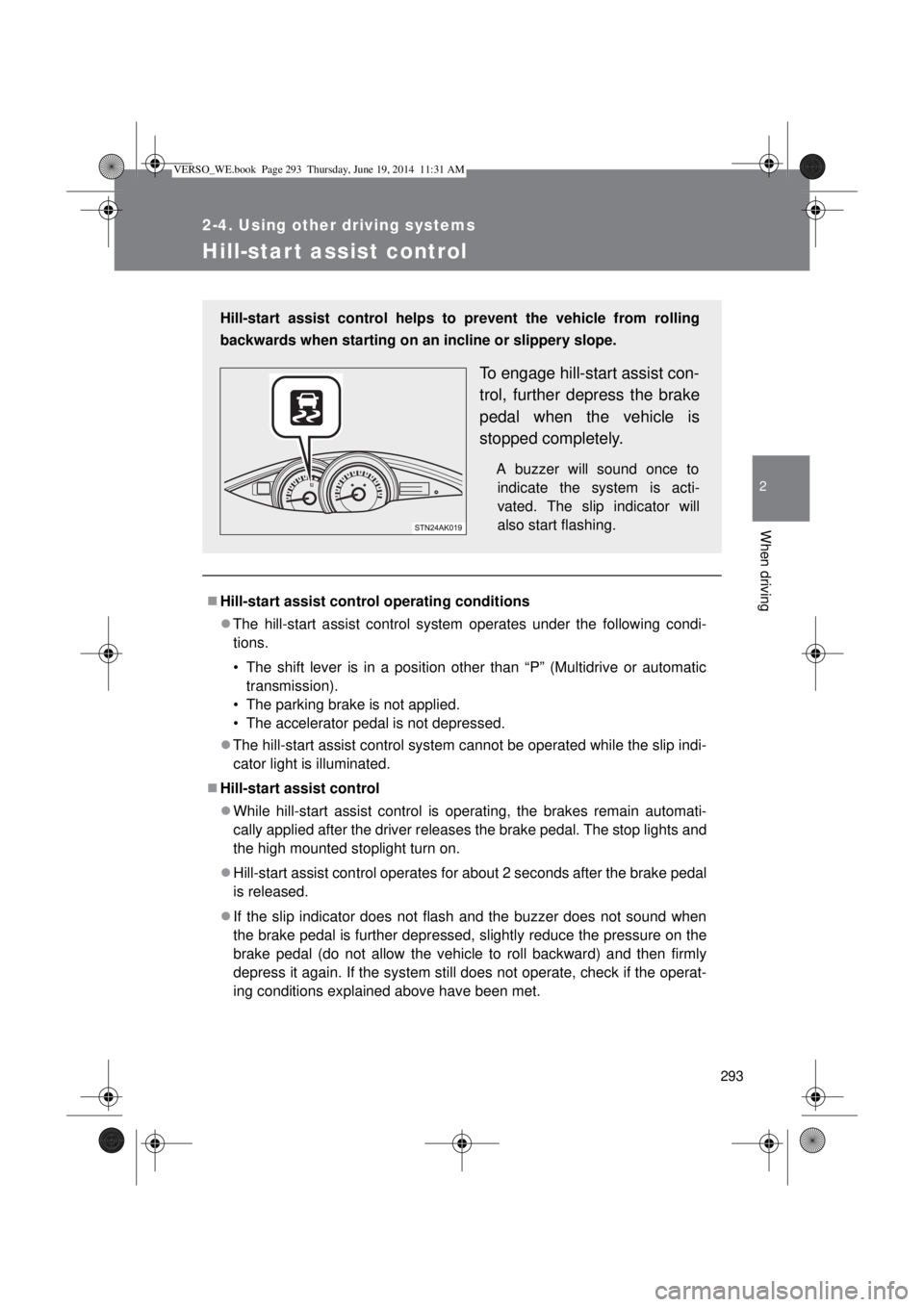
ing conditions explained above have been met. Hill-start assist control helps to prevent the vehicle from rolling
backwards when starting on an incline or slippery slope.
To engage hill-start assist con-
trol, further depress the brake
pedal when the vehicle is
stopped completely.
A buzzer will sound once to
indicate the system is acti-
vated. The slip indicator will
also start flashing.
VERSO_WE.book Page 293 Thursday, June 19, 2014 11:31 AM
Page 324 of 650

324
3-1. Using the air conditioning system and defogger
Power heater
: If equipped
Power heater can be operated when
The engine is running.
The engine coolant temperature is low.
Normal characteristics of power heater operation
The following cases do not indicate a malfunction.
When the power heater is turned on or off, some white smoke and a
slight odor may be emitted from the power heater exhaust that is located
under the floor.
When the power heater is used under extremely cold conditions, vapor
may be visible from its exhaust.
When the power heater is turned off, you may hear a sound in the engine
compartment for about 2 minutes until the power heater turns off com-
pletely.
After the heater is turned off
We recommend not restarting the heater for 10 minutes after you turn it off.
Otherwise, a noise may be heard as the heater ignites.
When refueling your vehicle
The engine must be turned off. Turning the engine off turns the power heater
off. This feature is used to keep the cabin warm in cold conditions.
Turns the power heater on/off
The power heater turns on
about 30 seconds after the
switch is pressed.
VERSO_WE.book Page 324 Thursday, June 19, 2014 11:31 AM
Page 476 of 650

476 4-3. Do-it-yourself maintenance
18 SPARE 20 A Spare fuse
19 DOOR NO.2 25 A Main body ECU
20EFI MAIN
NO.2
*1,*27.5 AMultiport fuel injection system/
sequential multiport fuel injection
system
21 ECU-B2 10 ASmart entry & start system, air con-
ditioning system, power windows
22 D.C.C SHORT No circuit
23 ECU-B 10 AGauges and meters, main body
ECU, steering sensor, double lock-
ing system, wireless remote con-
trol, smart entry & start system
24 RAD NO.1
*2,*320 A Audio system
25 DOME 10 ALuggage compartment light, vanity
lights, front door courtesy lights,
personal/interior lights, foot lights
26 AM2 NO.2 7.5 A Starting system
27 TURN-HAZ 10 ATurn signal lights, emergency
flashers
28 ETCS
*310 A Electronic throttle control system
29 AM2 30 A Starting system
30 STRG LOCK 20 A Steering lock system
31IGT/INJ
*315 AMultiport fuel injection system/
sequential multiport fuel injection
system EDU
*220 A
32EFI MAIN
*320 AMultiport fuel injection system/
sequential multiport fuel injection
system, EFI NO.1, EFI NO.2
FUEL PUMP
*130 A Fuel pump
33 HORN 15 A Horn
34 IG2 15 A IGN, METER
FuseAmpereCircuit
VERSO_WE.book Page 476 Thursday, June 19, 2014 11:31 AM
Page 477 of 650
477 4-3. Do-it-yourself maintenance
4
Maintenance and care
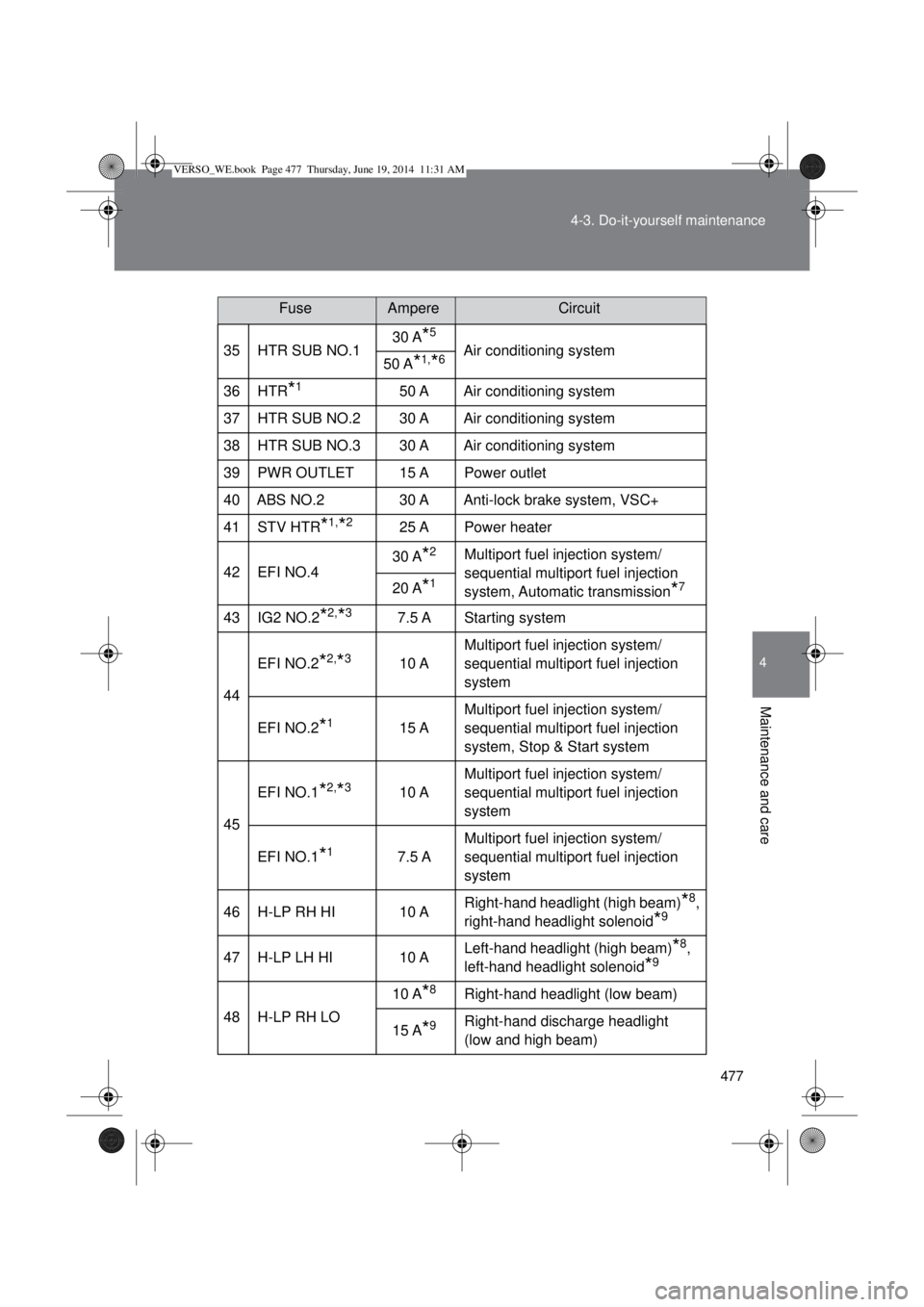
35 HTR SUB NO.130 A*5
Air conditioning system
50 A*1,*6
36 HTR*150 A Air conditioning system
37 HTR SUB NO.2 30 A Air conditioning system
38 HTR SUB NO.3 30 A Air conditioning system
39PWR OUTLET15 APower outlet
40 ABS NO.2 30 A Anti-lock brake system, VSC+
41 STV HTR
*1,*225 A Power heater
42 EFI NO.430 A
*2Multiport fuel injection system/
sequential multiport fuel injection
system, Automatic transmission
*720 A*1
43 IG2 NO.2*2,*37.5 A Starting system
44EFI NO.2
*2,*310 AMultiport fuel injection system/
sequential multiport fuel injection
system
EFI NO.2
*115 AMultiport fuel injection system/
sequential multiport fuel injection
system, Stop & Start system
45EFI NO.1
*2,*310 AMultiport fuel injection system/
sequential multiport fuel injection
system
EFI NO.1
*17.5 AMultiport fuel injection system/
sequential multiport fuel injection
system
46 H-LP RH HI 10 ARight-hand headlight (high beam)
*8,
right-hand headlight solenoid
*9
47 H-LP LH HI 10 ALeft-hand headlight (high beam)*8,
left-hand headlight solenoid
*9
48 H-LP RH LO10 A
*8Right-hand headlight (low beam)
15 A
*9Right-hand discharge headlight
(low and high beam)
FuseAmpereCircuit
VERSO_WE.book Page 477 Thursday, June 19, 2014 11:31 AM