Page 86 of 576
862. Instrument cluster
*1: These lights turn on when the engine switch is turned to the “ON” positionto indicate that a system check is being performed. They will turn off after
the engine is started, or after a few seconds. There may be a malfunction
in a system if a lights does not come on, or if the lights do not turn off. Have
the vehicle inspected by your Toyota dealer for details.
*2: Vehicles without multi-information display
*3: The light comes on to indicate a malfunction.
*4: Vehicles with multi-information display
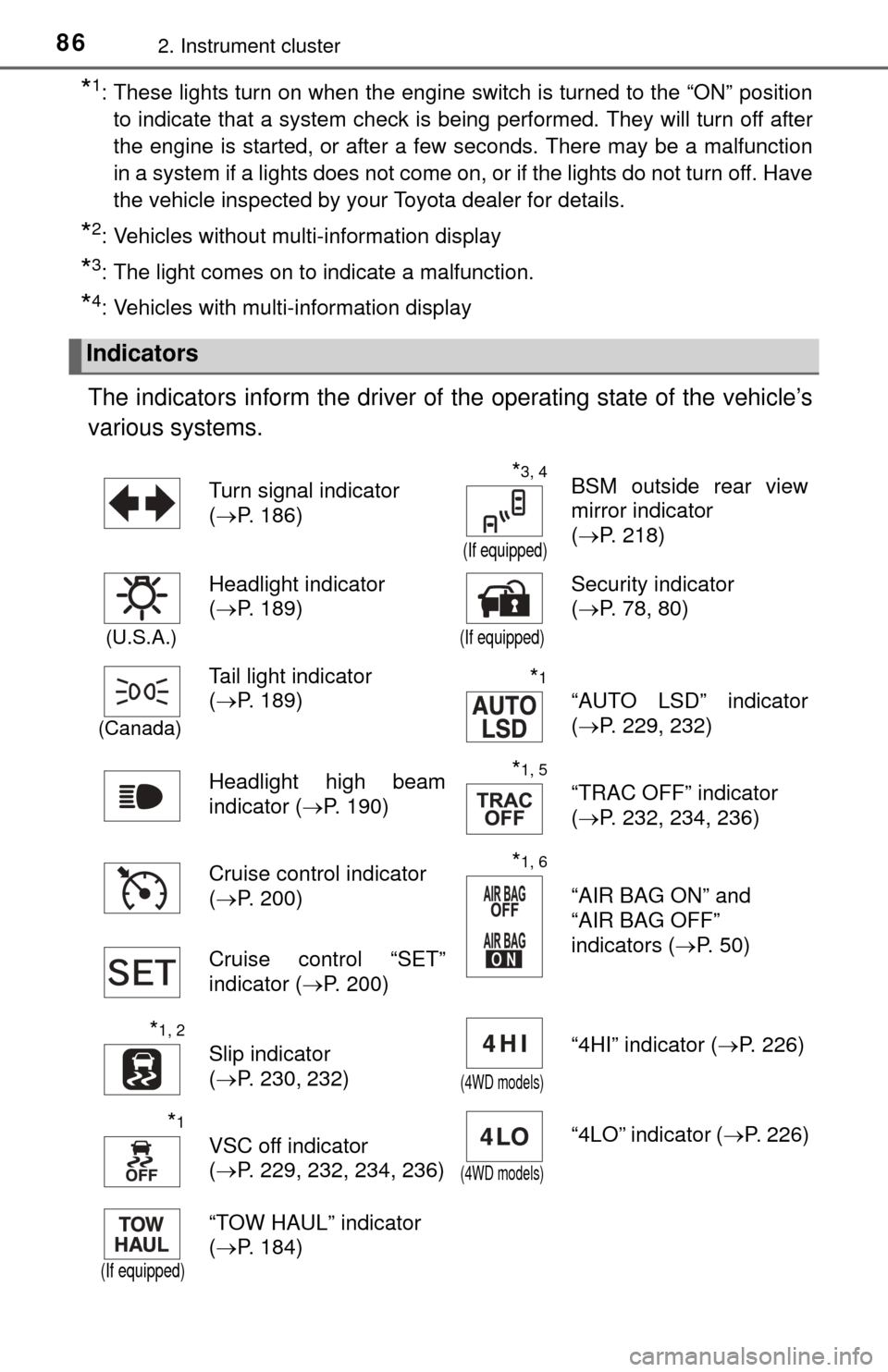
The indicators inform the driver of the operating state of the vehicle’s
various systems.
Indicators
Turn signal indicator
( P. 186)*3, 4
(If equipped)
BSM outside rear view
mirror indicator
(P. 218)
(U.S.A.)
Headlight indicator
(P. 189)
(If equipped)
Security indicator
(P. 78, 80)
(Canada)
Tail light indicator
(P. 189)*1
“AUTO LSD” indicator
(P. 229, 232)
Headlight high beam
indicator ( P. 190)
*1, 5
“TRAC OFF” indicator
(P. 232, 234, 236)
Cruise control indicator
( P. 200)
*1, 6
“AIR BAG ON” and
“AIR BAG OFF”
indicators ( P. 50)
Cruise control “SET”
indicator ( P. 200)
*1, 2
Slip indicator
(P. 230, 232)
(4WD models)
“4HI” indicator ( P. 226)
*1
VSC off indicator
(P. 229, 232, 234, 236)
(4WD models)
“4LO” indicator ( P. 226)
(If equipped)
“TOW HAUL” indicator
(P. 184)
Page 151 of 576
1514-1. Before driving
4
Driving
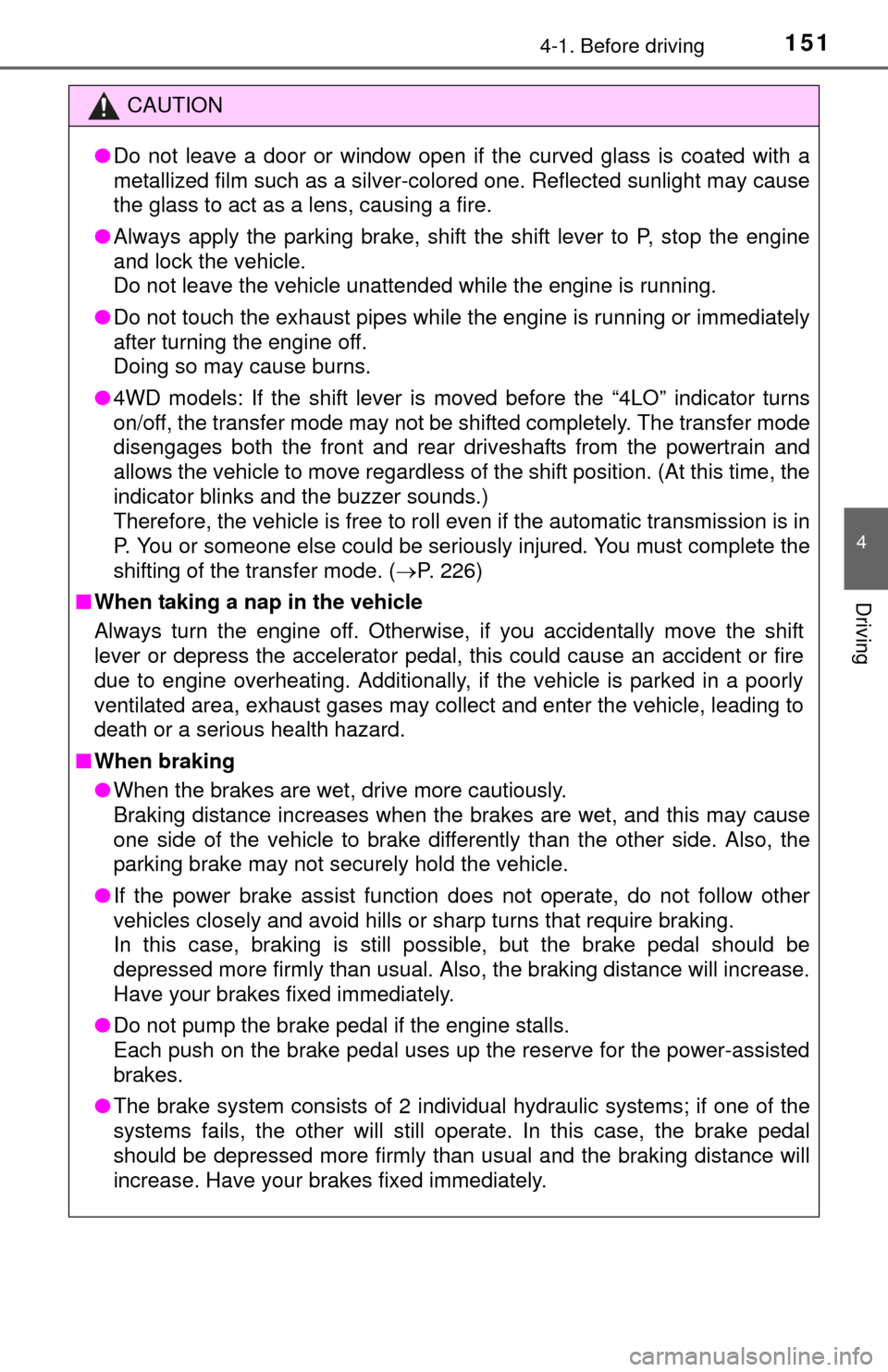
CAUTION
●Do not leave a door or window open if the curved glass is coated with a
metallized film such as a silver-colored one. Reflected sunlight may cause
the glass to act as a lens, causing a fire.
● Always apply the parking brake, shift the shift lever to P, stop the engine
and lock the vehicle.
Do not leave the vehicle unattended while the engine is running.
● Do not touch the exhaust pipes while the engine is running or immediately
after turning the engine off.
Doing so may cause burns.
● 4WD models: If the shift lever is moved before the “4LO” indicator turns
on/off, the transfer mode may not be shifted completely. The transfer mode
disengages both the front and rear driveshafts from the powertrain and
allows the vehicle to move regardless of the shift position. (At this time, the
indicator blinks and the buzzer sounds.)
Therefore, the vehicle is free to roll even if the automatic transmission is in
P. You or someone else could be seriously injured. You must complete the
shifting of the transfer mode. ( P. 226)
■ When taking a nap in the vehicle
Always turn the engine off. Otherwise, if you accidentally move the shift
lever or depress the accelerator pedal, this could cause an accident or fire
due to engine overheating. Additionally, if the vehicle is parked in a poorly
ventilated area, exhaust gases may collect and enter the vehicle, leading to
death or a serious health hazard.
■ When braking
● When the brakes are wet, drive more cautiously.
Braking distance increases when the brakes are wet, and this may cause
one side of the vehicle to brake differently than the other side. Also, the
parking brake may not securely hold the vehicle.
● If the power brake assist function does not operate, do not follow other\
vehicles closely and avoid hills or sharp turns that require braking.
In this case, braking is still possible, but the brake pedal should be
depressed more firmly than usual. Also, the braking distance will increase.
Have your brakes fixed immediately.
● Do not pump the brake pedal if the engine stalls.
Each push on the brake pedal uses up the reserve for the power-assisted
brakes.
● The brake system consists of 2 individual hydraulic systems; if one of the
systems fails, the other will still operate. In this case, the brake pedal
should be depressed more firmly than usual and the braking distance will
increase. Have your brakes fixed immediately.
Page 152 of 576
1524-1. Before driving
NOTICE
■When driving the vehicle
● Do not depress the accelerator and brake pedals at the same time during
driving, as this may restrain driving torque.
● Do not use the accelerator pedal or depress the accelerator and brake
pedals at the same time to hold the vehicle on a hill.
■ When parking the vehicle
Always shift the shift lever to P. Failure to do so may cause the vehicle to
move or the vehicle may accelerate suddenly if the accelerator pedal is
accidentally depressed.
■ Avoiding damage to vehicle parts
● Do not turn the steering wheel fully in either direction and hold it there for
an extended period of time.
Doing so may damage the power steering pump.
● When driving over bumps in the road, drive as slowly as possible to avoid
damaging the wheels, underside of the vehicle, etc.
■ If you get a flat tire while driving
A flat or damaged tire may cause the following situations. Hold the steering
wheel firmly and gradually depress the brake pedal to slow down the vehi-
cle.
● It may be difficult to control your vehicle.
● The vehicle will make abnormal sounds or vibrations.
● The vehicle will lean abnormally.
Information on what to do in case of a flat tire ( P. 475)
■ When encounterin g flooded roads
Do not drive on a road that has flooded after heavy rain, etc. Doing so may
cause the following serious damage to the vehicle:
● Engine stalling
● Short in electrical components
● Engine damage caused by water immersion
In the event that you drive on a flooded road and the vehicle is flooded, be
sure to have your Toyota dealer check the following:
● Brake function
● Changes in quantity and quality of oil and fluid used for the engine, trans-
mission, transfer (4WD models) differentials, etc.
● Lubricant condition for the propeller shaft, bearings and suspension joints
(where possible), and the function of all joints, bearings, etc.
Page 162 of 576
1624-1. Before driving
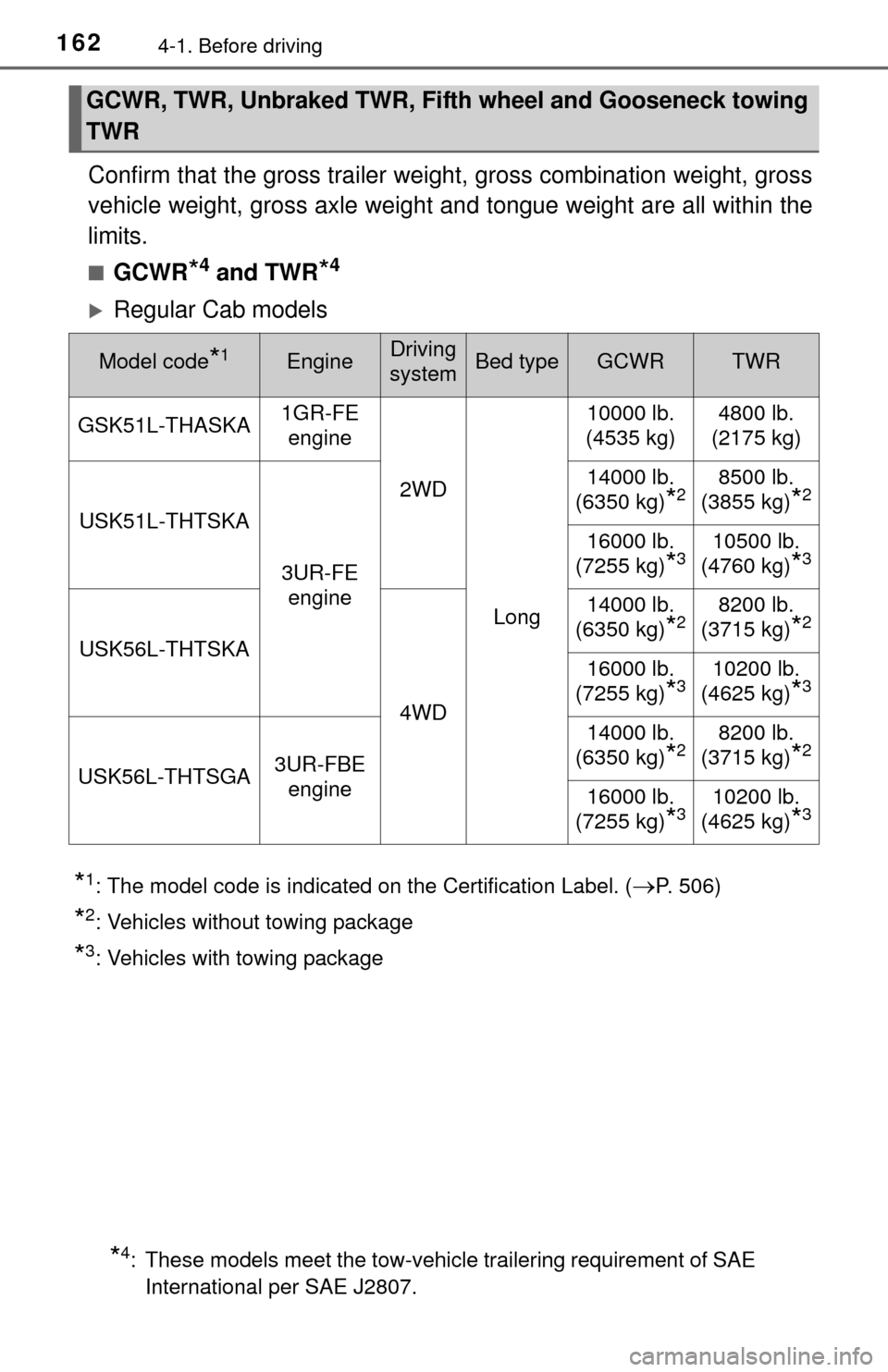
Confirm that the gross trailer weight, gross combination weight, gross
vehicle weight, gross axle weight and tongue weight are all within the
limits.
■GCWR*4 and TWR*4
Regular Cab models
*1: The model code is indicated on the Certification Label. (P. 506)
*2: Vehicles without towing package
*3: Vehicles with towing package
GCWR, TWR, Unbraked TWR, Fifth wheel and Gooseneck towing
TWR
*4: These models meet the tow-vehicle trailering requirement of SAE International per SAE J2807.
Model code*1EngineDriving
systemBed typeGCWRTWR
GSK51L-THASKA 1GR-FE
engine
2WD
Long10000 lb.
(4535 kg) 4800 lb.
(2175 kg)
USK51L-THTSKA 3UR-FE engine 14000 lb.
(6350 kg)
*28500 lb.
(3855 kg)
*2
16000 lb.
(7255 kg)
*310500 lb.
(4760 kg)
*3
USK56L-THTSKA
4WD14000 lb.
(6350 kg)*28200 lb.
(3715 kg)
*2
16000 lb.
(7255 kg)
*310200 lb.
(4625 kg)
*3
USK56L-THTSGA 3UR-FBE
engine 14000 lb.
(6350 kg)*28200 lb.
(3715 kg)
*2
16000 lb.
(7255 kg)
*310200 lb.
(4625 kg)
*3
Page 163 of 576
1634-1. Before driving
4
Driving
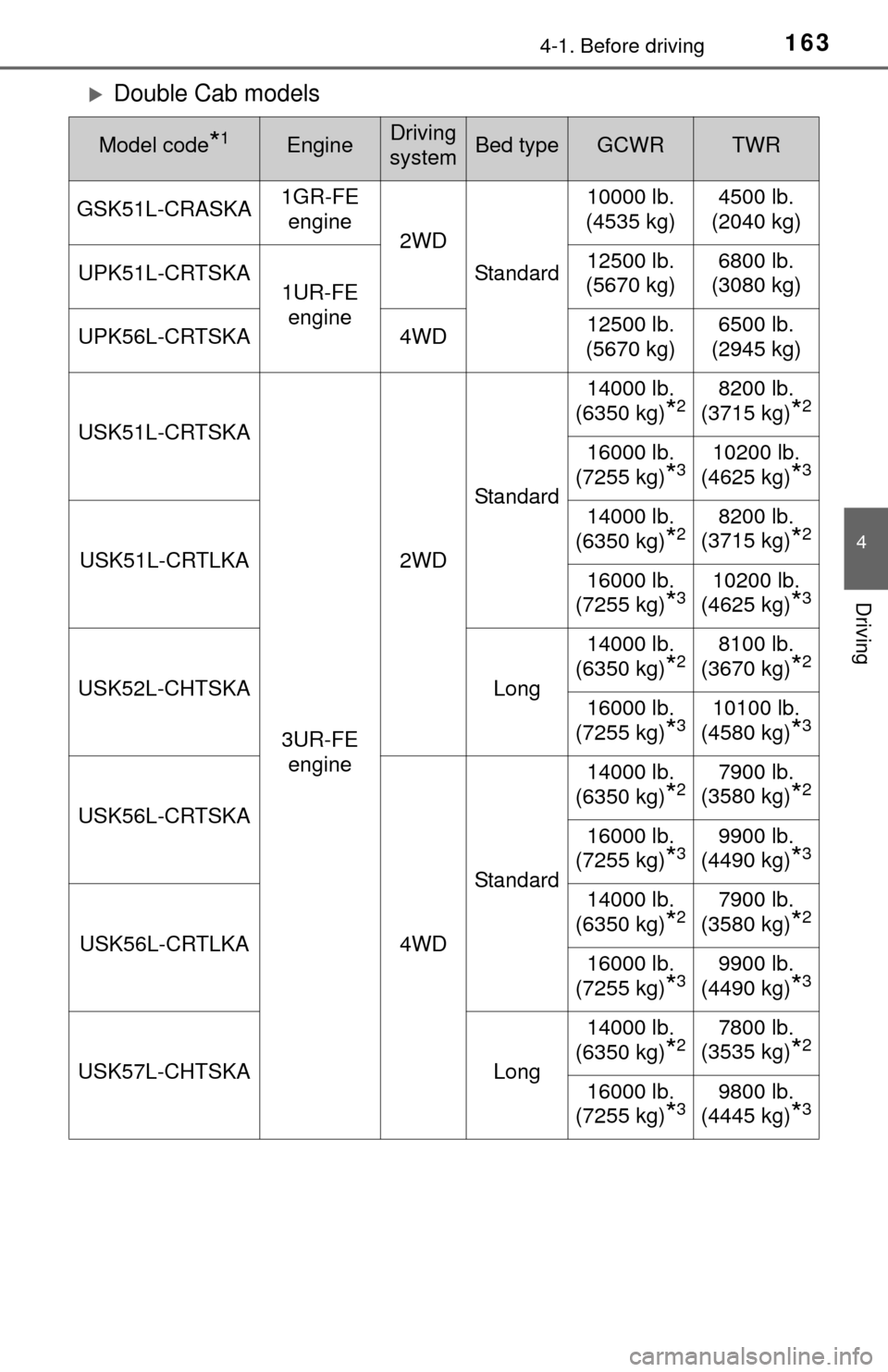
Double Cab models
Model code*1EngineDriving
systemBed typeGCWRTWR
GSK51L-CRASKA 1GR-FE
engine 2WD
Standard 10000 lb.
(4535 kg) 4500 lb.
(2040 kg)
UPK51L-CRTSKA 1UR-FE
engine 12500 lb.
(5670 kg) 6800 lb.
(3080 kg)
UPK56L-CRTSKA 4WD 12500 lb.
(5670 kg) 6500 lb.
(2945 kg)
USK51L-CRTSKA
3UR-FE engine 2WD
Standard 14000 lb.
(6350 kg)
*28200 lb.
(3715 kg)
*2
16000 lb.
(7255 kg)
*310200 lb.
(4625 kg)
*3
USK51L-CRTLKA 14000 lb.
(6350 kg)*28200 lb.
(3715 kg)
*2
16000 lb.
(7255 kg)
*310200 lb.
(4625 kg)
*3
USK52L-CHTSKA Long14000 lb.
(6350 kg)*28100 lb.
(3670 kg)
*2
16000 lb.
(7255 kg)
*310100 lb.
(4580 kg)
*3
USK56L-CRTSKA
4WDStandard 14000 lb.
(6350 kg)*27900 lb.
(3580 kg)
*2
16000 lb.
(7255 kg)
*39900 lb.
(4490 kg)
*3
USK56L-CRTLKA 14000 lb.
(6350 kg)*27900 lb.
(3580 kg)
*2
16000 lb.
(7255 kg)
*39900 lb.
(4490 kg)
*3
USK57L-CHTSKA Long14000 lb.
(6350 kg)*27800 lb.
(3535 kg)
*2
16000 lb.
(7255 kg)
*39800 lb.
(4445 kg)
*3
Page 164 of 576
1644-1. Before driving
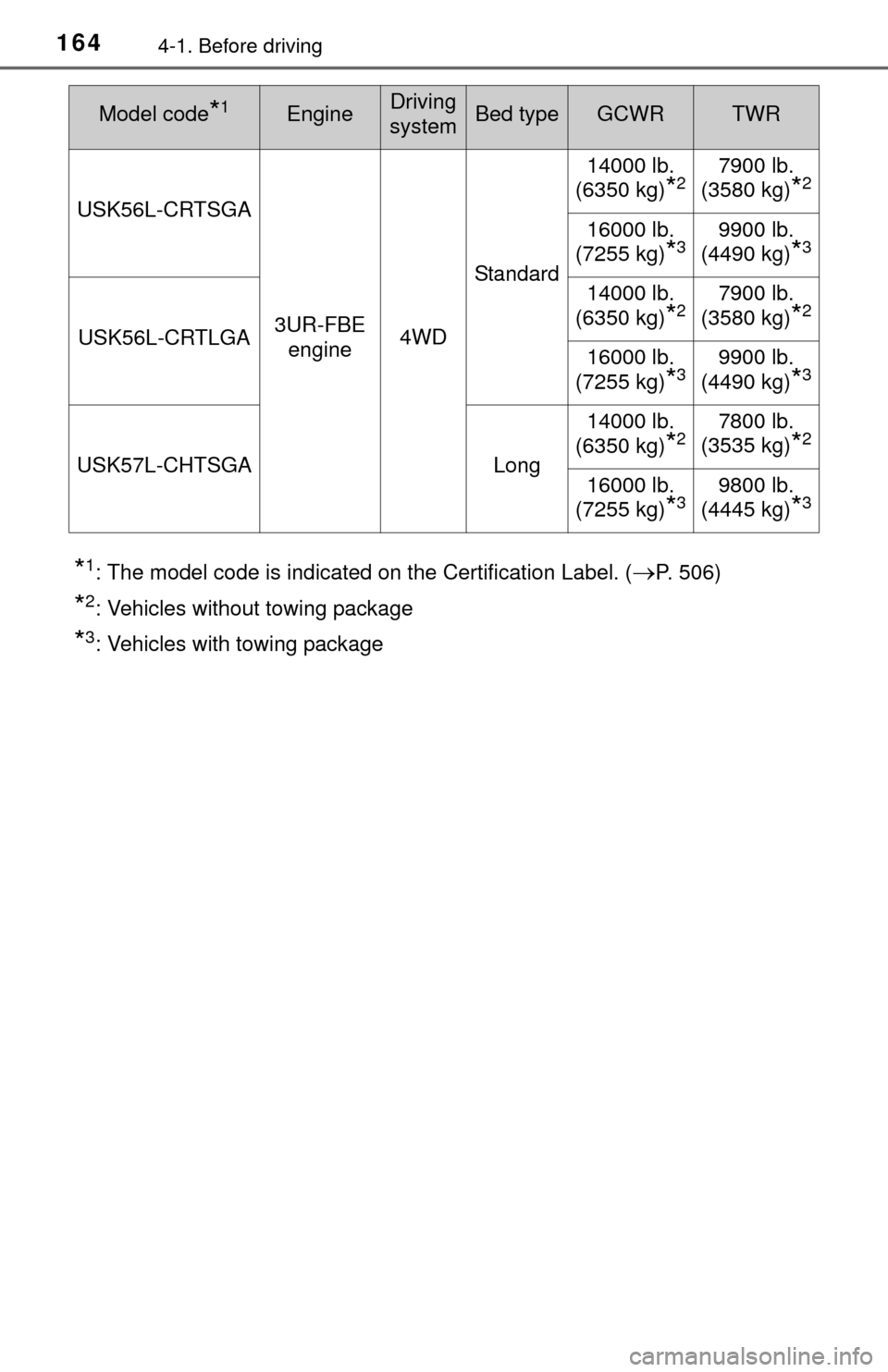
*1: The model code is indicated on the Certification Label. (P. 506)
*2: Vehicles without towing package
*3: Vehicles with towing package
USK56L-CRTSGA
3UR-FBE engine 4WDStandard 14000 lb.
(6350 kg)
*27900 lb.
(3580 kg)
*2
16000 lb.
(7255 kg)
*39900 lb.
(4490 kg)
*3
USK56L-CRTLGA 14000 lb.
(6350 kg)*27900 lb.
(3580 kg)
*2
16000 lb.
(7255 kg)
*39900 lb.
(4490 kg)
*3
USK57L-CHTSGA Long14000 lb.
(6350 kg)*27800 lb.
(3535 kg)
*2
16000 lb.
(7255 kg)
*39800 lb.
(4445 kg)
*3
Model code*1EngineDriving
systemBed typeGCWRTWR
Page 165 of 576
1654-1. Before driving
4
Driving
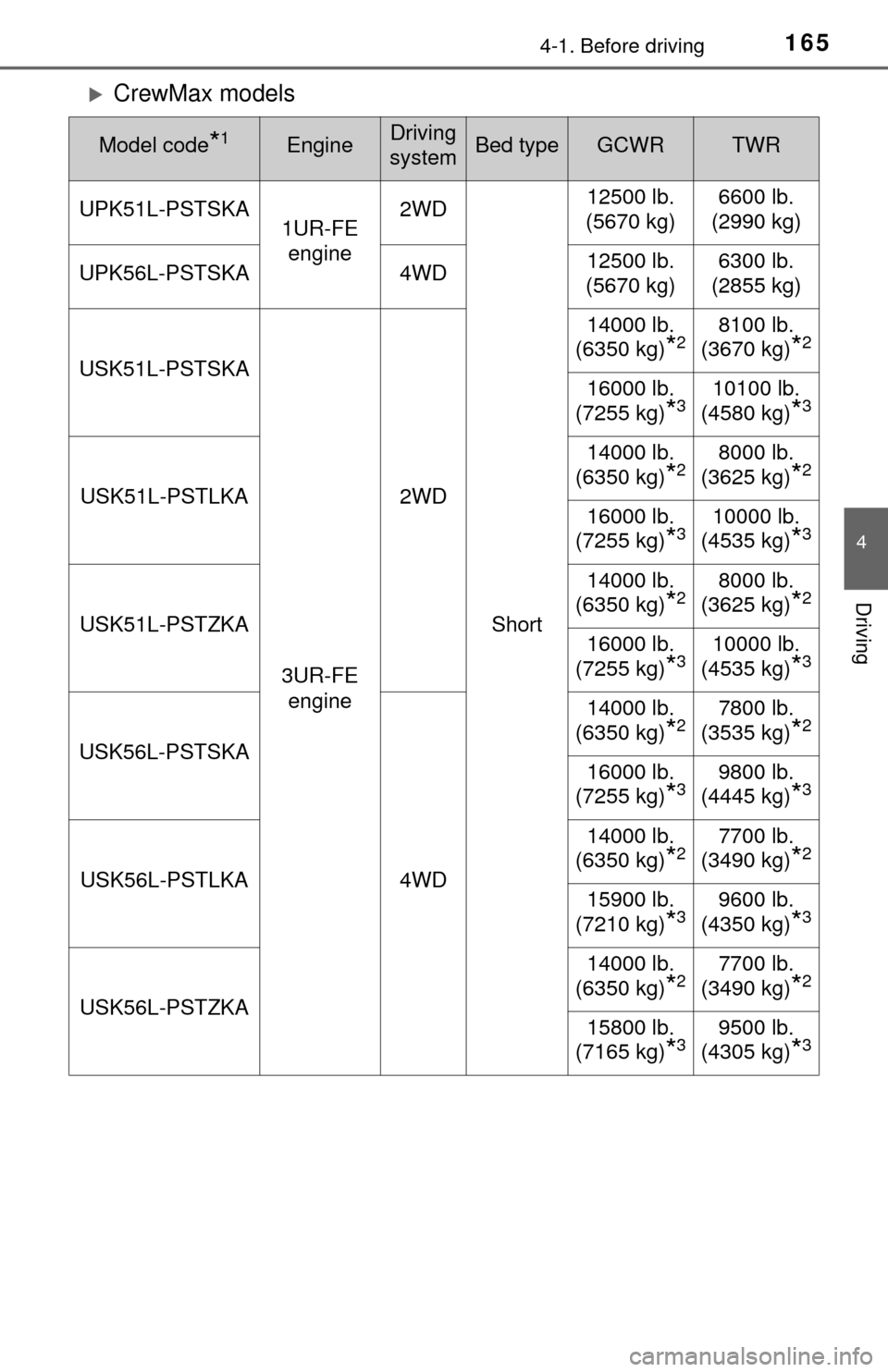
CrewMax models
Model code*1EngineDriving
systemBed typeGCWRTWR
UPK51L-PSTSKA 1UR-FE
engine 2WD
Short 12500 lb.
(5670 kg) 6600 lb.
(2990 kg)
UPK56L-PSTSKA 4WD 12500 lb.
(5670 kg) 6300 lb.
(2855 kg)
USK51L-PSTSKA
3UR-FE engine 2WD
14000 lb.
(6350 kg)
*28100 lb.
(3670 kg)
*2
16000 lb.
(7255 kg)
*310100 lb.
(4580 kg)
*3
USK51L-PSTLKA 14000 lb.
(6350 kg)*28000 lb.
(3625 kg)
*2
16000 lb.
(7255 kg)
*310000 lb.
(4535 kg)
*3
USK51L-PSTZKA 14000 lb.
(6350 kg)*28000 lb.
(3625 kg)
*2
16000 lb.
(7255 kg)
*310000 lb.
(4535 kg)
*3
USK56L-PSTSKA
4WD14000 lb.
(6350 kg)*27800 lb.
(3535 kg)
*2
16000 lb.
(7255 kg)
*39800 lb.
(4445 kg)
*3
USK56L-PSTLKA 14000 lb.
(6350 kg)*27700 lb.
(3490 kg)
*2
15900 lb.
(7210 kg)
*39600 lb.
(4350 kg)
*3
USK56L-PSTZKA 14000 lb.
(6350 kg)*27700 lb.
(3490 kg)
*2
15800 lb.
(7165 kg)
*39500 lb.
(4305 kg)
*3
Page 166 of 576
1664-1. Before driving
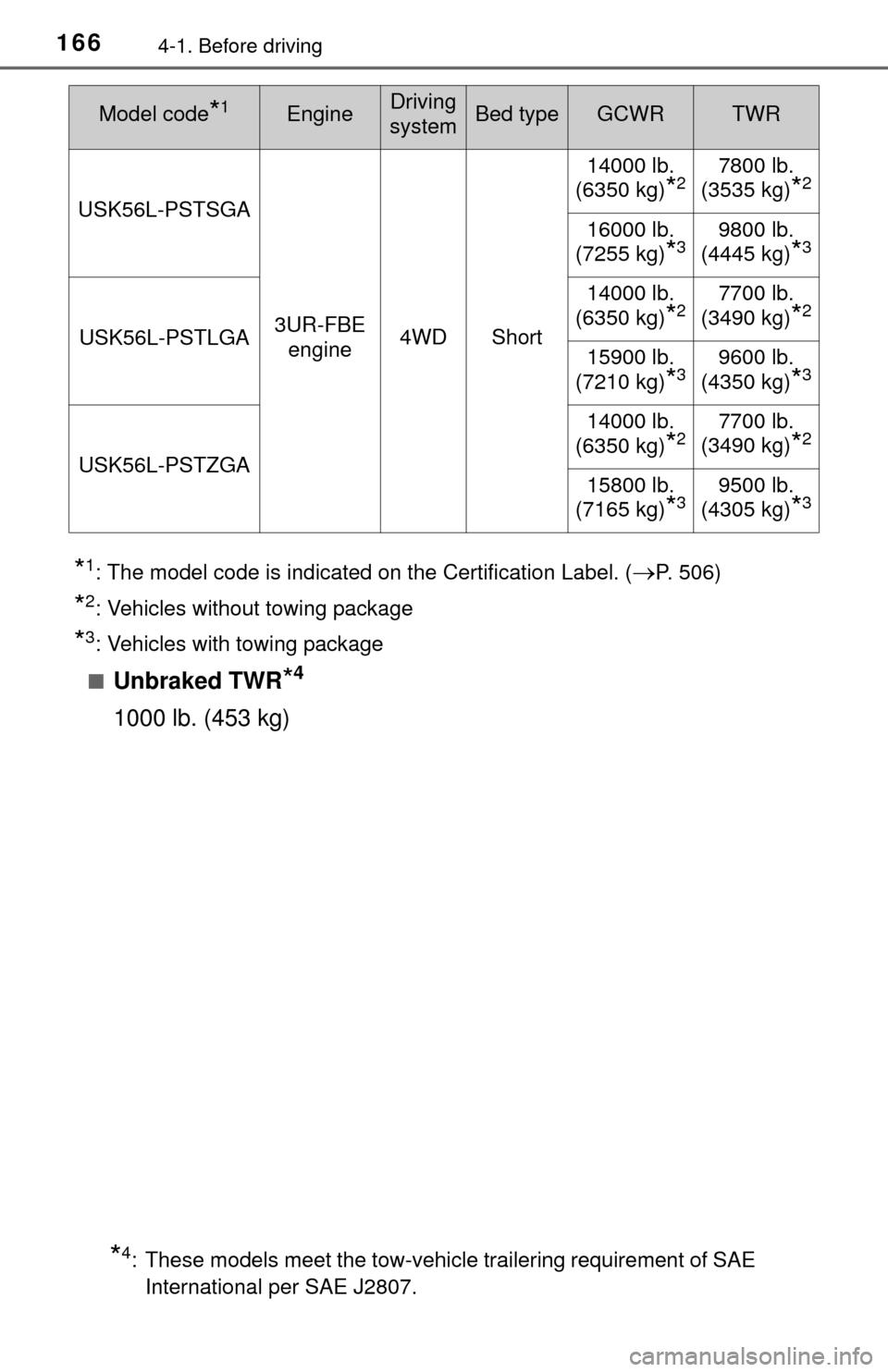
*1: The model code is indicated on the Certification Label. (P. 506)
*2: Vehicles without towing package
*3: Vehicles with towing package
■
Unbraked TWR*4
1000 lb. (453 kg)
USK56L-PSTSGA
3UR-FBE engine 4WD Short 14000 lb.
(6350 kg)*27800 lb.
(3535 kg)
*2
16000 lb.
(7255 kg)
*39800 lb.
(4445 kg)
*3
USK56L-PSTLGA 14000 lb.
(6350 kg)*27700 lb.
(3490 kg)
*2
15900 lb.
(7210 kg)
*39600 lb.
(4350 kg)
*3
USK56L-PSTZGA 14000 lb.
(6350 kg)*27700 lb.
(3490 kg)
*2
15800 lb.
(7165 kg)
*39500 lb.
(4305 kg)
*3
*4: These models meet the tow-vehicle trailering requirement of SAE
International per SAE J2807.
Model code*1EngineDriving
systemBed typeGCWRTWR