Page 466 of 576
4668-2. Steps to take in an emergency
(If equipped)
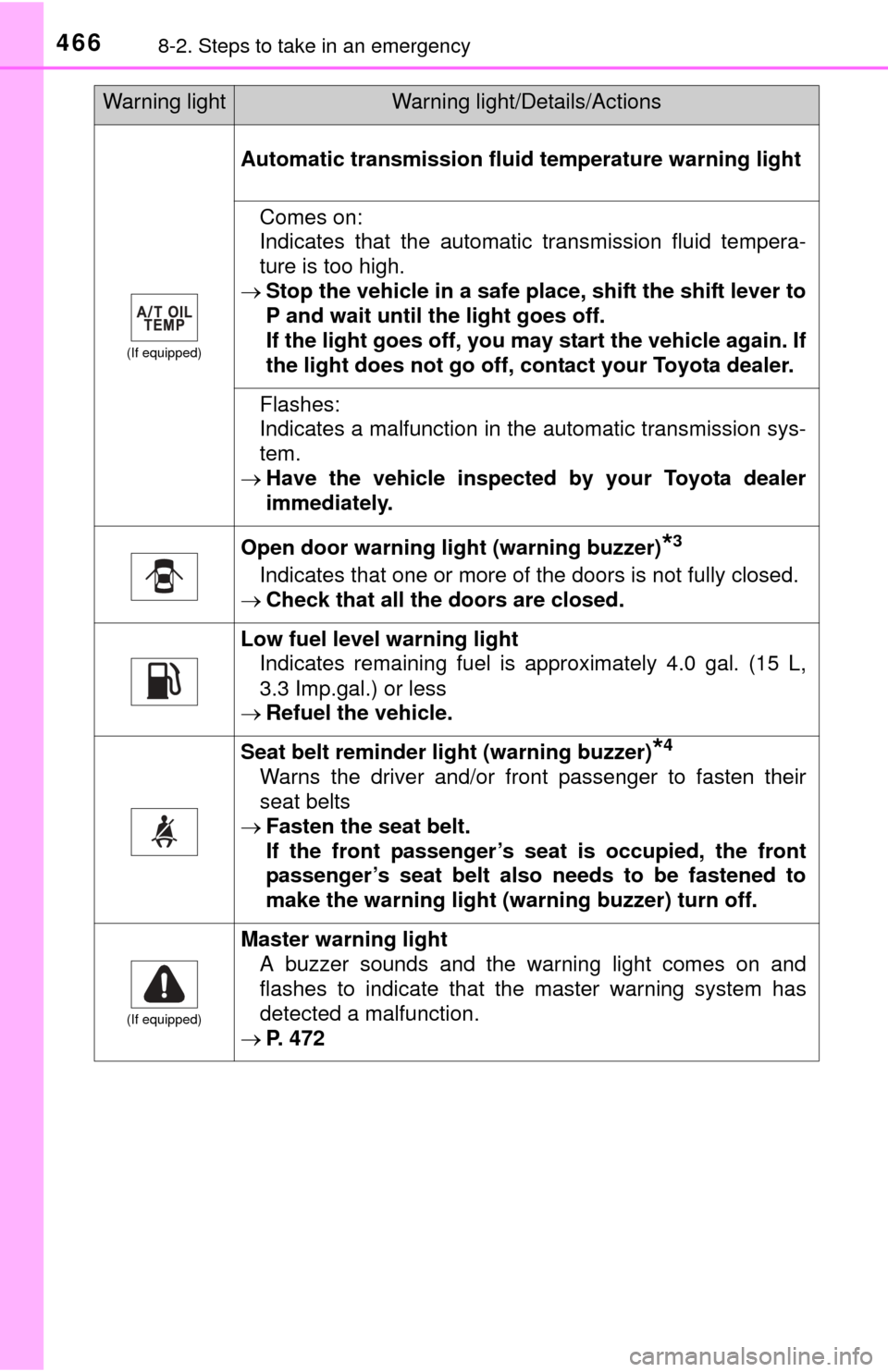
Automatic transmission fluid temperature warning light
Comes on:
Indicates that the automatic transmission fluid tempera-
ture is too high.
Stop the vehicle in a safe place, shift the shift lever to
P and wait until th e light goes off.
If the light goes off, you may start the vehicle again. If
the light does not go off, contact your Toyota dealer.
Flashes:
Indicates a malfunction in the automatic transmission sys-
tem.
Have the vehicle inspected by your Toyota dealer
immediately.
Open door warning light (warning buzzer)*3
Indicates that one or more of the doors is not fully closed.
Check that all the doors are closed.
Low fuel level warning light
Indicates remaining fuel is approximately 4.0 gal. (15 L,
3.3 Imp.gal.) or less
Refuel the vehicle.
Seat belt reminder light (warning buzzer)*4
Warns the driver and/or front passenger to fasten their
seat belts
Fasten the seat belt.
If the front passenger’s seat is occupied, the front
passenger’s seat belt also needs to be fastened to
make the warning light (warning buzzer) turn off.
(If equipped)
Master warning light
A buzzer sounds and the warning light comes on and
flashes to indicate that the master warning system has
detected a malfunction.
P. 472
Warning lightWarning light/Details/Actions
Page 473 of 576
4738-2. Steps to take in an emergency
8
When trouble arises
(If equipped)
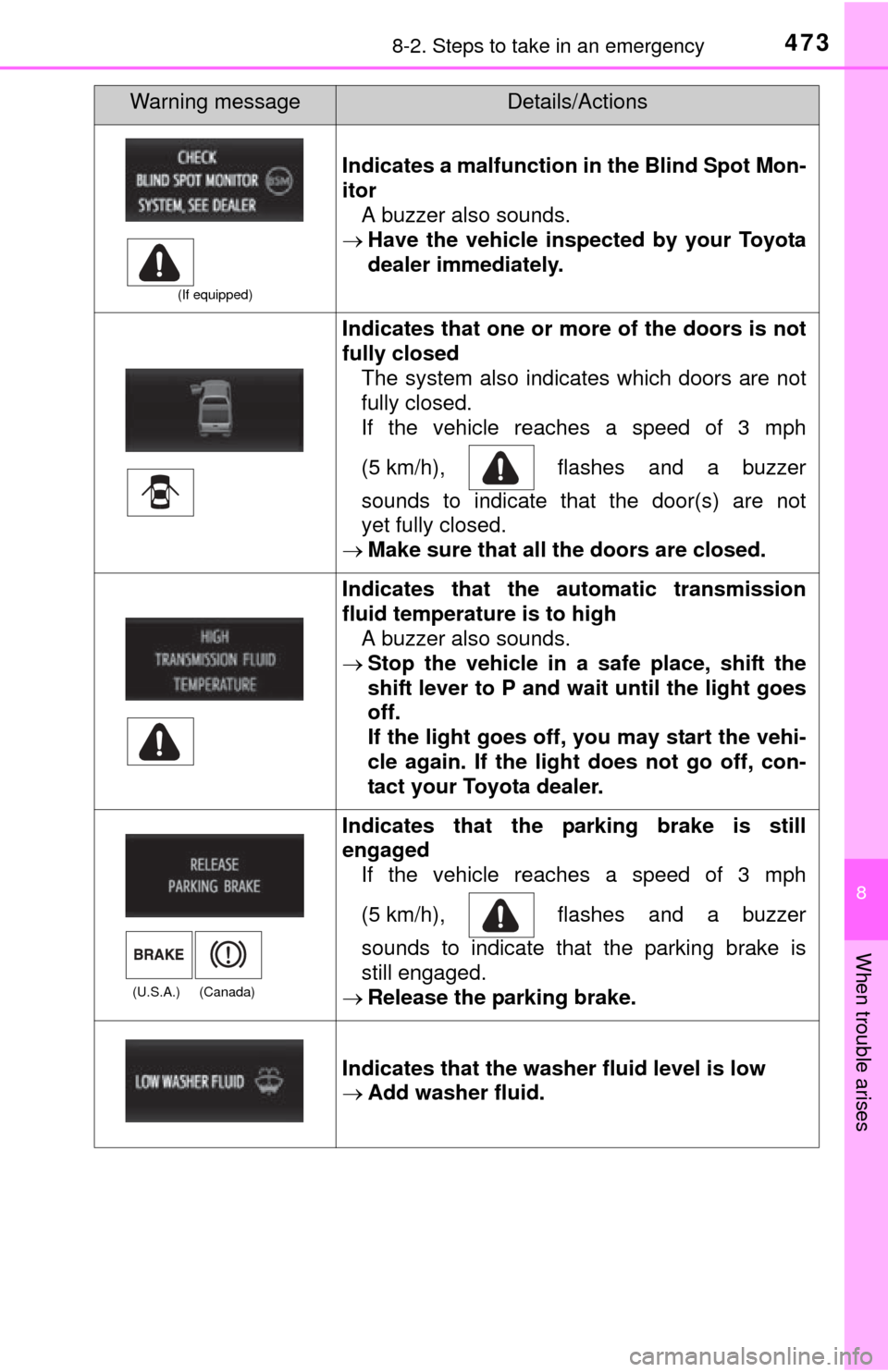
Indicates a malfunction in the Blind Spot Mon-
itorA buzzer also sounds.
Have the vehicle inspected by your Toyota
dealer immediately.
Indicates that one or more of the doors is not
fully closed The system also indicates which doors are not
fully closed.
If the vehicle reaches a speed of 3 mph
(5 km/h), flashes and a buzzer
sounds to indicate that the door(s) are not
yet fully closed.
Make sure that all the doors are closed.
Indicates that the automatic transmission
fluid temperature is to high
A buzzer also sounds.
Stop the vehicle in a safe place, shift the
shift lever to P and wait until the light goes
off.
If the light goes off, you may start the vehi-
cle again. If the light does not go off, con-
tact your Toyota dealer.
(U.S.A.) (Canada)
Indicates that the parking brake is still
engaged If the vehicle reaches a speed of 3 mph
(5 km/h), flashes and a buzzer
sounds to indicate that the parking brake is
still engaged.
Release the parking brake.
Indicates that the washer fluid level is low
Add washer fluid.
Warning messageDetails/Actions
Page 497 of 576
4978-2. Steps to take in an emergency
8
When trouble arises
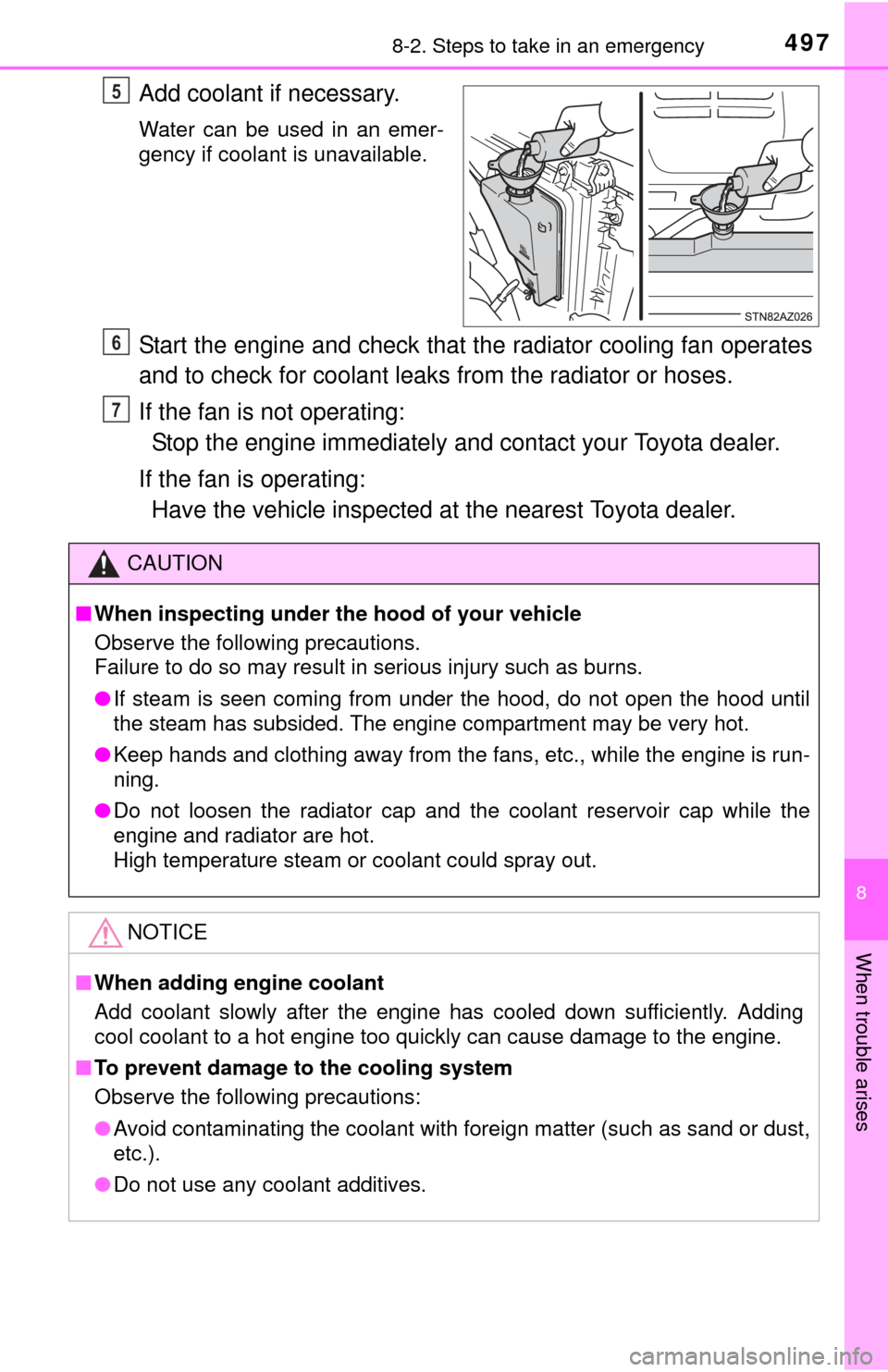
Add coolant if necessary.
Water can be used in an emer-
gency if coolant is unavailable.
Start the engine and check that the radiator cooling fan operates
and to check for coolant leaks from the radiator or hoses.
If the fan is not operating: Stop the engine immediately and contact your Toyota dealer.
If the fan is operating: Have the vehicle inspected at the nearest Toyota dealer.
5
CAUTION
■ When inspecting under the hood of your vehicle
Observe the following precautions.
Failure to do so may result in serious injury such as burns.
● If steam is seen coming from under the hood, do not open the hood until
the steam has subsided. The engine compartment may be very hot.
● Keep hands and clothing away from the fans, etc., while the engine is run-
ning.
● Do not loosen the radiator cap and the coolant reservoir cap while the
engine and radiator are hot.
High temperature steam or coolant could spray out.
NOTICE
■When adding engine coolant
Add coolant slowly after the engine has cooled down sufficiently. Adding
cool coolant to a hot engine too quickly can cause damage to the engine.
■ To prevent damage to the cooling system
Observe the following precautions:
● Avoid contaminating the coolant with foreign matter (such as sand or dust,
etc.).
● Do not use any coolant additives.
6
7
Page 498 of 576
4988-2. Steps to take in an emergency
If the vehicle becomes stuck
Stop the engine. Set the parking brake and shift the shift lever to P.
Remove the mud, snow or sand from around the rear wheels.
Place wood, stones or some other material to help provide traction
under the rear wheels.
Restart the engine.
Shift the shift lever to D or R and release the parking brake. Then,
while exercising caution, depress the accelerator pedal.
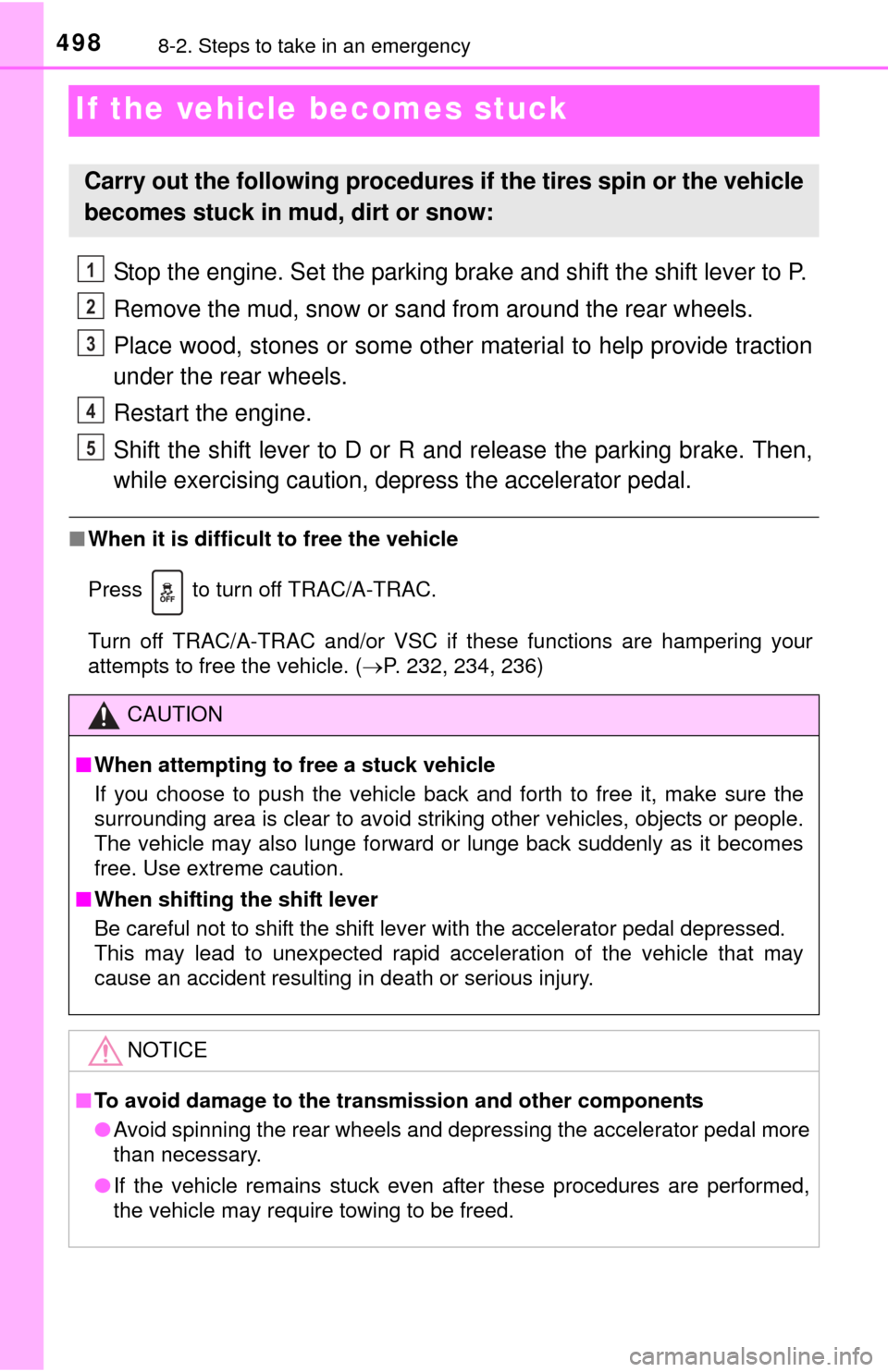
■When it is difficult to free the vehicle
Press to turn off TRAC/A-TRAC.
Turn off TRAC/A-TRAC and/or VSC if these functions are hampering your
attempts to free the vehicle. ( P. 232, 234, 236)
Carry out the following procedures if the tires spin or the vehicle
becomes stuck in mud, dirt or snow:
CAUTION
■When attempting to free a stuck vehicle
If you choose to push the vehicle back and forth to free it, make sure the
surrounding area is clear to avoid striking other vehicles, objects or people.
The vehicle may also lunge forward or lunge back suddenly as it becomes
free. Use extreme caution.
■ When shifting the shift lever
Be careful not to shift the shift lever with the accelerator pedal depressed.
This may lead to unexpected rapid acceleration of the vehicle that may
cause an accident resulting in death or serious injury.
NOTICE
■To avoid damage to the tran smission and other components
● Avoid spinning the rear wheels and depressing the accelerator pedal more
than necessary.
● If the vehicle remains stuck even after these procedures are performed,
the vehicle may require towing to be freed.
1
2
3
4
5
Page 559 of 576
559What to do if... (Troubleshooting)
●It is locked to prevent theft of the vehicle if the key is removed from the
engine switch. (P. 180)
●Is the window lock switch pressed?
The power window except for the one at the driver’s seat cannot be oper-
ated if the window lock switch is pressed. ( P. 136)
●The seat belt reminder light is flashing
Are the driver and the front passenger wearing the seat belts? ( P. 466)
●The parking brake indicator is on
Is the parking brake released? (P. 187)
Depending on the situation, other types of warning buzzer may also sound.
( P. 464, 472)
●Did anyone inside the vehicle open a door during setting the alarm?
The sensor detects it and the alarm sounds. ( P. 80)
To stop the alarm, turn the engine switch to the “ACC” or “ON” position, or
start the engine.
●When a warning light turns on or a warning message is displayed, refer to
P. 464, 472.
The steering wheel cannot be turned after the engine is
stopped
The windows do not open or close by operating the power
window switches
A warning buzzer sounds during driving
An alarm is activated and the horn sounds
A warning light turns on or a warning message is displayed
Page 564 of 576

564Alphabetical index
EDR (Event data recorder) ........ 10
Emergency, in case ofIf the engine will not start ...... 490
If the shift lever cannot be shifted from P .... 491
If the vehicle has discharged battery ................................ 493
If the warning buzzer sounds ................................ 464
If the warning light turns
on ....................................... 464
If the warning message is displayed......................... 472
If you have a flat tire ............. 475
If you lose your keys ............. 100
If you think something is wrong .............................. 462
If your vehicle becomes stuck ................................... 498
If your vehicle has to be stopped in an emergency ... 457
If your vehicle needs
to be towed ......................... 458
If your vehicle overheats ....... 496
Emergency flashers ................ 456 Engine
“ACC” position ...................... 179
Compartment ........................ 406
Engine switch ....................... 179
Hood ..................................... 405
How to start the engine......... 179
Identification number ............ 506
If the engine will not start ...... 490
Ignition switch (engine switch) ................... 179
Immobilizer system .. ............... 78
Overheating .......................... 496
Engine coolant......................... 410
Capacity................................ 510
Checking............................... 410
Preparing and checking before winter ...................... 240
Engine coolant temperature gauge ....................................... 88
Engine immobilizer system ...... 78
Engine oil ................................. 408 Capacity................................ 508
Checking............................... 408
Oil pressure warning light ..... 464
Preparing and checking
before winter ...................... 240
Engine oil maintenance data......................................... 398
Engine switch (ignition switch) .................... 179
Engine switch light
(ignition switch light) ............ 353
Event data recorder (EDR)........ 10
E