Page 735 of 872
When trouble arises5
735
SIENNA_OM_OM45483U_(U)
5-1. Essential informationEmergency flashers ......... 736
If your vehicle needs to be towed .................... 737
If you think something is wrong ......................... 741
Fuel pump shut off system ........................... 742 5-2. Steps to take in an
emergency
If a warning light turns on or a warning buzzer
sounds... ....................... 743
If a warning message is displayed........................ 758
If you have a flat tire (vehicles with
run-flat tires)................... 759
If you have a flat tire (vehicles with
standard tires) ................ 761
If the engine will not start .......................... 776
If the shift lever cannot be shifted from P............ 778
If you lose your keys ........ 780
If the electronic key does not operate properly....... 781
If the battery is discharged ..................... 784
If your vehicle overheats ....................... 790
If the vehicle becomes stuck .............................. 793
If your vehicle has to be stopped in an
emergency ..................... 795
Page 741 of 872
5
When trouble arises
741
5-1. Essential information
SIENNA_OM_OM45483U_(U)
If you think something is wrong
If you notice any of the following symptoms, your vehicle probably
needs adjustment or repair. Contact your Toyota dealer as soon as
possible.
■ Visible symptoms
●Fluid leaks under the vehicle
(Water dripping from the air cond itioning after use is normal.)
● Flat-looking tires or uneven tire wear
● Engine coolant temperature g auge needle continually points
higher than normal
■ Audible symptoms
●Changes in exhaust sound
● Excessive tire squeal when cornering
● Strange noises related to the suspension system
● Pinging or other noises related to the engine
■ Operational symptoms
●Engine missing, stumbling or running rough
● Appreciable loss of power
● Vehicle pulls heavily to one side when braking
● Vehicle pulls heavily to one side when driving on a level road
● Loss of brake effectiveness, s pongy feeling, pedal almost
touches the floor
Page 748 of 872
748 5-2. Steps to take in an emergency
SIENNA_OM_OM45483U_(U)
Warning lightWarning light/DetailsCorrection procedure
Tire pressure warning
light
When the light comes on:
Low tire inflation pressure
such as
• Natural causes (P. 752)
• Flat tire ( P. 759, 761) Adjust the tire inflation
pressure to the specified
level.
The light will turn off after
a few minutes. In case
the light does not turn off
even if the tire inflation
pressure is adjusted,
have the system checked
by your Toyota dealer.
When the light comes on
after blinking for 1 minute:
Malfunction in the tire
pressure warning system
( P. 754) Have the system checked
by your Toyota dealer.
Low windshield washer
fluid warning light
Low level of washer fluid Fill the tank.
Page 752 of 872
752 5-2. Steps to take in an emergency
SIENNA_OM_OM45483U_(U)
■If the malfunction indicator lamp comes on while driving
First check the following:
● Is the fuel tank empty?
If it is, fill the fuel tank immediately.
● Is the fuel tank cap loose?
If it is, tighten it securely.
The malfunction indicator lamp will go off after taking several driving trips.
If the malfunction indicator lamp does not go off even after several trips, con-
tact your Toyota dealer as soon as possible.
■
When the tire pressure warning light comes on
Check the tire inflation pressure and adjust to the appropriate level.
Pushing the tire pressure warning reset switch will not turn off the tire
pressure warning light.
■The tire pressure warning light may come on due to natural causes
The tire pressure warning light may come on due to natural causes such
as natural air leaks and tire inflat ion pressure changes caused by tem-
perature. In this case, adjusting the tire inflation pressure will turn off the
warning light (after a few minutes).
■When a tire is replaced with a spare tire (vehicles with compact
spare tire)
The compact spare tire is not equipped with a tire pressure warning
valve and transmitter. If a tire goes flat, the tire pressure warning light will
not turn off even though the flat tire has been replaced with the spare
tire. Replace the spare tire with the re paired tire and adjust the tire infla-
tion pressure. The tire pressure wa rning light will go off after a few min-
utes.
Page 753 of 872

5
When trouble arises
753
5-2. Steps to take in an emergency
SIENNA_OM_OM45483U_(U)
■If the tire pressure warning system is inoperative
The tire pressure warning system will be disabled in the following condi-
tions:
(When the condition be
comes normal, the system will work properly.)
●If tires not equipped with tire pressure warning valves and transmit-
ters are used.
●If the ID code on the tire pressure warning valves and transmitters is
not registered in the tire pressure warning computer.
●If the tire inflation pressure is 73 psi (500 kPa, 5.1 kgf/cm2 or bar) or
higher.
The tire pressure warning system may be disabled in the following condi-
tions:
(When the condition be comes normal, the system will work properly.)
●If electronic devices or facilities using similar radio wave frequencies
are nearby.
●If a radio set at similar frequencies is in use in the vehicle.
●If a window tint that affects the radio wave signals is installed.
●If there is a lot of snow or ice on the vehicle, in particular around the
wheels or wheel housings.
●If non-genuine Toyota wheels are used. (Even if you use Toyota
wheels, the tire pressu re warning system may not work properly with
some types of tires.)
●If tire chains are used.
Page 755 of 872

5
When trouble arises
755
5-2. Steps to take in an emergency
SIENNA_OM_OM45483U_(U)
CAUTION
■When the electric power steering system warning light comes on
The steering wheel may become extremely heavy.
If the steering wheel becomes heavier than usual when operating, hold
firmly and operate using more force than usual.
■If the tire pressure warning light comes on
Be sure to observe the following precautions. Failure to do so could
cause loss of vehicle control and result in death or serious injury.
●Vehicles with standard tires:
• Stop your vehicle in a safe place as soon as possible. Adjust the
tire inflation pressure immediately.
• If the tire pressure warning light comes on even after tire inflation pressure adjustment, it is probable that you have a flat tire. Check
the tires. If a tire is flat, change it with the spare tire and have the
flat tire repaired by the nearest Toyota dealer.
• Avoid abrupt maneuvering and brak ing. If the vehicle tires deterio-
rate, you could lose control of th e steering wheel or the brakes.
●Vehicles with run-flat tires:
• Decelerate to the lowest appropr iate speed as soon as possible.
Do not drive over 50 mph (80 km/h).
• Check and adjust the tire inflation pressure immediately.
• If the tire pressure warning light comes on even after tire inflation pressure adjustment, it is probable that you have a flat tire. Have
the tire replaced by the nearest Toyota dealer.
• Avoid abrupt maneuvering and brak ing. If the vehicle tires deterio-
rate, you could lose control of th e steering wheel or the brakes.
Page 756 of 872

756 5-2. Steps to take in an emergency
SIENNA_OM_OM45483U_(U)
CAUTION
■If a blowout or sudden air leakage should occur
The tire pressure warning system may not activate immediately.
■Maintenance of the tires
Each tire, including the spare (if provided), should be checked monthly
when cold and inflated to the inflation pressure recommended by the
vehicle manufacturer on the vehicle placard or tire inflation pressure
label (tire and load information label). (If your vehicle has tires of a differ-
ent size than the size indicated on the vehicle placard or tire inflation
pressure label [tire and load information label], you should determine the
proper tire inflation pr essure for those tires.)
As an added safety feature, your vehicle has been equipped with a tire
pressure monitoring system (TPMS-ti re pressure warning system) that
illuminates a low tire pressure telltal e (tire pressure warning light) when
one or more of your tires is significantly under-inflated. Accordingly,
when the low tire pressu re telltale (tire pressure warning light) illumi-
nates, you should stop and check your tires as soon as possible, and
inflate them to the proper pressure. Driving on a significantly under-
inflated tire causes the tire to overheat and can lead to tire failure.
Under-inflation also reduces fuel effi ciency and tire tread life, and may
affect the vehicle’s handling and stopping ability.
Please note that the TPMS (tire pressure warning system) is not a sub-
stitute for proper tire main tenance, and it is the driver’s responsibility to
maintain correct tire pressure, even if under-inflation has not reached the
level to trigger illu mination of the TPMS low tire pressure telltale (tire
pressure warning light).
Page 759 of 872
5
When trouble arises
759
5-2. Steps to take in an emergency
SIENNA_OM_OM45483U_(U)
If you have a flat tire (vehicles with run-flat tires)
■In some condition (such as at high temperatures)
You cannot continue driving for up to 100 miles (160 km).
■For the detailed information on run-flat tires
See the tire warranty booklet.
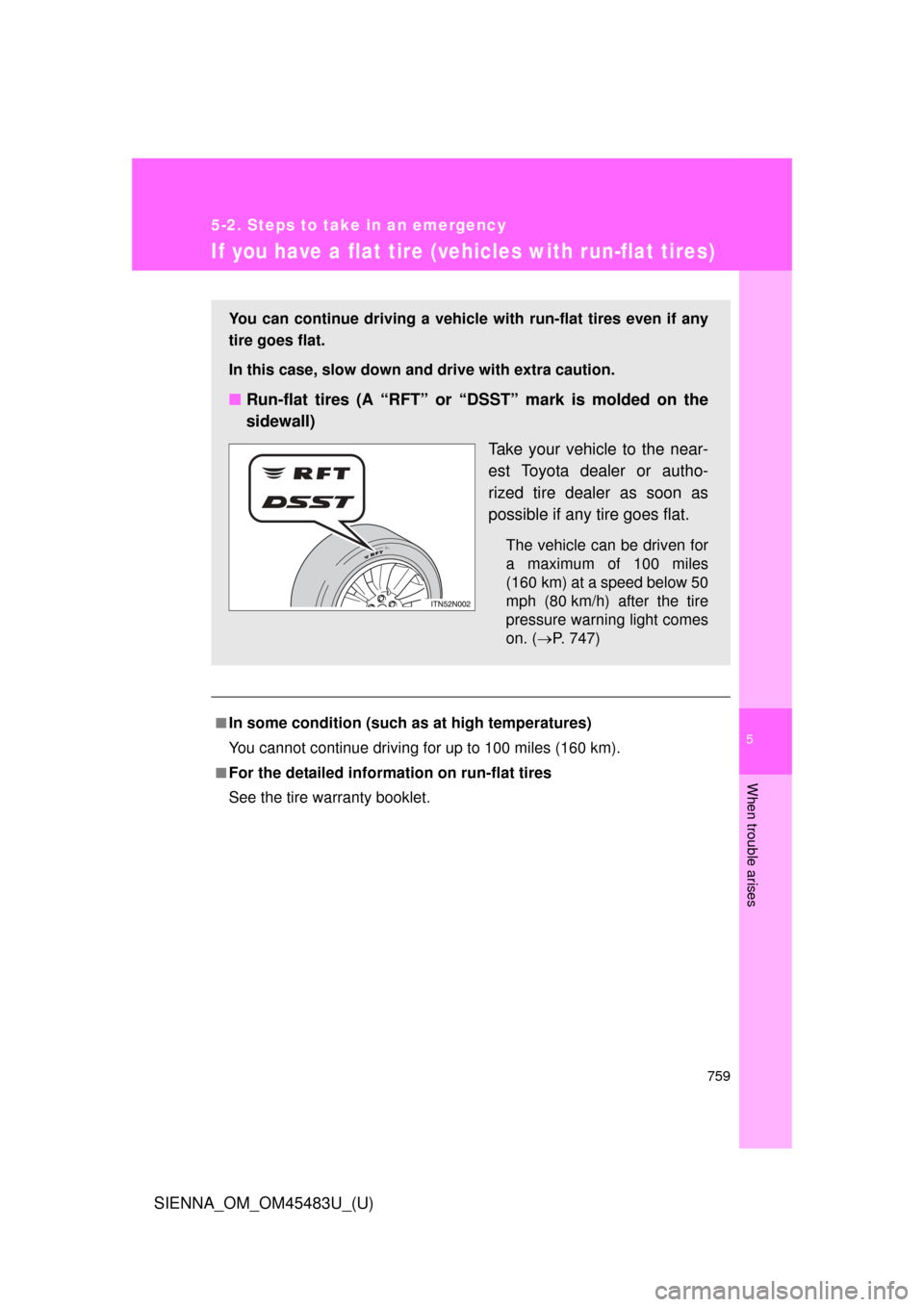
You can continue driving a vehicle with run-flat tires even if any
tire goes flat.
In this case, slow down and drive with extra caution.
■Run-flat tires (A “RFT” or “DSST” mark is molded on the
sidewall)
Take your vehicle to the near-
est Toyota dealer or autho-
rized tire dealer as soon as
possible if any tire goes flat.
The vehicle can be driven for
a maximum of 100 miles
(160 km) at a speed below 50
mph (80 km/h) after the tire
pressure warning light comes
on. (P. 747)