Page 133 of 563
132 1-8. Safety information
■Child restraint system with infant*5
■Unoccupied
Indicator/
warning light “AIR BAG ON” and “AIR BAG OFF”
indicator lights “AIR BAG
OFF”
*6
SRS warning light Off
Seat belt reminder light Off
*2
or
flashing
*3
Devices Front passenger airbag Deactivated
Side airbag on the front passenger seat Activated
Curtain shield airbag in the front passenger
side
Seat cushion airbag in the front passenger side Deactivated
Front passenger’s seat belt pretensioner Activated
Indicator/
warning light “AIR BAG ON” and “AIR BAG OFF”
indicator lights “AIR BAG
OFF”
SRS warning light Off
Seat belt reminder light
Devices Front passenger airbag Deactivated
Side airbag on the front passenger seat Activated
Curtain shield airbag in the front passenger
side
Seat cushion airbag in the front passenger side Deactivated
Front passenger’s seat belt pretensioner Activated
Page 134 of 563

133
1-8. Safety information
1
Before driving
■
There is a malfunction in the system
*1: The system judges a person of adult size as an adult. When a
smaller adult sits in the front passenger seat, the system may not
recognize him/her as an adult depending on his/her physique and
posture.
*2: In the event the front passenger is wearing a seat belt.
*3: In the event the front passenger does not wear a seat belt.
*4: For some children, child in seat, child in booster seat or child in convertible seat, the system may not recognize him/her as a child.
Factors which may affect this can be the physique or posture.
*5: Never install a rear-facing child restraint system on the front pas- senger seat. A forward-facing ch ild restraint system should only
be installed on the front passenger seat when it is unavoidable.
( P. 136)
*6: In case the indicator light is not illuminated, consult this manual on
how to install the child re straint system properly. (P. 140)
Indicator/
warning light “AIR BAG ON” and “AIR BAG OFF”
indicator lights “AIR BAG
OFF”
SRS warning light On
Seat belt reminder light
Devices Front passenger airbag Deactivated
Side airbag on the front passenger seat Activated
Curtain shield airbag in the front passenger
side
Seat cushion airbag in the front passenger side Deactivated
Front passenger’s seat belt pretensioner Activated
Page 136 of 563

135
1-8. Safety information
1
Before driving
CAUTION
■
Front passenger occupant cl assification system precautions
● Do not recline the front passenger seatback so far that it touches a rear
seat. This may cause the “AIR BAG OFF” indicator light to be illuminated,
which indicates that the passenger’s airbags will not deploy in the event of
a severe accident. If the seatback touches the rear seat, return the seat-
back to a position where it does not touch the rear seat. Keep the front\
passenger seatback as upright as possible when the vehicle is moving.
Reclining the seatback excessively may lessen the effectiveness of the
seat belt system.
● If an adult sits in the front passenger seat, the “AIR BAG ON” indicator
light is illuminated. If the “AIR BAG OFF” indicator is illuminated, ask the
passenger to sit up straight, well back in the seat, feet on the floor, and
with the seat belt worn correctly. If the “AIR BAG OFF” indicator still
remains illuminated, either ask the passenger to move to the rear seat, or
if that is not possible, move the front passenger seat fully rearward.
● When it is unavoidable to install a forward-facing child restraint system on
the front passenger seat, install the child restraint system on the front pas-
senger seat in the proper order. ( P. 140)
● Do not modify or remove the front seats.
● Do not kick the front passenger seat or subject it to severe impact. Other-
wise, the SRS warning light may come on to indicate a malfunction of the
detection system. In this case, contact your Toyota dealer immediately.
● Child restraint systems installed on the rear seat should not contact the
front seatbacks.
● Do not use a seat accessory, such as a cushion and seat cover, that cov-
ers the seat cushion surface.
● Do not modify or replace the upholstery of the front seat.
Page 150 of 563

When driving2
149
2-1. Driving proceduresDriving the vehicle............ 150
Engine (ignition) switch ............................. 160
Power (ignition) switch ..... 164
EV drive mode ................. 172
Hybrid transmission ......... 175
Turn signal lever .............. 178
Parking brake ................... 179
Horn ................................. 180
2-2. Instrument cluster Gauges and meters ......... 181
Indicators and warning lights ................. 184
Multi-information display............................ 187
2-3. Operating the lights and wipers
Headlight switch ............... 204
Fog light switch ................ 208
Windshield wipers and washer .................... 210
Rear window wiper and washer .................... 214 2-4. Using other driving
systems
Cruise control ................... 217
Driving assist systems ..... 221
2-5. Driving information Cargo and luggage .......... 226
Vehicle load limits ............ 230
Winter driving tips ............ 231
Trailer towing ................... 235
Dinghy towing .................. 236
Page 180 of 563
179
2-1. Driving procedures
2
When driving
Parking brake
■Parking brake engaged warning buzzer
A buzzer will sound if the vehicle is driven at a speed of approximately 3
mph (5 km/h) or more with the parking brake engaged. ( P. 450)
■ Usage in winter time
P. 231
NOTICE
■Before driving
Fully release the parking brake.
Driving the vehicle with the parking brake set will lead to brake components
overheating, which may affect braking performance and increase brake
wear.
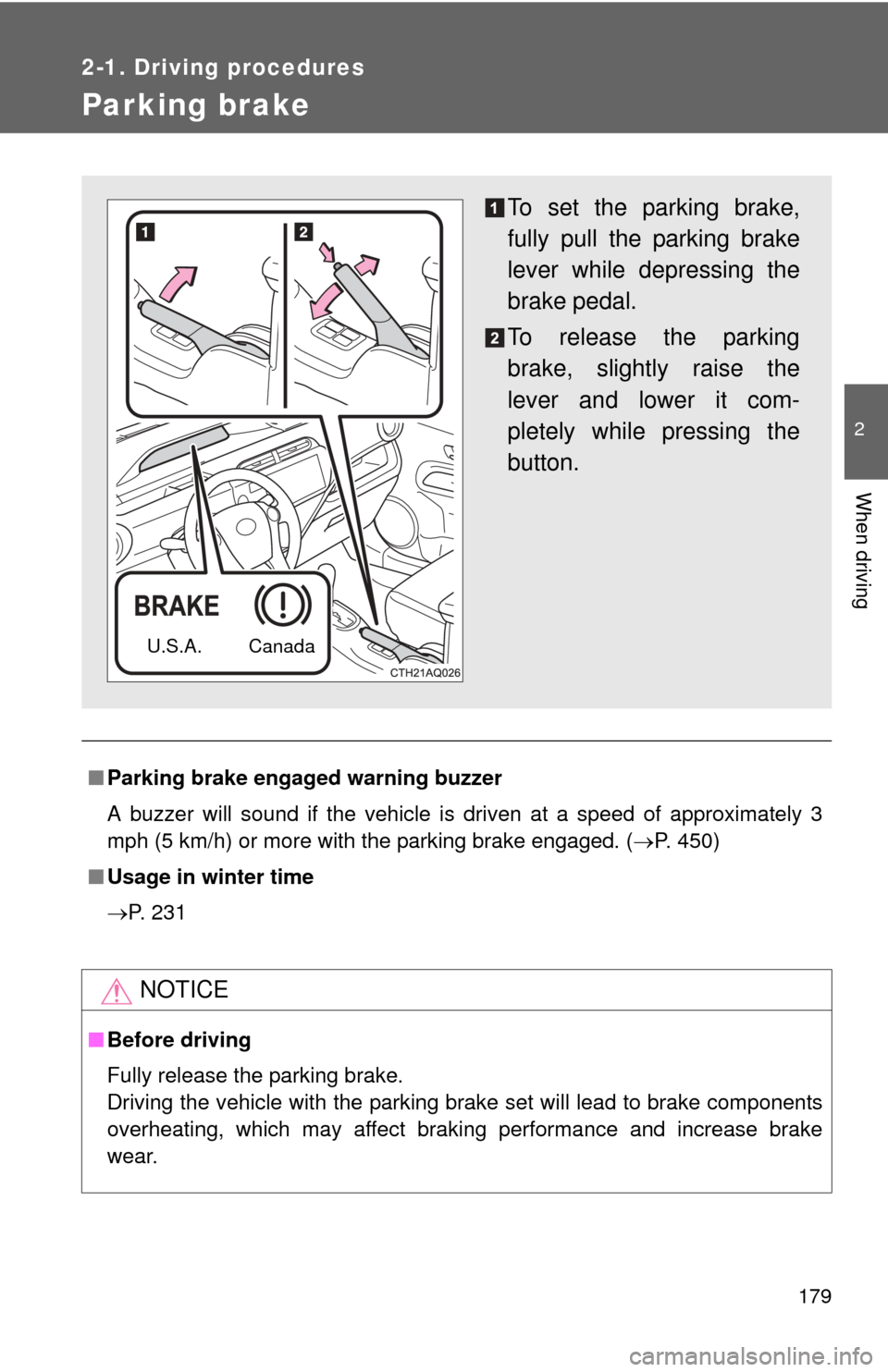
To set the parking brake,
fully pull the parking brake
lever while depressing the
brake pedal.
To release the parking
brake, slightly raise the
lever and lower it com-
pletely while pressing the
button.
U.S.A. Canada
Page 185 of 563
184
2-2. Instrument cluster
Indicators and warning lights
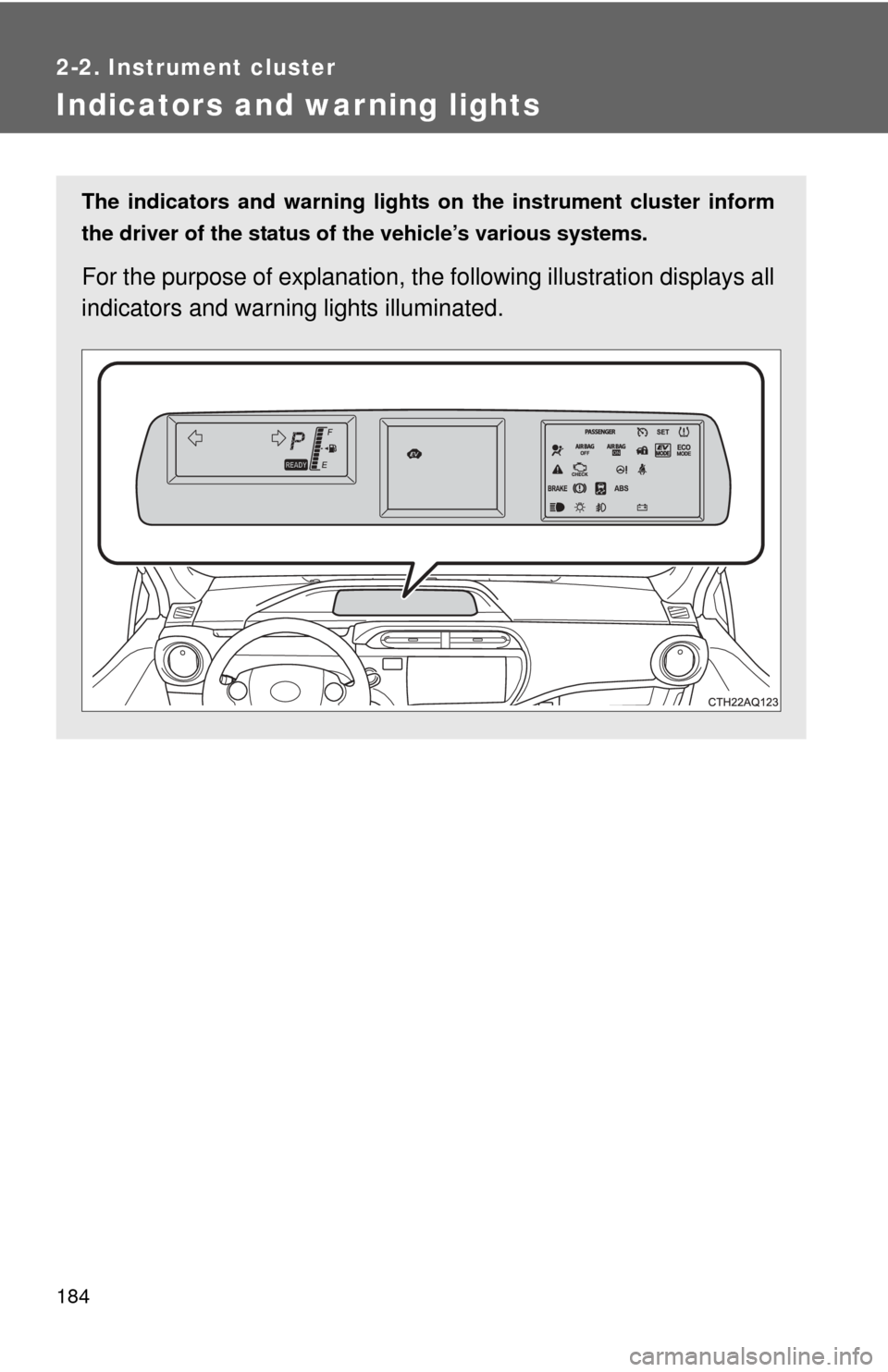
The indicators and warning lights on the instrument cluster inform
the driver of the status of the vehicle’s various systems.
For the purpose of explanation, the following illustration displays all
indicators and warn ing lights illuminated.
Page 187 of 563

186 2-2. Instrument cluster
CAUTION
■If a safety system warning light does not come on
Should a safety system light such as the ABS or SRS warning light not come
on when you start the hybrid system, this could mean that these systems are
not available to help protect you in an accident, which could result in death
or serious injury. Have the vehicle inspected by your Toyota dealer immedi-
ately if this occurs.
■ Warning lights
Warning lights inform the driver of malfunctions in any of the
vehicle's systems. ( P. 437)
*1: These lights turn on when the engine switch is turned to the “ON”
position (vehicles without a smart key system) or the “POWER”
switch is turned to ON mode (vehicles with a smart key system) to
indicate that a system check is being performed. They will turn off
after the hybrid system is on, or after a few seconds. There may be
a malfunction in a system if a light does not come on, or if the lights
do not turn off. Have the vehicle inspected by your Toyota dealer.
*2: For vehicles sold in U.S.A.
*3: For vehicles sold in Canada
(red)
(yellow)(Flashes)
*1, 2*1, 3*1*1, 2*1, 3*1*1, 2*1, 3
*1*1*1*1*1
Page 389 of 563
386 4-3. Do-it-yourself maintenance
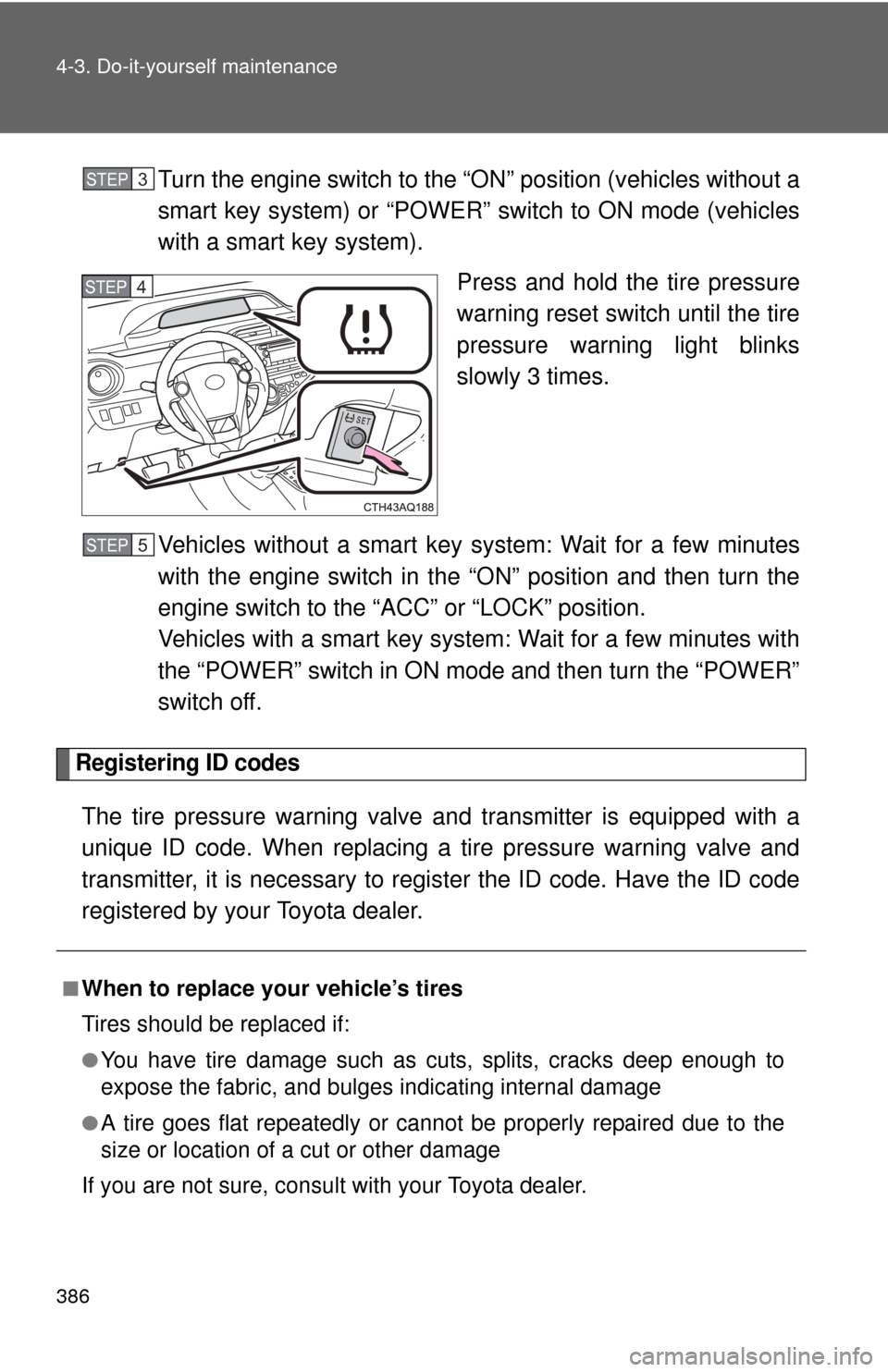
Turn the engine switch to the “ON” position (vehicles without a
smart key system) or “POWER” switch to ON mode (vehicles
with a smart key system).
Press and hold the tire pressure
warning reset switch until the tire
pressure warning light blinks
slowly 3 times.
Vehicles without a smart key system: Wait for a few minutes
with the engine switch in the “ON” position and then turn the
engine switch to the “ACC” or “LOCK” position.
Vehicles with a smart key system: Wait for a few minutes with
the “POWER” switch in ON mode and then turn the “POWER”
switch off.
Registering ID codes
The tire pressure warning valve and transmitter is equipped with a
unique ID code. When replacing a tire pressure warning valve and
transmitter, it is necessary to regi ster the ID code. Have the ID code
registered by your Toyota dealer.
STEP3
STEP4STEP4
■When to replace your vehicle’s tires
Tires should be replaced if:
●You have tire damage such as cuts, splits, cracks deep enough to
expose the fabric, and bulges indicating internal damage
●A tire goes flat repeatedly or c annot be properly repaired due to the
size or location of a cut or other damage
If you are not sure, consult with your Toyota dealer.
STEP5