Page 367 of 500
367
4-3. Do-it-yourself maintenance
4
Maintenance and care
Key batter y (vehicles with wireless remote control)
Replace the battery with a new one if it is discharged.
■You will need the following items:
●Flathead screwdriver (To prevent damage to the key, cover
the tip of the screwdriver with a rag.)
● Lithium battery CR2025
■ Replacing the battery
Remove the cover.
Remove the module.
Open the case cover using a
flathead screwdriver pro-
tected with tape etc. and
remove the depleted battery.
Insert a new battery with the
“+” terminal facing up.
STEP1
STEP2
STEP3
Page 368 of 500
368 4-3. Do-it-yourself maintenance
■If the key battery is discharged
The following symptoms may occur.
●The wireless remote control will not function properly.
● The operational range is reduced.
■ Use CR2025 lithium battery
●Batteries can be purchased at your Toyota dealer, jewelers, or camera
stores.
● Replace only with the same or equivalent type recommended by your
To y o t a dealer.
● Dispose of used batteries according to the local laws.
CAUTION
■Removed battery and other parts
These parts are small and if swallowed by a child, they can cause choking.
Keep away from children. Failure to do so could result in death or serious
injury.
NOTICE
■For normal operation after replacing the battery
Observe the following precautions to prevent accidents.
●Always work with dry hands.
Moisture may cause the battery to rust.
● Do not touch or move any other components inside the remote control.
● Do not bend either of the battery terminals.
Page 387 of 500
When trouble arises5
387
5-1. Essential informationEmergency flashers ......... 388
If your vehicle needs to be towed ........................ 389
If you think something is wrong ............................. 395
Fuel pump shut off system ........................... 396 5-2. Steps to take in an
emergency
If a warning light turns on or a warning buzzer
sounds... ....................... 397
If you have a flat tire......... 408
If the engine will not start ................................ 422
If the shift lever cannot be shifted from P............ 423
If you lose your keys ........ 424
If the battery is discharged ..................... 425
If your vehicle overheats ....................... 430
If the vehicle becomes stuck .............................. 433
If your vehicle has to be stopped in an
emergency ..................... 435
Page 388 of 500
388
5-1. Essential information
Emergency flashers
NOTICE
■To prevent battery discharge
Do not leave the emergency flashers on longer than necessary when the
engine is not running.
Use the emergency flashers if th e vehicle malfunctions or is
involved in an accident.
Press the switch to flash all
the turn signal lights. To turn
them off, press the switch
once again.
Page 422 of 500

422
5-2. Steps to take in an emergency
If the engine will not star t
If the engine still does not start after following the correct starting
procedure ( P. 118) or releasing the steering lock ( P. 120), confirm
the following points.
■ The engine will not start even when the starter motor oper-
ates normally.
One of the following may be the cause of the problem.
●There may not be sufficient fuel in the vehicle’s tank.
Refuel the vehicle.
● The engine may be flooded.
Try to restart the engine once more following correct starting
procedures. ( P. 1 1 8 )
● There may be a malfunction in the engine immobilizer system.
( P. 6 8 )
■ The starter motor turns over slowly, the interior lights and
headlights are dim, or the horn does not sound or sounds at
a low volume.
One of the following may be the cause of the problem.
●The battery may be discharged. ( P. 425)
● The battery terminal connec tions may be loose or corroded.
■ The starter motor does not turn over, the interior lights and
headlights do not turn on, or the horn does not sound.
One of the following may be the cause of the problem.
● One or both of the battery terminals may be disconnected.
● The battery may be discharged. ( P. 425)
Contact your Toyota dealer if the problem cannot be repaired, or if
repair procedures are unknown.
Page 425 of 500
5
When trouble arises
425
5-2. Steps to take in an emergency
If the batter y is discharged
The following procedures may be used to start the engine if the vehi-
cle's battery is discharged.
You can call your Toyota dealer or qualified repair shop.
If you have a set of jumper (or boo ster) cables and a second vehi-
cle with a 12-volt battery, you can jump start your Toyota following
the steps below.
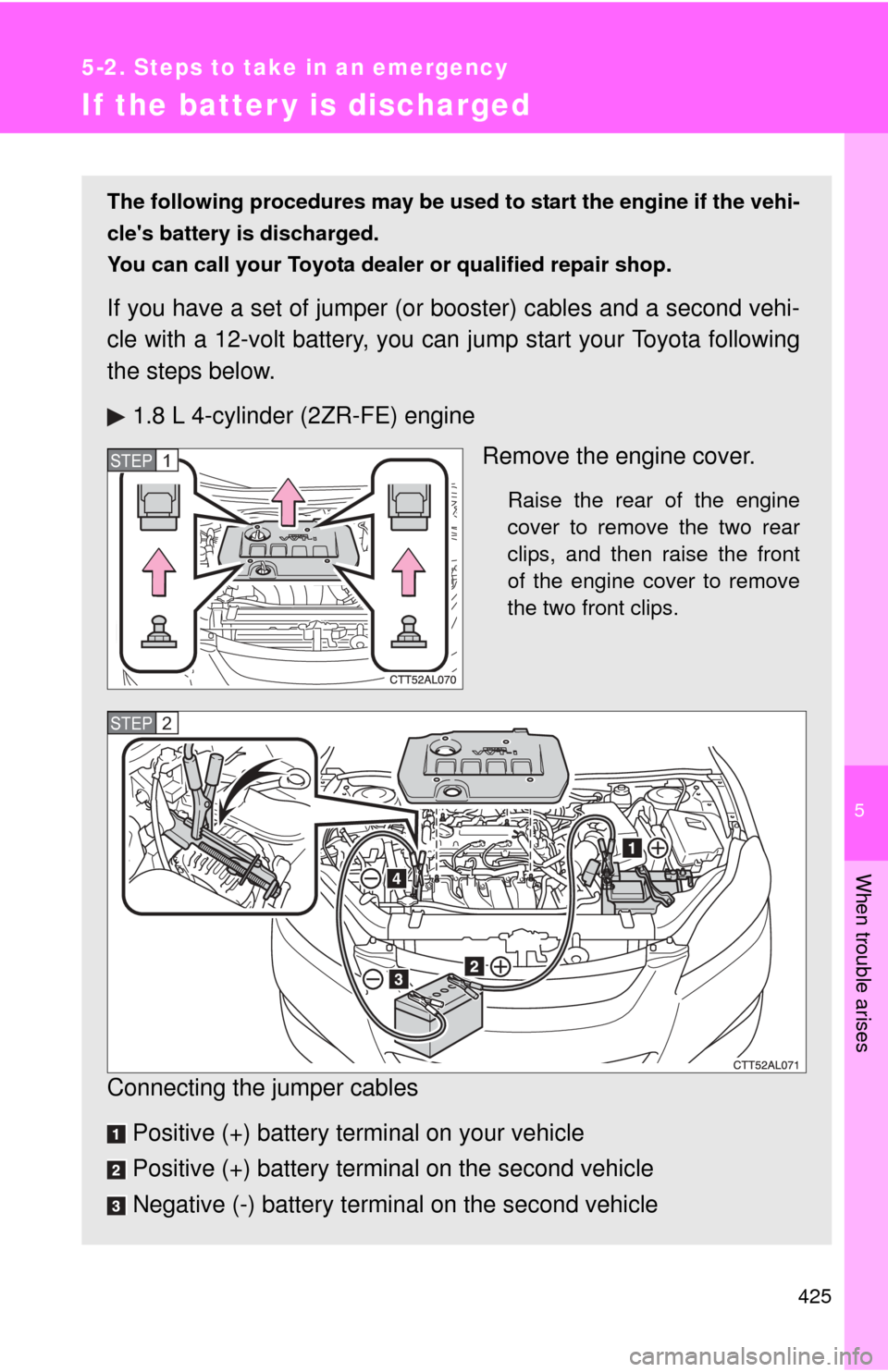
1.8 L 4-cylinder (2ZR-FE) engine Remove the engine cover.
Raise the rear of the engine
cover to remove the two rear
clips, and then raise the front
of the engine cover to remove
the two front clips.
Connecting the jumper cables
Positive (+) battery terminal on your vehicle
Positive (+) battery terminal on the second vehicle
Negative (-) battery terminal on the second vehicle
STEP5STEP1
STEP2
Page 426 of 500
426 5-2. Steps to take in an emergency
Connect the jumper cable to ground on your vehicle as shown in
the illustration.Start the engine of the second vehicle. Increase the engine
speed slightly and maintain at that level for approximately 5
minutes to recharge the battery of your vehicle.
Maintain the engine speed of the second vehicle, and turn
the engine switch to the “ON” position then start the vehi-
cle's engine.
Once the vehicle’s engine has started, remove the jumper
cables in the exact reverse order in which they were con-
nected.
Once the engine starts, have the vehicle checked at your Toyota
dealer as soon as possible.
STEP3
STEP4
STEP5
Page 427 of 500
5
When trouble arises
427
5-2. Steps to take in an emergency
2.4 L 4-cylinder (2AZ-FE) engine
Connecting the jumper cables Positive (+) battery terminal on your vehicle
Positive (+) battery terminal on the second vehicle
Negative (-) battery terminal on the second vehicle
Connect the jumper cable to ground on your vehicle as shown in
the illustration. Start the engine of the second vehicle. Increase the engine
speed slightly and maintain at that level for approximately 5
minutes to recharge the battery of your vehicle.
Maintain the engine speed of the second vehicle, and turn
the engine switch to the “ON” position then start the vehi-
cle's engine.
Once the vehicle’s engine has started, remove the jumper
cables in the exact reverse order in which they were con-
nected.
Once the engine starts, have the vehicle checked at your Toyota
dealer as soon as possible.
STEP1
STEP2
STEP3
STEP4