Page 537 of 724
537
4-3. Do-it-yourself maintenance
4
Maintenance and care
LC200_OM_OM60L09U_(U)
Brake fluid
■ Checking fluid level
The brake fluid level should be
between the “MAX” and “MIN”
lines on the tank.
MAX
MIN
Make sure to check the fluid type and prepare the necessary items.
■ Adding fluid
■ Refilling brake fluid
Turn the “ENGINE START STOP” switch OFF.
Depress the brake pedal more than 40 times.
Remove the reservoir cap by hand. Add brake fluid up to the
“MAX” line.
If you do not follow the procedure above, the reservoir may over-
flow.
1
2
ITY43C069
Fluid typeFMVSS No.116 DOT 3 or SAE J1703 brake fluid
ItemsClean funnel
STEP1
STEP2
STEP3
Page 538 of 724
538 4-3. Do-it-yourself maintenance
LC200_OM_OM60L09U_(U)
■Brake fluid can absorb moisture from the air
Excess moisture in the fluid can cause a dangerous loss of braking effi-
ciency. Use only newly opened brake fluid.
CAUTION
■When filling the reservoir
Take care because brake fluid can harm your hands or eyes and damage
painted surfaces.
If fluid gets in your eyes, flush your eyes with clean water immediately.
If you still experience discomfort, see a doctor.
NOTICE
■If the fluid level is low or high
It is normal for the brake fluid level to go down slightly as the brake pads
wear or when the fluid level in the accumulator is high.
If the reservoir needs frequent refilling, it may indicate a serious pro\
blem.
Page 541 of 724

541
4-3. Do-it-yourself maintenance
4
Maintenance and care
LC200_OM_OM60L09U_(U)
■
Before recharging
When recharging, the battery produces hydrogen gas which is flammable
and explosive. Therefore, before recharging:
●If recharging with the battery installed on the vehicle, be sure to discon-
nect the ground cable.
● Make sure the power switch on the charger is off when connecting and
disconnecting the charger cables to the battery.
■ After recharging the battery
The engine may not start. Follow the procedure below to initialize the sys-
tem.
Depress the brake pedal with the shift lever in “N”.
Open and close any of the doors.
Restart the engine.
CAUTION
■Chemicals in the battery
A battery contains poisonous and corrosive sulfuric acid and may produce
hydrogen gas which is flammable and explosive. To reduce the risk of death
or serious injury, take the following precautions while working on or near bat-
tery:
● Do not cause sparks by touching the battery terminals with tools.
● Do not smoke or light a match near the battery.
● Avoid contact with eyes, skin and clothes.
● Never inhale or swallow electrolyte.
● Wear protective safety glasses when working near the battery.
● Keep children away from the battery.
STEP1
STEP2
STEP3
Page 570 of 724
570 4-3. Do-it-yourself maintenance
LC200_OM_OM60L09U_(U)
Fuse layout and amperage ratings■ Engine compartment (fuse box on the left side)
FuseAmpereCircuit
1A/F15 A A/F heater
2 HORN 10 A Horn
3 EFI MAIN 25 A EFI, A/F heater, fuel pump
4 IG2 MAIN 30 A INJ, IGN, MET
5 RR A/C 50 A Blower controller
6 CDS FAN 25 A Condenser fan
7 RR S/HTR 20 A Rear seat heater
8 FR FOG 7.5 A Front fog lights
9 STOP 15 A Stoplights, high mounted stoplight,
brake controller, ABS, VSC, main
body ECU, EFI, trailer
10 SEAT-A/C LH 25 A Seat heaters and ventilators
Page 574 of 724
574 4-3. Do-it-yourself maintenance
LC200_OM_OM60L09U_(U)■
Engine compartment (fuse box on the right side)
FuseAmpereCircuit
1HWD130 ANo circuit
2 TOW BRK 30 A Brake controller
3 RR P/SEAT 30 A No circuit
4 PWR HTR 7.5 A No circuit
5 DEICER 20 A Windshield wiper de-icer
6 A LT- C D S 1 0 A A LT- C D S
7 SECURITY 5 A SECURITY
8 SEAT A/C RH 25 A Seat heaters and ventilators
9 AI PMP HTR 10 A AI pump heater
10 TOW TAIL 30 A Towing tail light system
11 HWD2 30 A No circuit
Page 575 of 724
575
4-3. Do-it-yourself maintenance
4
Maintenance and care
LC200_OM_OM60L09U_(U)
■
Driver’s side instrument panel
FuseAmpereCircuit
1CIG15 A Cigarette lighter
2BK/UP LP10 A Back-up lights, trailer
3ACC7.5 A Audio system, multi-display
assembly, main body ECU,
mirror ECU, rear seat enter-
tainment, smart key system,
clock
4PA N E L10 AFour-wheel drive system, ash-
tray, cigarette lighter, brake
controller, cool box, cruise con-
trol, center differential lock,
multi-display assembly, seat
heater, air conditioning system,
glove box light, emergency
flashers, audio system, head-
light cleaner switch, inverter,
driving position memory sys-
tem, outside rear view mirror
switches, overhead module,
roll sensing of curtain shield
airbags off switch, shift lever
switch, steering switches, VSC
OFF switch, console switch
Page 601 of 724
5
When trouble arises
601
5-1. Essential information
LC200_OM_OM60L09U_(U)
If your vehicle needs to be towed
Before towingThe following may indicate a problem with your transmission. Contact
your Toyota dealer before towing.
● The engine is running, but the vehicle will not move.
● The vehicle makes an abnormal sound.
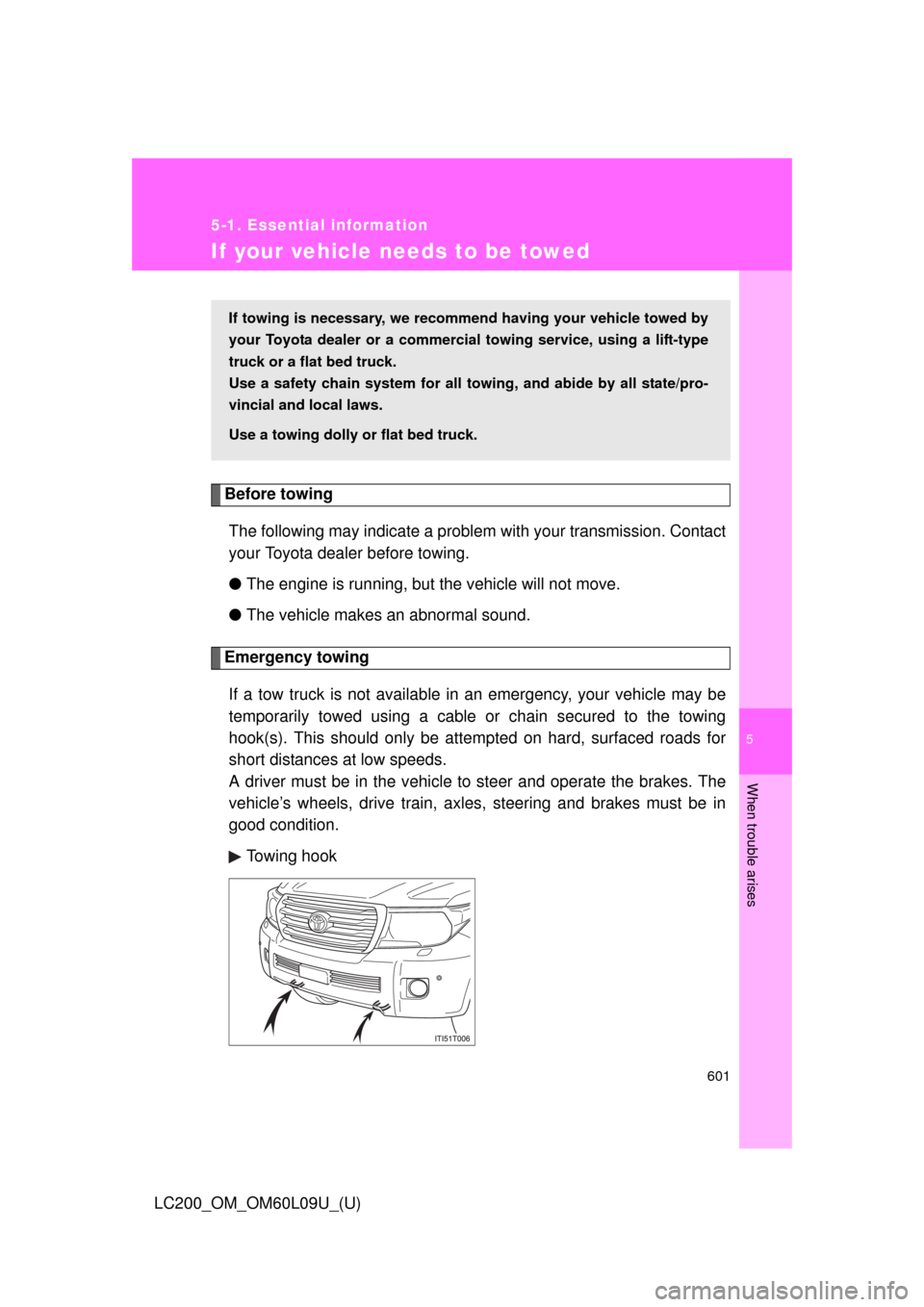
Emergency towing
If a tow truck is not available in an emergency, your vehicle may be
temporarily towed using a cable or chain secured to the towing
hook(s). This should only be attempted on hard, surfaced roads for
short distances at low speeds.
A driver must be in the vehicle to steer and operate the brakes. The
vehicle’s wheels, drive train, axles, steering and brakes must be in
good condition.
Towing hook
If towing is necessary, we recommend having your vehicle towed by
your Toyota dealer or a commerci al towing service, using a lift-type
truck or a flat bed truck.
Use a safety chain system for all to wing, and abide by all state/pro-
vincial and local laws.
Use a towing dolly or flat bed truck.
Page 602 of 724
602 5-1. Essential information
LC200_OM_OM60L09U_(U)
■Emergency towin g procedure
The engine must be in ACCESSORY mode (engine off) or IGNI-
TION ON mode (engine running).
Put the four-wheel drive control swit ch in “H4”. (The center differen-
tial is unlocked.)
Put the shift lever in “N”.
Release the parking brake.
CAUTION
■ While towing
●Use extreme caution when towing the vehicle.
Avoid sudden starts or erratic driving maneuvers which place excessive
stress on the emergency towing hook and the cable or chain. Always be
cautious of the surroundings and other vehicles while towing.
● If the engine is not running, the power assist for the brakes and steering
will not function, making steering and braking more difficult.
NOTICE
■To prevent causing serious dama ge to the transmission
● Never tow this vehicle with the wheels on the ground.
● Use only the front emergency towing hooks or towing eyelets (depending
on vehicles) when towing your vehicle.
STEP1
STEP2
STEP3
STEP4


