Page 3 of 232

iii
Important information about your
To y o t a
Accessories, spare parts and
modification of your Toyota
Both genuine Toyota and a wide variety of other spare parts and
accessories for Toyota vehicles are currently available on the market.
Should it be determined that any of the genuine Toyota parts or
accessories supplied with the vehicle need to be replaced, Toyota
recommends that genuine Toyota parts or accessories, be used to
replace them. Other parts or accessories of matching quality can
also be used. Toyota cannot acceptany liability orguarantee spare
parts and accessories which are not genuine Toyota products, nor for
replacement or installation involving such parts. In addition, damage
or performance problems resulting from the use of non−genuine
Toyota spare parts or accessories may not be covered under
warranty.
Installation of an RF−transmitter system
As the installation of an RF−transmitter system in your vehicle could
affect electronic systems such as the electronically controlled fuel
pump, electronic engine controlsystem, anti−lock brake system, SRS
airbag system and seat belt pretensionersystem, be sure to check
with any authorized Toyota dealer or repairer, or another duly quali-
fied and equipped professional, for precautionary measures or special
instructions regarding installation.
Further information regarding frequency bands, power levels, antenna
positions and installation provisions for the installation of RF−trans-
mitters, is available on request at any authorized Toyota dealer or
repairer, or another duly qualified and equipped professional.
Dyna100/150_EE
Page 4 of 232
iv
Maintenance schedule
Please refer to the separate “Toyota Service Booklet” or “Toyota War-
ranty Booklet”.
Scrapping of your Toyota
The SRS airbag and seat belt pretensioner devices in your Toyota
contain explosive chemicals. If the vehicle is scrapped with the air-
bag and pretensioner left as they are, this may cause an accident
such as fire. Be sure to have the systems of the SRS airbag and
seat belt pretensioner removed and disposed of by a qualified ser-
vice shop or by an authorized Toyota dealer or repairer, or another
duly qualified and equipped professional, before you dispose of your
vehicle.
Your vehicle contains batteries and/or accumulators. Do not discard
them into the environment but cooperate with separate collection (Di-
rective 2006/66/EC).
Dyna100/150_EE
Page 5 of 232

v
Table of contents
1 OPERATION OF INSTRUMENTS AND CONTROLSPage
1 Overview of instruments and controls
1 .......................
2 Keys and Doors11 ......................................
3 Seats, Seat belts, Steering wheel and Mirrors23 ...............
4 Lights and Wipers61 .....................................
5 Gauges, Meters and Service reminder indicators67 .............
6 Engine (ignition) switch, Transmission and Parking brake79 ......
7 Air conditioning system83 .................................
8 Other equipment99 ......................................
2 INFORMATION BEFORE DRIVING YOUR TOYOTA 107........
3 STARTING AND DRIVING 123...............................
4 IN CASE OF AN EMERGENCY 141..........................
5 CORROSION PREVENTION AND APPEARANCE CARE 169...
6 MAINTENANCE REQUIREMENTS 175.......................
7DO−IT−YOURSELF MAINTENANCE
1 Introduction179 .........................................
2 Engine and Chassis187 ..................................
3 Electrical components199 .................................
8 SPECIFICATIONS 211......................................
9 INDEX 221................................................
Dyna100/150_EE
Page 14 of 232
8OVERVIEW OF INSTRUMENTS AND CONTROLS
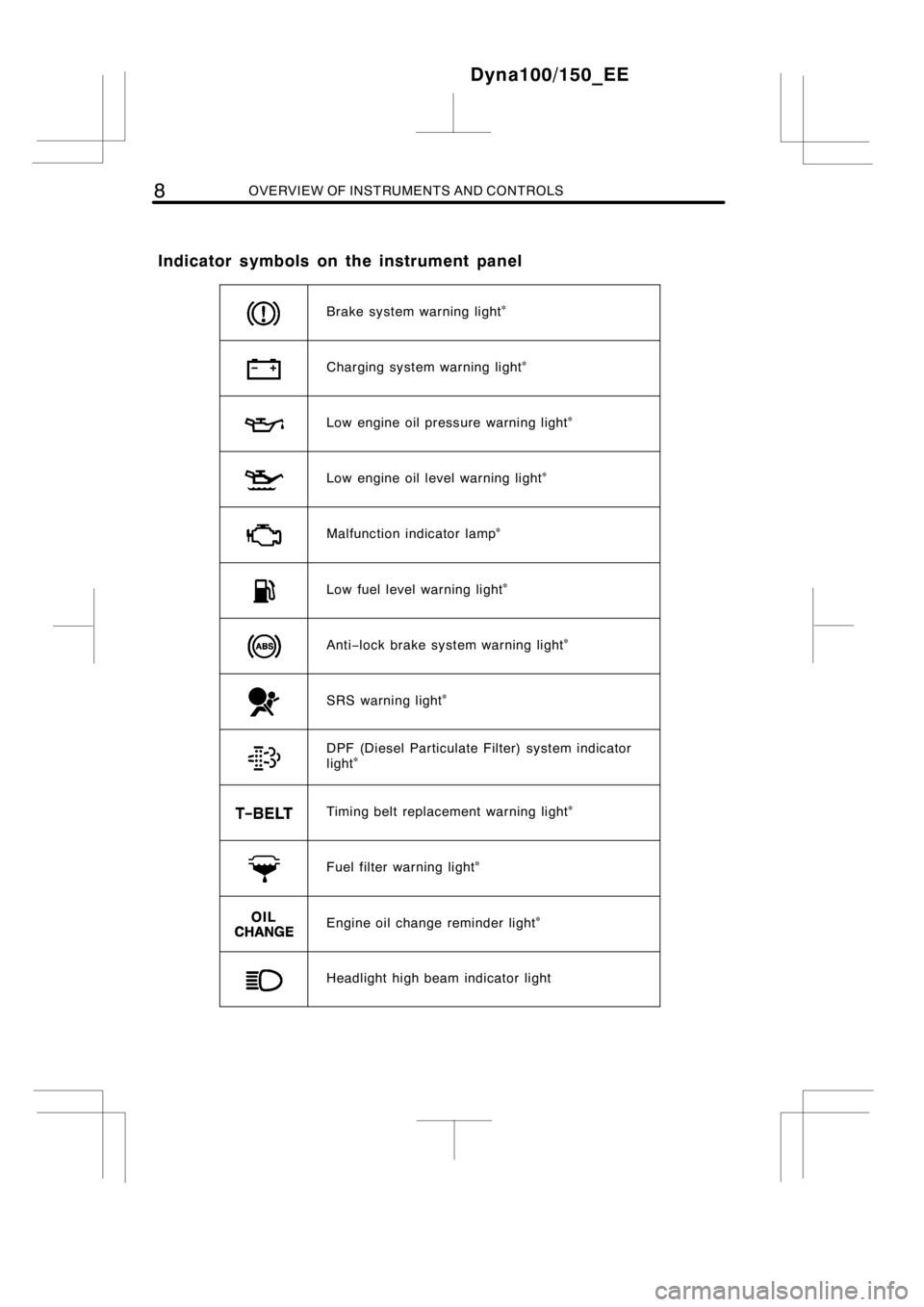
Brake system warning light�
Charging system warning light�
Low engine oil pressure warning light�
Low engine oil level warning light�
Malfunction indicator lamp�
Low fuel level warning light�
Anti−lock brake system warning light�
SRS warning light�
DPF (Diesel Particulate Filter) system indicator
light�
Timing belt replacement warning light�
Fuel filter warning light�
Engine oil change reminder light�
Headlight high beam indicator light
Dyna100/150_EE
Indicator symbols on the instrument panel
Page 29 of 232
SEATS, SEAT BELTS, STEERING WHEEL AND MIRRORS23
Section 1−3
OPERATION OF INSTRUMENTS AND
CONTROLS
Seats, Seat belts, Steering wheel and Mirrors
DSeats 24..............................................
DDriver’s seat 24.......................................
DFolding up rear seat 26.................................
DHead restraints 27.....................................
DSeat belts 28..........................................
DSRS driver airbag 38...................................
DChild restraint 44......................................
DTilt and telescopic steering wheel 58....................
DOutside rear view mirrors 59............................
Dyna100/150_EE
Page 30 of 232

24SEATS, SEAT BELTS, STEERING WHEEL AND MIRRORS
While the vehicle is being driven, all ve-
hicle occupants should have the seatback
upright, sit well back in the seat and prop-
erly wear the seat belts provided.
CAUTION
DDo not drive the vehicle unless the
occupants are properly seated. Do
not allow any occupants to sit on
top of a folded−down seatback, or
in the luggage compartment or car-
go area. If the occupants are im-
properly seated or restrained by
seat belts, death or serious injury
could result in the event of emer-
gency braking, sudden swerving or
an accident.
DDuring driving, do not allow any
passengers to stand up or move
around between seats. Otherwise,
death or serious injuries can occur
in the event of emergency braking,
sudden swerving or an accident.
Adjust the driver ’s seat so that the foot
pedals, steering wheel and instrument
panel controls are within easy reach of
the driver.
CAUTION
DDo not adjust the seat while the
vehicle is moving as the seat may
unexpectedly move and cause the
driver to lose control of the vehicle.
DWhen adjusting the seat, be careful
that the seat does not hit a lug-
gage.
DAfter adjusting the seat position, re-
lease the lever and try sliding the
seat forward and backward to make
sure it is locked in position.
DMake sure the seatback is securely
locked by pushing forward and rear-
ward on the top of the seatback.
Failure to do so will prevent the
seat belt from operating properly.
DDo not put objects under the driv-
er ’s seat. Otherwise, the objects
may interfere with the seat−lock
mechanism or unexpectedly push
up the seat position adjusting lever
and the seat may suddenly move,
causing the driver to lose control of
the vehicle.
DWhile adjusting the seat, do not put
your hands under the seat or near
the moving parts. Otherwise, you
may catch and injure your hands or
fingers.
Dyna100/150_EE
SeatsDriver’s seat—
—Seat adjustment precautions
Page 31 of 232
SEATS, SEAT BELTS, STEERING WHEEL AND MIRRORS25
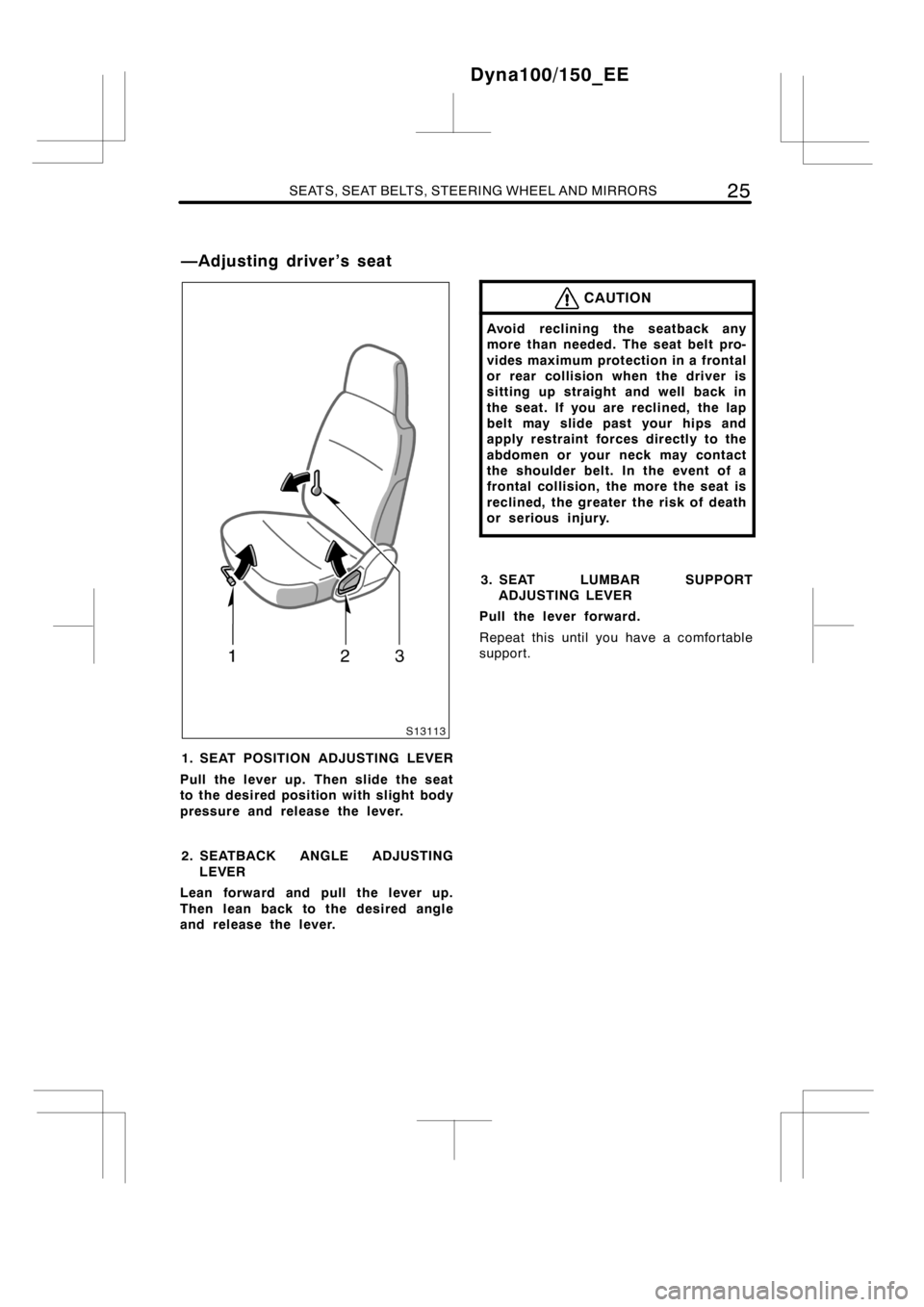
1. SEAT POSITION ADJUSTING LEVER
Pull the lever up. Then slide the seat
to the desired position with slight body
pressure and release the lever.
2. SEATBACK ANGLE ADJUSTING
LEVER
Lean forward and pull the lever up.
Then lean back to the desired angle
and release the lever.
CAUTION
Avoid reclining the seatback any
more than needed. The seat belt pro-
vides maximum protection in a frontal
or rear collision when the driver is
sitting up straight and well back in
the seat. If you are reclined, the lap
belt may slide past your hips and
apply restraint forces directly to the
abdomen or your neck may contact
the shoulder belt. In the event of a
frontal collision, the more theseat is
reclined, the greater the risk of death
or serious injury.
3. SEAT LUMBAR SUPPORT
ADJUSTING LEVER
Pull the lever forward.
Repeat this until you have a comfortable
support.
Dyna100/150_EE
—Adjusting driver’s seat
Page 32 of 232
26SEATS, SEAT BELTS, STEERING WHEEL AND MIRRORS
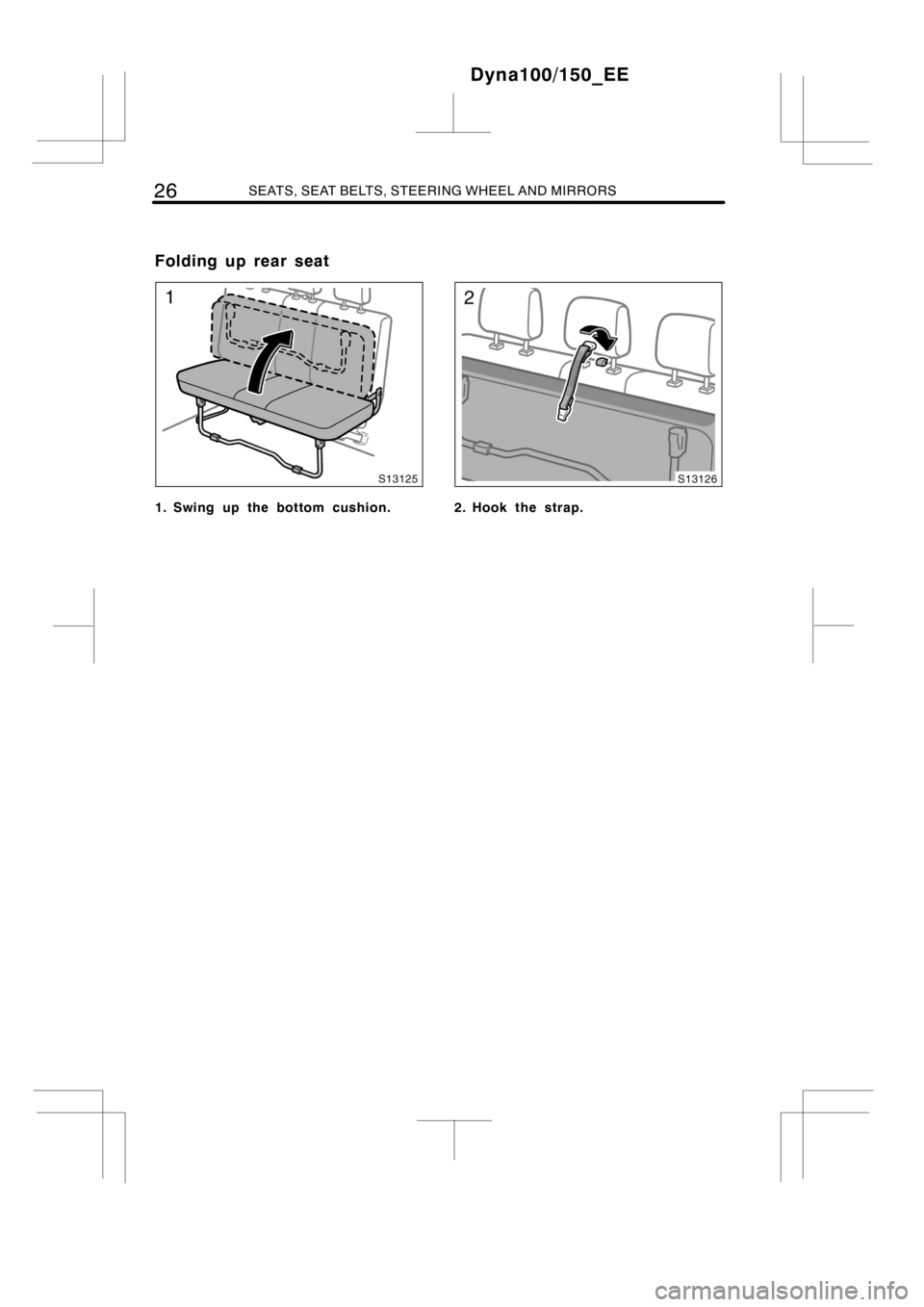
1. Swing up the bottom cushion.2. Hook the strap.
Dyna100/150_EE
Folding up rear seat