Page 43 of 232
SEATS, SEAT BELTS, STEERING WHEEL AND MIRRORS37
NOTICE
Do not perform any of the following
changes without consulting any autho-
rized Toyota dealer or repairer, or
another duly qualified and equipped
professional. Such changes can inter-
fere with proper operation of the
driver ’s seat belt pretensioner in
some cases.
zInstallation of electronic devices
such as an RF−transmitter, cassette
tape player or compact disc player
zRepairs on or near the driver ’s seat
belt retractor assembly
zModification of the suspension sys-
tem
zModification of the front end struc-
ture
zAttachment of a grille guard (bull
bar, kangaroo bar, etc.), snowplow,
winches or any other equipment to
the front end
zRepairsmadeonornearthefront
end structure or console
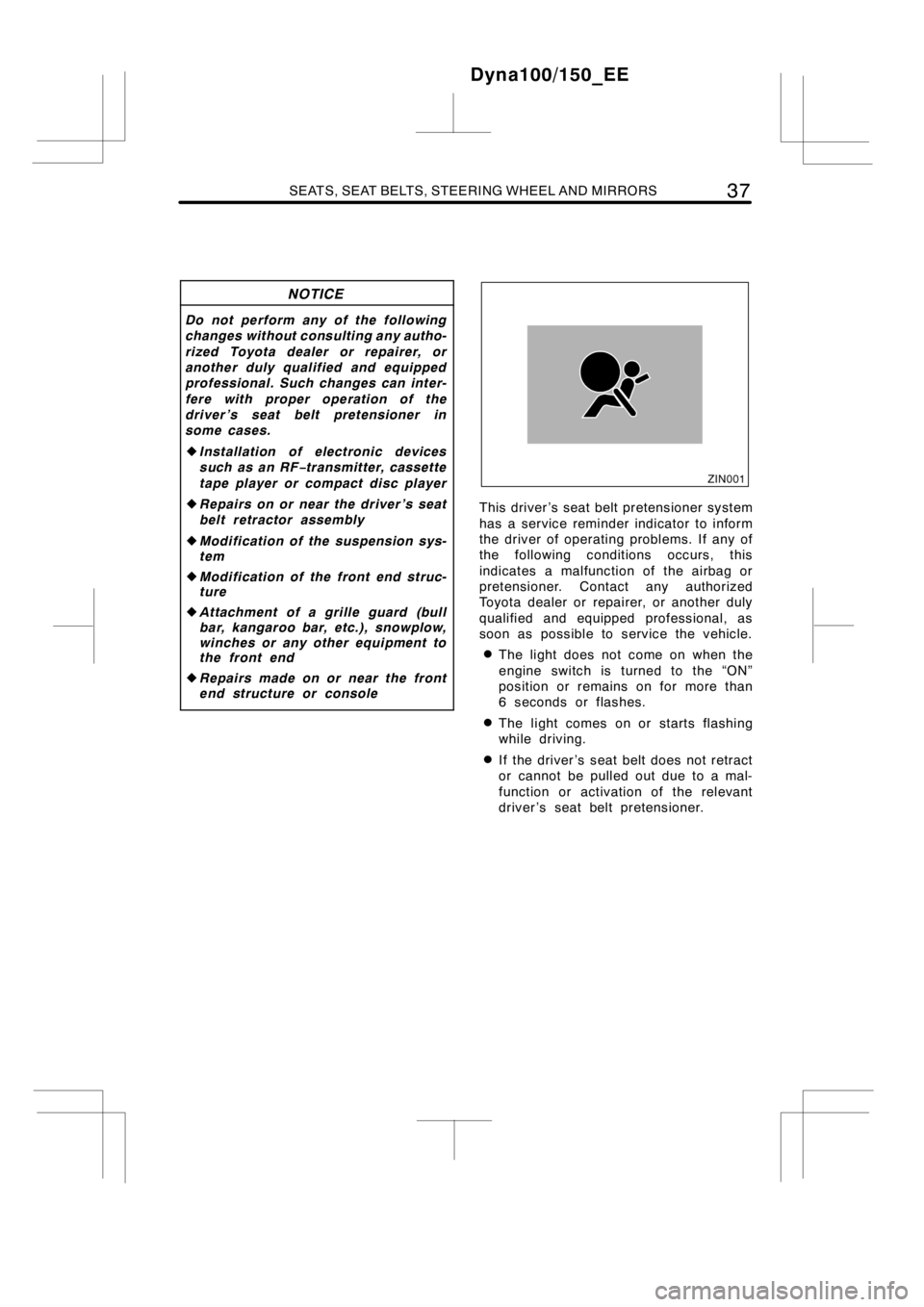
This driver ’s seat belt pretensionersystem
has a service reminder indicator to inform
the driver of operating problems. If any of
the following conditions occurs, this
indicates a malfunction of the airbag or
pretensioner. Contact any authorized
Toyota dealer or repairer, or another duly
qualified and equipped professional, as
soon as possible to service the vehicle.
DThe light does not come on when the
engine switch is turned to the “ON”
position or remains on for more than
6 seconds or flashes.
DThe light comes on or starts flashing
while driving.
DIf the driver ’s seat belt does not retract
or cannot be pulled out due to a mal-
function or activation of the relevant
driver ’s seat belt pretensioner.
Dyna100/150_EE
Page 45 of 232

SEATS, SEAT BELTS, STEERING WHEEL AND MIRRORS39
This indicator comes on when the en-
gine switch is turned to the “ON” posi-
tion. It goes off after about 6 seconds.
This means the SRS airbag is operating
properly.
This warning light system monitors the
airbag sensor assembly, airbag sensor,
driver ’s seat belt pretensioner assembly,
inflator, interconnecting wiring and power
sources. (For details, see “Service
reminder indicators and warning buzzer”
on page 73 in Section 1−5.)The SRS airbag system is designed to
activate in response to a severe frontal
impact within the shaded area between
the arrows in the illustration.
The SRS airbag will deploy in the event
of an impact that exceeds the set thresh-
old level (the level of force corresponding
to an approximately 20−30 km/h [12−18
mph] frontal collision with a fixed wall that
does not move or deform).
If the severity of the impact is below the
above threshold level, the SRS airbag
may not deploy.
However, this threshold velocity will be
considerably higher if the vehicle strikes
an object, such as a parked vehicle or
sign pole, which can move or deform on
impact, or if it is involved in an underride
collision (e.g. a collision in which the nose
of the vehicle “underrides”, or goes under,
the bed of a truck, etc.).
It is possible that in some collisions at the
lower zone of airbag sensor detection and
activation the SRS airbag and seat belt
pretensioner will not operate all together.
For the safety of all occupants, always
wear your seat belts properly.
Dyna100/150_EE
Page 47 of 232

SEATS, SEAT BELTS, STEERING WHEEL AND MIRRORS41
The SRS airbag system consists mainly of
the following components, and their loca-
tions are shown in the illustration.
1. SRS warning light
2. Airbag module for driver
(airbag and inflator)
3. Airbag sensor
4. Airbag sensor assembly
The airbag sensor assembly consists of a
safing sensor and airbag sensor.
In a severe frontal impact, the sensor de-
tects deceleration and the system triggers
the airbag inflator. At this time a chemical
reaction in the inflator quickly fills the air-
bag with non−toxic gas to help restrain
the forward motion of the driver.
When the airbag inflates, it produces a
fairly loud noise and releases some
smoke and residue along with non−toxic
gas. This does not indicate a fire. This
gas is normally harmless; however, for
those who have delicate skin, it may
cause a minor skin irritation. Be sure to
wash off any residue as soon as possible
to prevent any potential skin irritation.
Deployment of the airbag happens in a
fraction of a second, so the airbag must
inflate with considerable force. While the
system is designed to reduce serious inju-
ries, it may also cause minor burns or
abrasions and swelling.The steering wheel hub may be hot for
several minutes, but the airbag itself will
not be hot. The airbag is designed to
inflate only once.
CAUTION
The SRS airbag system is designed
only as a supplement to the primary
protection of the driver side seat belt
system. The driver can be killed or
seriously injured by the inflating air-
bag if he/she does not wear the avail-
able seat belt properly. During sudden
braking just before a collision, an un-
restrained driver can move forward
into direct contact with or close prox-
imity to the airbag which may then
deploy during the collision. To ensure
maximum protection in an accident,
the driver and all passengers in the
vehicle must wear their seat belts
properly. Wearing a seat belt properly
during an accident reduces the
chances of death or serious injury or
being thrown out of the vehicle. For
instructions and precautions concern-
ing the seat belt system, see “Seat
belts” on page 28 in this Section.
Dyna100/150_EE
Page 49 of 232
SEATS, SEAT BELTS, STEERING WHEEL AND MIRRORS43
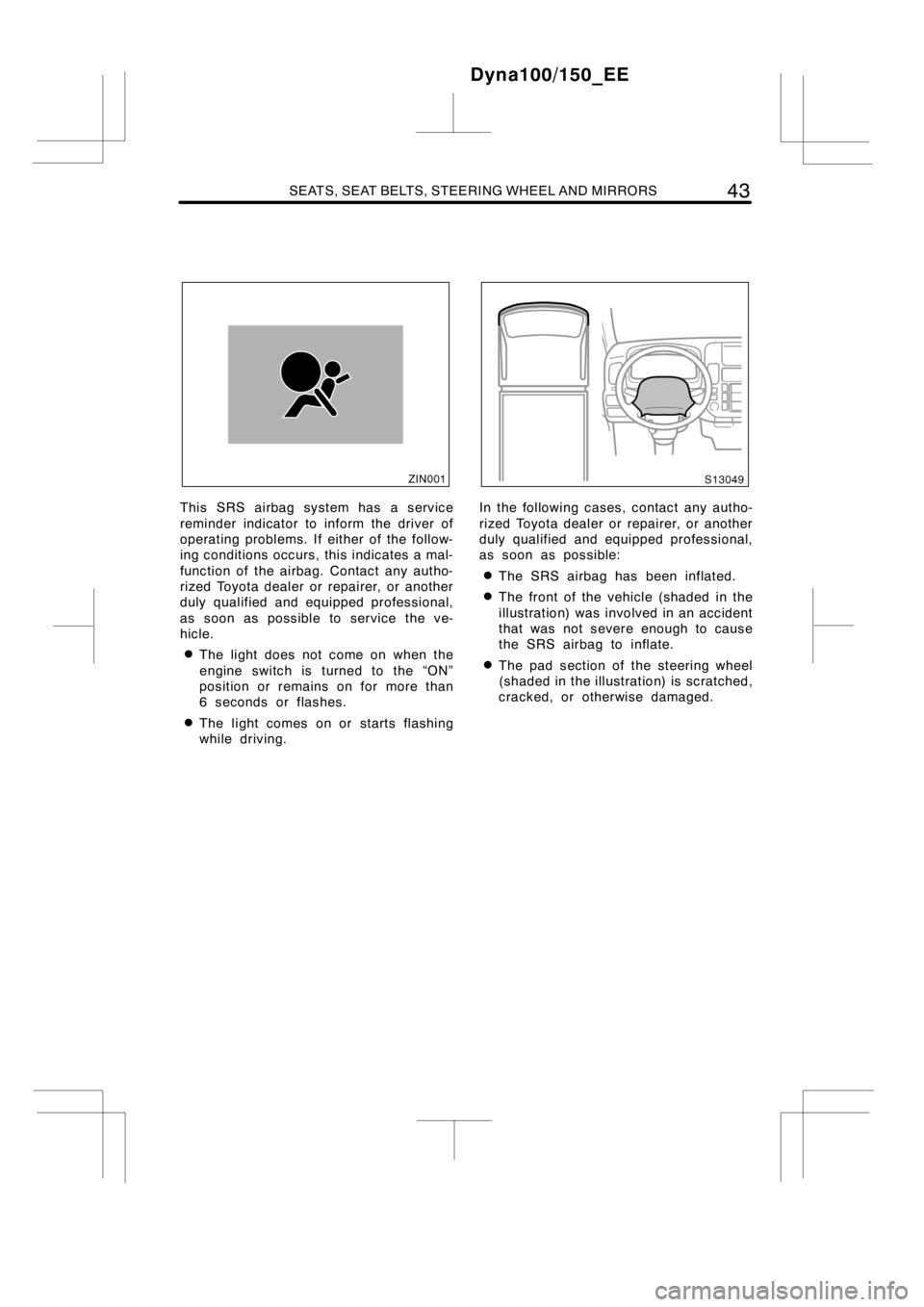
This SRS airbag system has a service
reminder indicator to inform the driver of
operating problems. If either of the follow-
ing conditions occurs, this indicates a mal-
function of the airbag. Contact any autho-
rized Toyota dealer or repairer, or another
duly qualified and equipped professional,
as soon as possible to service the ve-
hicle.
DThe light does not come on when the
engine switch is turned to the “ON”
position or remains on for more than
6 seconds or flashes.
DThe light comes on or starts flashing
while driving.
In the following cases, contact any autho-
rized Toyota dealer or repairer, or another
duly qualified and equipped professional,
as soon as possible:
DThe SRS airbag has been inflated.
DThe front of the vehicle (shaded in the
illustration) was involved in an accident
that was not severe enough to cause
the SRS airbag to inflate.
DThe pad section of the steering wheel
(shaded in theillustration) is scratched,
cracked, or otherwise damaged.
Dyna100/150_EE
Page 67 of 232
LIGHTS AND WIPERS61
Section 1−4
OPERATION OF INSTRUMENTS AND
CONTROLS
Lights and Wipers
DHeadlights and turn signals 62..........................
DHeadlight beam level control 63.........................
DEmergency flashers 64.................................
DRear fog light 64.......................................
DInterior light 65........................................
DWindshield wipers and washer 65.......................
Dyna100/150_EE
Page 68 of 232
62LIGHTS AND WIPERS
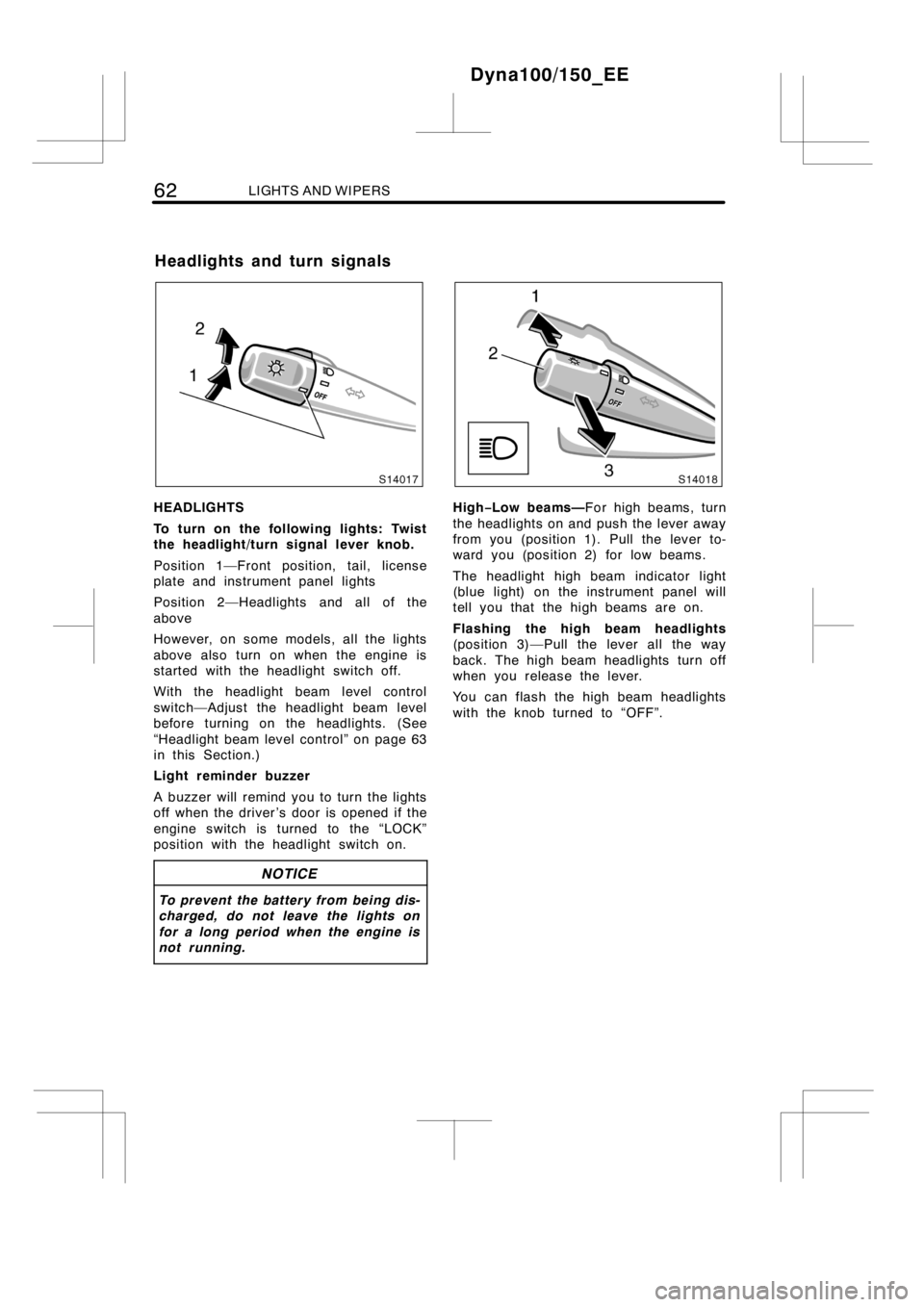
HEADLIGHTS
To turn on the following lights: Twist
the headlight/turn signal lever knob.
Position 1—Front position, tail, license
plate and instrument panel lights
Position 2—Headlights and all of the
above
However, on some models, all the lights
above also turn on when the engine is
started with the headlight switch off.
With the headlight beam level control
switch—Adjust the headlight beam level
before turning on the headlights. (See
“Headlight beam level control” on page 63
in this Section.)
Light reminder buzzer
A buzzer will remind you to turn the lights
off when the driver ’s door is opened if the
engine switch is turned to the “LOCK”
position with the headlight switch on.
NOTICE
To prevent the battery from being dis-
charged, do not leave the lights on
for a long period when the engine is
not running.
High−Low beams—For high beams, turn
the headlights on and push the lever away
from you (position 1). Pull the lever to-
ward you (position 2) for low beams.
The headlight high beam indicator light
(blue light) on the instrument panel will
tell you that the high beams are on.
Flashing the high beam headlights
(position 3)—Pull the lever all the way
back. The high beam headlights turn off
when you release the lever.
You can flash the high beam headlights
with the knob turned to “OFF”.
Dyna100/150_EE
Headlights and turn signals
Page 69 of 232

LIGHTS AND WIPERS63
TURN SIGNALS
To signal a turn, push the headlight/
turn signal lever up or down to position
1.
The engine switch must be in the “ON”
position.
The lever automatically returns after you
make a turn, but you may have to return
it by hand after you change lanes.
To signal a lane change, move the lever
up or down to the pressure point (position
2) and hold it.
If the turn signal indicator lights (green
lights) on the instrument panel flash faster
than normal, a front or rear turn signal
bulb is burned out. See “Replacing light
bulbs” on page 205 in Section 7−3.To adjust the headlight beam level, turn
the dial.
The following list shows examples of prop-
er dial settings. For loading conditions oth-
er than those listed, adjust the dial posi-
tion so that the beam level is the same
as the one obtained according to the list
when only the driver is in the vehicle. The
higher the number of the dial position, the
lower the headlight beam level.
Always keep the headlight beam at the
proper level, or your headlights may
dazzle other road users.
Loading condition and dial position
No luggage loading (driver only) 0
Driver + full luggage loading 3
Dyna100/150_EE
Headlight beam level control
Page 70 of 232
64LIGHTS AND WIPERS
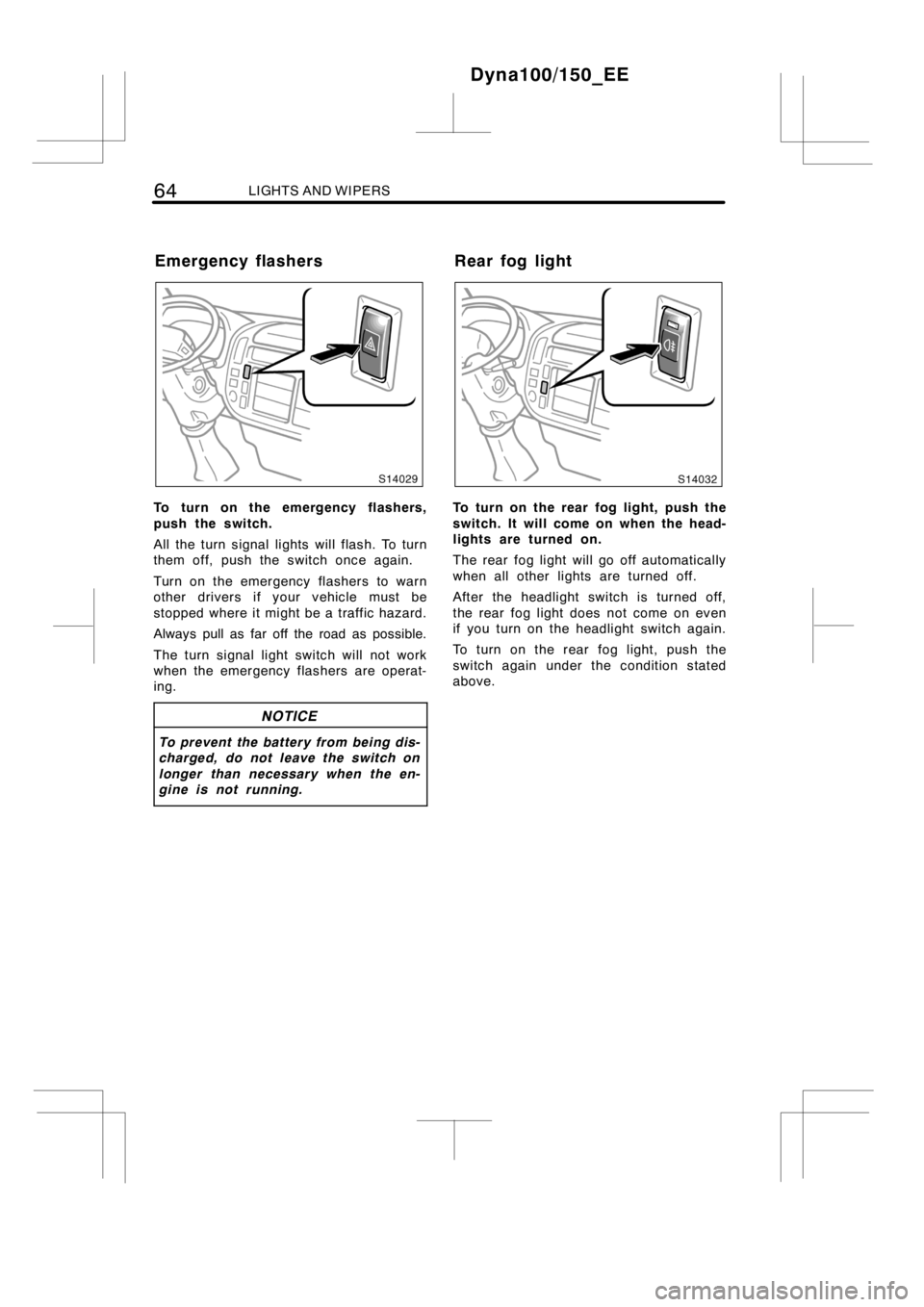
To turn on the emergency flashers,
push the switch.
All the turn signal lights will flash. To turn
them off, push the switch once again.
Turn on the emergency flashers to warn
other drivers if your vehicle must be
stopped where it might be a traffic hazard.
Always pull as far off the road as possible.
The turn signal light switch will not work
when the emergency flashers are operat-
ing.
NOTICE
To prevent the battery from being dis-
charged, do not leave the switch on
longer than necessary when the en-
gine is not running.
To turn on the rear fog light, push the
switch. It will come on when the head-
lights are turned on.
The rear fog light will go off automatically
when all other lights are turned off.
After the headlight switch is turned off,
the rear fog light does not come on even
if you turn on the headlight switch again.
To turn on the rear fog light, push the
switch again under the condition stated
above.
Dyna100/150_EE
Emergency flashers Rear fog light