Page 523 of 612
5238-2. Steps to take in an emergency
8
When trouble arises
COROLLA_TMMMS_TMMC_U (OM12F00U)
■The compact spare tire
●The compact spare tire is identified by the label “TEMPORARY USE
ONLY” on the tire sidewall.
Use the compact spare tire temporarily, and only in an emergency.
●Make sure to check the tire inflation pressure of the compact spare tire.
(P. 552)
■When the compact spare tire is equipped
The vehicle becomes lower when driving with the compact spare tire
compared to when driving with standard tires.
■After completing the tire change (vehicles with a tire pressure warn-
ing system)
The tire pressure warning system must be reset. (P. 450)
■When using the compact spare tire (vehicles with a tire pressure
warning system)
As the compact spare tire is not equipped with a tire pressure warning
valve and transmitter, low inflation pressure of the spare tire will not be
indicated by the tire pressure warning system. Also, if you replace the
compact spare tire after the tire pressure warning light comes on, the light
remains on.
■If you have a flat front tire on a road covered with snow or ice
Install the compact spare tire on one of the rear wheels of the vehicle.
Perform the following steps and fit tire chains to the front tires:
Replace a rear tire with the compact spare tire.
Replace the flat front tire with the tire removed from the rear of the vehi-
cle.
Fit tire chains to the front tires.
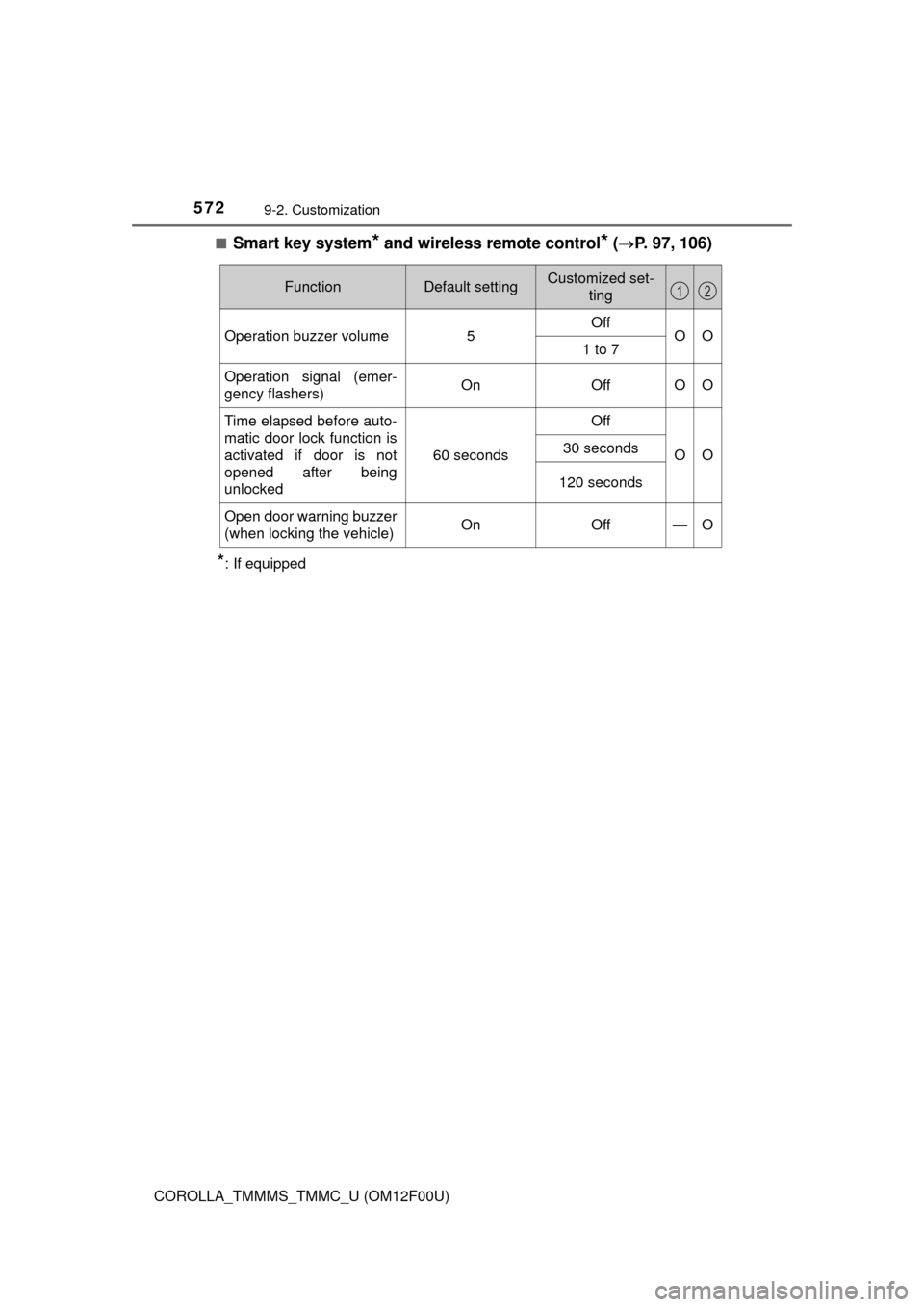
■When reinstalling the wheel ornament (vehicles with steel wheels)
Align the cutout of the wheel ornament
with the valve stem as shown the illus-
tration.
1
2
3
Page 525 of 612

5258-2. Steps to take in an emergency
8
When trouble arises
COROLLA_TMMMS_TMMC_U (OM12F00U)
NOTICE
■Be careful when driving over bumps with the compact spare tire
installed on the vehicle.
The vehicle becomes lower when driving with the compact spare tire
compared to when driving with standard tires. Be careful when driving
over uneven road surfaces.
■Driving with tire chains and the compact spare tire
Do not fit tire chains to the compact spare tire.
Tire chains may damage the vehicle body and adversely affect driving
performance.
■When replacing the tires (vehicles with a tire pressure warning sys-
tem)
When removing or fitting the wheels, tires or the tire pressure warning
valve and transmitter, contact your Toyota dealer as the tire pressure
warning valve and transmitter may be damaged if not handled correctly.
■To avoid damage to the tire pressure warning valves and transmit-
ters (vehicles with a tire pressure warning system)
When a tire is repaired with liquid sealants, the tire pressure warning
valve and transmitter may not operate properly. If a liquid sealant is
used, contact your Toyota dealer or other qualified service shop as soon
as possible. Make sure to replace the tire pressure warning valve and
transmitter when replacing the tire. (P. 449)
Page 537 of 612
5378-2. Steps to take in an emergency
8
When trouble arises
COROLLA_TMMMS_TMMC_U (OM12F00U)
●Vehicles without a multi-information display: The high engine cool-
ant temperature warning light (P. 492) comes on or a loss of
power is experienced.
Vehicles with a multi-information display: The engine coolant tem-
perature gauge (P. 82) enters the red zone or a loss of power is
experienced.
●Steam comes out from under the hood.
Stop the vehicle in a safe place and turn off the air conditioning sys-
tem, and then stop the engine.
If you see steam:
Carefully lift the hood after the steam subsides.
If you do not see steam:
Carefully lift the hood.
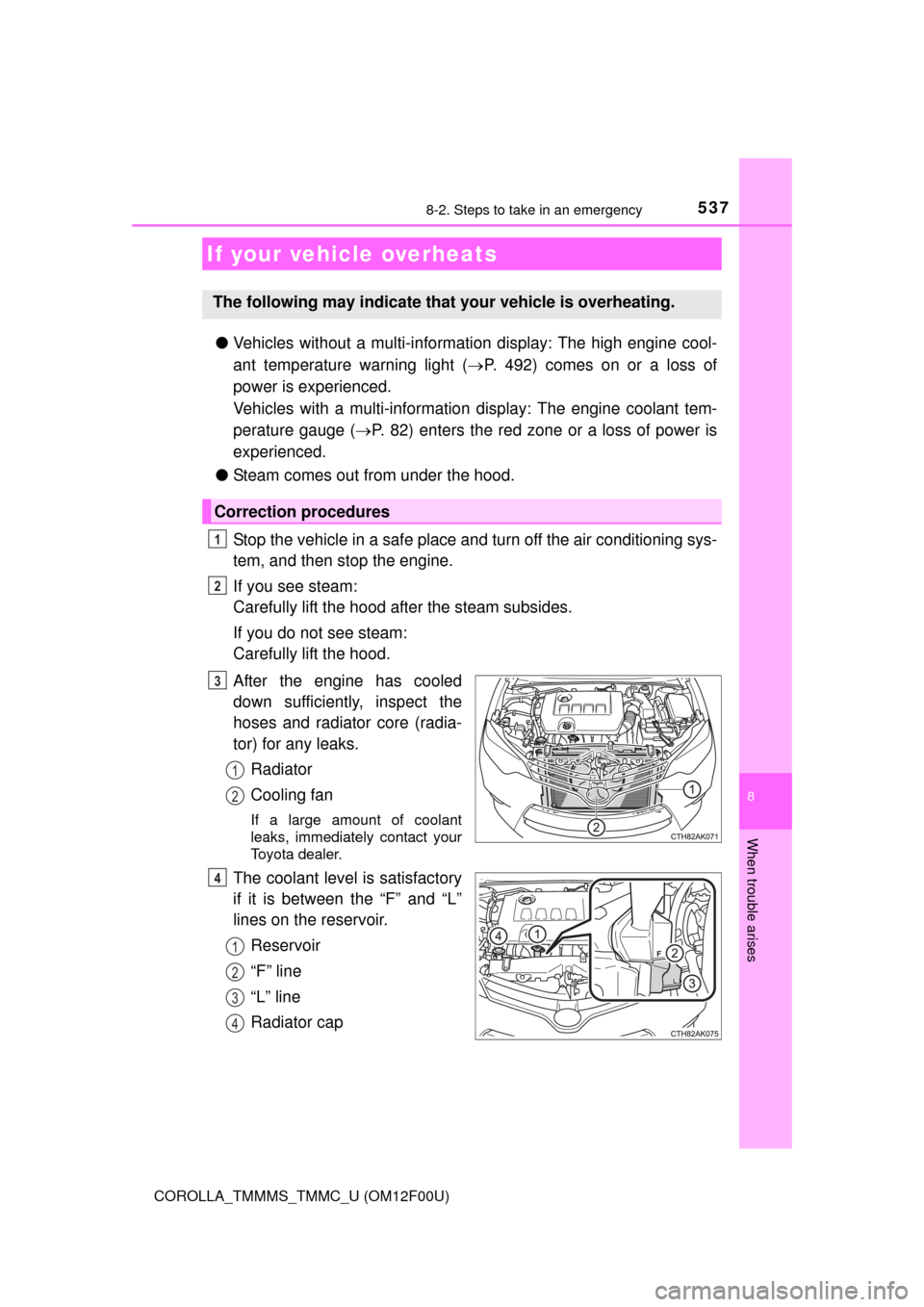
After the engine has cooled
down sufficiently, inspect the
hoses and radiator core (radia-
tor) for any leaks.
Radiator
Cooling fan
If a large amount of coolant
leaks, immediately contact your
Toyota dealer.
The coolant level is satisfactory
if it is between the “F” and “L”
lines on the reservoir.
Reservoir
“F” line
“L” line
Radiator cap
If your vehicle overheats
The following may indicate that your vehicle is overheating.
Correction procedures
1
2
3
1
2
4
1
2
3
4
Page 562 of 612

5629-1. Specifications
COROLLA_TMMMS_TMMC_U (OM12F00U)
This information has been prepared in accordance with regulations
issued by the National Highway Traffic Safety Administration of the
U.S. Department of Transportation.
It provides the purchasers and/or prospective purchasers of Toyota
vehicles with information on uniform tire quality grading.
Your Toyota dealer will help answer any questions you may have as
you read this information.
■DOT quality grades
All passenger vehicle tires must conform to Federal Safety Require-
ments in addition to these grades. Quality grades can be found
where applicable on the tire sidewall between tread shoulder and
maximum section width.
For example: Treadwear 200 Traction AA Temperature A
■Treadwear
The treadwear grade is a comparative rating based on the wear
rate of the tire when tested under controlled conditions on a speci-
fied government test course.
For example, a tire graded 150 would wear one and a half (1 - 1/2)
times as well on the government course as a tire graded 100.
The relative performance of tires depends upon the actual condi-
tions of their use. Performance may differ significantly from the norm
due to variations in driving habits, service practices and differences
in road characteristics and climate.
■Traction AA, A, B, C
The traction grades, from highest to lowest, are AA, A, B and C,
and they represent the tire’s ability to stop on wet pavement as
measured under controlled conditions on specified government test
surfaces of asphalt and concrete.
A tire marked C may have poor traction performance.
Warning: The traction grade assigned to this tire is based on braking
(straight ahead) traction tests and does not include cornering (turn-
ing) traction.
Uniform Tire Quality Grading
Page 563 of 612

5639-1. Specifications
9
Vehicle specifications
COROLLA_TMMMS_TMMC_U (OM12F00U)■
Temperature A, B, C
The temperature grades are A (the highest), B, and C, representing
the tire’s resistance to the generation of heat and its ability to dissi-
pate heat when tested under controlled conditions on a specified
indoor laboratory test wheel.
Sustained high temperature can cause the material of the tire to
degenerate and reduce tire life, and excessive temperature can lead
to sudden tire failure.
Grade C corresponds to a level of performance which all passenger
car tires must meet under the Federal Motor Vehicle Safety Stan-
dard No. 109.
Grades B and A represent higher levels of performance on the labo-
ratory test wheel than the minimum required by law.
Warning: The temperature grades of a tire assume that it is properly
inflated and not overloaded.
Excessive speed, underinflation, or excessive loading, either sepa-
rately or in combination, can cause heat buildup and possible tire
failure.
Page 572 of 612
5729-2. Customization
COROLLA_TMMMS_TMMC_U (OM12F00U)■
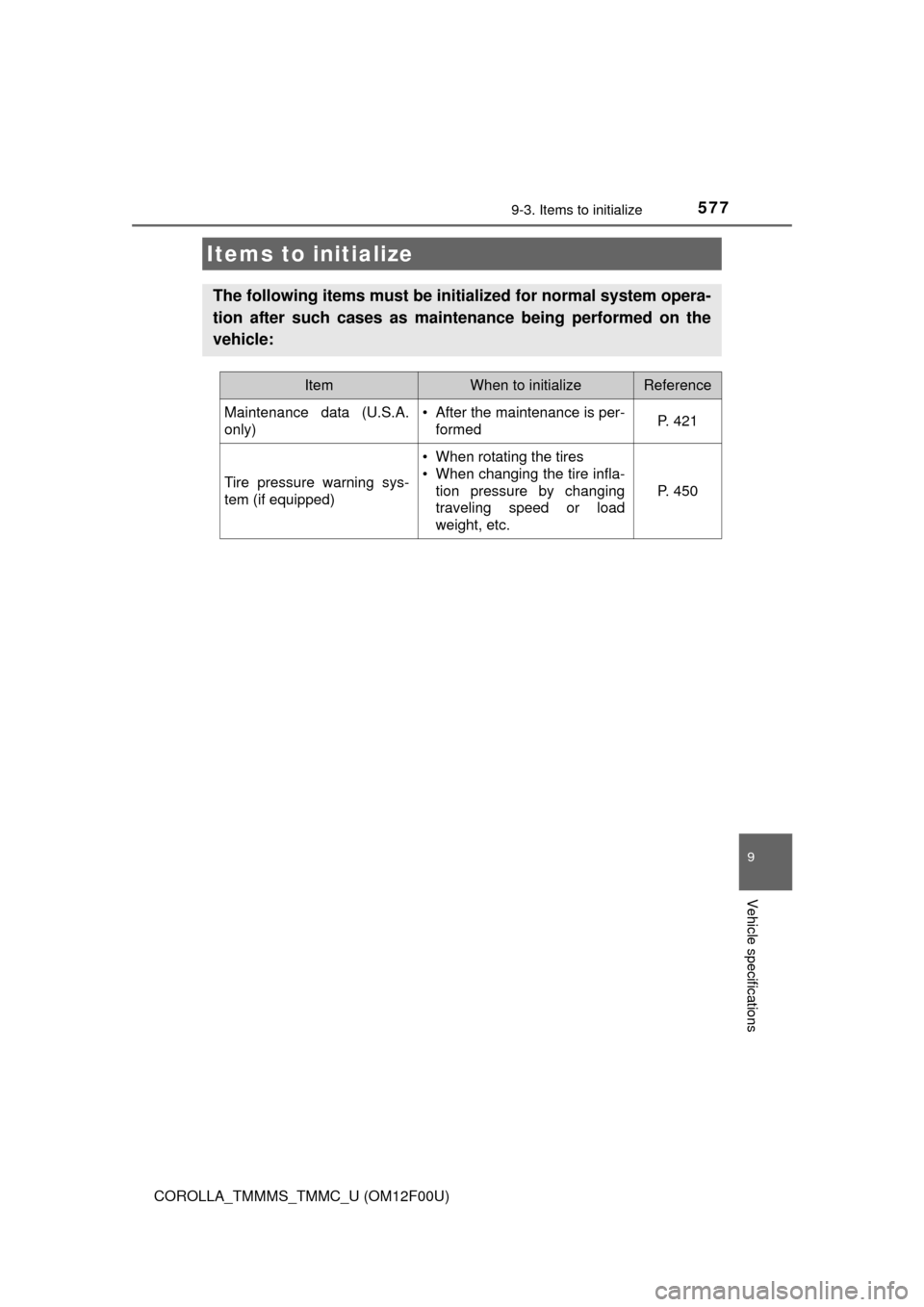
Smart key system* and wireless remote control* (P. 97, 106)
*: If equipped
FunctionDefault settingCustomized set-
ting
Operation buzzer volume5OffOO1 to 7
Operation signal (emer-
gency flashers)OnOffOO
Time elapsed before auto-
matic door lock function is
activated if door is not
opened after being
unlocked
60 seconds
Off
OO30 seconds
120 seconds
Open door warning buzzer
(when locking the vehicle)OnOff—O
12
Page 577 of 612
577
9
Vehicle specifications
COROLLA_TMMMS_TMMC_U (OM12F00U)
9-3. Items to initialize
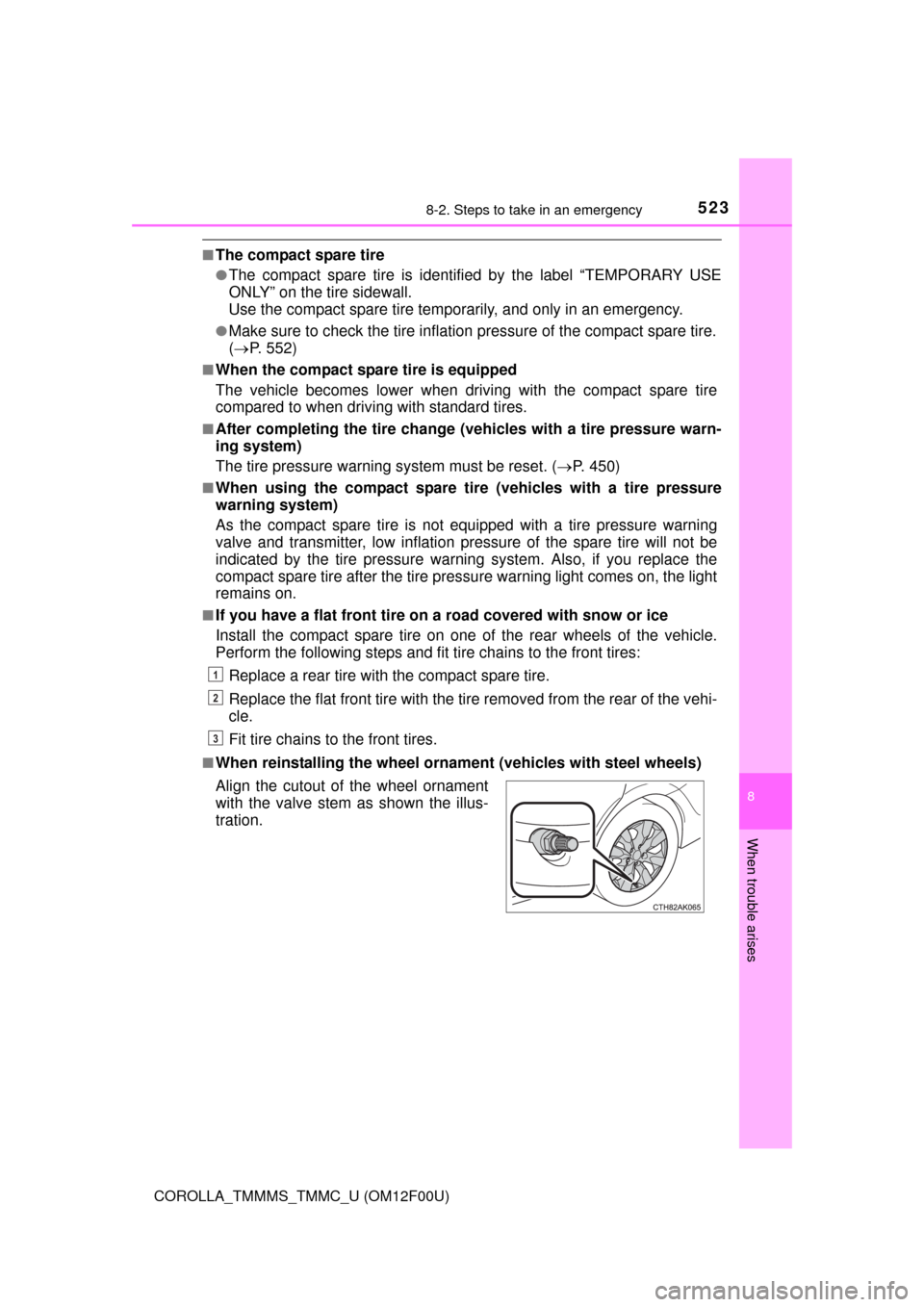
Items to initialize
The following items must be initialized for normal system opera-
tion after such cases as maintenance being performed on the
vehicle:
ItemWhen to initializeReference
Maintenance data (U.S.A.
only)• After the maintenance is per-
formedP. 421
Tire pressure warning sys-
tem (if equipped)
• When rotating the tires
• When changing the tire infla-
tion pressure by changing
traveling speed or load
weight, etc.
P. 450
Page 598 of 612

598What to do if... (Troubleshooting)
COROLLA_TMMMS_TMMC_U (OM12F00U)
●The auto power off function will be operated if the vehicle is left in ACCES-
SORY or IGNITION ON mode (the engine is not running) for a period of
time. (P. 168)
●The seat belt reminder light is flashing
Are the driver and the front passenger wearing the seat belts? (P. 494)
●The brake system warning light is on
Is the parking brake released? (P. 183)
Depending on the situation, other types of warning buzzer may also sound.
(P. 492, 504)
●Is the electronic key left inside the vehicle?
Vehicles with a multi-information display: Check the message on the multi-
information display. (P. 504)
●Did anyone inside the vehicle open a door during setting the alarm?
The sensor detects it and the alarm sounds. (P. 68)
Vehicles without a smart key system
To stop the alarm, turn the engine switch to the “ON” position or start the
engine.
Vehicles with a smart key system
To stop the alarm, turn the engine switch to IGNITION ON mode or start the
engine.
●When a warning light turns on, refer to P. 492.
The engine switch is turned off automatically
(vehicles with a smart key system)
A warning buzzer sounds during driving
A warning buzzer sounds when leaving the vehicle
(vehicles with a smart key system)
An alarm is activated and the horn sounds
(vehicles with an alarm)
A warning light turns on
(vehicles with a drive monitor display)