Page 447 of 620

447
4-3. Do-it-yourself maintenance
4
Maintenance and care
Engine coolant
The coolant level is sati sfactory if it is between the “F” and “L” lines on
the reservoir when the engine is cold.
Reservoir cap
“F” line
“L” line
If the level is on or below the “L”
line, add coolant up to the “F” line.
(P. 544)
■ Coolant selection
Only use “Toyota Super Long Life Coolant” or a similar high quality ethylene
glycol based non-silicate, non-amine, non-nitrite, and non-borate coolant
with long-life hybrid organic acid technology.
U.S.A.: “Toyota Super Long Life Coolant” is a mixture of 50% coolant and 50% deionized water. (Minimum temperature: -31 F [-35 C])
Canada: “Toyota Super Long Life Coolant” is a mixture of 55% coolant and 45% deionized water. (Minimum temperature: -44 F [-42 C])
For more details about engine coolant, contact your Toyota dealer.
■ If the coolant level drops within a short time of replenishing
Visually check the radiator, hoses, engine coolant reservoir caps, drain cock
and water pump.
If you cannot find a leak, have your Toyota dealer test the cap and check for
leaks in the cooling system.
CAUTION
■When the engine is hot
Do not remove the engine coolant reservoir cap.
The cooling system may be under pressure and may spray hot coolant if the
cap is removed, causing serious injuries, such as burns.
Page 448 of 620
448 4-3. Do-it-yourself maintenance
Radiator and condenserCheck the radiator and condenser and clear away any foreign
objects.
If either of the above parts is extr emely dirty or you are not sure of
their condition, have your vehicle inspected by your Toyota dealer.
NOTICE
■When adding coolant
Coolant is neither plain water nor stra ight antifreeze. The correct mixture of
water and antifreeze must be used to provide proper lubrication, corrosion
protection and cooling. Be sure to read the antifreeze or coolant label.
■ If you spill coolant
Be sure to wash it off with water to prevent it from damaging parts or paint.
CAUTION
■When the engine is hot
Do not touch the radiator or condenser as they may be hot and cause seri-
ous injuries, such as burns.
Page 478 of 620
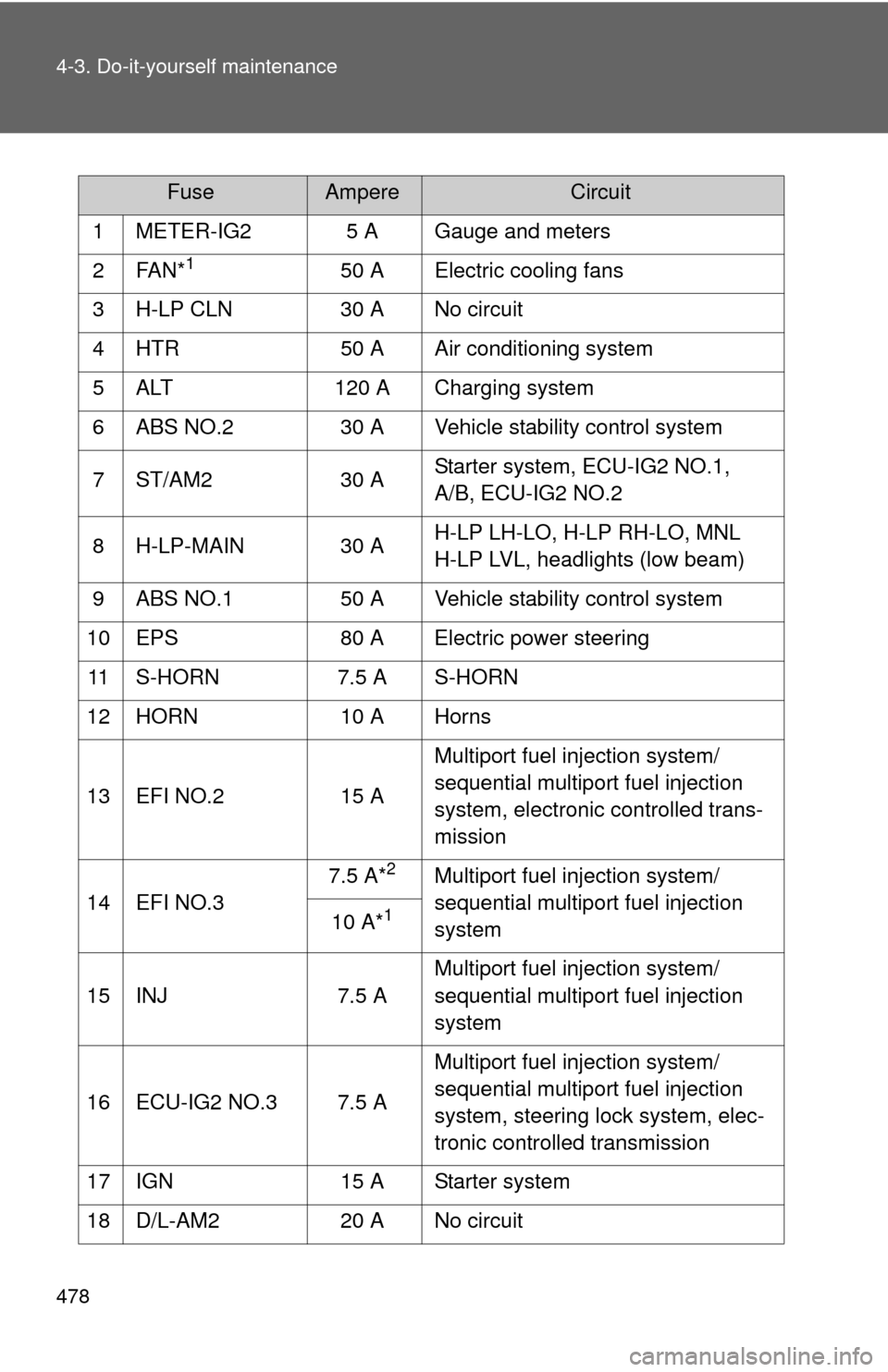
478 4-3. Do-it-yourself maintenance
FuseAmpereCircuit
1 METER-IG2 5 A Gauge and meters
2FAN*
150 A Electric cooling fans
3 H-LP CLN 30 A No circuit
4 HTR 50 A Air conditioning system
5 ALT 120 A Charging system
6 ABS NO.2 30 A Vehicle stability control system
7 ST/AM2 30 A Starter system, ECU-IG2 NO.1,
A/B, ECU-IG2 NO.2
8 H-LP-MAIN 30 A H-LP LH-LO, H-LP RH-LO, MNL
H-LP LVL, headlights (low beam)
9 ABS NO.1 50 A Vehicle stability control system
10 EPS 80 A Electric power steering
11 S-HORN 7.5 A S-HORN
12 HORN 10 A Horns
13 EFI NO.2 15 A Multiport fuel injection system/
sequential multiport fuel injection
system, electronic controlled trans-
mission
14 EFI NO.3 7.5 A*
2Multiport fuel injection system/
sequential multiport fuel injection
system
10 A*
1
15 INJ
7.5 AMultiport fuel injection system/
sequential multiport fuel injection
system
16 ECU-IG2 NO.3 7.5 A Multiport fuel injection system/
sequential multiport fuel injection
system, steering lock system, elec-
tronic controlled transmission
17 IGN 15 A Starter system
18 D/L-AM2 20 A No circuit
Page 481 of 620
481
4-3. Do-it-yourself maintenance
4
Maintenance and care
■
Under the instrument panel
FuseAmpereCircuit
1 ECU-IG1 NO.2 10 A Shift lock control system, seat
heaters, smart key system, tire
pressure warning system, wireless
remote control, multiplex communi-
cation system, audio system, navi-
gation system, moon roof, auto
anti-glare inside rear view mirror
2 ECU-IG1 NO.1 10 A Vehicle stability control system,
electric cooling fans, steering sen-
sor, multiport fuel injection system/
sequential multiport fuel injection
system, charging system, rear win-
dow defogger, outside rear view
mirror defoggers, Blind Spot Moni-
tor
3 PANEL 10 A Switch illumination, air condition-
ing system, shift lever light, glove
box light, interior lights, personal
lights, audio system, navigation
system
Page 543 of 620
5
When trouble arises
543
5-2. Steps to take in an emergency
NOTICE
■
When handling jumper cables
When connecting the jumper cables, ensure that they do not become entan-
gled in the cooling fans or belt.
Page 544 of 620
544
5-2. Steps to take in an emergency
If your vehicle overheats
Correction proceduresStop the vehicle in a safe place and turn off the air condition-
ing system, and then stop the engine.
If you see steam: Carefully lift the hood after the steam subsides.
If you do not see steam: Carefully lift the hood.
After the engine has cooled
down sufficiently, inspect the
hoses and radiator core (radia-
tor) for any leaks.
Radiator
Cooling fans
If a large amount of coolant leaks,
immediately contact your Toyota
dealer.
The following may indicate that, your vehicle is overheating.
●The rightmost segment of the engine coolant temperature dis-
play ( P. 172) is flashing or a loss of engine power is experi-
enced. (For example, the vehi cle speed does not increase.)
● Steam comes out from under the hood.
STEP1
STEP2
STEP3
Page 545 of 620
5
When trouble arises
545
5-2. Steps to take in an emergency
The coolant level is satisfactory if
it is between the “F” and “L” lines
on the reservoir.
Reservoir
“F” (Full)
“L” (Low)
Radiator cap
Add coolant if necessary.
Water can be used in an emer-
gency if coolant is unavailable.
Start the engine and turn the air conditioning system on to
check that the radiator cooling fans operate and to check for
coolant leaks from the radiator or hoses.
The fans operate when the air conditioning system is turned on
immediately after a cold start. Conf irm that the fans are operating by
checking the fan sound and air flow. If it is difficult to check these,
turn the air conditioning system on and off repeatedly.
(The fans may not operate in freezing temperatures.)
STEP4
STEP5
STEP6
Page 546 of 620

546 5-2. Steps to take in an emergency
If the fans are not operating:Stop the engine immediately and contact your Toyota
dealer.
If the fans are operating: Have the vehicle inspected at the nearest Toyota dealer.
CAUTION
■To prevent an accident or injury when inspecting under the hood of
your vehicle
● If steam is seen coming from under the hood, do not open the hood until
the steam has subsided. The engine compartment may be very hot, caus-
ing serious injuries such as burns.
● Keep hands and clothing (especially a tie, a scarf or a muffler) away from
the fans and belt. Failure to do so may cause the hands or clothing to be
caught, resulting in serious injury.
● Do not loosen the coolant reservoir cap while the engine and radiator are
hot.
Serious injury, such as burns, may result from hot coolant and steam
released under pressure.
NOTICE
■When adding engine coolant
Wait until the engine has cooled down before adding engine coolant.
When adding coolant, do so slowly. Adding cool coolant to a hot engine too
quickly can cause damage to the engine.
■ To prevent damage to the cooling system
Observe the following precautions:
●Avoid contaminating the coolant with foreign matter (such as sand or dust
etc.).
● Do not use any coolant additive.
STEP7