Page 5 of 612

1
2
3
4
5
6
7
5
4-1. Maintenance and careCleaning and protecting the vehicle exterior............ 410
Cleaning and protecting the vehicle interior............. 413
4-2. Maintenance Maintenance requirements ..................... 416
General maintenance.......... 418
Emission inspection and maintenance (I/M)
programs........................... 422
4-3. Do-it-yourself maintenance
Do-it-yourself service precautions ....................... 423
Hood ................................... 426
Positioning a floor jack ........ 427
Engine compartment ........... 429
12-volt battery ..................... 439
Tires .................................... 443
Tire inflation pressure ......... 449
Wheels ................................ 453
Air conditioning filter............ 456
Electronic key battery.......... 458
Checking and replacing fuses ................................. 460
Light bulbs........................... 471 5-1. Essential information
Emergency flashers............ 484
If your vehicle needs to be towed........................... 485
If you think something is wrong ............................ 489
5-2. Steps to take in an emergency
If a warning light turns on or a warning buzzer
sounds... .......................... 490
If a warning message is displayed .......................... 500
If you have a flat tire ........... 519
If the hybrid system will not start ............................ 531
If the shift lever cannot be shifted from P ................... 533
If you lose your keys........... 534
If the electronic key does not operate properly ......... 535
If the vehicle’s 12-volt battery is discharged ........ 538
If your vehicle overheats .... 542
If the vehicle becomes stuck ................................. 547
If your vehicle has to be stopped in an
emergency ....................... 548
4Maintenance and care5When trouble arises
Page 9 of 612
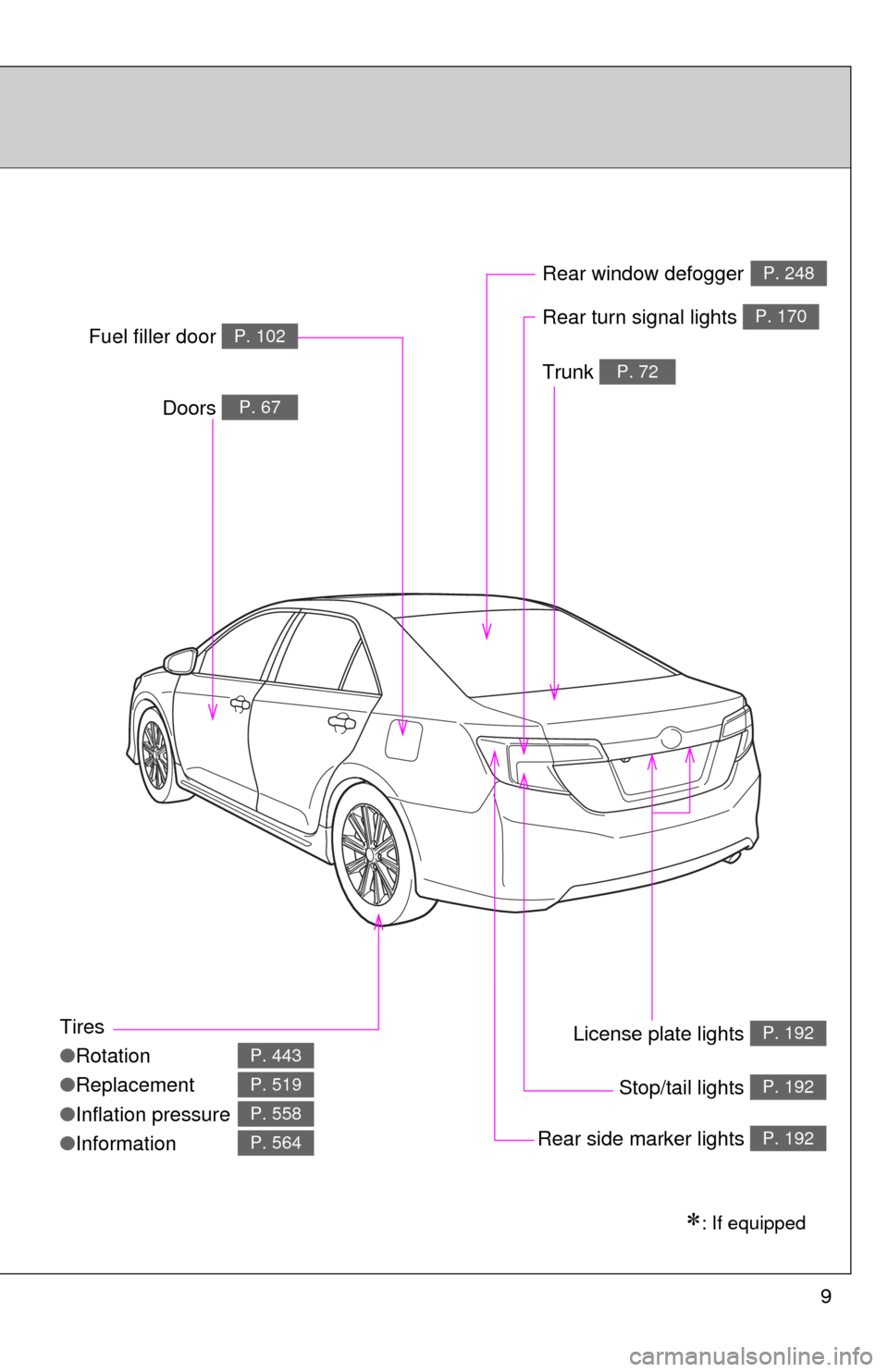
9
Tires
●Rotation
● Replacement
● Inflation pressure
● Information
P. 443
P. 519
P. 558
P. 564
Trunk P. 72
Doors P. 67
Fuel filler door P. 102Rear turn signal lights P. 170
Rear window defoggerP. 248
Stop/tail lights P. 192
Rear side marker lights P. 192
License plate lights P. 192
: If equipped
Page 47 of 612
47
1-1. Hybrid system
1
Before driving
■
Checking tire inflation pressure
Make sure to check the tire inflation pressure frequently. Improper tire
inflation pressure can cause poor fuel consumption.
Also, as snow tires can cause large amounts of friction, their use on dry
roads can lead to poor fuel consumption. Use a tire that is appropriate
for the season.
■Luggage
Carrying heavy luggage can lead to poor fuel consumption. Avoid car-
rying unnecessary luggage. Installing a large roof rack can also cause
poor fuel consumption.
■Warming up before driving
Since the gasoline engine starts up and cuts out automatically when
cold, warming up the engine is unnecessary. Moreover, frequently driv-
ing short distances will cause the engine to repeatedly warm up, which
can lead to poor fuel consumption.
Page 211 of 612

211
2-4. Using other
driving systems
2
When driving
CAUTION
■TRAC may not operate effectively when
Directional control and power may not be achievable while driving on slip-
pery road surfaces, even if the TRAC system is operating.
Drive the vehicle carefully in conditions where stability and power may be
lost.
■ When the VSC is activated
The slip indicator light flashes. Always drive carefully. Reckless driving may
cause an accident. Exercise particular care when the indicator light flashes.
■ When the TRAC/VSC syst ems are turned off
Be especially careful and drive at a speed appropriate to the road condi-
tions. As these are the systems to help ensure vehicle stability and driving
force, do not turn the TRAC/VSC systems off unless necessary.
■ Replacing tires
Make sure that all tires are of the specified size, brand, tread pattern and
total load capacity. In addition, make sure that the tires are inflated to the
recommended tire inflation pressure level.
The ABS, TRAC and VSC systems will not function correctly if different tires
are installed on the vehicle.
Contact your Toyota dealer for further information when replacing tires or
wheels.
■ Handling of tires and suspension
Using tires with any kind of problem or modifying the suspension will affect
the driving assist systems, and may cause a system to malfunction.
Page 231 of 612

231
2-5. Driving information
2
When driving
■
Tire chain installation
Observe the following precautions when installing and removing chains:
●Install and remove tire chains in a safe location.
● Install tire chains on the front tires only. Do not install tire chains on the
rear tires.
● Install tire chains on front tires as tightly as possible. Retighten chains
after driving 1/4 1/2 mile (0.5 1.0 km).
● Install tire chains following the instructions provided with the tire chains.
CAUTION
■Driving with snow tires
Observe the following precautions to reduce the risk of accidents.
Failure to do so may result in a loss of vehicle control and cause death or
serious injury.
●Use tires of the size specified.
● Maintain the recommended level of air pressure.
● Do not drive in excess of 75 mph (120 km/h), regardless of the type of
snow tires being used.
● Use snow tires on all, not just some wheels.
■ Driving with tire chains
Observe the following precautions to reduce the risk of accidents.
Failure to do so may result in the vehicle being unable to be driven safely,
and may cause death or serious injury.
●Do not drive in excess of the speed limit specified for the tire chains being
used, or 30 mph (50 km/h), whichever is lower.
● Avoid driving on bumpy road surfaces or over potholes.
● Avoid sudden turns and braking, as use of chains may adversely affect
vehicle handling.
● Slow down sufficiently before entering a curve to ensure that vehicle con-
trol is maintained.
Page 232 of 612
232 2-5. Driving information
NOTICE
■Repairing or replacing snow tires
Request repairs or replacement of snow tires from Toyota dealers or legiti-
mate tire retailers.
This is because the removal and attachment of snow tires affects the opera-
tion of the tire pressure warning valves and transmitters.
■ Fitting tire chains
The tire pressure warning valves and transmitters may not function correctly\
when tire chains are fitted.
Page 361 of 612
361
3-2. Using the audio system
3
Interior features
The fixed guide lines are very far out of alignment
• The vehicle is tilted (there is a heavy load on the vehicle, tire
pressure is low due to a tire punc-
ture, etc.)
• The vehicle is used on an incline. If this happens due to these
causes, it does not indicate a mal-
function. Back up while visually
checking the vehicle's surround-
ings.
The camera position is out of align-
ment. Have the vehicle inspected by your
Toyota dealer.
Likely causeSolution
Page 409 of 612
Maintenance and care4
409
4-1. Maintenance and careCleaning and protecting the vehicle exterior ......... 410
Cleaning and protecting the vehicle interior .......... 413
4-2. Maintenance Maintenance requirements .................. 416
General maintenance....... 418
Emission inspection and maintenance (I/M)
programs........................ 422
4-3. Do-it-yourself maintenance Do-it-yourself service precautions .................... 423
Hood ................................ 426
Positioning a floor jack ..... 427
Engine compartment ........ 429
12-volt battery .................. 439
Tires ................................. 443
Tire inflation pressure ...... 449
Wheels ............................. 453
Air conditioning filter......... 456
Electronic key battery....... 458
Checking and replacing fuses .............................. 460
Light bulbs........................ 471