Page 5 of 612

1
2
3
4
5
6
7
5
4-1. Maintenance and careCleaning and protecting the vehicle exterior............ 410
Cleaning and protecting the vehicle interior............. 413
4-2. Maintenance Maintenance requirements ..................... 416
General maintenance.......... 418
Emission inspection and maintenance (I/M)
programs........................... 422
4-3. Do-it-yourself maintenance
Do-it-yourself service precautions ....................... 423
Hood ................................... 426
Positioning a floor jack ........ 427
Engine compartment ........... 429
12-volt battery ..................... 439
Tires .................................... 443
Tire inflation pressure ......... 449
Wheels ................................ 453
Air conditioning filter............ 456
Electronic key battery.......... 458
Checking and replacing fuses ................................. 460
Light bulbs........................... 471 5-1. Essential information
Emergency flashers............ 484
If your vehicle needs to be towed........................... 485
If you think something is wrong ............................ 489
5-2. Steps to take in an emergency
If a warning light turns on or a warning buzzer
sounds... .......................... 490
If a warning message is displayed .......................... 500
If you have a flat tire ........... 519
If the hybrid system will not start ............................ 531
If the shift lever cannot be shifted from P ................... 533
If you lose your keys........... 534
If the electronic key does not operate properly ......... 535
If the vehicle’s 12-volt battery is discharged ........ 538
If your vehicle overheats .... 542
If the vehicle becomes stuck ................................. 547
If your vehicle has to be stopped in an
emergency ....................... 548
4Maintenance and care5When trouble arises
Page 21 of 612
21
Installation of a mobile two-way radio system
The installation of a mobile two-way radio system in your vehicle could affect
electronic systems such as:
●Multiport fuel injection system/sequential multiport fuel injection system
● Cruise control system
● Anti-lock brake system
● SRS airbag system
● Seat belt pretensioner system
Be sure to check with your Toyota dealer for precautionary measures or spe-
cial instructions regarding installation of a mobile two-way radio system.
High voltage parts and cables on the hybrid vehicles emit approximately the
same amount of electromagnetic waves as the conventional gasoline pow-
ered vehicles or home electronic appliances despite of their electromagnetic
shielding.
Unwanted noise may occur in the reception of the mobile two-way radio.
Page 26 of 612

26
CAUTION
■Hybrid battery (traction battery)
Never resell, hand over or modify the hybrid battery. To prevent accidents,
hybrid batteries that have been removed from a disposed vehicle are col-
lected through Toyota dealers. Do not dispose of the battery yourself.
Unless the battery is properly collected, the following may occur, resulting in
death or serious injury:
●The hybrid battery may be illegally disposed of or dumped, and someone
may touch a high voltage part, resulting in an electric shock.
● The hybrid battery is intended to be used exclusively with your hybrid vehi-
cle. If the hybrid battery is used outside of your vehicle or modified in any
way, accidents such as electric shock, heat generation, smoke generation,
an explosion and electrolyte leakage may occur.
When reselling or handing over your vehicle, the possibility of an accident is
extremely high because the person receiving the vehicle may not be aware
of these dangers.
■ Disposal of the hybrid battery (traction battery)
If your vehicle is disposed of without the hybrid battery having been
removed, there is a danger of serious electric shock if high voltage parts,
cables and their connectors are touched. In the event that your vehicle must
be disposed of, the hybrid battery must be disposed of by your Toyota dealer
or a qualified service shop. If the hybrid battery is not disposed of properly, it
may cause electric shock that can result in death or serious injury.
Page 33 of 612

33
1-1. Hybrid system
1
Before driving
■
Charging the hybrid battery (traction battery)
●As the gasoline engine charges the hybrid battery (traction battery), the
battery does not need to be charged from an outside source. However, if
the vehicle is left parked for a long time the hybrid battery will slowly dis-
charge. For this reason, be sure to drive the vehicle at least once every
few months for at least 30 minutes or 10 miles (16 km). If the hybrid bat-
tery becomes fully discharged and you are unable to jump-start the vehi-
cle with the 12-volt battery, contact your Toyota dealer.
● If the shift lever is in N, the hybrid battery (traction battery) will not be
charged. Always put the shift lever in P when the vehicle is stopped.
When driving in heavy traffic, operate the vehicle with the shift lever in D
or B to avoid discharging the battery.
■ Charging the 12-volt battery
P. 540
■ After the 12-volt battery has di scharged or has been changed or
removed
The gasoline engine may not stop even if the vehicle is running on the hybrid
battery (traction battery). If this continues for a few days, contact your Toyota
dealer.
Page 35 of 612
35
1
1-1. Hybrid system
Before driving
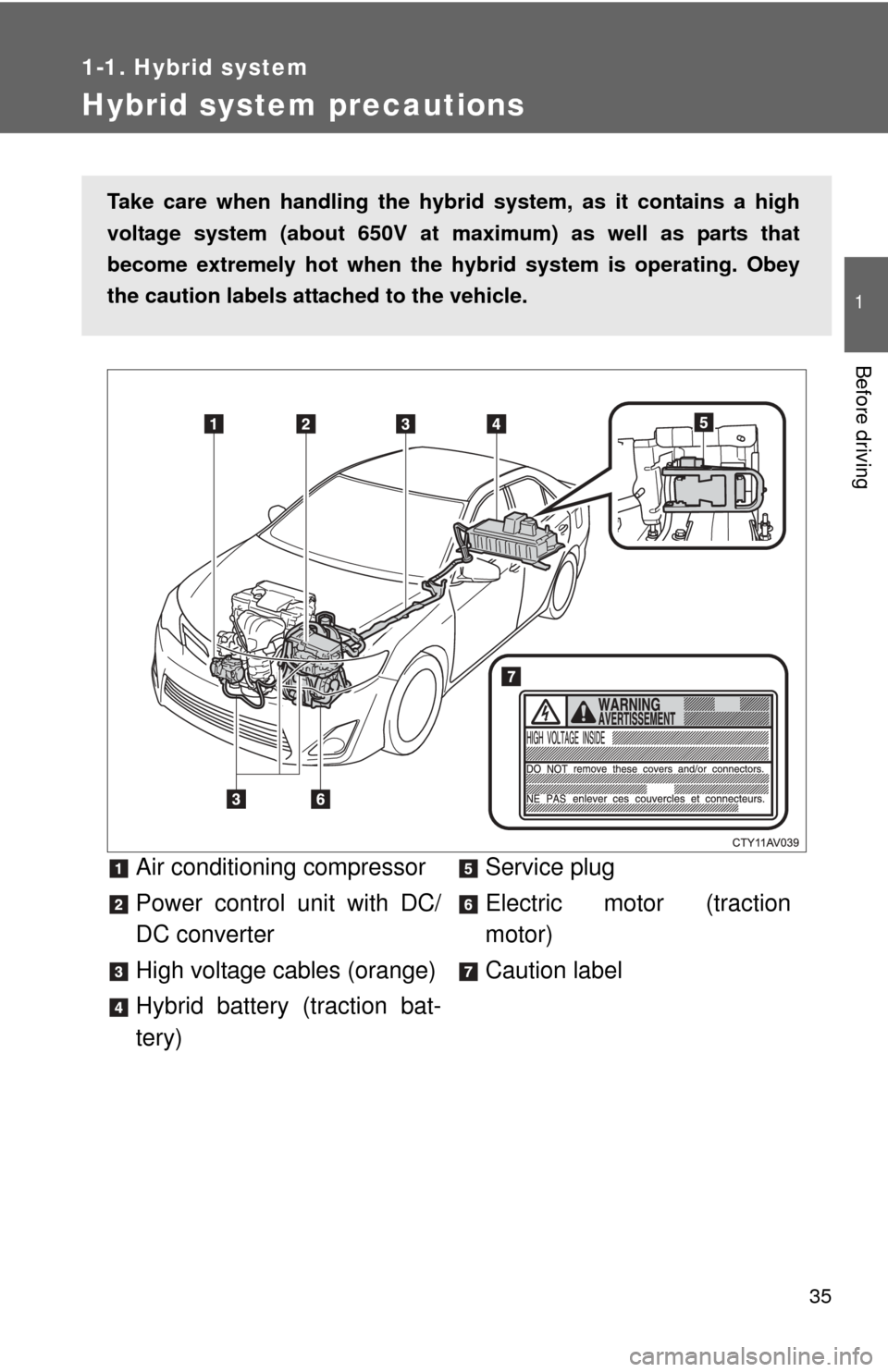
Hybrid system precautions
Air conditioning compressor
Power control unit with DC/
DC converter
High voltage cables (orange)
Hybrid battery (traction bat-
tery)Service plug
Electric motor (traction
motor)
Caution label
Take care when handling the hybrid system, as it contains a high
voltage system (about 650V at m
aximum) as well as parts that
become extremely hot when the hy brid system is operating. Obey
the caution labels attached to the vehicle.
Page 36 of 612
36 1-1. Hybrid system
Hybrid battery air vent There is an air intake vent beside
the rear left seat for the purpose
of cooling the hybrid battery
(traction battery). If the vent
becomes blocked, the hybrid
battery may overheat, leading to
a reduction in hybrid battery out-
put.
Emergency shut off system When a certain level of impact is detected by the impact sensor, the
emergency shut off syst em blocks off the high voltage current and
stops the fuel pump to minimize t he risk of electrocution and fuel
leakage. If the emergency shut off system activates, your vehicle will
not restart. To restart the hybrid system, contact your Toyota dealer.
Hybrid warning message
A message is automatically displayed when a malfunction occurs in
the hybrid system or an impr oper operation is attempted.
If a warning message is shown
on the multi-information display,
read the message and follow the
instructions. ( P. 500)
Page 37 of 612

37
1-1. Hybrid system
1
Before driving
■
If a warning light comes on, a warn ing message is displayed, or the 12-
volt battery has been disconnected
The hybrid system may not start. In that case, try to start the system again. If
the “READY” indicator does not come on, contact your Toyota dealer.
■ Running out of fuel
When the vehicle has run out of fuel and the hybrid system cannot be
started, refuel the vehicle with at least enough gasoline to make the low fuel
level warning light ( P. 493) go off. If there is only a small amount of fuel,
the hybrid system may not be able to start. (The minimum amount of fuel to
add to make the low fuel level warning light go out is about 3.0 gal. [11.3 L,
2.5 Imp. gal.] when the vehicle is on a level surface. This value may vary
when the vehicle is on a slope.)
■ Electromagnetic waves
●High voltage parts and cables on the hybrid vehicles incorporate electro-
magnetic shielding, and therefore emit approximately the same amount
of electromagnetic waves as conventional gasoline powered vehicles or
home electronic appliances.
● Your vehicle may cause sound interference in some third party-produced
radio parts.
■ Hybrid battery (traction battery)
The hybrid battery (traction battery) has a limited service life. The lifespan of
the hybrid battery (traction battery) can change in accordance with driving
style and driving conditions.
Page 38 of 612
38 1-1. Hybrid system
CAUTION
■High voltage precautions
The vehicle has high voltage DC and AC systems as well as a 12-volt sys-
tem. DC and AC high voltage is very dangerous and can cause severe burns
and electric shock that may result in death or serious injury.
●Never touch, disassemble, remove or replace the high voltage parts,
cables or their connectors.
● The hybrid system will become hot after starting as the system uses high
voltage. Be careful of both the high voltage and the high temperature, and
always obey the caution labels attached to the vehicle.
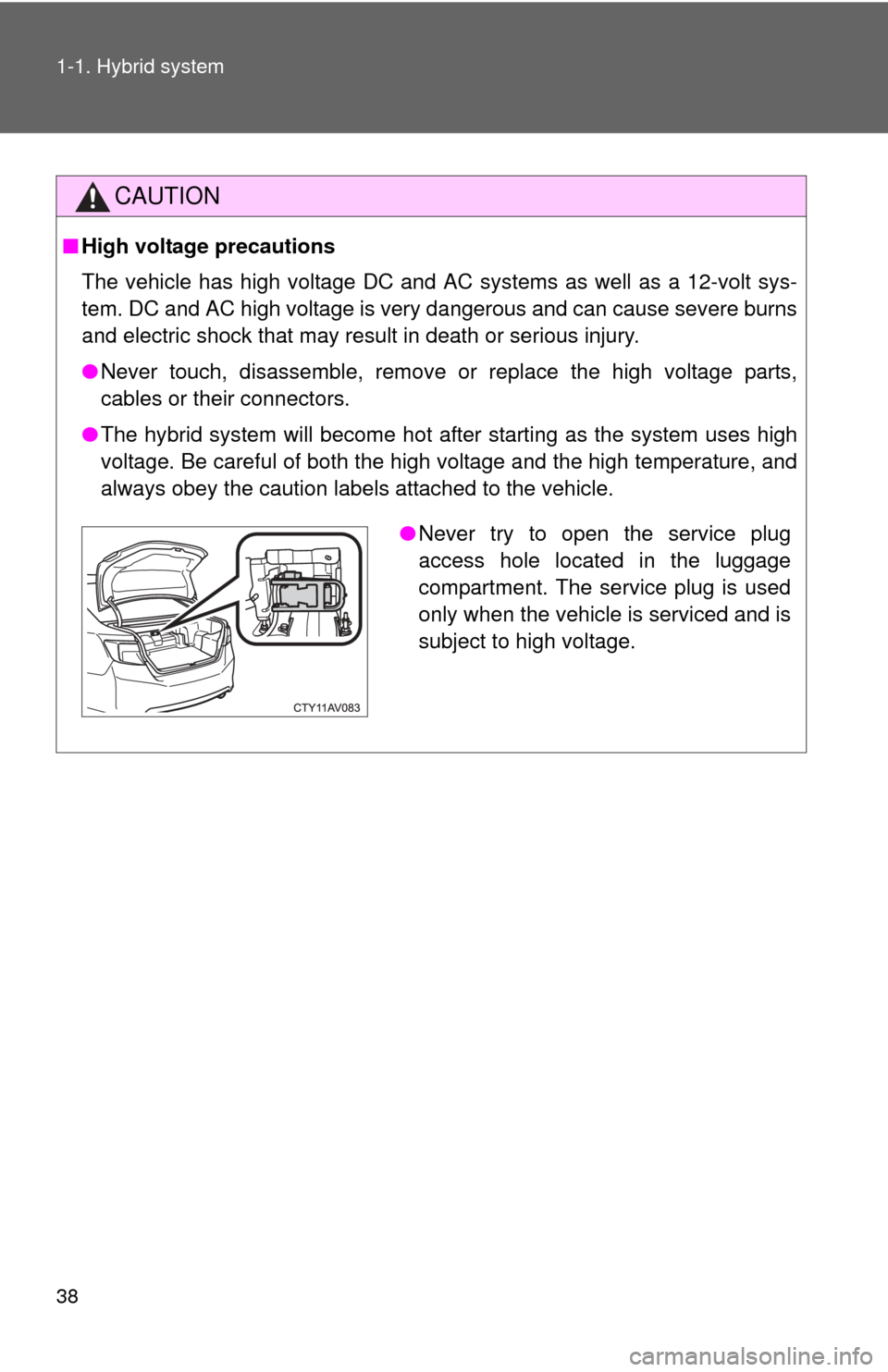
●Never try to open the service plug
access hole located in the luggage
compartment. The service plug is used
only when the vehicle is serviced and is
subject to high voltage.