Page 366 of 530
3646-3. Do-it-yourself maintenance
4RUNNER (U)_(OM35A83U)■
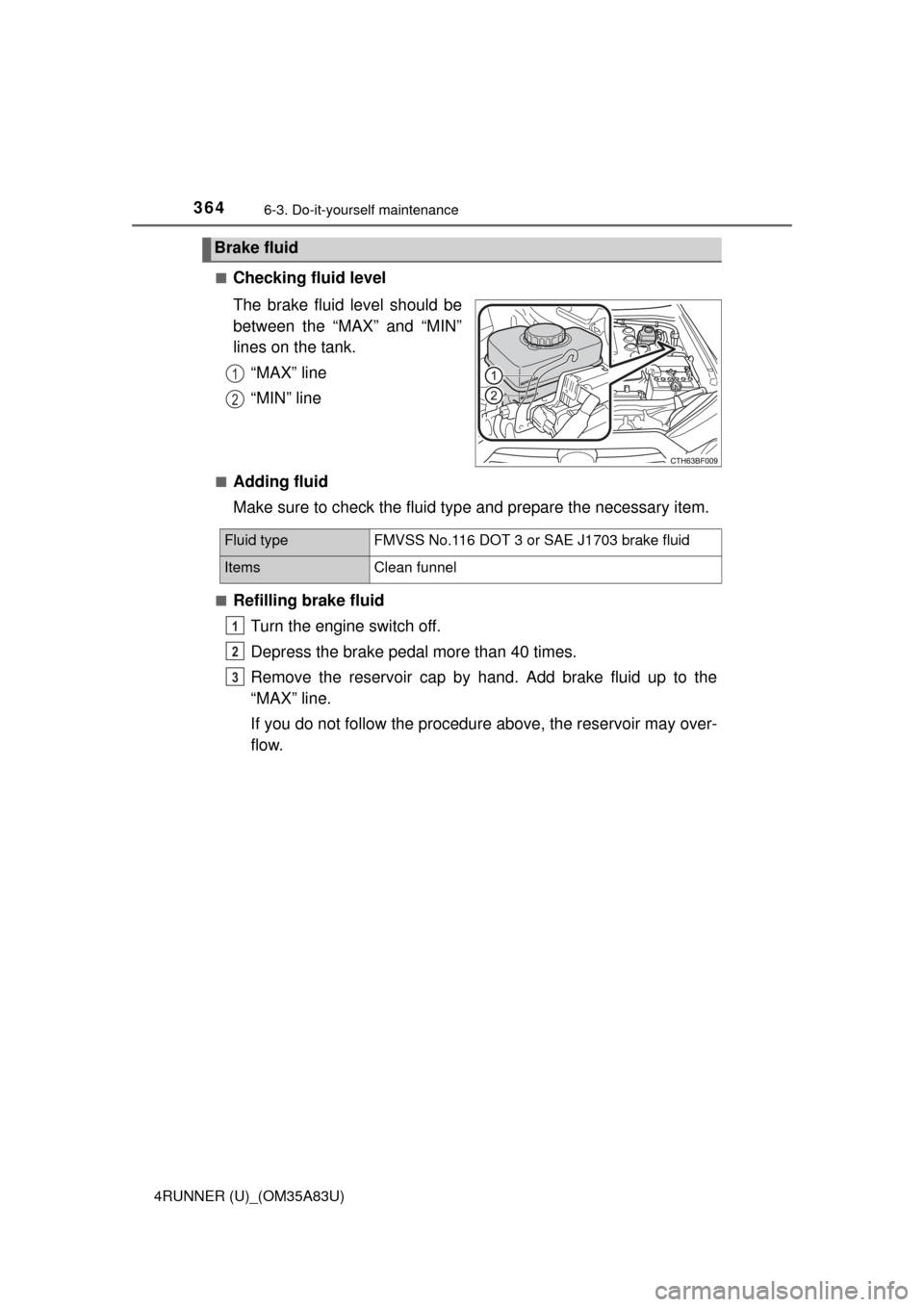
Checking fluid level
The brake fluid level should be
between the “MAX” and “MIN”
lines on the tank.
“MAX” line
“MIN” line
■Adding fluid
Make sure to check the fluid type and prepare the necessary item.
■Refilling brake fluidTurn the engine switch off.
Depress the brake pedal more than 40 times.
Remove the reservoir cap by hand. Add brake fluid up to the
“MAX” line.
If you do not follow the procedure above, the reservoir may over-
flow.
Brake fluid
1
2
Fluid type FMVSS No.116 DOT 3 or SAE J1703 brake fluid
Items Clean funnel
1
2
3
Page 367 of 530
3656-3. Do-it-yourself maintenance
6
Maintenance and care
4RUNNER (U)_(OM35A83U)
■Brake fluid can absorb moisture from the air
Excess moisture in the brake fluid can cause a dangerous loss of braking effi-
ciency. Use only newly opened brake fluid.
CAUTION
■When filling the reservoir
Take care as brake fluid can harm your hands and eyes and damage
painted surfaces.
If fluid gets on your hands or in your eyes, flush the affected area with clean
water immediately.
If you still experience discomfort, see a doctor.
NOTICE
■If the fluid level is low or high
It is normal for the brake fluid level to go down slightly as the brake pads
wear out or when the fluid level in the accumulator is high.
If the reservoir needs frequent refilling, there may be a serious problem.
Page 411 of 530
4097-1. Essential information
7
When trouble arises
4RUNNER (U)_(OM35A83U)
Steadily step on the brake pedal with both feet and firmly depress it.
Do not pump the brake pedal repeatedly as this will increase the effort
required to slow the vehicle.
Shift the shift lever to N.
If the shift lever is shifted to N
After slowing down, stop the vehicle in a safe place by the road.
Stop the engine.
If the shift lever cannot be shifted to N
Keep depressing the brake pedal with both feet to reduce vehicle
speed as much as possible.
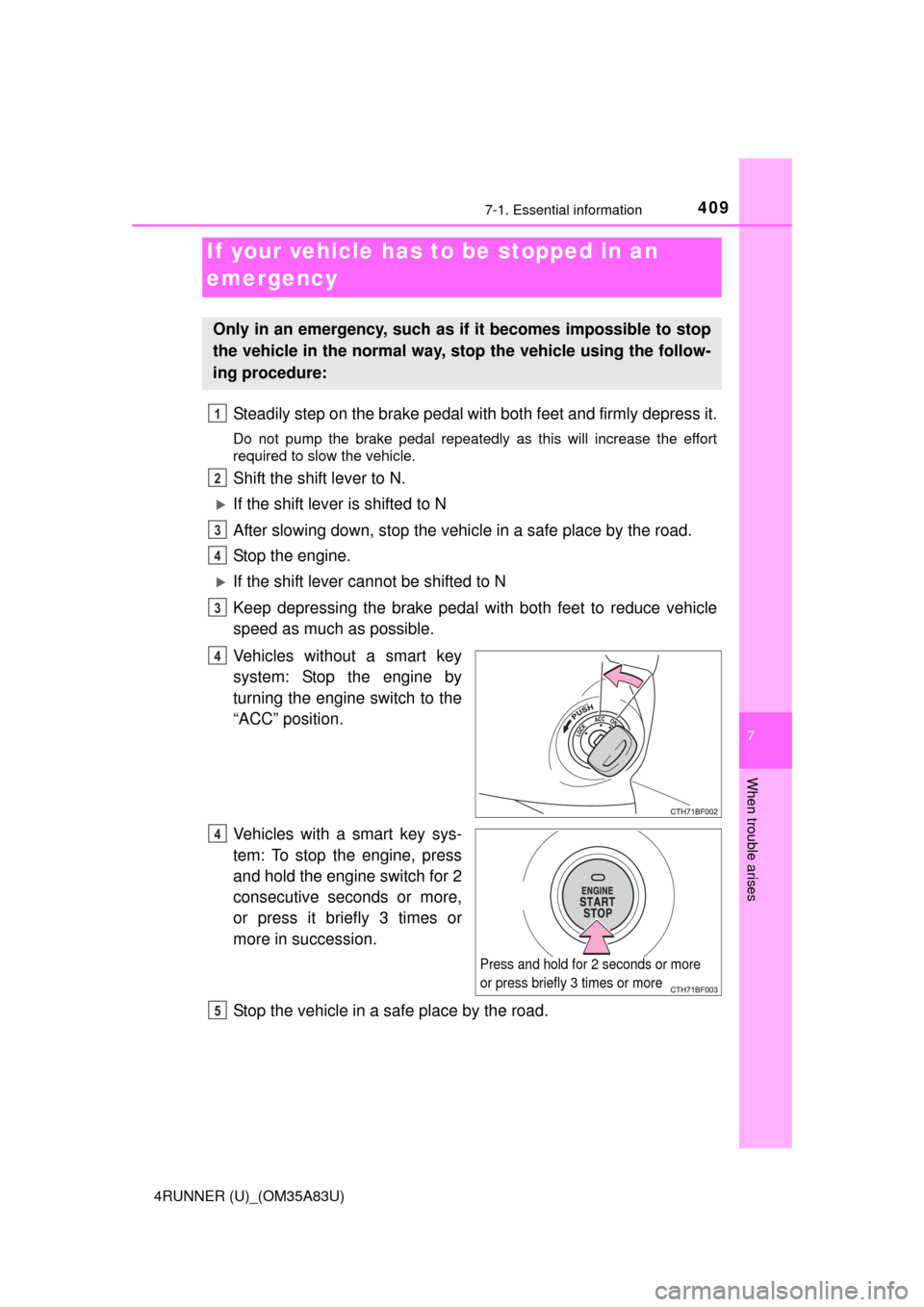
Vehicles without a smart key
system: Stop the engine by
turning the engine switch to the
“ACC” position.
Vehicles with a smart key sys-
tem: To stop the engine, press
and hold the engine switch for 2
consecutive seconds or more,
or press it briefly 3 times or
more in succession.
Stop the vehicle in a safe place by the road.
If your vehicle has to be stopped in an
emergency
Only in an emergency, such as if it becomes impossible to stop
the vehicle in the normal way, st op the vehicle using the follow-
ing procedure:
1
2
3
4
3
4
Press and hold for 2 seconds or more
or press briefly 3 times or more
4
5
Page 412 of 530
4107-1. Essential information
4RUNNER (U)_(OM35A83U)
CAUTION
■If the engine has to be turned off while driving
● Power assist for the brakes and steering wheel will be lost, making the
brake pedal harder to depress and the steering wheel heavier to turn.
Decelerate as much as possible before turning off the engine.
● Vehicles without a smart key system:
Never attempt to remove the key, as doing so will lock the steering wheel.
Page 413 of 530
411
7
When trouble arises
4RUNNER (U)_(OM35A83U)
7-2. Steps to take in an emergency
The following may indicate a problem with your transmission. Contact
your Toyota dealer before towing.
●The engine is running but the vehicle will not move.
● The vehicle makes an abnormal sound.
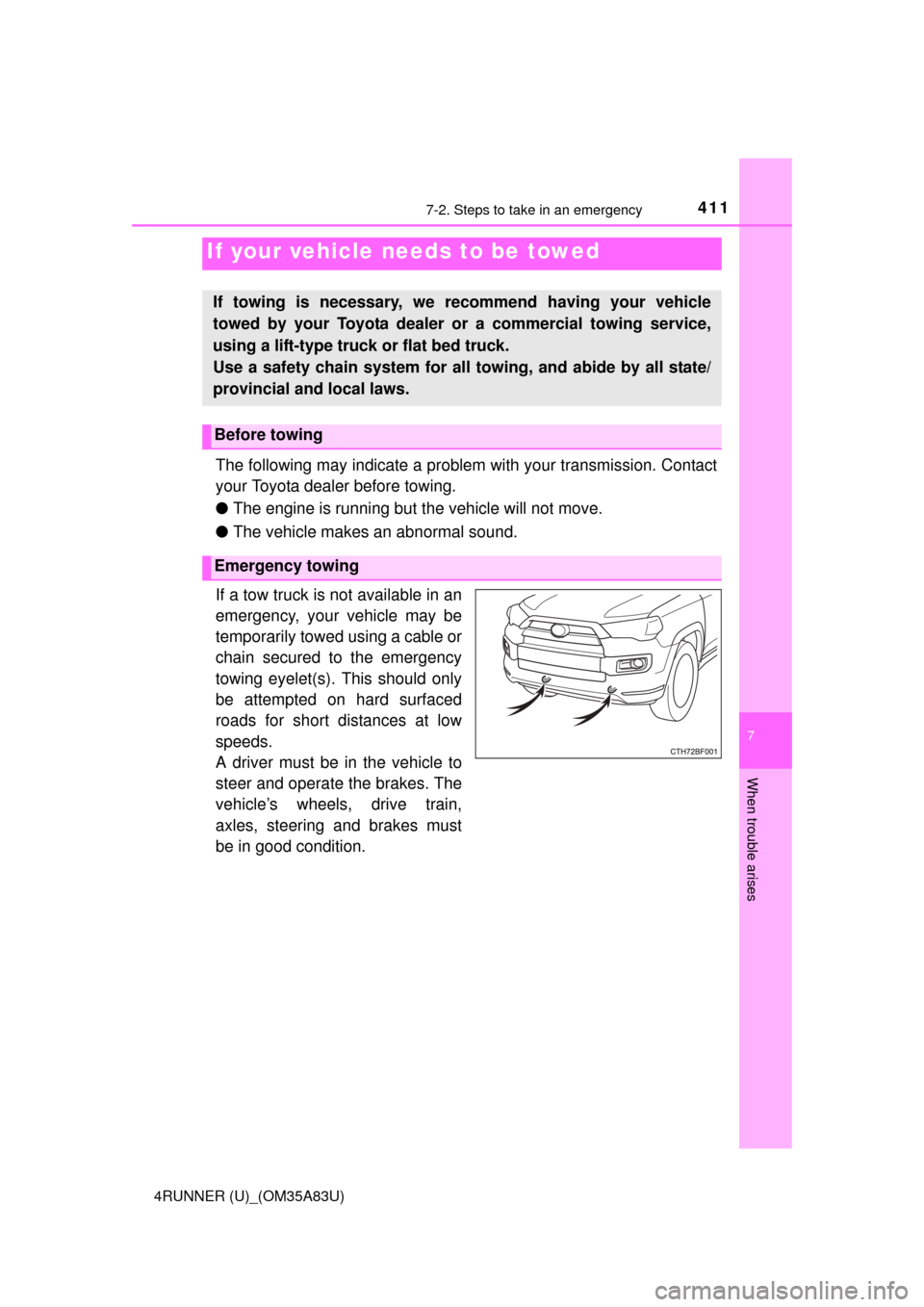
If a tow truck is not available in an
emergency, your vehicle may be
temporarily towed using a cable or
chain secured to the emergency
towing eyelet(s). This should only
be attempted on hard surfaced
roads for short distances at low
speeds.
A driver must be in the vehicle to
steer and operate the brakes. The
vehicle’s wheels, drive train,
axles, steering and brakes must
be in good condition.
If your vehicle needs to be towed
If towing is necessary, we re commend having your vehicle
towed by your Toyota dealer or a commercial towing service,
using a lift-type truc k or flat bed truck.
Use a safety chain system for all towing, and abide by all state/
provincial and local laws.
Before towing
Emergency towing
Page 416 of 530
4147-2. Steps to take in an emergency
4RUNNER (U)_(OM35A83U)
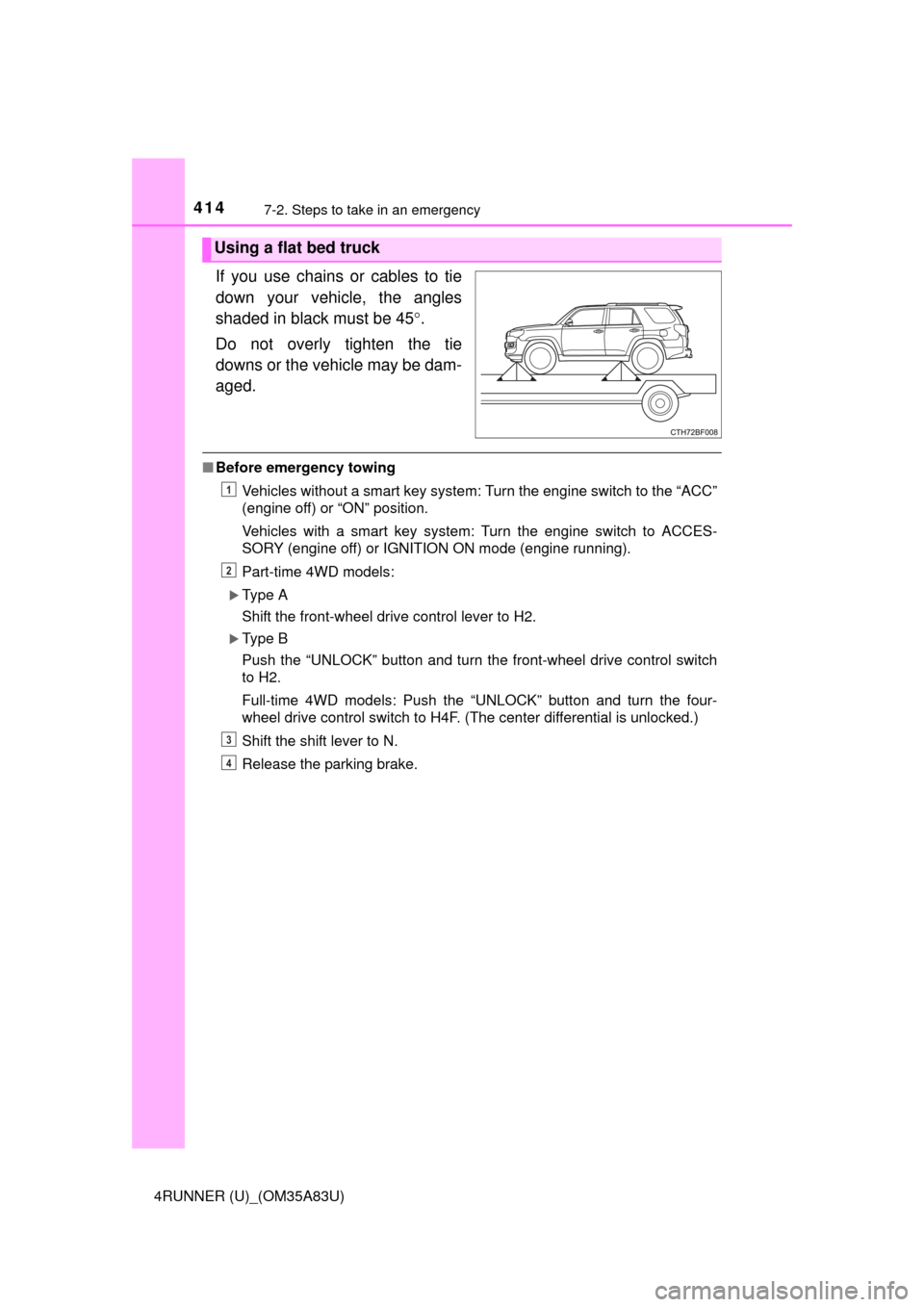
If you use chains or cables to tie
down your vehicle, the angles
shaded in black must be 45.
Do not overly tighten the tie
downs or the vehicle may be dam-
aged.
■ Before emergency towing
Vehicles without a smart key system: Turn the engine switch to the “ACC”
(engine off) or “ON” position.
Vehicles with a smart key system: Turn the engine switch to ACCES- SORY (engine off) or IGNITION ON mode (engine running).
Part-time 4WD models:
Type A
Shift the front-wheel drive control lever to H2.
Type B
Push the “UNLOCK” button and turn the front-wheel drive control switch
to H2.
Full-time 4WD models: Push the “ UNLOCK” button and turn the four-
wheel drive control switch to H4F. (The center differential is unlocked.)
Shift the shift lever to N.
Release the parking brake.
Using a flat bed truck
1
2
3
4
Page 417 of 530
4157-2. Steps to take in an emergency
7
When trouble arises
4RUNNER (U)_(OM35A83U)
CAUTION
■Caution while towing
● Use extreme caution when towing the vehicle.
Avoid sudden starts or erratic driving maneuvers which place excessive
stress on the emergency towing eyelets and the cables or chains. Always
be cautious of the surroundings and other vehicles while towing.
● Vehicles with a smart key system: Do not turn the engine switch off.
Doing so will lock the steering wheel and prevent operation, possibly caus-
ing an accident and resulting in death or serious injury.
● If the engine is not running, the power assist for the brakes and steering
will not function, making steering and braking more difficult.
NOTICE
■To prevent causing serious damage to the transmission and transfer
(4WD models) when towing using a wheel-lift type truck
2WD models: Never tow this vehicle from the front with the rear wheels on
the ground.
4WD models: Never tow this vehicle with any of the wheels in contact with
the ground.
■ To prevent damage to the vehicle when towing using a wheel-lift type
truck
● 2WD models without a smart key system: Do not tow the vehicle from the
rear when the engine switch is in the “LOCK” position or the key is
removed. The steering lock mechanism is not strong enough to hold the
front wheels straight.
● 2WD models with a smart key system: Do not tow the vehicle from the rear
when the engine switch is off. The steering lock mechanism is not strong
enough to hold the front wheels straight.
● When raising the vehicle, ensure adequate ground clearance for towing at
the opposite end of the raised vehicle. Without adequate clearance, the
vehicle could be damaged while being towed.
■ To prevent body damage when towi ng with a sling-type truck
Do not tow with a sling-type truck, either from the front or rear.
■ To prevent causing serious damage to the transmission and transfer
(4WD models) in emergency towing
Never tow a vehicle from the rear with four wheels on the ground. This may
cause serious damage to the transmission and transfer.
Page 418 of 530
4167-2. Steps to take in an emergency
4RUNNER (U)_(OM35A83U)
●Fluid leaks under the vehicle.
(Water dripping from the air co nditioning after use is normal.)
● Flat-looking tires or uneven tire wear
● Engine coolant temperature gauge needle continually points higher
than normal.
● Changes in exhaust sound
● Excessive tire squeal when cornering
● Strange noises related to the suspension system
● Pinging or other noises related to the engine
● Engine missing, stumbling or running roughly
● Appreciable loss of power
● Vehicle pulls heavily to one side when braking
● Vehicle pulls heavily to one side when driving on a level road
● Loss of brake effectiveness, spon gy feeling, pedal almost touches
the floor
If you think something is wrong
If you notice any of the follow ing symptoms, your vehicle proba-
bly needs adjustment or repair. Contact your Toyota dealer as
soon as possible.
Visible symptoms
Audible symptoms
Operational symptoms