2014 SUBARU TRIBECA brake fluid
[x] Cancel search: brake fluidPage 337 of 426
11-4Maintenance and service
guard against getting oil or fluidsin your eyes. If something doesget in your eyes, thoroughlywash them out with clean water.
.Do not tamper with the wiring ofthe SRS airbag system or seat-belt pretensioner system, or at-tempt to take its connectorsapart, as that may activate thesystem or it can render it inop-erative. NEVER use a circuittester for these wiring. If yourSRS airbag or seatbelt preten-sioner needs service, consultyour nearest SUBARU dealer.
&Before checking or servicing
in the engine compartment
WARNING
.Always stop the engine and setthe parking brake firmly to pre-vent the vehicle from moving.
.Always let the engine cool down.Engine parts become very hotwhen the engine is running andremain hot for some time afterthe engine is stopped.
.Do not spill engine oil, enginecoolant, brake fluid or any other
fluid on hot engine components.This may cause a fire.
.Always remove the key from theignition switch. When the ignitionswitch is in the“ON”position,the cooling fan may operatesuddenly even when the engineis stopped.
&When you do checking or
servicing in the engine com-
partment while the engine is
running
WARNING
A running engine can be dangerous.Keep your fingers, hands, clothing,hair and tools away from the coolingfan, belts and any other movingengine parts. Removing rings,watches and ties is advisable.
Engine hood
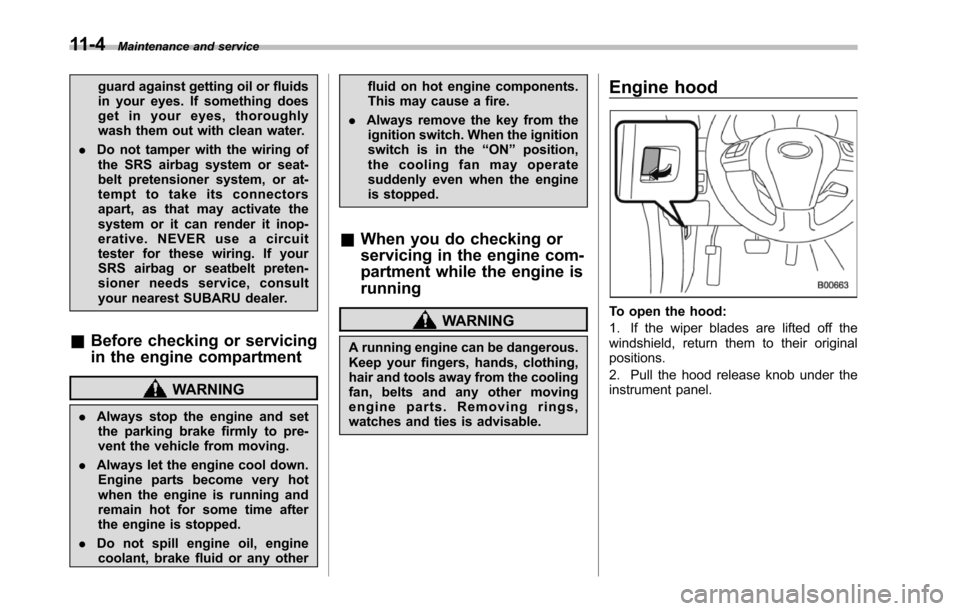
To open the hood:
1. If the wiper blades are lifted off thewindshield, return them to their originalpositions.
2. Pull the hood release knob under theinstrument panel.
Page 339 of 426
11-6Maintenance and service
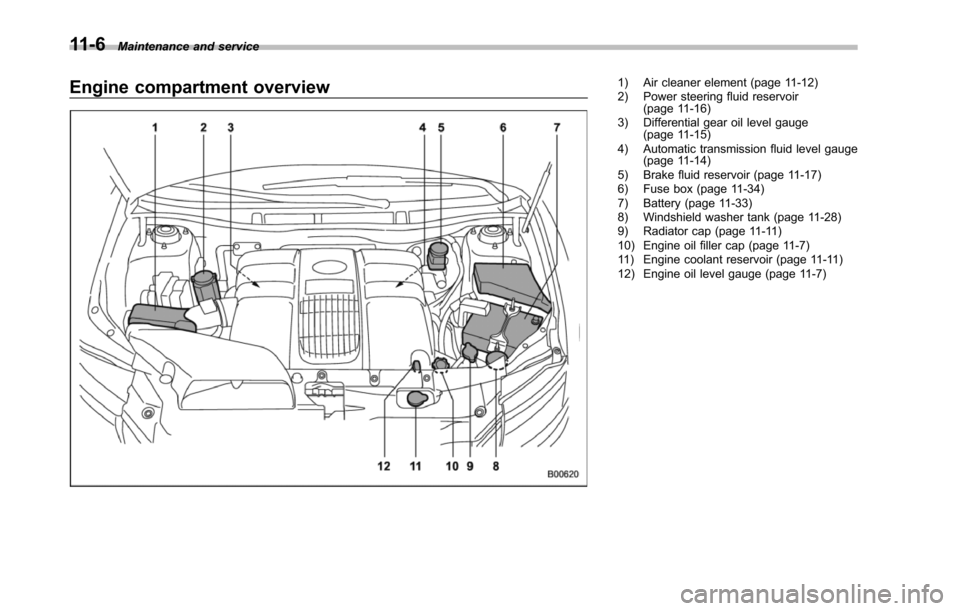
Engine compartment overview1) Air cleaner element (page 11-12)2) Power steering fluid reservoir(page 11-16)3) Differential gear oil level gauge(page 11-15)4) Automatic transmission fluid level gauge(page 11-14)5) Brake fluid reservoir (page 11-17)6) Fuse box (page 11-34)7) Battery (page 11-33)8) Windshield washer tank (page 11-28)9) Radiator cap (page 11-11)10) Engine oil filler cap (page 11-7)11) Engine coolant reservoir (page 11-11)12) Engineoil level gauge (page 11-7)
Page 347 of 426
11-14Maintenance and service
Automatic transmission fluid
&Checking the fluid level
The automatic transmission fluid expandslargely as its temperature rises; the fluidlevel differs according to fluid temperature.Therefore, there are two different scalesfor checking the level of hot fluid and coldfluid on the level gauge.
Though the fluid level can be checkedwithout warming up the fluid on the“COLD”range, we recommend checkingthe fluid level when the fluid is at operatingtemperature.
!Checking the fluid level when thefluid is hot
Check the fluid level monthly.
1. Drive the vehicle several miles to raisethe temperature of the transmission fluidup to normal operating temperature; 158to 1768F (70 to 808C) is normal.
2. Park the vehicle on a level surface andset the parking brake.
3. First shift the select lever in eachposition. Then shift it in the“P”position,and run the engine at idling speed.
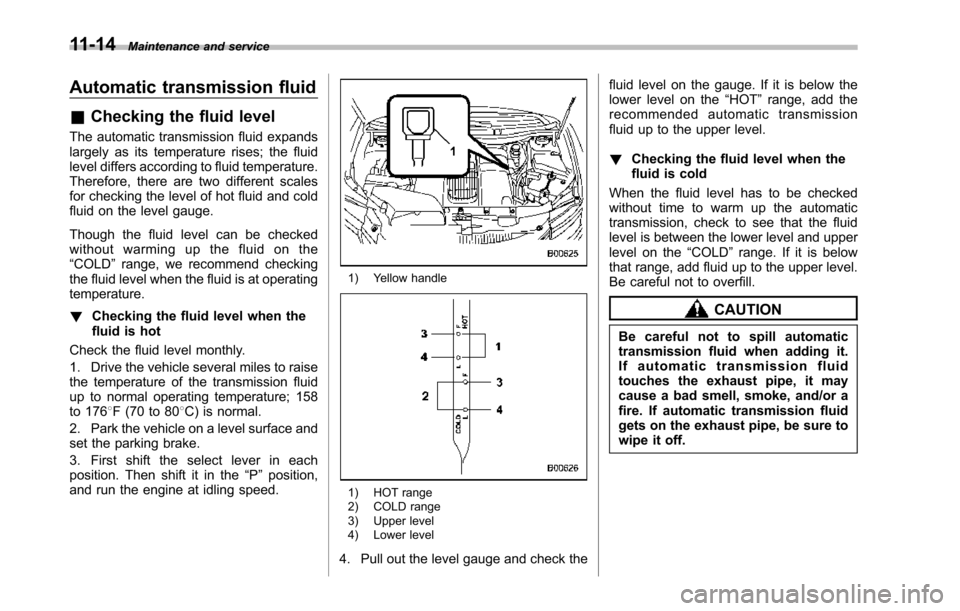
1) Yellow handle
1) HOT range2) COLD range3) Upper level4) Lower level
4. Pull out the level gauge and check the
fluid level on the gauge. If it is below thelower level on the“HOT”range, add therecommended automatic transmissionfluid up to the upper level.
!Checking the fluid level when thefluid is cold
When the fluid level has to be checkedwithout time to warm up the automatictransmission,check to see that the fluidlevel is between the lower level and upperlevel on the“COLD”range. If it is belowthat range, add fluid up to the upper level.Be careful not to overfill.
CAUTION
Be careful not to spill automatictransmission fluid when adding it.If automatic transmission fluidtouches the exhaust pipe, it maycause a bad smell, smoke, and/or afire. If automatic transmission fluidgets on the exhaust pipe, be sure towipe it off.
Page 350 of 426
power steering fluid touches theexhaust pipe, it may cause a badsmell, smoke, and/or a fire. Ifpower steering fluid gets on theexhaust pipe, be sure to wipe itoff.
The power steering fluid expands greatlyas its temperature rises; the fluid leveldiffers according to fluid temperature.Therefore, the reservoir tank has twodifferent checking ranges for hot and coldfluids.
Check the power steering fluid levelmonthly.
1. Park the vehicle on a level surface,and stop the engine.
2. Check the fluid level of the reservoirtank.
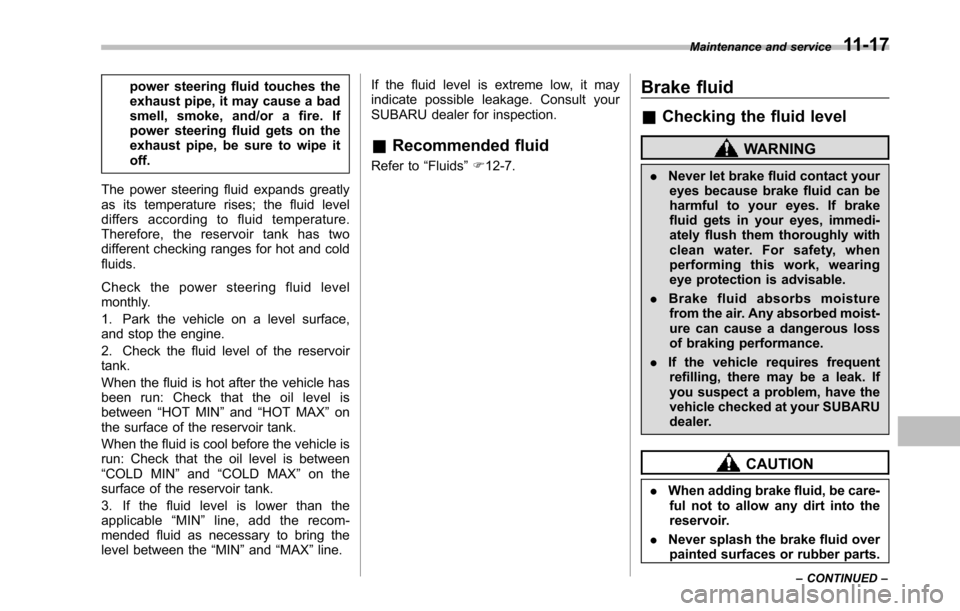
When the fluid is hot after the vehicle hasbeen run: Check that the oil level isbetween“HOT MIN”and“HOT MAX”onthe surface of the reservoir tank.
When the fluid is cool before the vehicle isrun: Check that the oil level is between“COLD MIN”and“COLD MAX”on thesurface of the reservoir tank.
3. If the fluid level is lower than theapplicable“MIN”line, add the recom-mended fluid as necessary to bring thelevel between the“MIN”and“MAX”line.
If the fluid level is extreme low, it mayindicate possible leakage. Consult yourSUBARU dealer for inspection.
&Recommended fluid
Refer to“Fluids”F12-7.
Brake fluid
&Checking the fluid level
WARNING
.Never let brake fluid contact youreyes because brake fluid can beharmful to your eyes. If brakefluid gets in your eyes, immedi-ately flush them thoroughly withclean water. For safety, whenperforming this work, wearingeye protection is advisable.
.Brake fluid absorbs moisturefrom the air. Any absorbed moist-ure can cause a dangerous lossof braking performance.
.If the vehicle requires frequentrefilling, there may be a leak. Ifyou suspecta problem, have thevehicle checked at your SUBARUdealer.
CAUTION
.When adding brake fluid, be care-ful not to allow any dirt into thereservoir.
.Never splash the brake fluid overpainted surfaces or rubber parts.
Maintenance and service11-17
–CONTINUED–
Page 351 of 426
11-18Maintenance and service
Alcohol contained in the brakefluid may damage them.
.Be careful not to spill brake fluidwhen adding it. If brake fluidtouches the exhaust pipe, it maycause a bad smell, smoke, and/ora fire. If brake fluid gets on theexhaust pipe, be sure to wipe itoff.
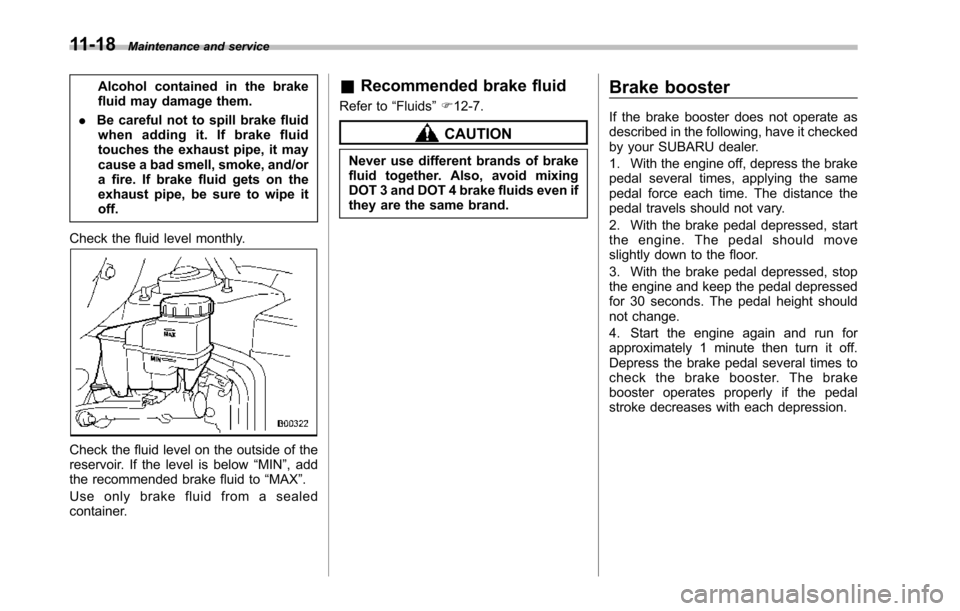
Check the fluid level monthly.
Check thefluid level on the outside of thereservoir. If the level is below“MIN”, addthe recommended brake fluid to“MAX”.
Use only brake fluid from a sealedcontainer.
&Recommended brake fluid
Refer to“Fluids”F12-7.
CAUTION
Never use different brands of brakefluid together. Also, avoid mixingDOT 3 and DOT 4 brake fluids even ifthey are the same brand.
Brake booster
If the brake booster does not operate asdescribed in the following, have it checkedby your SUBARU dealer.
1. With the engine off, depress the brakepedal several times, applying the samepedal force each time. The distance thepedal travels should not vary.
2. With the brake pedal depressed, startthe engine. The pedal should moveslightly down to the floor.
3. With the brake pedal depressed, stopthe engine and keep the pedal depressedfor 30 seconds. The pedal height shouldnot change.
4. Start the engine again and run forapproximately 1 minute then turn it off.Depress the brake pedal several times tocheck the brake booster. The brakebooster operates properly if the pedalstroke decreases with each depression.
Page 384 of 426

&Fluids
FluidFluid type*1Fluid capacity*2Remarks*3
Automatic transmission fluid· SUBARU ATF· IDEMITSU ATF HP10.4 US qt (9.8 liters, 8.6 Imp qt)“Automatic transmission fluid”F11 -14
Power steering fluid
· SUBARU ATF· IDEMITSU ATF HP·“Dexron III”Type AutomaticTransmission Fluid
0.95 US qt (0.9 liters, 0.79 Imp qt)·“Power steering”F7-18·“Power steering fluid”F11-16
Brake fluidFMVSSNo. 116, fresh DOT 3 or DOT 4brake fluid–“Brake fluid”F11-17
*1: Use one of the indicated types of fluid.*2: The indicated fluid quantity is only a guideline. The necessary quantity for replacement may differ slightly depending on the temperature and otherfactors.*3: For moredetails about maintenance and service,referto the indicated section.
&Engine coolant
Coolant type Coolant capacity
SUBARU Super Coolant8.0 US qt (7.6 liters, 6.7 Imp qt)
The indicated coolant quantity is only a guideline. The necessary quantity for replacement may differ slightly depending on the temperature and otherfactors. For more details about maintenance and service, refer to“Cooling system”F11-10.
&Electrical system
Battery type and capacity (5HR) 75D23L (12V-52AH)
Alternator12V-130A
Spark plugsSILFR6C11 (NGK)
Specifications12-7
–CONTINUED–
Page 400 of 426
.Measuring rim
The rim on which a tire is fitted for
physical dimension requirements.
.Normal occupant weight
150 lbs (68 kg) times the number of
occupants specified in the second
column of Table 1 that is appended
to the end of this section.
.Occupant distribution
Distribution of occupants in a vehi-
cle as specified in the third column
of Table 1 that is appended to the
end of this section.
.Open splice
Any parting at any junction of tread,
sidewall, or innerliner that extends
to cord material.
.Outer diameter
The overall diameter of an inflated
new tire.
.Overall width
The linear distance between the
exteriors of the sidewalls of an
inflated tire, including elevations
due to labeling, decorations, or
protective bands or ribs.
.Passenger car tire
A tire intended for use on passen-
ger cars, multipurpose passenger
vehicles, and trucks, that have a
gross vehicle weight rating (GVWR)
of 10,000 lbs (4,535 kg) or less.
.Ply
A layer of rubber-coated parallel
cords.
.Ply separation
Apartingofrubbercompound
between adjacent plies.
.Pneumatic tire
A mechanical device made of rub-
ber, chemicals, fabric and steel or
other materials, that, when
mounted on an automotive wheel,
provides the traction and contains
the gas or fluid that sustains the
load.
.Production options weight
The combined weight of those
installed regular production options
weighing over 5.1 lbs (2.3 kg) in
excess of those standard items
which they replace, not previously
considered in curb weight or acces-
sory weight, including heavy duty
brakes, ride levelers, roof rack,
heavy duty battery, and special
trim.
.Radial ply tire
A pneumatic tire in which the ply
cords that extend to the beads are
laid at substantially 90 degrees to
the centerline of the tread.
.Recommended inflation pres-
sure
The cold inflation pressure recom-
mended by a vehicle manufacturer.
.Reinforced tire
A tire designed to operate at higher
loads and at higher inflation pres-
sures than the corresponding stan-
dard tire.
.Rim
A metal support for a tire or a tire
and tube assembly upon which the
tire beads are seated.
.Rim diameter
Nominal diameter of the bead seat.
.Rim size designation
Rim diameter and width.
Consumer information and Reporting safety defects13-7
–CONTINUED–
Page 411 of 426
14-2Index
AAbbreviation................................................................... 3ABS (Anti-lock Brake System)..................................... 7-20Warning light................................................. 3-15, 7-21Accessories....................................................... 5-2, 11-36Accessory power outlet............................................... 6-10Active head restraint..................................................... 1-6Air cleaner element................................................... 11-12Air conditionerAutomatic climate control system............................... 4-5Air filtration system..................................................... 4-11Airflow........................................................................ 4-2Airflow mode selection.................................................. 4-3Airflow selectionAutomatic climate control system......................... 4-5, 4-8Alarm system............................................................ 2-16All-Wheel Drive warning light....................................... 3-18Aluminum wheel....................................................... 11-27Cleaning............................................................... 10-3Antenna system........................................................... 5-2Anti-lock Brake System (ABS)..................................... 7-20Arming the system..................................................... 2-17Armrest..................................................................... 1-13AT OIL TEMP warning light......................................... 3-13AudioAntenna system....................................................... 5-2Auxiliary input jack................................................. 5-28Control button........................................................ 5-26Set ......................................................................... 5-3Auto-dimming mirror/compass.............................. 3-38, 3-41Automatic climate control system................................... 4-5
Automatic transmission............................................... 7-12Fluid........................................................... 11-14, 12-7MANUAL mode...................................................... 7-16Oil temperature warning light (AT OIL TEMP)............. 3-13Select lever........................................................... 7-13Shift lock function................................................... 7-14Shift lock release.................................................... 7-14SPORT mode........................................................ 7-18Automatic/Emergency Locking Retractor (A/ELR)........... 1-18Auxiliary input jack...................................................... 5-28
BBattery.................................................................... 11-33Drainage prevention function..................................... 2-6Jump starting......................................................... 9-11Replacement (remote keyless entry system).............. 2-11Booster seat.............................................................. 1-36Bottle holder............................................................... 6-9BrakeAssist.................................................................... 7-19Booster....................................................... 7-19, 11-18Fluid........................................................... 11-17, 12-7Pad and lining...................................................... 11-20Parking....................................................... 7-28, 11-20Pedal.................................................................. 11-19System.................................................................. 7-19Brake pedalFree play............................................................. 11-19Reserve distance.................................................. 11-19Brake system............................................................. 7-19Warning light.......................................................... 3-16