2014 SUBARU TRIBECA weight
[x] Cancel search: weightPage 82 of 426

WARNING
Do not attach accessories to thewindshield, or fit an extra-wide mir-ror over the rear view mirror. If theSRS airbag deploys, those objectscould become projectiles that couldseriouslyinjure vehicle occupants.
!Driver’s SRS frontal airbag
The driver’s SRS frontal airbag uses adual stage inflator. The inflator operates indifferent ways depending on the severityof impact, backward-forward adjustmentof the driver’s seat position and whether ornot he/she is wearing the seatbelt.
The backward-forward adjustment of thedriver’s seat position is monitored by the
driver’s seat position sensor under thedriver’s seat.
Whether or not the driver is wearing theseatbelt is monitored by the seatbeltbuckle switch.
Observe the following precautions. Failureto do so may cause the seatbelt buckleswitch and/or the seat position sensor tomalfunction,preventing the SUBARU ad-vanced frontal airbag system from func-tioning correctly or causing the system tofail.
.Do not place articles/metal objects orinstall any accessory other than a genuineSUBARU accessory under the driver’sseat. Do not allow the rear seat occupantto kick the driver’s seat or push up itsbottom surface with his/her feet.
.Do not place a magnet near theseatbelt buckle or under the driver’s seat.
If the seatbelt buckle switch and/or thedriver’s seat position sensor have failed,the SRS airbag system warning light willilluminate. Although the driver’sSRSfrontal airbag can deploy regardless ofthe backward-forward adjustment of thedriver’sseatpositionevenwhenthewarning light illuminates, have the systeminspected by your SUBARU dealer im-mediatelyif the SRS airbag system warn-ing light illuminates.
NOTE
The driver’sSRSsideairbag,SRScurtain airbag and seatbelt preten-sioner are not controlled by theSUBARU advanced frontal airbag sys-tem.
!Front passenger’s SRS frontal air-bag
The front passenger’s SRS frontal airbaguses a dual stage inflator. The inflatoroperates in different ways depending onthe severity of impact.
The total load on the seat is monitored bythe occupant detection system’s weightsensor located under the seat.
The system has another sensor thatmonitors the tension of the front passen-ger seatbelt. Using the total seat load andseatbelt tension data from the sensors,the occupant detection system determineswhether the front passenger’s SRS frontalairbag should or should not be inflated.
The occupant detection system may notinflate the front passenger’s SRS frontalairbag even when the driver’s SRS frontalairbagdeploys. This is normal.
Observe the following precautions. Failureto do so may prevent the SUBARUadvanced frontal airbag system fromfunctioning correctly or cause the systemto fail.
Seat, seatbelt and SRS airbags1-51
–CONTINUED–
Page 87 of 426

1-56Seat, seatbelt and SRS airbags
!Operation
1) Driver’s side2) Passenger’s side
The SRS airbag can function only whenthe ignition switch is in the“ON”position.
The SUBARU advanced frontal airbag
system is designed to determine theactivation or deactivation condition of thefront passenger’sSRSfrontalairbagdepending on the total load on the frontpassenger’s seat monitored by the frontpassenger’s occupant detection systemweight sensor. For this reason, only thedriver’s SRS frontal airbag may deploy inthe event of a collision, but this does notmeanfailure of the system.
If the front sub sensors located on bothsides of the radiator panel and the impactsensors in the airbag control moduledetect a predetermined amount of forceduring a frontal collision, the controlmodule sends signals to the airbagmodule(s) (only driver’s module or bothdriver’s and front passenger’s modules)instructing the module(s) to inflate theSRS frontal airbag(s). The driver’s andfront passenger’s SRS frontal airbags usedual stage inflators. The two inflators ofeach airbag are triggered either sequen-tially or simultaneously, depending on theseverity of impact, backward-forward ad-justmentof the driver’s seat position andfastening/unfastening of the seatbelt in thecase of the driver’s SRS frontal airbag anddepending on the severity of impact andthe total load on the seat in the case of thefront passenger’s SRS frontal airbag.
After deployment, the SRS airbag imme-diately starts to deflate so that the driver’svision is not obstructed. The time requiredfrom detecting impact to the deflation ofthe SRS airbag after deployment is short-er than the blink of an eye.
When only the driver’s SRS frontal airbagdeploys and both the driver’s and frontpassenger’s SRS frontal airbags deploy,the driver’s and front passenger’s seatbeltpretensioners operate at the same time.
Although it is highly unlikely that the SRSairbag would activate in a non-accidentsituation, should it occur, the SRS airbagwill deflate quickly, not obscuring visionand will not interfere with the driver’sability to maintain control of the vehicle.
When the SRS airbag deploys, a sudden,fairly loud inflation noise will be heard andsome smoke will be released. Theseoccurrencesare a normal result of thedeployment. This smoke does not indicatea fire in the vehicle.
CAUTION
Do not touch the SRS airbag systemcomponents around the steeringwheel and dashboard with barehands right after deployment. Doingso can cause burns because the
Page 102 of 426
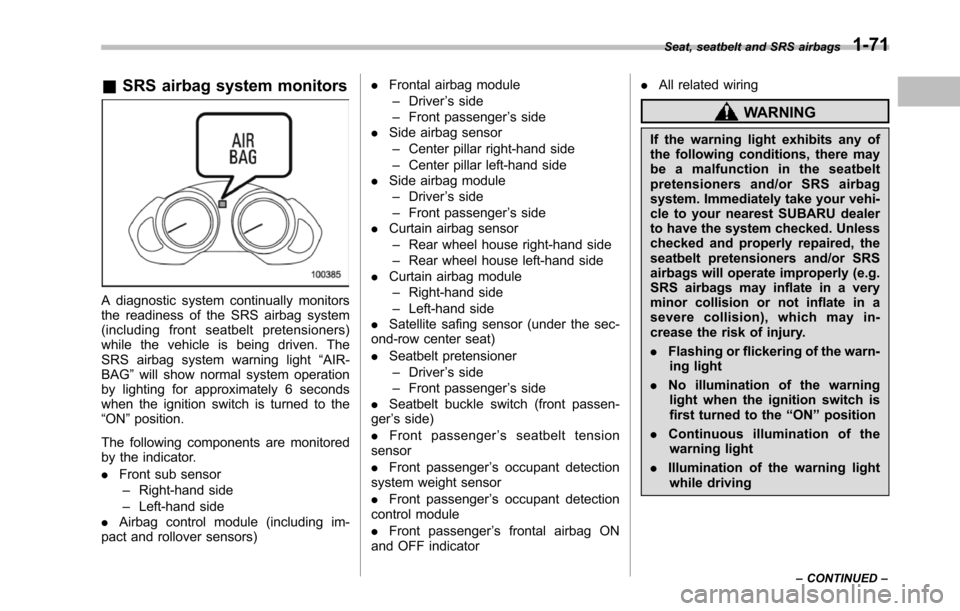
&SRS airbag system monitors
A diagnostic system continually monitorsthe readiness of the SRS airbag system(including front seatbelt pretensioners)while the vehicle is being driven. TheSRS airbag system warning light“AIR-BAG”will show normal system operationby lighting for approximately 6 secondswhen the ignition switch is turned to the“ON”position.
The following components are monitoredby the indicator.
.Front sub sensor–Right-hand side–Left-hand side.Airbag control module (including im-pact and rolloversensors)
.Frontal airbag module–Driver’s side–Front passenger’s side.Side airbag sensor–Center pillar right-hand side–Center pillar left-hand side.Side airbag module–Driver’s side–Front passenger’s side.Curtain airbag sensor–Rear wheel house right-hand side–Rear wheel house left-hand side.Curtain airbag module–Right-hand side–Left-hand side.Satellite safing sensor (under the sec-ond-row center seat)
.Seatbelt pretensioner–Driver’s side–Front passenger’s side.Seatbelt buckleswitch (front passen-ger’s side)
.Front passenger’sseatbelttensionsensor
.Front passenger’s occupant detectionsystem weight sensor
.Front passenger’s occupant detectioncontrolmodule
.Front passenger’s frontal airbag ONand OFF indicator
.All related wiring
WARNING
If the warning light exhibits any ofthe following conditions, there maybe a malfunction in the seatbeltpretensioners and/or SRS airbagsystem. Immediately take your vehi-cle to your nearest SUBARU dealerto have the system checked. Unlesschecked and properly repaired, theseatbelt pretensioners and/or SRSairbags will operate improperly (e.g.SRS airbags may inflate in a veryminor collision or not inflate in asevere collision), which may in-crease the risk of injury.
.Flashing or flickering of the warn-ing light
.No illumination of the warninglight when the ignition switch isfirst turned to the“ON”position
.Continuous illumination of thewarning light
.Illumination of the warning lightwhile driving
Seat, seatbelt and SRS airbags1-71
–CONTINUED–
Page 235 of 426
6-14Interior equipment
.Do not use more than one floormat.Cargo area cover (if
equipped)
The cargo area cover is provided forcovering the cargo area and to protect itscontents from direct sunlight. This cover isdetachable to make room for additionalcargo.
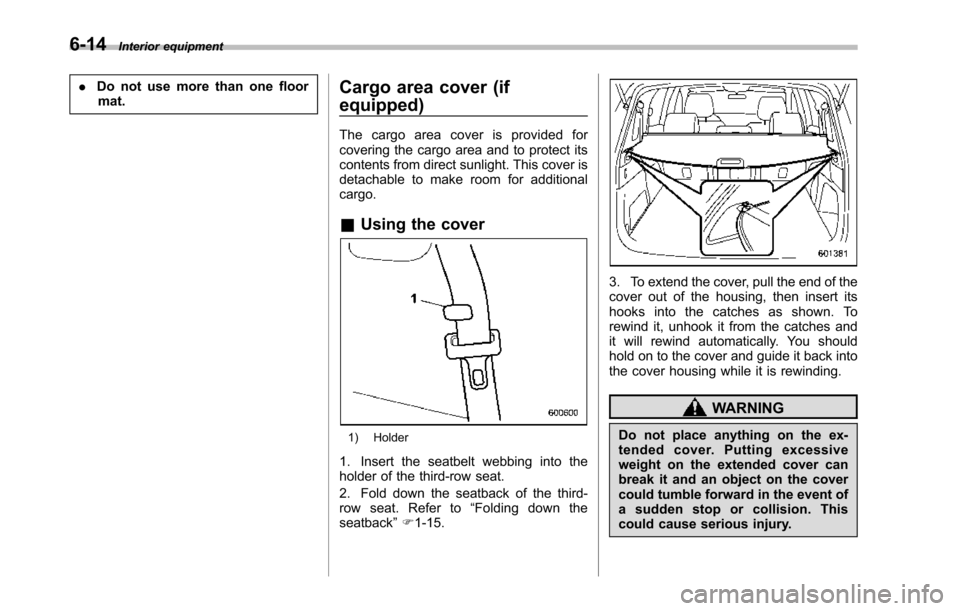
&Using the cover
1) Holder
1. Insert the seatbelt webbing into theholder of the third-row seat.
2. Fold down the seatback of the third-row seat. Refer to“Folding down theseatback”F1-15.
3. To extend the cover, pull the end of thecover out of the housing, then insert itshooks into the catches as shown. Torewind it, unhook it from the catches andit will rewind automatically. You shouldhold on to the cover and guide it back intothe cover housing while it is rewinding.
WARNING
Do not place anything on the ex-tended cover. Putting excessiveweight on the extended cover canbreak it and an object on the covercould tumble forward in the event ofasuddenstoporcollision.Thiscould cause serious injury.
Page 280 of 426
New vehicle break-in driving–the first1,000 miles (1,600 km)..................................... 8-2
Fuel economy hints............................................ 8-2
Engine exhaust gas (carbon monoxide)............ 8-2
Catalytic converter.............................................. 8-3
Periodic inspections........................................... 8-4
Driving in foreign countries............................... 8-4
Driving tips for AWD models.............................. 8-4
On-road and off-road driving.............................. 8-6
Winter driving...................................................... 8-8Operation during cold weather............................. 8-8Driving on snowy and icy roads.......................... 8-9Corrosion protection.......................................... 8-10Snow tires......................................................... 8-10Tire chains......................................................... 8-11Rockingthe vehicle............................................ 8-11
Loading your vehicle......................................... 8-12Vehicle capacity weight...................................... 8-12GVWR and GAWR (Gross Vehicle Weight Ratingand Gross Axle Weight Rating)........................ 8-13Roof rails and crossbar (if equipped).................. 8-14Roof molding and crossbar (if equipped)............ 8-17
Trailer hitch (if equipped).................................. 8-18Connecting a trailer........................................... 8-19When you do not tow a trailer ............................ 8-20
Trailer towing..................................................... 8-21Warranties and maintenance.............................. 8-21Maximum load limits.......................................... 8-21Trailer hitches.................................................... 8-24Connecting a trailer........................................... 8-25Trailer towing tips.............................................. 8-26
Driving tips
8
Page 291 of 426
8-12Driving tips
Loading your vehicle
WARNING
Never allow passengers to ride on afolded rear seatback or in the cargoarea. Doing so may result in seriousinjury.
WARNING
.Never stack luggage or othercargo higher than the top of theseatback because it could tumbleforward and injure passengers inthe event of a sudden stop oraccident. Keep luggage or cargolow, as close to the floor as
possible.
.When you carry something insidethe vehicle, secure it wheneveryou can to prevent it from beingthrown around inside the vehicleduring sudden stops, sharp turnsor in an accident.
.Do not pile heavy loads on theroof. These loads raise the vehi-cle’s center of gravity and make itmore prone to tip over.
.Secure lengthy items properly toprevent them from shooting for-ward and causing serious injuryduring a sudden stop.
.Never exceed the maximum loadlimit. If you do, some parts onyour vehicle can break, or it canchange the way your vehiclehandles. This could result in lossof control and cause personalinjury. Also, overloading canshorten the life of your vehicle.
.Do not place anything on theextended luggage cover. Suchitems could tumble forward inthe event of a sudden stop or acollision. This could cause ser-ious injury.
CAUTION
Do not carry spray cans, containerswith flammable or corrosive liquidsor any other dangerous items insidethe vehicle.
NOTE
For better fueleconomy, do not carryunneeded cargo.
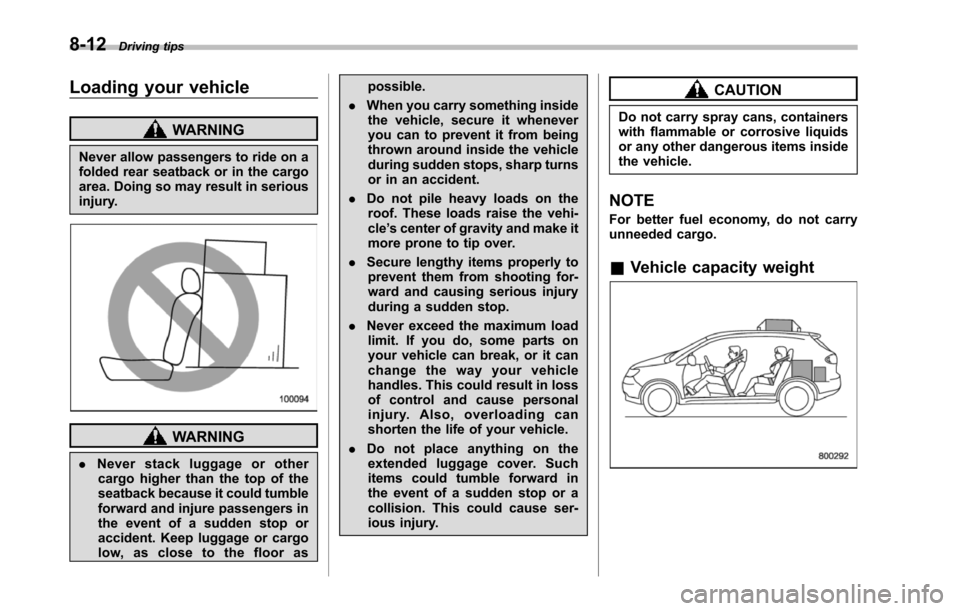
&Vehicle capacity weight
Page 292 of 426
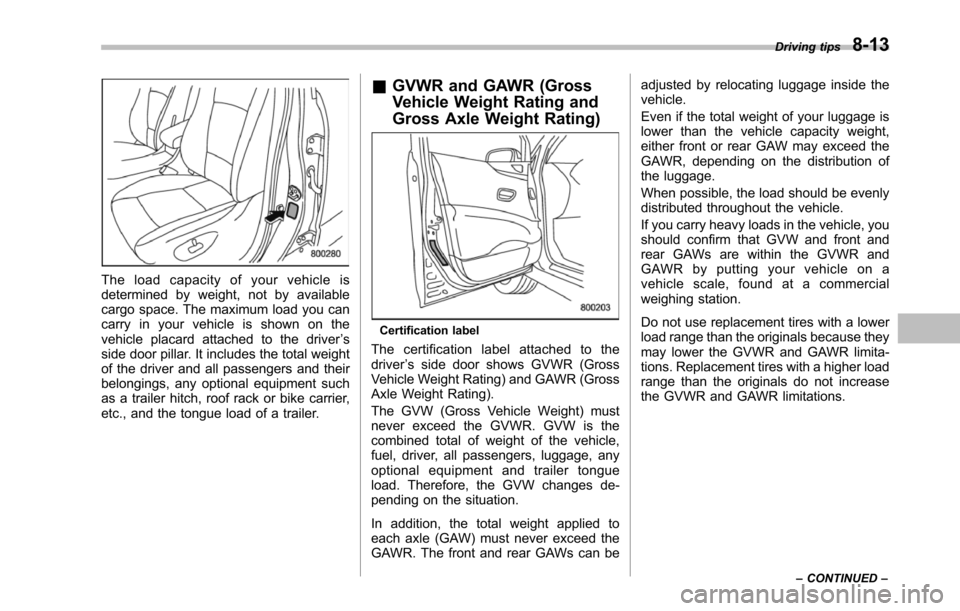
The load capacity of your vehicle isdetermined by weight, not by availablecargospace. The maximum load you cancarry in your vehicle is shown on thevehicle placard attached to the driver’sside door pillar. It includes the total weightof the driver and all passengers and theirbelongings, any optional equipment suchas a trailer hitch, roof rack or bike carrier,etc., and the tongue load of a trailer.
&GVWR and GAWR (Gross
Vehicle Weight Rating and
Gross Axle Weight Rating)
Certification label
The certification label attached to thedriver’s side door shows GVWR (GrossVehicle Weight Rating) and GAWR (GrossAxle Weight Rating).
The GVW (Gross Vehicle Weight) mustnever exceed the GVWR. GVW is thecombined total of weight of the vehicle,fuel, driver, all passengers, luggage, anyoptional equipment and trailer tongueload. Therefore, the GVW changes de-pending on the situation.
In addition, the total weight applied toeach axle (GAW) must never exceed theGAWR. The front and rear GAWs can be
adjusted by relocating luggage inside thevehicle.
Even if the total weight of your luggage islower than the vehicle capacity weight,either front or rear GAW may exceed theGAWR, depending on the distribution ofthe luggage.
When possible, the load should be evenlydistributedthroughout the vehicle.
If you carry heavy loads in the vehicle, youshould confirm that GVW and front andrearGAWs are within the GVWR andGAWR by putting your vehicle on avehicle scale, found at a commercialweighing station.
Do not use replacement tires with a lowerload range than the originals because theymay lower the GVWR and GAWR limita-tions. Replacement tires with a higher loadrange than the originals do not increasethe GVWR and GAWR limitations.
Driving tips8-13
–CONTINUED–
Page 293 of 426
8-14Driving tips
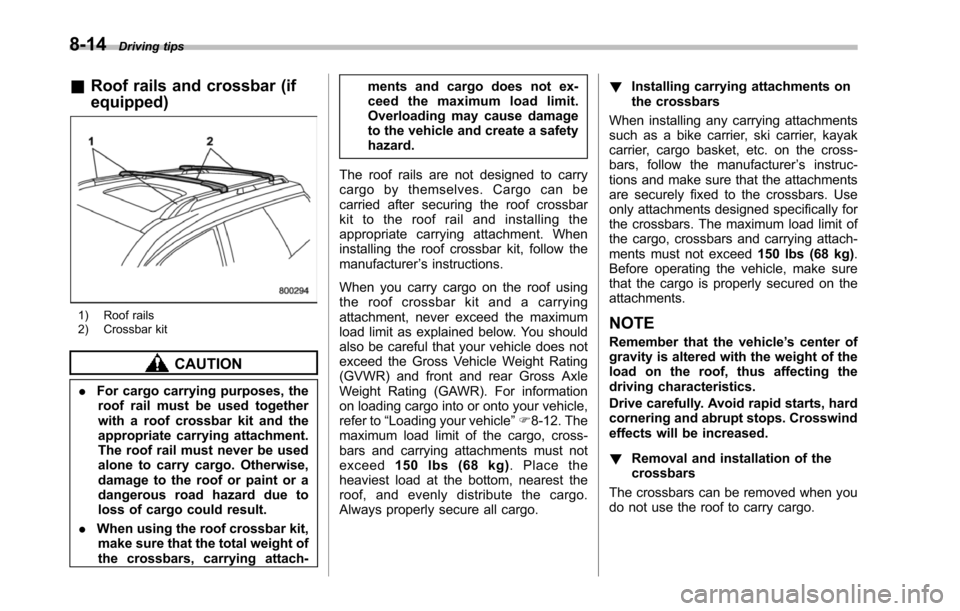
&Roof rails and crossbar (if
equipped)
1) Roof rails2) Crossbar kit
CAUTION
.For cargo carrying purposes, theroof rail must be used togetherwith a roof crossbar kit and theappropriate carrying attachment.The roof rail must never be usedalone to carry cargo. Otherwise,damageto the roof or paint or adangerous road hazard due toloss of cargo could result.
.When using the roof crossbar kit,make sure that the total weight ofthe crossbars,carrying attach-
ments and cargo does not ex-ceed the maximum load limit.Overloading may cause damageto the vehicle and create a safetyhazard.
The roof rails are not designed to carrycargo by themselves. Cargo can becarried after securing the roof crossbarkit to the roof rail and installing theappropriate carrying attachment. Wheninstalling the roof crossbar kit, follow themanufacturer’s instructions.
When you carry cargo on the roof usingthe roof crossbar kit and a carryingattachment, never exceed the maximumload limit as explained below. You shouldalso be careful that your vehicle does notexceed the Gross Vehicle Weight Rating(GVWR) and front and rear Gross AxleWeight Rating (GAWR). For informationon loading cargo into or onto your vehicle,refer to“Loading your vehicle”F8-12. Themaximum load limit of the cargo, cross-bars and carrying attachments must notexceed150 lbs (68 kg).Placetheheaviestload at the bottom, nearest theroof, and evenly distribute the cargo.Always properly secure all cargo.
!Installing carrying attachments onthe crossbars
When installing any carrying attachmentssuch as a bike carrier, ski carrier, kayakcarrier, cargo basket, etc. on the cross-bars, follow the manufacturer’s instruc-tions and make sure that the attachmentsare securely fixed to the crossbars. Useonly attachments designed specifically forthe crossbars. The maximum load limit ofthe cargo, crossbars and carrying attach-ments must not exceed150 lbs (68 kg).Before operating the vehicle, make surethat the cargo is properly secured on theattachments.
NOTE
Remember that the vehicle’s center ofgravity is altered with the weight of theload on the roof, thus affecting thedriving characteristics.
Drive carefully. Avoid rapid starts, hardcornering and abrupt stops. Crosswindeffects will be increased.
!Removal and installation of thecrossbars
The crossbars can be removed when youdo not use the roof to carry cargo.