Page 349 of 426
11-16Maintenance and service
&Recommended grade and
viscosity
Each oil manufacturer has its own baseoils and additives. Never use differentbrands together. For details, refer to“Frontdifferential and rear differential gear oil”F12-6.
Rear differential gear oil
There is no oil level gauge. To check therear differential gear oil level, consult yourSUBARU dealer for inspection.
&Recommended grade and
viscosity
Each oil manufacturer has its own baseoils and additives. Never use differentbrands together. For details, refer to“Frontdifferential and rear differential gear oil”F12-6.
Power steering fluid
&Checking the fluid level
WARNING
Be careful not to burn yourselfbecause the fluid may be hot.
CAUTION
.When power steering fluid isbeing added, use only clean fluid,and be careful not to allow anydirt into the tank. And never usedifferent brands together.
.Be careful not to spill powersteering fluid when adding it. If
Page 350 of 426
power steering fluid touches theexhaust pipe, it may cause a badsmell, smoke, and/or a fire. Ifpower steering fluid gets on theexhaust pipe, be sure to wipe itoff.
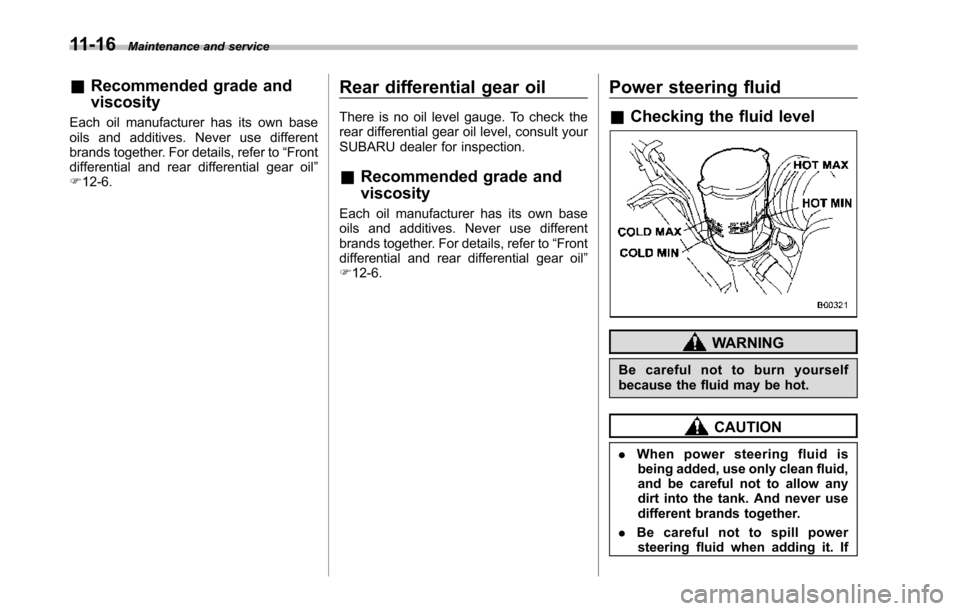
The power steering fluid expands greatlyas its temperature rises; the fluid leveldiffers according to fluid temperature.Therefore, the reservoir tank has twodifferent checking ranges for hot and coldfluids.
Check the power steering fluid levelmonthly.
1. Park the vehicle on a level surface,and stop the engine.
2. Check the fluid level of the reservoirtank.
When the fluid is hot after the vehicle hasbeen run: Check that the oil level isbetween“HOT MIN”and“HOT MAX”onthe surface of the reservoir tank.
When the fluid is cool before the vehicle isrun: Check that the oil level is between“COLD MIN”and“COLD MAX”on thesurface of the reservoir tank.
3. If the fluid level is lower than theapplicable“MIN”line, add the recom-mended fluid as necessary to bring thelevel between the“MIN”and“MAX”line.
If the fluid level is extreme low, it mayindicate possible leakage. Consult yourSUBARU dealer for inspection.
&Recommended fluid
Refer to“Fluids”F12-7.
Brake fluid
&Checking the fluid level
WARNING
.Never let brake fluid contact youreyes because brake fluid can beharmful to your eyes. If brakefluid gets in your eyes, immedi-ately flush them thoroughly withclean water. For safety, whenperforming this work, wearingeye protection is advisable.
.Brake fluid absorbs moisturefrom the air. Any absorbed moist-ure can cause a dangerous lossof braking performance.
.If the vehicle requires frequentrefilling, there may be a leak. Ifyou suspecta problem, have thevehicle checked at your SUBARUdealer.
CAUTION
.When adding brake fluid, be care-ful not to allow any dirt into thereservoir.
.Never splash the brake fluid overpainted surfaces or rubber parts.
Maintenance and service11-17
–CONTINUED–
Page 381 of 426
12-4Specifications
&Engine oil
For the checking, adding and replacing procedure or other details, refer to“Engine oil”F11-7.
NOTE
The procedure for changing the engine oil and oil filter should be performed by a properly-trained expert. It is recommendedthat you have this service performed by your SUBARU dealer.
!Approved engine oil
Always use the SUBARU approved engine oil. For further details, please contact your SUBARU dealer.If the approved engine oil is unavailable, use the alternative engine oil described on the next page.
!Alternative engine oil
If the SUBARU approved oil is unavailable, the following alternative oil can be used.
NOTE
.Each quantity indicated is only a guideline. The necessary quantity for replacement may differ slightly depending on thetemperature and other factors..In choosing an oil, you want the proper quality and viscosity, as well as one that will enhance fuel economy. Oils of lowerviscosity provide better fuel economy. However, in hot weather, oil of higher viscosity is required to properly lubricate theengine. The following table lists the recommended viscosities and applicable temperatures..When adding oil, different brands may be used togetheras long as they are the same API classification and SAE viscosityas those recommended by SUBARU.
Page 412 of 426
Braking..................................................................... 7-19Tips . . . . . . . . . . . . . . . . . . . . . . . . . . . . . . . . . . . . . . . . . . . . . . . . . . . . . . . . . . . . . . . . . . . . . . 7-19Breaking-in of new brake pads and linings................... 11-20BulbChart.................................................................. 12-12Replacing............................................................. 11-36
CCargo areaCover................................................................... 6-14Light....................................................................... 6-3Tie-down hooks..................................................... 6-16Catalytic converter....................................................... 8-3CenterConsole.................................................................. 6-6Ventilators............................................................... 4-4ChangingCoolant................................................................ 11-11Flat tire................................................................... 9-6Oil andoil filter...................................................... 11-8Charge warning light.................................................. 3-13CHECKENGINE warning light/Malfunction indicatorlight....................................................................... 3-12CheckingBrake pedal free play............................................ 11-19Brake pedal reserve distance................................. 11-19Coolant level........................................................ 11-11Fluid level (automatic transmission fluid).................. 11-14Fluid level (brake fluid).......................................... 11-17Fluidlevel (power steering fluid).............................. 11-16Fluid level (washer fluid)........................................ 11-28
Oil level (engine oil)................................................ 11-7Oil level (front differential gear oil).......................... 11-15Child restraint systems................................................ 1-29Installation of a booster seat.................................... 1-36Installation with A/ELR seatbelt ................................ 1-32Lower and tether anchorages................................... 1-37Top tether anchorages............................................ 1-40Child safety................................................................... 5Locks.................................................................... 2-21ChimeKey........................................................................ 3-4Light..................................................................... 3-27Seatbelt................................................................. 3-10CleaningAluminum wheels................................................... 10-3Interior.................................................................. 10-5Ventilation grille...................................................... 4-10Climate control systemAutomatic............................................................... 4-5Clock................................................................ 3-22, 3-24Coat hook.................................................................. 6-12Compass........................................................... 3-38, 3-41Console..................................................................... 6-6Coolant........................................................... 11-11, 12-7Cooling system........................................................ 11-10Corrosionprotection.................................................... 10-4Cruise control............................................................ 7-29Indicator light......................................................... 3-22Set indicator light.................................................... 3-22Cup holder................................................................. 6-8Front passenger’s.................................................... 6-8
Index14-3