2014 SUBARU IMPREZA WRX spare wheel
[x] Cancel search: spare wheelPage 345 of 414
11-26Maintenance and service/Tires and wheels
rough surface, they can suffer damage
that cannot be seen with the naked eye.
This type of damage does not become
evident until time has passed. Try not
to drive over curbs, potholes or on
other rough surfaces. If doing so is
unavoidable, keep the vehicle’s speed
down to a walking pace or less, and
approach the curbs as squarely as
possible. Also, make sure the tires are
not pressed against the curb when you
park the vehicle.. If you feel unusual vibration while
driving or find it difficult to steer the
vehicle in a straight line, one of the
tires and/or wheels may be damaged.
Drive slowly to the nearest authorized
SUBARU dealer and have the vehicleinspected.
& Tire pressures and wear
Maintaining the correct tire pressures
helps to maximize the tires ’service lives
and is essential for good running perfor-
mance. Check and, if necessary, adjust
the pressure of each tire (including the
spare) at least once a month (for example,
during a fuel stop) and before any long
journey.
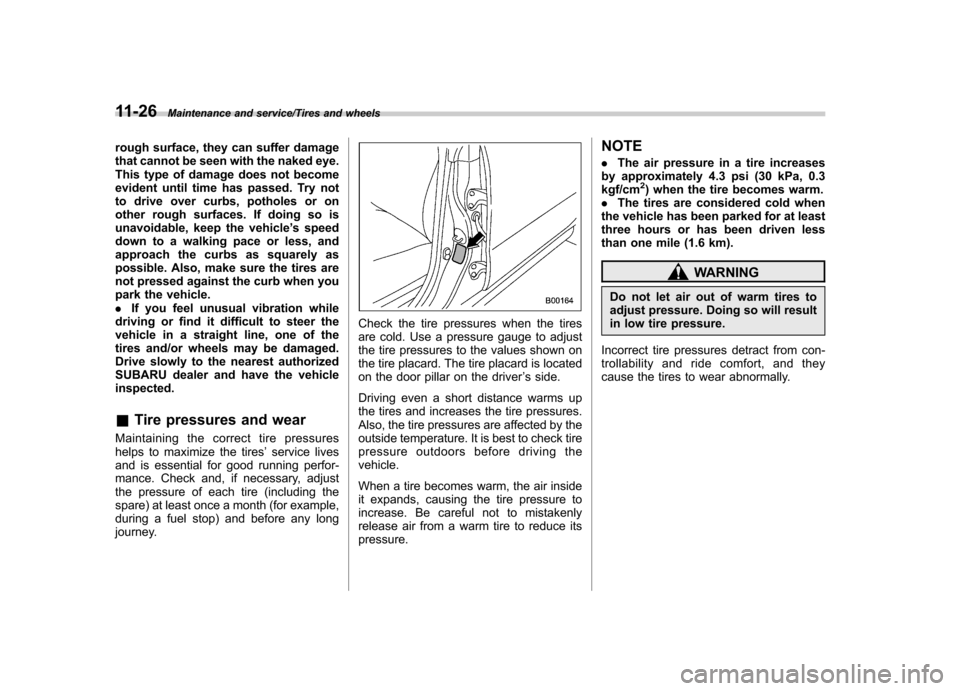
Check the tire pressures when the tires
are cold. Use a pressure gauge to adjust
the tire pressures to the values shown on
the tire placard. The tire placard is located
on the door pillar on the driver ’s side.
Driving even a short distance warms up
the tires and increases the tire pressures.
Also, the tire pressures are affected by the
outside temperature. It is best to check tire
pressure outdoors before driving thevehicle.
When a tire becomes warm, the air inside
it expands, causing the tire pressure to
increase. Be careful not to mistakenly
release air from a warm tire to reduce itspressure. NOTE .
The air pressure in a tire increases
by approximately 4.3 psi (30 kPa, 0.3 kgf/cm
2) when the tire becomes warm.
. The tires are considered cold when
the vehicle has been parked for at least
three hours or has been driven less
than one mile (1.6 km).
WARNING
Do not let air out of warm tires to
adjust pressure. Doing so will result
in low tire pressure.
Incorrect tire pressures detract from con-
trollability and ride comfort, and they
cause the tires to wear abnormally.
Page 376 of 414

&Tires
Tire size 235/45R17 245/40R18
Wheel size 1768J 18 68
1/2J
Pressure Front 33 psi (230 kPa, 2.3 kgf/cm2)
Rear 32 psi (220 kPa, 2.2 kgf/cm2)
Temporary spare tire Size T135/70 D17
Pressure 60 psi (420 kPa, 4.2 kgf/cm
2)
Wheel nut tightening torque 72 lbf·ft (100 N·m, 10 kgf·m)*
*: This torque is equivalent to applying approximately 88 to 110 lbf (40 to 50 kgf) at the edge of the wheel nut wrench. If you have tightened the wheel
nuts by yourself, have the tightening torque checked at the nearest automotive service facility as soon as possible.
Specifications/Specifications12-9
Page 400 of 414
Uniform tire quality grading standards
This information indicates the rela-
tive performance of passenger car
tires in the area of treadwear,
traction, and temperature resis-
tance. This is to aid the consumer
in making an informed choice in the
purchase of tires.
Quality grades can be found where
applicable on the tire sidewall be-
tween tread shoulder and maxi-
mum section width. For example:
Treadwear 200 Traction AA Tem-
perature A
The quality grades apply to new
pneumatic tires for use on passen-
ger cars. However, they do not
apply to deep tread, winter type
snow tires, space-saver or tempor-
ary use spare tires, tires with
nominal rim diameters of 12 inches
or less, or to some limited produc-
tion tires.
All passenger car tires must con-form to Federal Safety Require-
ments in addition to these grades.
& Treadwear
The treadwear grade is a compara-
tive rating based on the wear rate of
the tire when tested under con-
trolled conditions on a specified
government test course.
For example, a tire graded 150
would wear one and one-half (1-
1/2) times as well on the govern-
ment course as a tire graded 100.
The relative performance of tires
depends upon the actual conditions
of their use, however, and may
depart significantly from the norm
due to variations in driving habits,
service practices and differences in
road characteristics and climate. & Traction AA, A, B, C
The traction grades, from highest to
lowest, are AA, A, B and C. Those
grades represent the tire ’s ability to
stop on wet pavement as measured
under controlled conditions on spe- cified government test surfaces of
asphalt and concrete. A tire marked
C may have poor traction perfor- mance.
WARNING
The traction grade assigned to
this tire is based on straight-
ahead braking traction tests,
and does not include accel-
eration, cornering, hydroplan-
ing, or peak traction charac-teristics.
& Temperature A, B, C
The temperature grades are A (the
highest), B, and C, representing thetire ’s resistance to the generation of
heat and its ability to dissipate heat
when tested under controlled con-
ditions on a specified indoor labora-
tory test wheel. Sustained high
temperature can cause the material
of the tire to degenerate and reduce
tire life, and excessive temperature
can lead to sudden tire failure. The
Consumer information and Reporting safety defects/Uniform tire quality grading standards13-15
– CONTINUED –
Page 410 of 414

Warnings................................................................... 2
Satellite radio ............................................................ 5-13
Seat
Fabric ................................................................... 10-5
Front ...................................................................... 1-2
Heater .................................................................... 1-6
Rear ....................................................................... 1-7
Seatbelt ................................................................. 5, 1-11
Fastening .............................................................. 1-12
Maintenance .......................................................... 1-19
Pretensioners ........................................................ 1-19
Safety tips ............................................................. 1-11
Warning light and chime ......................................... 3-13
Security Alarm system ........................................................ 2-15
ID plate ................................................................... 2-3
Immobilizer. ............................................................. 2-2
Indicator light ......................................................... 3-23
Shock sensors ....................................................... 2-19
Shift-up indicator light ................................................. 3-23
Shock sensors ........................................................... 2-19
Shopping bag hook .................................................... 6-11
SI-DRIVE Indicator light ......................................................... 3-23
SI-DRIVE mode ......................................................... 7-22
Snow tires ......................................................... 8-8, 11-24
Snowy and icy roads .................................................... 8-7
Sounding a panic alarm .............................................. 2-10
Spark plugs ...................................................... 11-14, 12-3
Specifications ............................................................ 12-2
Speedometer ............................................................... 3-7 SRS
Frontal airbag ......................................................... 1-43
SRS airbag (Supplemental Restraint System airbag)... 5, 1-34
SRS airbag system Monitors ................................................................ 1-55
Servicing ............................................................... 1-56
Warning light .......................................................... 3-14
Starting the engine ...................................................... 7-9
State emission testing (U.S. only) .................................. 7-7
Steering wheel Power ................................................................... 7-24
Tilt/telescopic ......................................................... 3-48
Stop light ................................................................. 11-43
Stopping the engine .................................................... 7-10
Storage compartment ................................................... 6-4
Sun shade ................................................................. 2-29
Sun visors .................................................................. 6-4
Supplemental Restraint System airbag (SRS) ................ 1-34
Synthetic leather upholstery ......................................... 10-5
T
Tachometer ................................................................. 3-9
Temperature gauge ..................................................... 3-10
Temperature warning light
Rear differential oil .................................................. 3-16
Temporary spare tire .................................................... 9-2
Tether (child restraint system) .............................. 1-29, 1-31
Tie-down hooks .......................................................... 9-13
Tire................................................................. 11-24, 12-9 Chains ................................................................... 8-9
Inspection ............................................................ 11-25 Index
14-9