2014 SMART FORTWO COUPE ECU
[x] Cancel search: ECUPage 46 of 222

R
Your vehicle is equipped with air bag
technology designed to turn off the
passenger front air bag in your vehicle
when the Occupant Classification System
senses the weight of a typical
12‑month‑old child or less along with the
weight of an appropriate child restraint
on the passenger seat.
R A child in a rear-facing child restraint
on the passenger seat may be seriously
injured or even killed if the passenger
front air bag inflates in a collision.
R If you install a rear-facing child
restraint on the passenger seat, make
sure the 0073006Findicator lamp
is illuminated, indicating that the
passenger front air bag is deactivated.
Should the 0073006Findicator
lamp not illuminate or go out while the
restraint is installed, please check
installation. Periodically check the
0073006Findicator lamp while
driving to make sure the
0073006Findicator lamp is illu-
minated. If the 0073006Findica-
tor lamp goes out or remains out, do not
transport a child on the passenger seat
until the system has been repaired. A
child in a rear-facing child restraint on
the passenger seat may be seriously
injured or even killed if the passenger
front air bag inflates.
R If you place a child in a forward-facing
child restraint on the passenger seat,
move the seat as far back as possible, use
a proper child restraint recommended
for the age, size and weight of the child,
and secure child restraint with the vehi-
cle’s seat belt according to the child seat
manufacturer’s instructions. For chil-
dren larger than the typical
12‑month‑old child, the passenger front
air bag may or may not be activated. G
WARNING
Infants and small children should never
share a seat belt with another occupant.
During an accident, they could be crushed
between the occupant and seat belt.
A child’s risk of serious or fatal injuries
is significantly increased if the child
restraints are not properly secured in the
vehicle and/or the child is not properly
secured in the child restraint.
Children too big for a toddler restraint
must ride in a seat using regular seat belt.
Position shoulder belt across chest and
shoulder, not face or neck. A booster seat
may be necessary to achieve proper seat
belt positioning for children over 41 lbs
until they reach a height where a lap-
shoulder belt fits properly without a boos-
ter.
When the child restraint is not in use,
remove it from the vehicle or secure it with
the seat belt to prevent the child restraint
from becoming a projectile in the event of
an accident.
Do not leave children unattended in the
vehicle, even if the children are secured in
a child restraint system. Unsupervised
children in a child restraint system may
use vehicle equipment and may cause an
accident and/or serious personal injury.
If you are using a rear-facing child
restraint system on the passenger seat, you
must verify that the passenger front air bag
is deactivated. When the passenger front
air bag is deactivated, the
0073006Findicator lamp is illumi-
nated (Y page 41).
Top tether
Top tether permits an additional connec-
tion between a child restraint system and
the passenger seat. Proper usage of the top
tether, in accordance with instructions
provided by the child restraint manufac-
turer, can further reduce the risk of inju-
ries. 44
Occupant safety>> Safety.
Page 47 of 222

The top tether anchorage is located on the
floor of the cargo compartment. The top
tether guide for the top tether strap is
located above, on the head restraint. X
Thread top tether strap 0083through top
tether guide 0043down the back of
passenger seat 0044to top tether anchor-
age 0087.
X Attach top tether hook 0085to top tether
anchorage 0087on the floor of the cargo
compartment.
i If you are using divider plus*, the
hooks of the top tether and the divider
plus* are attached to the same anchorage.
X Install the child restraint system and
tighten top tether strap 0083according to
the child restraint manufacturer’s
instructions. G
WARNING
After installing top tether straps, make
sure the seat backrests are in an upright
position and are properly locked. Push and pull on the seat backrests to ensure they are
properly secured in the locked position. If
a seat backrest is not properly locked, the
seat backrest could fold. The child seat
would no longer be properly supported or
positioned to provide its intended bene-
fit. That could cause serious or even fatal
injuries. Panic alarm
X
Activating: Press and hold button 0043for
at least 1 second.
An audible alarm and flashing exterior
lamps will operate briefly.
X Deactivating: Press button0043once more.
or
X Insert the key in the starter switch.
i USA only:
This device complies with Part 15 of the
FCC Rules. Operation is subject to the
following two conditions:
1. This device may not cause harmful
interference, and
2. this device must accept any interfer-
ence received, including interference
that may cause undesired operation.
Any unauthorized modification to this
device could void the user’s authority to
operate the equipment.
The product label with FCC ID and IC cer-
tification number can be found in the
battery case. Panic alarm
45>> Safety.
* optional Z
Page 60 of 222
Seats
Safety notes
G
WARNING
All seat adjustments, as well as fastening
of seat belts, must be done before the vehi-
cle is operated. G
WARNING
When adjusting the seat, make sure no one
becomes trapped.
Do not adjust the driver’s seat while driv-
ing. Adjusting the seat while driving could
cause the driver to lose control of the vehi-
cle.
Never ride in a moving vehicle with the seat
backrest in an excessively reclined posi-
tion as this can be dangerous. You could
slide under the seat belt in a collision. If
you slide under the seat belt, it could apply
force at the abdomen or neck, potentially
causing serious or fatal injuries. The seat
backrest and seat belts provide the best
restraint when the wearer is in a position
that is as upright as possible and seat belts
are properly positioned on the body.
Your seat must be adjusted so that you can
correctly fasten your seat belt.
Observe the following points:
R Adjust the seat backrest until your arms
are slightly angled when holding the
steering wheel.
R Adjust the seat to a comfortable seating
position that still allows you to reach the
accelerator/brake pedal safely. The
position should be as far back as possi-
ble with the driver still able to operate
the controls properly.
R Never place hands under the seat or near
any moving parts while a seat is being
adjusted.
Failure to do so could result in an accident
and/or serious personal injury.
Observe the notes on the air bag system. G
WARNING
Children 12 years old and under must be
seated and properly secured in an appro-
priately sized infant restraint, toddler
restraint, or booster seat recommended for
the size and weight of the child. For addi-
tional information, see “Children in the
vehicle”.
A child’s risk of serious or fatal injuries
is significantly increased if the child
restraints are not properly secured in the
vehicle and/or the child is not properly
secured in the child restraint. G
WARNING
Contact an authorized electric drive smart
center if the seats have become damaged.
The seat is an integral part of the vehicle’s
safety system in the same way as seat belts
and air bags. Damage to the seats may
reduce their ability to protect the occu-
pants in an accident. Seat adjustment
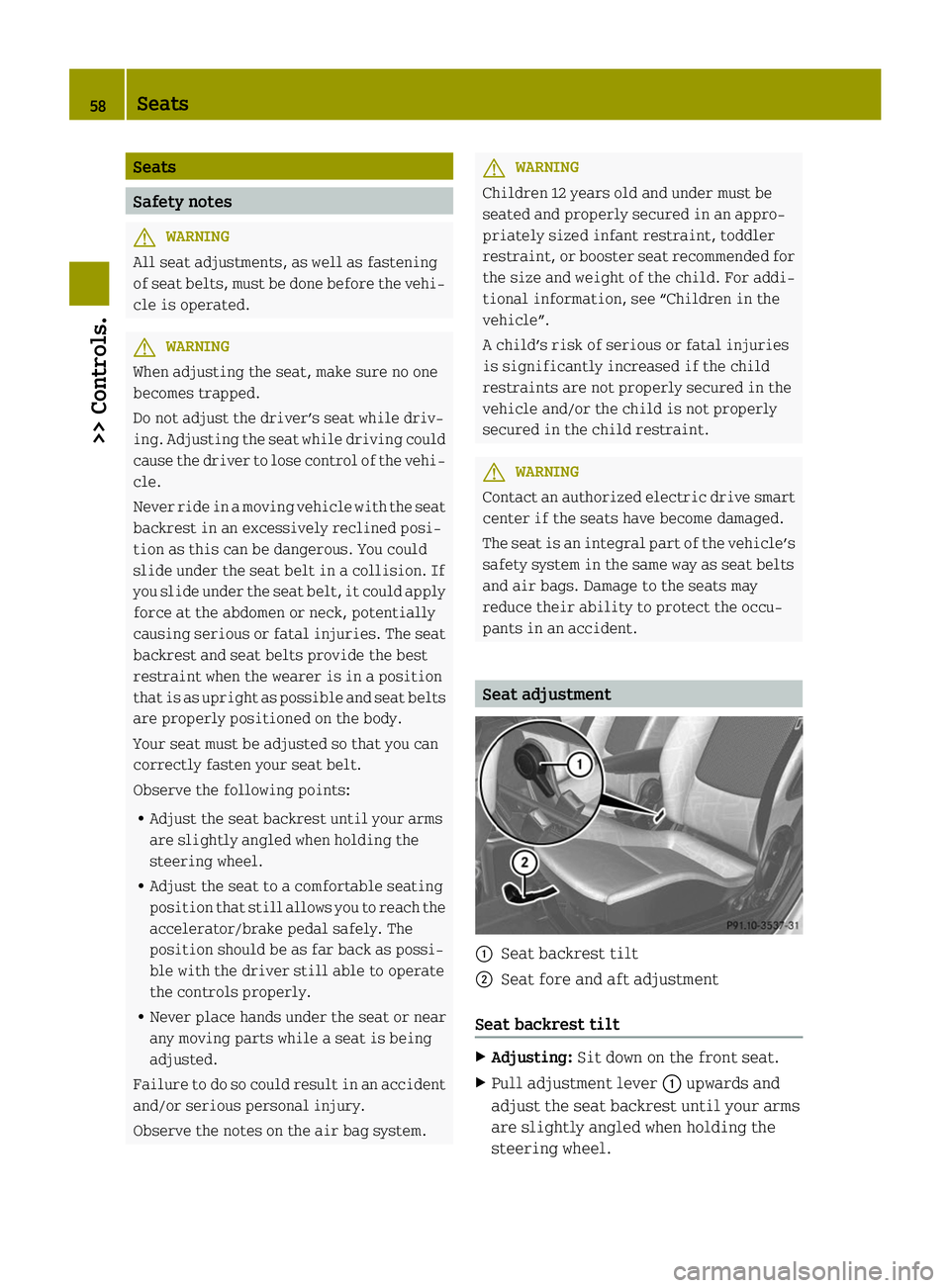
0043
Seat backrest tilt
0044 Seat fore and aft adjustment
Seat backrest tilt X
Adjusting: Sit down on the front seat.
X Pull adjustment lever 0043upwards and
adjust the seat backrest until your arms
are slightly angled when holding the
steering wheel. 58
Seats>> Controls.
Page 64 of 222

Seat belts
Fastening the seat belts
G
WARNING
Always fasten your seat belt before driving.
Always make sure all of your passengers are
properly restrained.
Failure to wear and properly fasten and
position your seat belt greatly increases
your risk of injuries and their likely
severity in an accident. You and your
passenger should always wear seat belts.
If you are ever in an accident, your injuries
can be considerably more severe without
your seat belt properly buckled.
Without your seat belt buckled, you are
much more likely to hit the interior of the
vehicle or be ejected from it. You can be
seriously injured or killed.
In the same crash, the possibility of injury
or death is lessened if you are properly
wearing your seat belt. Air bags can only
protect you if you are properly wearing
your seat belt. G
WARNING
Children 12 years old and under must be
seated and properly secured in an appro-
priately sized infant restraint, toddler
restraint, or booster seat recommended for
the size and weight of the child. For addi-
tional information, see “Children in the
vehicle”.
A child’s risk of serious or fatal injuries
is significantly increased if the child
restraints are not properly secured in the
vehicle and/or the child is not properly
secured in the child restraint. G
WARNING
Never let more people ride in the vehicle
than there are seat belts available. Make
sure everyone riding in the vehicle is cor-
rectly restrained with a separate seat belt.
Never use a seat belt for more than one per-
son at a time. G
WARNING
Never ride in a moving vehicle with the seat
backrest in an excessively reclined posi-
tion as this can be dangerous. You could
slide under the seat belt in a collision. If
you slide under it, the belt would apply
force at the abdomen or neck, causing ser-
ious or even fatal injuries. The seat back-
rest and seat belt provide the best
restraint when the wearer is in a position
that is as upright as possible and the belt
is properly positioned on the body. G
WARNING
Observe ”Safety notes“ (Y page 35). 0043
Seat belt outlet
0044 Seat belt guide
0087 Latch plate
0085 Seat belt buckle
0083 Release button
X Fastening the seat belt: With a smooth
motion, pull the seat belt out of seat belt
outlet 0043.
X Place the shoulder portion of the seat
belt across the top of your shoulder and
the lap portion across your hips. 62
Seat belts>> Controls.
Page 65 of 222

X
Push latch plate 0087into seat belt
buckle 0085until it clicks.
X If necessary, tighten the lap portion of
the seat belt to a snug fit by pulling
shoulder portion up.
X Unfastening the seat belt: Press release
button 0083.
X Allow the retractor to completely rewind
the seat belt by guiding latch plate 0087.
Proper use of seat belts R
Do not twist the seat belt when fastening.
R Adjust the seat belt so that the shoulder
portion is located as close as possible
to the middle of the shoulder (it should
not touch the neck). Never pass the
shoulder portion of the seat belt under
your arm.
R Position the lap belt as low as possible
on your hips (over hip joint) and not
across the abdomen.
R Place the seat backrest in a position that
is as upright as possible.
R Never use a seat belt for more than one
person at a time.
R Do not fasten a seat belt around a person
and another object at the same time. When
using a seat belt to secure infant or tod-
dler restraints or children in booster
seats, always follow the child seat man-
ufacturer’s instructions.
R Check your seat belt during travel to
make sure it is properly positioned.
R Make sure the seat belt is always fitted
snugly. Take special care to maintain a
snug fit when wearing loose clothing. G
WARNING
Do not pass seat belts over sharp edges.
They could tear.
Do not allow the seat belt to get caught in
the door or in the seat adjustment mecha-
nism. This could damage the seat belt. Never attempt to make modifications to
seat belts. This could impair the effec-
tiveness of the seat belts.
Do not bleach or dye seat belts as this may
severely weaken them. In a crash they may
not be able to provide adequate protection.
Damaged seat belts or seat belts that were
highly stressed in an accident must be
replaced. Contact an authorized electric
drive smart center. Correct driver seat adjustment
G
WARNING
Observe ”Safety notes“ (Y page 58). X
Adjust the driver’s seat properly
(Y page 58).
Make sure that you
R are positioned as far away from the
driver’s front air bag as possible
R can reach steering wheel 0043with your
arms slightly bent at the elbows
R can fasten seat belt 0044properly Seat belts
63>> Controls. Z
Page 75 of 222
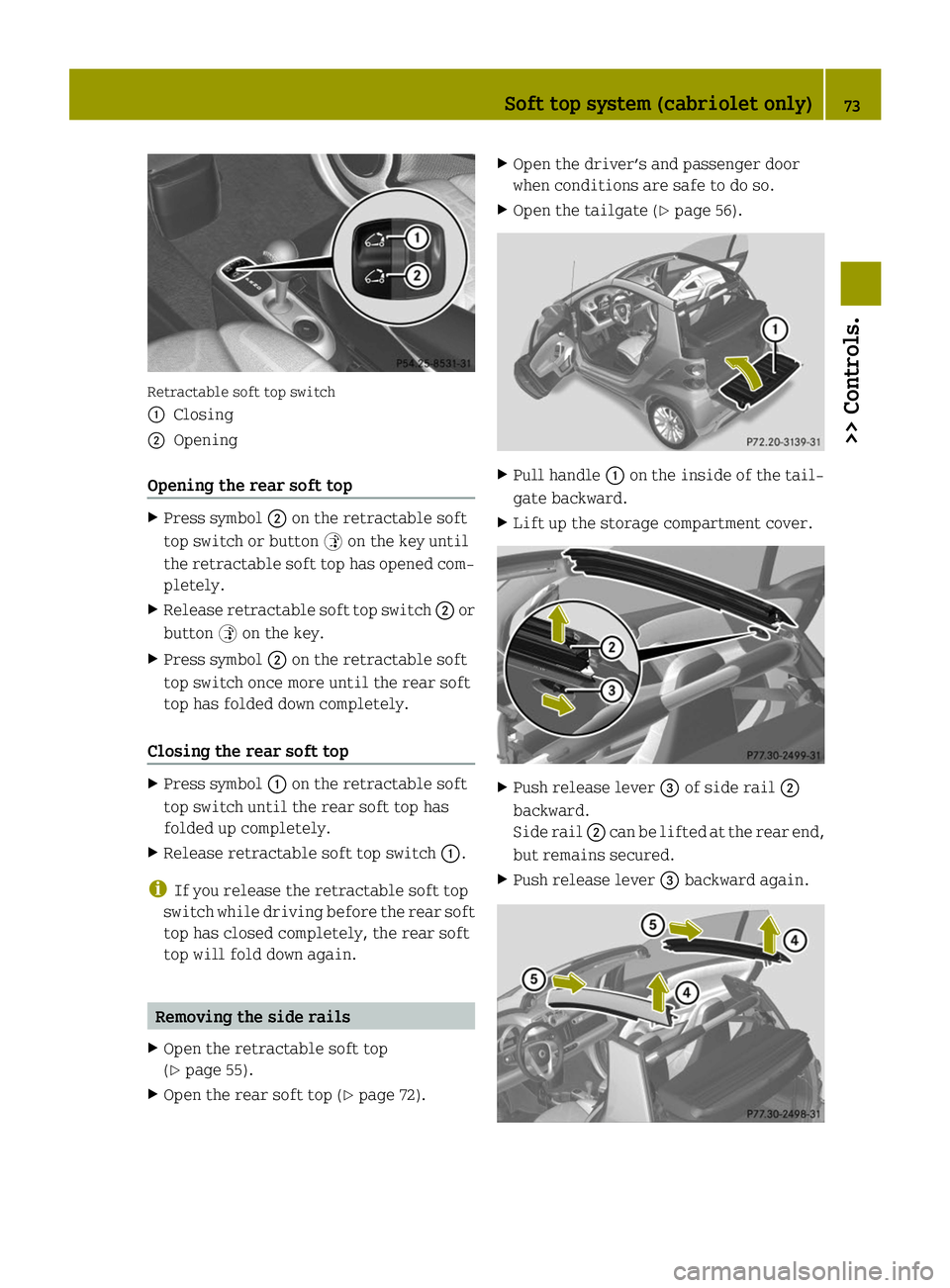
Retractable soft top switch
0043
Closing
0044 Opening
Opening the rear soft top X
Press symbol 0044on the retractable soft
top switch or button 0035on the key until
the retractable soft top has opened com-
pletely.
X Release retractable soft top switch 0044or
button 0035on the key.
X Press symbol 0044on the retractable soft
top switch once more until the rear soft
top has folded down completely.
Closing the rear soft top X
Press symbol 0043on the retractable soft
top switch until the rear soft top has
folded up completely.
X Release retractable soft top switch 0043.
i If you release the retractable soft top
switch while driving before the rear soft
top has closed completely, the rear soft
top will fold down again. Removing the side rails
X Open the retractable soft top
(Y page 55).
X Open the rear soft top (Y page 72).X
Open the driver’s and passenger door
when conditions are safe to do so.
X Open the tailgate (Y page 56). X
Pull handle 0043on the inside of the tail-
gate backward.
X Lift up the storage compartment cover. X
Push release lever 0087of side rail 0044
backward.
Side rail 0044can be lifted at the rear end,
but remains secured.
X Push release lever 0087backward again. Soft top system (cabriolet only)
73>> Controls. Z
Page 79 of 222

appears in the multifunction display
(Y
page 87).
The pointer of the power gauge moves
from "OFF“ to "0“ (Y page 81).Driving
i The vehicle has a crawler function. The
vehicle moves forward when the brake
pedal is released.
X Depress the brake pedal.
X Move the gear selector lever to drive
position D.
D D appears in the transmission position
indicator.
X Release the brake pedal.
The vehicle moves forward.
X Depress the accelerator pedal smoothly.
The vehicle accelerates. Reversing the vehicle
! Shift the transmission into reverse
gear Ronly when the vehicle is stopped
in order to avoid damaging the trans-
mission.
You can drive in reverse gear at a speed
of up to 9 mph (15 km/h).
i The vehicle has a crawler function.
Thevehicle moves forward when the
brakepedal is released.
X Depress the brake pedal.
X Move the gear selector lever to reverse
gear R.
R R appears in the transmission position
indicator.
X Release the brake pedal.
The vehicle moves forward.
X Depress the accelerator pedal smoothly.
The vehicle accelerates. Parking
G
WARNING
With the drive system inactive, there is no
power assistance for the brake and steering
systems. In this case, it is important to
keep in mind that a considerably higher
degree of effort is necessary to brake and
steer the vehicle. Adapt your driving
accordingly. G
WARNING
Vehicle movement can cause serious per-
sonal injury. Therefore, always do the fol-
lowing before exiting and leaving the
vehicle:
R Keep right foot on the brake pedal.
R Engage the parking brake.
R Move the gear selector lever to park
position P.
R Slowly release the brake pedal.
R When parked on an incline, always turn
the front wheels towards the curb.
R Turn the key to starter switch position 0
and remove the key from the starter
switch.
R Take the key with you and lock the vehicle
when leaving.
X Properly stop and park the vehicle.
X Depress the brake pedal.
X Engage the parking brake (Y page 77).
When the ignition is switched on, the
brake warning lamp 0027(USA only) or
004D (Canada only) in the instrument
cluster comes on.
X Release the brake pedal.
Parking brake The parking brake serves to secure the
vehicle against rolling away when it is
stationary or parked. Driving and parking
77>> Controls. Z
Page 81 of 222

Make sure the drive system is active when-
ever the vehicle is rolling. Have the brake
system repaired at an authorized electric
drive smart center, if there is a fault in the
brake system. If a brake circuit has failed (Y
page 167),
you must depress brake pedal 0043further
down to achieve the same effect and the
braking distance is increased.
i The brake servo will only function with
the ignition switched on. Switching off the drive system
G
WARNING
Do not turn off the drive system before the
vehicle has come to a complete stop. With
the drive system not running, there is no
power assistance for the brake and steering
systems. In this case, it is important to
keep in mind that a considerably higher
degree of effort is necessary to brake and
steer the vehicle.
X Depress the brake pedal.
X Move the gear selector lever to park
position P.
The transmission position indicator
should be on P P
! Always engage the parking brake in
addition to shifting to park position P.X
Release the brake pedal.
X Turn the key to starter switch position
0.
X Remove the key from the starter switch.
The electronic immobilizer is acti-
vated. Transmission
Shifting procedure
Gearshift pattern for transmission
005D
Park position
005E
Reverse gear
005C
Neutral position
005B
Drive position
Select a gear:
X
Switch on the ignition.
X Depress the brake pedal.
X Move the gear selector lever to the
desired position. Steering wheel paddle shifters* (for
recuperation)
G
WARNING
The operating condition of the high-volt-
age battery (e.g. not yet at normal operat-
ing temperature or fully charged) influen- Transmission
79>> Controls.
* optional Z