2014 SKODA RAPID SPACEBACK lights
[x] Cancel search: lightsPage 168 of 204

Components of the puncture repair kitsFig. 145
Principle sketch: Components of the breakdown kit
Read and observe
on page 164 first.
Components of the set » Fig. 145
Sticker with speed designation “max. 80 km/h”/“max. 50 mph”
Valve remover
Inflation hose with plug
Air compressor
Button for releasing the tyre pressure
12 volt cable connector
Tyre inflation hose
Tyre inflation pressure indicator
ON and OFF switch
Tyre inflater bottle with sealing agent
Replacement valve core
The valve remover
2
has a slot at its lower end which fits into the valve core.
The kit is located in a box under the floor covering in the luggage compart-
ment. This contains a sealing means and an air compressor.
Note
The declaration of conformity is included with the air compressor or the log
folder.1234567891011General information
Read and observe
on page 164 first.
For your own safety and the safety of your passengers, the following instruc-
tions must be observed before carrying out a wheel repair on the road.
Switch on the hazard warning lights system.
The warning triangle is to be set up at the prescribed distance - observe
the national legal provisions when doing so.
Park the vehicle as far away as possible from the flow of traffic.
Choose a location with a flat, solid surface.
Have all the occupants get out. The passengers should not stand on the
road (instead they should remain behind a crash barrier, for instance) while
the wheel is being changed.
The national legal requirements must be observed when repairing a tyre.
The breakdown kit must not be used under the following circumstances. › The rim is damaged.
› The outside temperature is below -20 ° C.
› The cut or puncture is larger than 4 mm.
› The tyre wall is damaged.
› The result will be to drive with very low tyre pressure or with a completely
flat tyres.
› After the expiration date (see inflation bottle).
Preparations for using the breakdown kit
Read and observe
on page 164 first.
The following preparatory work must be carried out before using the puncturerepair kit.
›
Switch off the engine.
›
Select the first gear or move the selector lever for the automatic gearbox
into position P .
›
Firmly apply the handbrake.
›
Check that you can carry out the repairs with the breakdown kit » page 165,
General information .
›
Remove the breakdown kit from the boot.
›
Stick the sticker
1
» Fig. 145 on page 165 on the dashboard in the driver's
field of view.
›
Unscrew the valve cap.
165Emergency equipment and self-help
Page 171 of 204
WARNING■Do not clamp the jump-start cable to the negative terminal of the dis-
charged battery. There is the risk of detonating gas seeping out of the bat-
tery being ignited by the strong spark resulting from the engine being star-
ted.■
The non-insulated parts of the terminal clamps must never touch each
other – there is a risk of short circuit!
■
The jump-start cable connected to the positive terminal of the battery
must not come into contact with electrically conducting parts of the vehicle
– there is a risk of short circuit!
■
Route the jump-start cables so that they cannot be caught by any rotat-
ing parts in the engine compartment.
■
There must not be any contact between the two vehicles, otherwise cur-
rent may flow as soon as the negative terminals are connected.
Towing the vehicle
Introduction
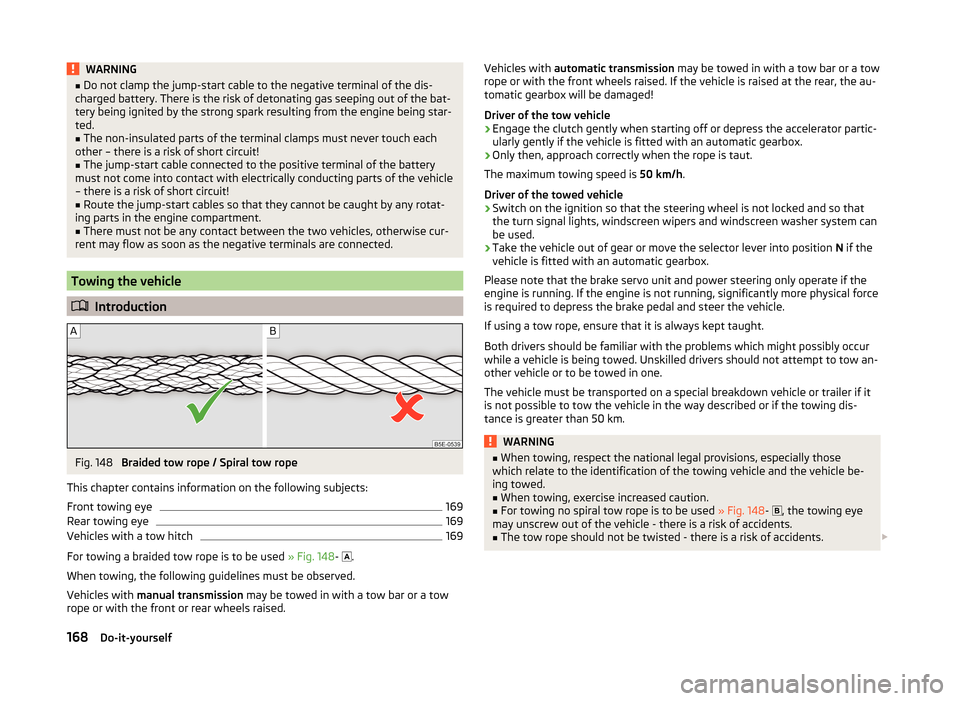
Fig. 148
Braided tow rope / Spiral tow rope
This chapter contains information on the following subjects:
Front towing eye
169
Rear towing eye
169
Vehicles with a tow hitch
169
For towing a braided tow rope is to be used » Fig. 148-
.
When towing, the following guidelines must be observed.
Vehicles with manual transmission may be towed in with a tow bar or a tow
rope or with the front or rear wheels raised.
Vehicles with automatic transmission may be towed in with a tow bar or a tow
rope or with the front wheels raised. If the vehicle is raised at the rear, the au-
tomatic gearbox will be damaged!
Driver of the tow vehicle›
Engage the clutch gently when starting off or depress the accelerator partic-
ularly gently if the vehicle is fitted with an automatic gearbox.
›
Only then, approach correctly when the rope is taut.
The maximum towing speed is 50 km/h.
Driver of the towed vehicle
›
Switch on the ignition so that the steering wheel is not locked and so that
the turn signal lights, windscreen wipers and windscreen washer system can
be used.
›
Take the vehicle out of gear or move the selector lever into position N if the
vehicle is fitted with an automatic gearbox.
Please note that the brake servo unit and power steering only operate if the
engine is running. If the engine is not running, significantly more physical force
is required to depress the brake pedal and steer the vehicle.
If using a tow rope, ensure that it is always kept taught.
Both drivers should be familiar with the problems which might possibly occur while a vehicle is being towed. Unskilled drivers should not attempt to tow an-
other vehicle or to be towed in one.
The vehicle must be transported on a special breakdown vehicle or trailer if it
is not possible to tow the vehicle in the way described or if the towing dis-
tance is greater than 50 km.
WARNING■ When towing, respect the national legal provisions, especially those
which relate to the identification of the towing vehicle and the vehicle be- ing towed.■
When towing, exercise increased caution.
■
For towing no spiral tow rope is to be used » Fig. 148-
, the towing eye
may unscrew out of the vehicle - there is a risk of accidents.
■
The tow rope should not be twisted - there is a risk of accidents.
168Do-it-yourself
Page 177 of 204

Assignment of the fuses in the dash panelFig. 158
Schematic representation of the fuse box for vehicles with left-
hand steering/right-hand steering
Read and observe
and on page 173 first.
No.Power consumer1S-contact2START - STOP3Instrument cluster, headlight range adjustment, telephone, oil level
sensor, diagnostic port, dimmable interior rear-view mirror4Control unit for ABS/ESC, steering angle sensor strip with switches5Petrol engine: Speed regulating system6Reversing light (manual gearbox)7Ignition, engine control unit, automatic gearbox8Brake pedal switch, clutch switch, engine cooling fan9Operating controls for the heating, electronic control unit for air con-
ditioning system, park distance control, window lift, engine cooling
fan, heated washer nozzles10DC-DC converter11Mirror adjustment12Control unit for trailer detection13Electronic control unit for automatic gearbox, selector lever of the
automatic gearbox14Headlight range control15Not assignedNo.Power consumer16Power steering, speed sensor, engine control unit, control unit for
fuel pump17Daytime running lights/radio for vehicles with START-STOP18Mirror heater19Ignition lock input20Engine control unit, electronic control unit for fuel pump, fuel pump21Reversing lamp (automatic gearbox), fog lights with the function
CORNER
22
Operating controls for the heating, electronic control unit for air con-
ditioning system, telephone, instrument cluster, steering angle
sender, multi-function steering wheel, ignition key removal lock, di-
agnostic port, rain sensor23Interior lighting, storage compartment and luggage compartment,
side lights24Central control unit25Light switch26Rear window wiper27Operating lever underneath the steering wheel28Petrol engine: ACF valve, PTC heater29Injection, coolant pump30Fuel pump, ignition system, cruise control31Lambda probe32High-pressure fuel pump, control valve for fuel pressure33Engine control unit34Engine control unit, vacuum pump35Switch illumination, number plate light, parking light36High beam, light switch37Rear fog light, DC-DC converter38Fog lights39Air blower for heating40Not assigned41Heated front seats42Rear window heater 174Do-it-yourself
Page 178 of 204

No.Power consumer43Horn44Windscreen wipers45Boot lid lock, central locking system46Alarm47Cigarette lighter48ABS49Turn signal lights, brake lights50DC-DC converter, radio51Electric windows (driver's window and rear left window)52Electric windows (front passenger's window and rear right)53Windscreen washer54START-STOP instrument cluster, operating lever under the steering
wheel, multifunction steering wheel55Control unit for automatic gearbox56Headlight cleaning system57Headlights front, rear58Headlights front, rear
Fuses in the engine compartment
Fig. 159
Vehicle battery: Cover for the fuse box - variant 1 / variant 2
Read and observe and on page 173 first.
Replacing fuses
›
Press together the interlocks of the cover simultaneously in the direction of
the arrow
1
» Fig. 159 .
›
Remove the cover in the direction of the arrow
2
.
›
Replace the appropriate fuse.
›
Place the cover on top of the fuse box.
›
Push in the interlocks on the cover and lock.
The cover must engage securely.
Fuse assignment in the engine compartment
Fig. 160
Fuses
Read and observe and on page 173 first.
No.Power consumer1ABS2Radiator fan3Automatic gearbox4ABS5Central control unit6Electrical auxiliary heating system175Fuses and light bulbs
Page 179 of 204

Replacing bulbs
Introduction
This chapter contains information on the following subjects:
Bulb arrangement in the headlights
176
Replacing the high beam bulb (halogen headlights)
177
Replacing bulb for main beam, daytime running lights and parking light
177
Changing the front turn signal bulb
178
Replacing the bulb for the fog light
178
Replacing the bulb for the licence plate light
179
Rear Light
179
Replacing bulbs in rear light
180
Some manual skills are required to change a bulb. For this reason, we recom-
mend having bulbs replaced by a specialist garage or seeking other expert help
in the event of any uncertainties.
› Switch off the ignition and all of the lights before replacing a bulb.
› Faulty bulbs must only be replaced with the same type of bulbs. The designa-
tion is located on the light socket or the glass bulb.
› A stowage compartment for replacement bulbs is located in a plastic box in
the spare wheel or underneath the floor covering in the boot.
WARNING■ Always read and observe the warning notes before completing any work
in the engine compartment » page 141.■
Accidents can be caused if the road in front of the vehicle is not suffi-
ciently illuminated and the vehicle cannot be seen or can only be seen with
difficulty by other road users.
■
H7 and H15 bulbs are pressurised and may burst when changing the bulb -
risk of injury! We therefore recommended wearing gloves and safety
glasses when changing a bulb.
■
Gas discharge bulbs (xenon bulbs) operate with a high voltage, professio-
nal knowledge is required – risk of death!
■
Switch off the respective vehicle light when changing the bulb.
CAUTION
Do not take hold of the glass bulb with naked fingers (even the smallest
amount of dirt reduces the working life of the light bulb). Use a clean cloth,
napkin, or similar.Note■ This Owner's Manual only describes the replacement of bulbs where it is pos-
sible to replace the bulbs on your own without any complications arising. Other
bulbs must be replaced by a specialist garage.■
We recommend that a box of replacement bulbs always be carried in the ve-
hicle. Replacement bulbs can be purchased from ŠKODAOriginal Accessories.
■
We recommend having the headlight settings checked by a specialist garage
after replacing a bulb in the main, low or fog beam.
■
In case of failure of a xenon gas discharge lamp or an LED diode, visit a spe-
cialist garage.
Bulb arrangement in the headlights
Fig. 161
Principle sketch: Headlights
Read and observe and on page 176 first.
Bulb arrangement » Fig. 161
Low beam or low beam with xenon gas discharge lamp
Main beam, separate daytime running lights, and parking light
Turn signal light (at the front)
ABC176Do-it-yourself
Page 180 of 204

Replacing the high beam bulb (halogen headlights)Fig. 162
Changing the bulb for the low beam
Read and observe
and on page 176 first.
›
Remove the protective cap
A
» Fig. 161 on page 176 .
›
Remove the socket with the bulb by jiggling it out in the direction of arrow
1
» Fig. 162 .
›
Remove the connector.
›
Insert the connector with the new bulb in the direction of arrow
2
so that
the fixing lug
A
fits the bulb into the recess on the reflector.
›
Attach the connector.
›
Fit the protective cap
A
» Fig. 161 on page 176 .
Replacing bulb for main beam, daytime running lights and parking
light
Fig. 163
Replacing the bulb for main
beam and separate daytime run-
ning lights
Fig. 164
Change the light bulb for the parking light
Read and observe
and on page 176 first.
Removing/replacing the bulb for main beam and separate daytime running
lights
›
Remove the protective cap
B
» Fig. 161 on page 176 .
›
Pull the holder until it stops in the arrow direction
1
» Fig. 163 .
›
Remove the socket with the bulb in the direction of arrow
2
.
›
Change the bulb in the socket.
›
Insert the socket with the new bulb into the headlight in the opposite direc-
tion to the arrow
2
.
›
Turn the socket with the new bulb in the opposite direction to the arrow
1
until it stops.
›
Fit protective cap
B
» Fig. 161 on page 176 Insert.
Removing/replacing the bulb for the parking light
›
Remove the protective cap
B
» Fig. 161 on page 176 .
›
Remove the bulb holder with the bulb by jiggling it out in the direction of the
arrow
1
» Fig. 164 .
›
Grasp the lamp socket at the places marked by arrows.
›
Remove the faulty bulb from the holder in the direction of the arrow
2
.
›
Insert a new bulb in the bulb holder up to the stop.
›
Replace the bulb holder in the headlamp with the bulb.
›
Fit protective cap
B
» Fig. 161 on page 176 Insert.
177Fuses and light bulbs
Page 192 of 204

Index
A
abroad lead-free petrol
139
Abroad Headlights
63
ABS Function
113
Warning light37
Acceptance and recycling of used vehicles131
Accessories128
Adjusting Belt height
15
Exterior mirror68
head restraints70
Interior mirror67
Seat69
Steering wheel10
Adjusting the seats9
Adjustment Beam range
58
Air-conditioning system Air outlet vents
90
Airbag16
Deactivating20
Deactivating the front passenger airbag20
Deployment16
Front airbag17
Head airbag19
Indicator light39
Modifications and damage to the airbag system 130
Side airbag
18
Airbag system16
Air conditioning89
Air distribution control90
Climatronic92
manual air conditioning91
Air distribution control90
Air outlet vents90
Alarm Switching off
53
Triggering53
Alcantara cleaning
137
Anti-lock Braking System113
Anti-theft alarm system Activating/deactivating
54
Trailer126
Anti-theft wheel bolts164
Armrest Front
72
Rear72
artificial leather137
Ashtray76
ASR Warning light
37
Assembling the bar ball, Step 1
122
bar ball, Step 2122
Assist system ABS
113
Assist systems113
ABS37
ASR37
Cruise Control System115
EDL114
ESC37, 113
HBA114
HHC114
Parking aid114
START-STOP116
TCS113
Audio see radio / navigation system
4
Auto Check Control33
Automatic driving lamp control60
Automatic gearbox108
Manual shifting of gears110
Selector lever-emergency unlocking171
Selector lever lock109
Starting-off and driving110
Tiptronic110
Using the selector lever109
Automatic gearbox modes109
Automatic load deactivation151
automatic transmission selector lever lock defect
110
Automatic transmission Kickdown
110
Selector lever lock109
AUX101
B
Ball head Check fitting
123
Ready position121
Battery In the remote control key
170
Belts12
Belt tensioners15
Bonnet Closing
142
Opening142
Boot Cargo element
84
Class N1 vehicles85
Double-sided floor covering85
Hooks82
See Boot lid55
Storage compartments83
Boot cover Parking position
83
Boot lid automatic locking
55
Closing55
Opening55
189Index
Page 194 of 204

Climatronicair distribution control90
Operating elements92
Clothes hook79
Cockpit 12-Volt power outlet
76
Ashtray76
Cigarette lighter75
General view29
Lights63
storage compartments73
useful equipment73
COMING HOME62
compartments73
Components of the puncture repair kits165
Computer See multifunction display
43
convenience turn signal60
Coolant146
Checking147
Information messages36
Replenishing147
Temperature gauge32
Warning light36
Cooling system cost-effective use
93
malfunctions93
CORNER See Fog lights with CORNER function
61
Correct seated position9
Driver9
Front passenger10
Instructions11
Rear seats11
Counter for distance driven33
cruise control operation
115
operation description116
Cruise control system Warning light
41
Cruise Control System115
Cup holders74
D
DAY LIGHT See Daytime running lights
59
Daytime running lights59
Dazzle see sun screen of the panoramic roof
65
De-icing windows
134
Deactivating an airbag20
Decorative films134
Defrosting rear window64
Delayed locking of the boot lid see boot lid
55
Departure angle184
Diesel refer to Fuel
140
Diesel fuel Operation in winter
140
Diesel particle filter Information notices
38
Warning light38
Digital Clock Time
33
Dipstick145
Disconnecting and reconnecting vehicle battery
151
Display31
Compass points47
Coolant temperature32
Fuel supply32
Gear changes43
Service intervals47
Display a low temperature42
Display of the second speed33
Disposal Acceptance and recycling of used vehicles
131
Distance driven33
Door Child safety lock
53
Closing51
Emergency locking171
Opening51
Warning light for open door36
Door open Warning light
36
Double-sided floor covering85
Driving Driving through water
111
Emissions182
Fuel consumption182
Maximum speed185
off made-up roads111
Driving in Brake linings
111
the engine111
Tyres111
Driving off made-up roads111
Driving through water111
E
Economical driving Tips
111
EDL114
Electrical power windows Button in the passenger door
56
Buttons in the driver's door56
Electronic Differential Lock (EDL)114
Electronic immobilizer104
Electronic Stability Control (ESC)113
Emergency Changing a wheel
160
Hazard warning light system62
Jump-starting166, 167
Locking the door without a locking cylinder171
Selector lever-unlocking171
Towing the vehicle168
191Index