2014 Seat Toledo maintenance
[x] Cancel search: maintenancePage 127 of 200

Care and maintenance
Waxing and polishing of the vehicle
paintwork Care
To a great extent, good waxing protects the
vehicle surface from the harmful effects of
the environment.
The vehicle must be treated with a high qual-
ity, hard wax when water no longer forms
droplets on clean paintwork.
A new coat of high quality, hard wax can be
applied to the clean, painted surface only
when it has fully dried. Even if a wax solution
is used regularly in the car wash, it is advisa-
ble to protect the paint with a coat of wax at
least twice a year.
Polishing
Polishing is only necessary if the paint has
lost its shine, and the gloss cannot be
brought back by applying wax.
The vehicle must be waxed after polishing if
the polish used does not contain wax com-
pounds to seal the paint.
CAUTION
● Never wax the windows.
● Do not use polishes and hard wax on pain-
ted parts with a matt finish or on plastic
parts. ●
Do not polish your vehicle in a sandy or
dusty environment. Cleaning chrome
Clean the chrome first with a clean cloth and
then buff up with a soft, dry cloth. If this does
not clean the chrome properly, use a special
chrome cleaner.
CAUTION
Do not polish the chrome in a dusty environ-
ment or it could be scratched. Paint damage
Minor damage to the paint, such as scratches
or stone chips, should be touched up without
delay using paint.
Suitable
touch-up brushes or sprays for the
c o
lour of your vehicle can be purchased from
authorised SEAT dealers. Note
We recommend you leave paint damage re-
pairs to a SEAT Authorised Service. Plastic parts
Exterior plastic parts will come clean using a
damp cloth. If this is not sufficient, plastic
parts can also be treated with special sol-
vent-free plastic cleaning detergents
.
Do not u
se paint cleaners, polishes or wax on
plastic parts.
Windows and exterior mirrors Remove snow and ice from windows and rear
vision mirrors with a plastic scraper only. To
avoid damaging the surface of the glass, the
scraper should only be pushed in one direc-
tion and not moved to and fro.
The windows should also be cleaned on the
inside at regular intervals.
Use a separate cloth or chamois to dry the
windows and rear vision mirrors.
Do not use the chamois used to polish the
bodywork to dry the windows. Waxing and
polishing residues could cause smears on
the glass and hinder visibility.
CAUTION
● Never use hot or boiling water to remove
snow and ice from the windows. Risk of crack-
ing glass! » 125
Technical specifications
Advice
Operation
Safety
Page 129 of 200

Care and maintenance
Underbody sealant The underside of the vehicle is coated to per-
manently protect it from chemical and me-
chanical agents.
Given that damage to the
protective coating
during driving cannot be completely ruled
out, we recommend you check the condition
of the protective coating on the underbody
and suspension at regular intervals, prefera-
bly before the start and end of the coldest
season of the year.
Authorised SEAT dealers have suitable spe-
cial products and the necessary facilities and
are aware of the techniques required for their
application. We therefore recommend all
touch-up work or additional anti-corrosion
measures be performed by an authorised
SEAT dealer. WARNING
Do not apply underseal or anti-corrosion
coatings to the exhaust pipes, catalytic con-
verter, particulate filter or heat shields on the
exhaust system. Once the engine has
reached operating temperature, these sub-
stances could catch fire. Risk of fire! Cavity waxing
All cavities on the vehicle exposed to corro-
sion are permanently factory-protected by a
wax solution
.
This wax solution does not need to be
checked or touched up. Should wax run out
of the cavities at high ambient temperatures,
remove it using a plastic scraper and clean
away any stains using lighter fluid. WARNING
Note the regulations concerning safety and
environmental protection if you use lighter
fluid to remove the wax. Risk of fire! Leatherette and upholstery
Leatherette can be cleaned with a damp
cloth. If this is not sufficient, these parts
should only be cleaned with
solvent-free
plastic care and cleaning products .
Textile covers and trim parts on doors, boot
lid, etc. can be cleaned with special deter-
gents, e.g. dry foam. A soft sponge or brush
or a micro-fibre cloth for normal cleaning can
be used. Use special products to clean the
headliner.
The dye used in many garments, for example
dark jeans, is not always sufficiently colour-
fast. Seat upholstery (fabric and leather), es- pecially when light-coloured, may visibly dis-
colour if the dye comes out of clothing, even
in normal conditions. This is not an uphols-
tery defect but indicates that the dye in the
item of clothing is not solid enough.
Heated seat upholstery Do not clean the seat upholstery with
damp
products, as this could damage the seat
he atin
g system.
Clean the upholstery with special products,
e.g. dry foam, etc.
Natural leather Leather should be looked after from time to
time, depending on its use.
Normal cleaning
Moisten a cotton or woollen cloth with water
and wipe over the leather surfaces.
More stubborn dirt
Do not let water soak through the leather or
penetrate the seams.
Dry it with a soft, dry cloth.
»
127
Technical specifications
Advice
Operation
Safety
Page 137 of 200

Checking and refilling levels
Radiator fan The radiator is driven by an electric motor
and controlled according to the temperature
of the coolant.
After the engine has been stopped and the
ignition switched off, the radiator fan may
continue running for around 10 minutes.
Engine oil
General notes The engine comes with a special, multi-grade
oil that can be used all year round.
Because the use of high-quality oil is essen-
tial for the correct operation of the engine
and its long useful life, when topping up or
changing oil, use only those oils that comply
with VW standards.
The specifications (VW standards) set out in
the following page should appear on the con-
tainer of the service oil; when the container
displays the specific standards for petrol and
diesel engines together, it means that the oil
can be used for both types of engines.
We recommend that the oil change indicated
in the Maintenance Programme, be per-
formed by a technical service or specialised
workshop. The correct oil specifications for your engine
are listed in the
››› page 136, Oil properties .
Service intervals
Service intervals can be flexible (LongLife
service) or fixed (dependent on time/dis-
tance travelled).
If the PR code that appears on the back of the
Maintenance Programme booklet is QG1, this
means that your vehicle has the LongLife
service programmed. If it has the codes QG0
or QG2, the service interval is dependent on
time/distance travelled.
Flexible service intervals (LongLife service
intervals*)
Special oils and processes have been devel-
oped which, depending on the characteris-
tics and individual driving profiles, enable
the extension of the oil change service (Long-
Life service intervals).
Because this oil is essential for extending the
service intervals, it must only be used ob-
serving the following indications:
● Avoid mixing it with oil for fixed service in-
tervals.
● Only in exceptional circumstances, if the
engine oil level is too low ›››
page 136 and
LongLife oil is not available, it is permitted to
top up (once) with oil for fixed service inter-vals
››› page 136 (up to a maximum of 0.5 li-
tr e
s).
Fixed service intervals*
If your vehicle does not have the “LongLife
service interval” or it has been disabled (by
request), you may use oils for fixed service
intervals
, which also appear in ››› page 136,
Oil properties . In this case, your vehicle must
be serviced after a fixed interval of 1
year/15,000 km (10,000 miles)(whatever
comes first) ››› Booklet Maintenance Pro-
gramme.
● In ex
ceptional circumstances, if the engine
oil level is too low ››› page 136 and you can-
not o
btain the oil specified for your vehicle,
you can add a small quantity of oil conform-
ing to the specification ACEA A2 or ACEA A3
(petrol engines) or ACEA B3 or ACEA B4 (die-
sel engines) (up to 0.5 l).
Vehicles with diesel particulate filter*
The Maintenance Programme states whether
your vehicle is fitted with a diesel particulate
filter.
Only VW 507 00 engine oil, with reduced ash
formation, may be used in diesel engines
equipped with particulate filter. Using other
types of oil will cause a higher soot concen-
tration and reduce the life of the DPF. There-
fore: »
135
Technical specifications
Advice
Operation
Safety
Page 139 of 200
Checking and refilling levels
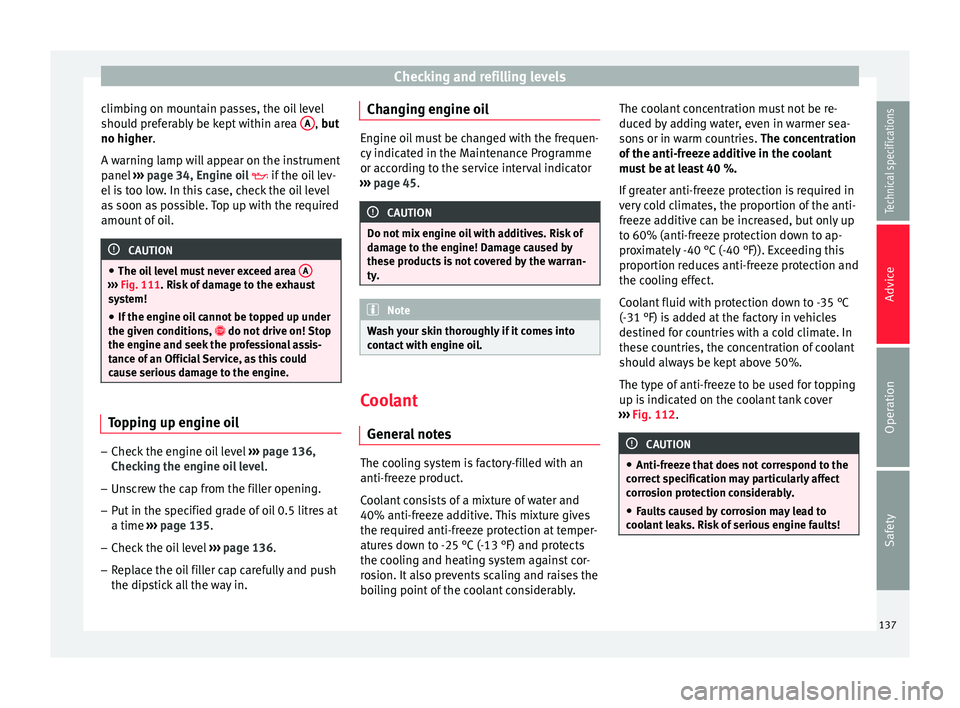
climbing on mountain passes, the oil level
should preferably be kept within area A ,
but
no higher .
A w
arning lamp will appear on the instrument
panel ››› page 34, Engine oil if the oil lev-
el is too low. In this case, check the oil level
as soon as possible. Top up with the required
amount of oil. CAUTION
● The oil level must never exceed area A›››
Fig. 111. Risk of damage to the exhaust
sy s
tem!
● If the engine oil cannot be topped up under
the given conditions, do not drive on! Stop the engine and seek
the professional assis-
tance of an Official Service, as this could
cause serious damage to the engine. Topping up engine oil
–
Check the engine oil level ›››
page 136,
Checking the engine oil level .
– Unscrew the cap from the filler opening.
– Put in the specified grade of oil 0.5 litres at
a time ›››
page 135 .
– Chec k
the oil level ›››
page 136.
– Replace the oil filler cap carefully and push
the dipstick all the way in. Changing engine oil Engine oil must be changed with the frequen-
cy indicated in the Maintenance Programme
or according to the service interval indicator
››› page 45. CAUTION
Do not mix engine oil with additives. Risk of
damage to the engine! Damage caused by
these products is not covered by the warran-
ty. Note
Wash your skin thoroughly if it comes into
contact with engine oil. Coolant
General notes The cooling system is factory-filled with an
anti-freeze product.
Coolant consists of a mixture of water and
40% anti-freeze additive. This mixture gives
the required anti-freeze protection at temper-
atures down to -25 °C (-13 °F) and protects
the cooling and heating system against cor-
rosion. It also prevents scaling and raises the
boiling point of the coolant considerably.The coolant concentration must not be re-
duced by adding water, even in warmer sea-
sons or in warm countries.
The concentration
of the anti-freeze additive in the coolant
must be at least 40 %.
If greater anti-freeze protection is required in
very cold climates, the proportion of the anti-
freeze additive can be increased, but only up
to 60% (anti-freeze protection down to ap-
proximately -40 °C (-40 °F)). Exceeding this
proportion reduces anti-freeze protection and
the cooling effect.
Coolant fluid with protection down to -35 °C
(-31 °F) is added at the factory in vehicles
destined for countries with a cold climate. In
these countries, the concentration of coolant
should always be kept above 50%.
The type of anti-freeze to be used for topping
up is indicated on the coolant tank cover
››› Fig. 112 . CAUTION
● Anti-freeze that does not correspond to the
correct specification may particularly affect
corrosion protection considerably.
● Faults caused by corrosion may lead to
coolant leaks. Risk of serious engine faults! 137
Technical specifications
Advice
Operation
Safety
Page 152 of 200
Advice
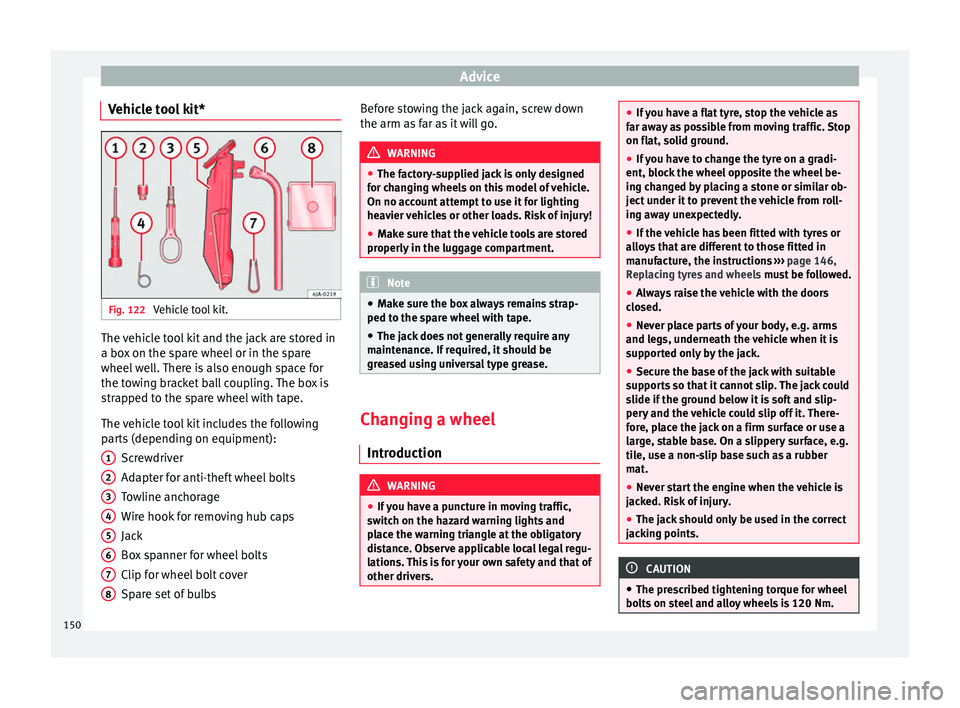
Vehicle tool kit* Fig. 122
Vehicle tool kit. The vehicle tool kit and the jack are stored in
a box on the spare wheel or in the spare
wheel well. There is also enough space for
the towing bracket ball coupling. The box is
strapped to the spare wheel with tape.
The vehicle tool kit includes the following
parts (depending on equipment):
Screwdriver
Adapter for anti-theft wheel bolts
Towline anchorage
Wire hook for removing hub caps
Jack
Box spanner for wheel bolts
Clip for wheel bolt cover
Spare set of bulbs
1 2
3
4
5
6
7
8 Before stowing the jack again, screw down
the arm as far as it will go.
WARNING
● The factory-supplied jack is only designed
for changing wheels on this model of vehicle.
On no account attempt to use it for lighting
heavier vehicles or other loads. Risk of injury!
● Make sure that the vehicle tools are stored
properly in the luggage compartment. Note
● Make sure the box always remains strap-
ped to the spare wheel with tape.
● The jack does not generally require any
maintenance. If required, it should be
greased using universal type grease. Changing a wheel
Introduction WARNING
● If you have a puncture in moving traffic,
switch on the hazard warning lights and
place the warning triangle at the obligatory
distance. Observe applicable local legal regu-
lations. This is for your own safety and that of
other drivers. ●
If you have a flat tyre, stop the vehicle as
far away as possible from moving traffic. Stop
on flat, solid ground.
● If you have to change the tyre on a gradi-
ent, block the wheel opposite the wheel be-
ing changed by placing a stone or similar ob-
ject under it to prevent the vehicle from roll-
ing away unexpectedly.
● If the vehicle has been fitted with tyres or
alloys that are different to those fitted in
manufacture, the instructions ››› page 146,
Replacing tyres and wheels must be followed.
● Always raise the vehicle with the doors
closed.
● Never place parts of your body, e.g. arms
and legs, underneath the vehicle when it is
supported only by the jack.
● Secure the base of the jack with suitable
supports so that it cannot slip. The jack could
slide if the ground below it is soft and slip-
pery and the vehicle could slip off it. There-
fore, place the jack on a firm surface or use a
large, stable base. On a slippery surface, e.g.
tile, use a non-slip base such as a rubber
mat.
● Never start the engine when the vehicle is
jacked. Risk of injury.
● The jack should only be used in the correct
jacking points. CAUTION
● The prescribed tightening torque for wheel
bolts on steel and alloy wheels is 120 Nm. 150
Page 176 of 200

Technical specifications
Technical specifications
Technical specifications
Important information Important The information in the vehicle documentation
always takes precedence over the informa-
tion in this Instruction Manual.
All technical specifications provided in this
documentation are valid for the standard
model in Spain. The vehicle data card inclu-
ded in the Maintenance Programme or the
vehicle registration documents shows which
engine is installed in the vehicle.
The figures may be different depending
whether additional equipment is fitted, for
different models, for special vehicles and for
other countries.
Abbreviations used in the Technical
Specifications sectionAbbrevia-
tionMeaning
kWKilowatt, engine power measurement.
PSPferdestärke (horsepower), formerly
used to denote engine power.
Abbrevia-tionMeaning
rpmRevolutions per minute - engine speed.
NmNewton metres, unit of engine torque.
litres per100 kmFuel consumption in litres per 100 km
(70 miles).
g/kmCarbon dioxide emissions in grams per
km (mile) travelled.
CO 2Carbon dioxide
CNCetane number, indication of the diesel
combustion power.
RONResearch octane number, indication of
the knock resistance of petrol. Vehicle identification data on the data
sticker
Fig. 164
Data sticker. Fig. 165
Identification plate Vehicle data sticker
The vehicle data sticker
››› Fig. 164 is located
on the boot floor and i
s also attached to the
Maintenance Programme.
The following information is provided on the
vehicle data sticker:
Vehicle identification number (VIN)
Vehicle model
Identifying letters of the gearbox/number
of the original paint finish/Interior equip-
ment number/engine power/engine
identifying letter
Partial description of the vehicle
Weight in running order
Fuel consumption (in litres per 100 km) –
urban/on the motorway/combined
Combined CO 2 emissions (g/km)
1 2
3
4
5
6
7
174
Page 177 of 200

Technical specifications
Type plate
The type plate ››› Fig. 165 is located at the
bott om of
the front driver side door pillar be-
tween the front and rear doors.
The type plate indicates the following
weights:
Total permitted weight of the vehicle
when loaded
Maximum authorised weight of the vehi-
cle with a trailer, when the vehicle oper-
ates as a tractor
Maximum permitted load of the front axle
Maximum permitted load of the rear axle
Weight in running order
The weight in running order only has one ap-
proximate value. This value corresponds to
the minimum operative weight of the vehicle
without additional equipment that increases
its weight, i.e. air conditioning, spare wheel,
towing bracket.
The running order weight also includes 75 kg
of the weight of the driver and service fluids,
in addition to a fuel tank at 90% capacity.
From the difference between the total permit-
ted weight in running order the approximate
carrying capacity can be calculated ››› .
The carrying capacity must include:
● occupants,
8 9
10
11 ●
all pieces of equipment and other weights,
● roof loads including the roof rack,
● equipment that is not included in the run-
ning order weight,
● when using the towing bracket, the draw-
bar load (max. 50 kg)
Calculating fuel consumption and CO 2
emissions according to the ECE regulations
and the EU specifications
Calculation of fuel consumption for urban
driving begins when cold-starting the engine.
Then, normal city driving is simulated.
In calculating extra-urban driving fuel con-
sumption, braking and acceleration is done
in all gears, as in daily use of the vehicle.
Driving speed varies within a range of 0 and
120 km/h (75 mph).
The consumption value in combined driving
is composed of 37% of the value of urban
driving and 63% of the value of extra-urban
driving. WARNING
The maximum permitted weight values must
not be exceeded – Risk of an accident and
damage to the vehicle! Note
● If you wish to calculate the exact weight of
your vehicle please contact a SEAT dealer. ●
Depending on the volume of equipment,
driving style, road conditions, weather condi-
tions and the condition of the vehicle, con-
sumption values can differ from the theoreti-
cal values stated here. Information on fuel
consumption
Fuel consumption The consumption and emission details
shown on the vehicle data sticker differ from
one vehicle to another.
Vehicle fuel consumption and CO
2 emissions
appear on the vehicle data sticker in the
spare wheel well, inside the boot and on the
rear cover of the Maintenance Programme.
The fuel consumption and CO 2 emission val-
ues refer to the weight category assigned to
your vehicle according to the engine and
gearbox combination, as well as the specific
equipment fitted, and is only used to com-
pare between the different models.
The fuel consumption and CO 2 emissions do
not depend only on the performance of the
vehicle, they can also differ from the estab-
lished values depending on other factors
such as driving style, road conditions, traffic
conditions, environmental conditions, load
and number of passengers. »
175
Technical specifications
Advice
Operation
Safety