2014 Seat Alhambra belt
[x] Cancel search: beltPage 20 of 381

18Seat belts
Seat belt status display for rear seats
The seat belt status display on the instrument panel informs the driver,
when the ignition is switched on, whether any passengers in the rear seats
have fastened their seat belts. The symbol indicates that the passenger
in this seat has fastened “his or her” seat belt ⇒ Fig. 4.
The seat belt status is displayed for around 30 seconds when a seat belt in
the rear seats is fastened or unfastened. You can switch off this display by
pressing the 0.0 / SET
button.
The seat belt status flashes for a maximum of 30 seconds when a seat belt
in the rear seats is unfastened while the vehicle is in motion. An audible
warning will also be heard if the vehicle is travelling at over 25 km/h
(15 mph).
The rear seat display can be enabled or disabled by a Technical Service.
WARNING
Unbuckled or badly buckled seat belts increase the risk of severe or even
fatal injuries. The optimal protection from seat belts can be achieved only
if you use them properly.
Page 21 of 381

19
Seat belts
Why wear seat belts? Frontal collisions and the laws of physics
Fig. 5 Vehicle about to
hit a wall: the vehicle oc-
cupants are not wearing
seat belts
Fig. 6 The vehicle hits
the wall: the vehicle oc-
cupants are not wearing
seat belts It is easy to explain how the laws of physics work in the case of a head-on
collision: when a vehicle starts moving
⇒ Fig. 5 it generates a certain
amount of energy known as “kinetic energy” both in the vehicle and in the
vehicle occupants.
The higher the speed and the greater the weight of the vehicle, the more
energy there is to be absorbed in an accident.
The most significant factor, however, is the speed of the vehicle. If the
speed doubles from 25 km/h (15 mph) to 50 km/h (30 mph), for example,
the kinetic energy is multiplied by four.
The amount of kinetic energy depends on the speed of the vehicle and the
weight of the vehicle and its passengers. The higher the speed and the
greater the weight of the vehicle and the vehicle occupants, the more ener-
gy there is to be absorbed in an accident.
Vehicle occupants not wearing seat belts are not “attached” to the vehicle.
As a result, in a frontal collision they will continue to move forward at the
speed their vehicle was travelling just before the impact until something
stops them! Because the vehicle occupants in our example are not restrain-
ed by seat belts, all of the occupants' kinetic energy has to be absorbed at
the point of impact ⇒ Fig. 6.
At speeds of 30 km/h to 50 km/h (19 to 31 mph), the forces acting on bod-
ies in a collision can easily exceed one tonne (1000 kg). At greater speed
these forces are even higher.
This example applies not only to head-on collisions, but to all accidents and
collisions.
Safety FirstOperating instructionsPractical TipsTechnical Specifications
Page 22 of 381

20Seat belts
Dangers of not using the seat belt
Fig. 7 A driver not wear-
ing a seat belt is thrown
forward violently
Fig. 8 The unbelted rear
passenger is thrown for-
ward violently, hitting the
driver wearing a seat belt
Many people believe that the vehicle occupants can protect themselves
with their hands in a minor collision. This is false!
Even at low speeds, the forces acting on the body in a collision are so great
that it is not possible to brace oneself with just one's arms and hands. In a frontal collision, unbelted passengers are thrown forward and will make vio-
lent contact with the steering wheel, dash panel, windscreen or whatever
else is in the way
⇒ Fig. 7.
The airbag system is not a substitute for seat belts. When triggered, airbags
provide only additional protection. Airbags do not deploy in all types of ac-
cident. All vehicle occupants (including the driver) must be wearing seat
belts properly during the trip, even if the vehicle is equipped with airbag
systems. This will reduce the risk of critical or fatal injuries in the event of an
accident – regardless of whether an airbag is fitted for the seat.
The airbag is only deployed once. To achieve the best possible protection,
the seat belt must always be worn properly so that you will be protected in
accidents in which no airbag is deployed. Vehicle occupants not wearing
belts could be thrown from the vehicle and sustain even more severe or fa-
tal injuries.
It is also important for the rear passengers to wear seat belts properly, as
they could otherwise be thrown forward violently in an accident. Rear pas-
sengers who do not use seat belts endanger not only themselves but also
the driver and other vehicle occupants ⇒ Fig. 8.
Page 23 of 381
21
Seat belts
Seat belt protection
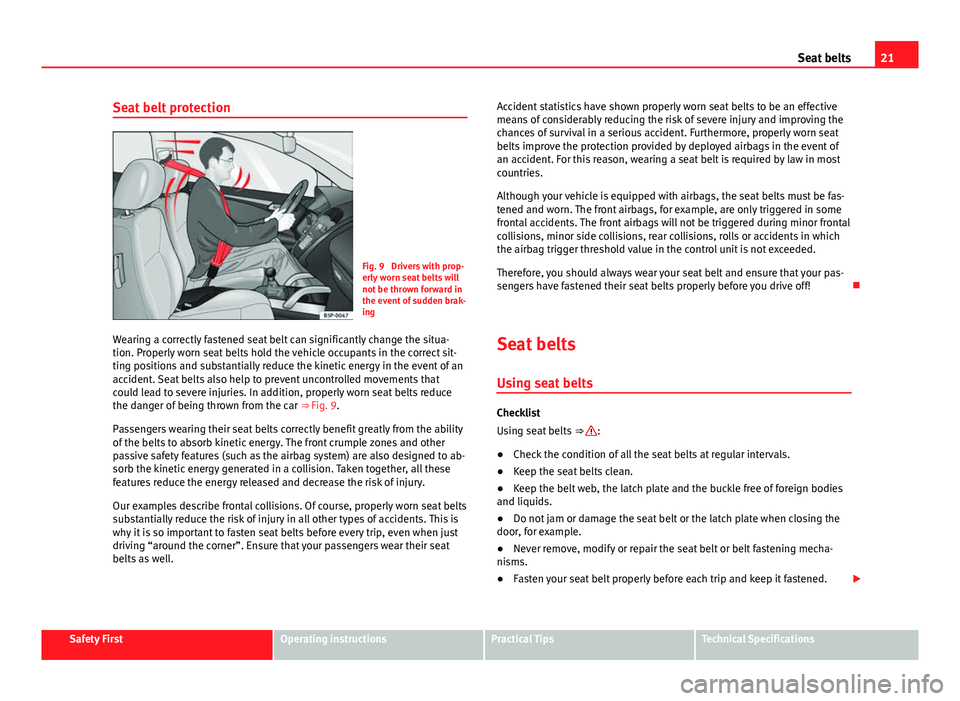
Fig. 9 Drivers with prop-
erly worn seat belts will
not be thrown forward in
the event of sudden brak-
ing
Wearing a correctly fastened seat belt can significantly change the situa-
tion. Properly worn seat belts hold the vehicle occupants in the correct sit-
ting positions and substantially reduce the kinetic energy in the event of an
accident. Seat belts also help to prevent uncontrolled movements that
could lead to severe injuries. In addition, properly worn seat belts reduce
the danger of being thrown from the car ⇒ Fig. 9.
Passengers wearing their seat belts correctly benefit greatly from the ability
of the belts to absorb kinetic energy. The front crumple zones and other
passive safety features (such as the airbag system) are also designed to ab-
sorb the kinetic energy generated in a collision. Taken together, all these
features reduce the energy released and decrease the risk of injury.
Our examples describe frontal collisions. Of course, properly worn seat belts
substantially reduce the risk of injury in all other types of accidents. This is
why it is so important to fasten seat belts before every trip, even when just
driving “around the corner”. Ensure that your passengers wear their seat
belts as well. Accident statistics have shown properly worn seat belts to be an effective
means of considerably reducing the risk of severe injury and improving the
chances of survival in a serious accident. Furthermore, properly worn seat
belts improve the protection provided by deployed airbags in the event of
an accident. For this reason, wearing a seat belt is required by law in most
countries.
Although your vehicle is equipped with airbags, the seat belts must be fas-
tened and worn. The front airbags, for example, are only triggered in some
frontal accidents. The front airbags will not be triggered during minor frontal
collisions, minor side collisions, rear collisions, rolls or accidents in which
the airbag trigger threshold value in the control unit is not exceeded.
Therefore, you should always wear your seat belt and ensure that your pas-
sengers have fastened their seat belts properly before you drive off!
Seat belts Using seat belts
Checklist
Using seat belts ⇒ :
● Check the condition of all the seat belts at regular intervals.
● Keep the seat belts clean.
● Keep the belt web, the latch plate and the buckle free of foreign bodies
and liquids.
● Do not jam or damage the seat belt or the latch plate when closing the
door, for example.
● Never remove, modify or repair the seat belt or belt fastening mecha-
nisms.
● Fasten your seat belt properly before each trip and keep it fastened.
Safety FirstOperating instructionsPractical TipsTechnical Specifications
Page 24 of 381

22Seat belts
Twisted seat belt
If it is difficult to remove the seat belt from the guide, the seat belt may
have become twisted inside the side trim after being wound too quickly on
unfastening:
● Pull out the seat belt completely, carefully pulling on the latch plate.
● Untwist the belt and guide it back, assisting it by hand.
The seat belt must be fastened even if it is impossible to untwist it. In this
case, the twisted area must not be in an area in direct contact with your
body. Have the seat belt untwisted urgently by a specialised workshop.
WARNING
An improperly handled seat belt increases the risk of sustaining severe
or fatal injuries.
● Regularly check that the seat belts and their components are in per-
fect condition.
● Always keep your seat belt clean.
● Do not jam or damage the seat belt or rub it with sharp edges.
● Make sure there are no liquids or foreign bodies on the latch plate
and in the buckle.
Fastening or unfastening a seat belt with one buckle
Fig. 10 Insert the latch
plate into the buckle
Fig. 11 Release the latch
plate from the buckle
Properly worn seat belts hold the vehicle occupants in the position that
most protects them in the event of an accident or sudden braking ⇒
.
Page 25 of 381

23
Seat belts
Fastening the seat belt
Fasten your seat belt before each trip.
● Adjust the front seat and head restraint correctly ⇒ page 10.
● Engage the seat backrest of the rear seat in an upright position ⇒
.
● Pull the latch plate and place the belt webbing evenly across your chest
and lap. Do not twist the seat belt when doing so ⇒
.
● Engage the latch plate in the buckle of the corresponding seat ⇒ Fig. 10.
● Pull the belt to ensure that the latch plate is securely engaged in the
buckle.
Unfastening the seat belt
The seat belt must not be unfastened until the vehicle has come to a stand-
still ⇒
.
● Press the red button on the buckle ⇒ Fig. 11. The latch plate is released
from the buckle.
● Guide the belt back by hand so that it rolls up easily and the trim will not
be damaged.
WARNING
An incorrectly worn seat belt web can cause severe or fatal injuries in the
event of an accident.
● The seat belt cannot offer its full protection unless the seat backrests
are in an upright position and the seat belt is worn correctly, according to
your size.
● Unbuckling your seat belt while the vehicle is in motion can cause se-
vere or fatal injuries in the event of an accident or sudden braking.
Fastening or unfastening the seat belt with two buckles
Fig. 12 Fasten the seat
belt on the centre seat in
the second row of seats
Properly worn seat belts hold the vehicle occupants in the position that
most protects them in the event of an accident or sudden braking ⇒
.
The seat belts for the centre seat in the second row of seats and for the
seats in the third row of seats are fastened using two buckles.
Fastening the seat belt
Fasten your seat belt before each trip.
● Adjust the rear seat and head restraint correctly
⇒ page 10.
● Engage the seat backrest of the rear seat in an upright position
⇒
.
● Use latch plate of the belt
⇒ Fig. 12 1 to pull the seat belt down. Do
not
twist the seat belt when doing so ⇒ .
● Engage the latch plate 1 in the buckle of the corresponding seat A.
● Use the latch plate
⇒ Fig. 12 2 to pull the seat belt across your lap.
● Engage the latch plate 2 in the buckle of the corresponding seat B.
● Pull the belt to ensure that both latch plates are securely engaged in the
buckles.
Safety FirstOperating instructionsPractical TipsTechnical Specifications
Page 26 of 381

24Seat belts
Unfastening the seat belt
The seat belt must not be unfastened until the vehicle has come to a stand-
still ⇒
.
● Press the red button on the buckle ⇒ Fig. 12 A
. The latch plate is re-
leased from the buckle.
● Press the red button on the buckle ⇒ Fig. 12 B
. The latch plate is re-
leased from the buckle.
● Guide the belt back by hand so that it rolls up easily and the trim will not
be damaged.
WARNING
An incorrectly worn seat belt web can cause severe or fatal injuries in the
event of an accident.
● The seat belt cannot offer its full protection unless the seat backrests
are in an upright position and the seat belt is worn correctly, according to
your size.
● Unbuckling your seat belt while the vehicle is in motion can cause se-
vere or fatal injuries in the event of an accident or sudden braking.
Note
Seat belts with two buckles include a diagram to show how to fasten the
seat belt.
Page 27 of 381

25
Seat belts
Seat belt position
Fig. 13 Correct belt web and head restraint positions
Fig. 14 Correct position-
ing of seat belts during
pregnancy
Seat belts offer their maximum protection in the event of an accident and
reduce the risk of sustaining severe or fatal injuries only when they are
properly positioned. Furthermore, if the webbing is correctly positioned, the
seat belt will hold the vehicle occupants in the optimum position to ensure the airbag provides the utmost protection. The seat belt must therefore al-
ways be worn and the webbing correctly positioned.
Incorrectly worn seat belts can cause severe or even fatal injuries
⇒ page 10, Adjusting the seat position.
Correct seat belt position
●
The shoulder part of the seat belt must lie on the centre of the shoulder,
never across the neck or the arm, under the arm or behind the shoulder.
● The lap part of the seat belt must lie across the pelvis, never across the
stomach.
● The seat belt must lie flat and fit comfortably. Pull the belt tight if neces-
sary to take up any slack.
In the case of pregnant women , the seat belt must lie evenly across the
chest and as low as possible over the pelvis, never across the stomach and
must be worn properly at all times during the pregnancy ⇒ Fig. 14.
Safety FirstOperating instructionsPractical TipsTechnical Specifications