Page 396 of 546
Trailer Towing Weights (Maximum Trailer Weight Ratings)
CHASSIS CAB 3500
ST/SLT/Laramie
5.7L HEMI® 6-Speed Automatic Transmission Towing: 14,050 lbs (6 372 kg)
Payload: 4,728 lbs (2 144 kg)
6.4L HEMI® 6-Speed Automatic Transmission Towing: 17,850 lbs (8 096 kg)
Payload: 8,013 lbs (3 634 kg)
CHASSIS CAB 4500
ST/SLT/Laramie
6.4L HEMI® 6-Speed Automatic Transmission Towing: 18,950 lbs (8 595 kg)
Payload: 9,134 lbs (4 143 kg)
394 STARTING AND OPERATING
Page 397 of 546
CHASSIS CAB 5500
ST/SLT/Laramie
6.4L HEMI® 6-Speed Automatic Transmission Towing: 18,900 lbs (8 572 kg)
Payload: 11,080 lbs (5 025 kg)
NOTE: For additional trailer towing information (maxi-
mum trailer weight ratings) refer to the following website
addresses:
• http://www.ramtrucks.com.
• http://www.ramtruck.ca (Canada).
Trailer And Tongue Weight
Always load a trailer with 60% of the weight in the front
of the trailer. This places 10% of the GTW on the tow
hitch of your vehicle. Loads balanced over the wheels or
heavier in the rear can cause the trailer to sway severely
side to side which will cause loss of control of the vehicle
and trailer. Failure to load trailers heavier in front is the cause of many trailer collisions. Never exceed the maxi-
mum tongue weight stamped on your trailer hitch.
5
STARTING AND OPERATING 395
Page 398 of 546

Consider the following items when computing the
weight on the rear axle of the vehicle:
•The tongue weight of the trailer
• The weight of any other type of cargo or equipment
put in or on your vehicle
• The weight of the driver and all passengers
NOTE: Remember that everything put into or on the
trailer adds to the load on your vehicle. Also, additional
factory-installed options or dealer-installed options must
be considered as part of the total load on your vehicle.
Refer to “Tire Safety Information/Tire and Loading In-
formation Placard” in “Starting and Operating” for fur-
ther information.Towing Requirements
To promote proper break-in of your new vehicle drive-
train components the following guidelines are recom-
mended:
CAUTION!
• Do not tow a trailer at all during the first 500 miles
(805 km) the new vehicle is driven. The engine, axle
or other parts could be damaged.
• Then, during the first 500 miles (805 km) that a
trailer is towed, do not drive over 50 mph (80 km/h)
and do not make starts at full throttle. This helps
the engine and other parts of the vehicle wear in at
the heavier loads.
396 STARTING AND OPERATING
Page 400 of 546

WARNING!(Continued)
•Total weight must be distributed between the tow
vehicle and the trailer such that the following four
ratings are not exceeded:
1. GVWR
2. GTW
3. GAWR
4. Tongue weight rating for the trailer hitch uti-
lized.
Towing Requirements — Tires
• Do not attempt to tow a trailer while using a compact
spare tire.
• Proper tire inflation pressures are essential to the safe
and satisfactory operation of your vehicle. Refer to “Tires – General Information” in “Starting and Oper-
ating” for proper tire inflation procedures.
• Check the trailer tires for proper tire inflation pres-
sures before trailer usage.
• Check for signs of tire wear or visible tire damage
before towing a trailer. Refer to “Tires – General
Information” in “Starting and Operating” for the
proper inspection procedure.
• When replacing tires, refer to “Tires – General Infor-
mation” in “Starting and Operating” for proper tire
replacement procedures. Replacing tires with a higher
load carrying capacity will not increase the vehicle’s
GVWR and GAWR limits.
398 STARTING AND OPERATING
Page 410 of 546

Snowplow Prep Package Model Availability
For Information about snowplow applications visit
www.ramtrucks.com or refer to the current Ram Body
Builders Guide.
1. The maximum number of occupants in the truckshould not exceed two.
2. The total GVWR or the Front GAWR or the Rear GAWR should never be exceeded.
3. Cargo capacity will be reduced by the addition of options or passengers, etc.
The loaded vehicle weight, including the snowplow
system, all aftermarket accessories, driver, passengers,
options, and cargo, must not exceed either the Gross
Vehicle Weight (GVWR) or Gross Axle Weight (GAWR)
ratings. These weights are specified on the Safety Com-
pliance Certification Label on the driver’s side door
opening. NOTE:
Detach the snowplow when transporting pas-
sengers.
Vehicle front end wheel alignment was set to specifica-
tions at the factory without consideration for the weight
of the plow. Front end toe-in should be checked and reset
if necessary at the beginning and end of the snowplow
season. This will help prevent uneven tire wear.
The blade should be lowered whenever the vehicle is
parked.
Maintain and operate your vehicle and snowplow equip-
ment following the recommendations provided by the
specific snowplow manufacturer.
Over The Road Operation With Snowplow
Attached
The blade restricts air flow to the radiator and causes the
engine to operate at higher than normal temperatures.
Therefore, when transporting the plow, angle the blade
408 STARTING AND OPERATING
Page 455 of 546

CAUTION!
Do not use chemical flushes in your engine oil as the
chemicals can damage your engine. Such damage is
not covered by the New Vehicle Limited Warranty.
Engine Oil Viscosity — 5.7L Engine
MOPAR SAE 5W-20 engine oil or equivalent Pennzoil®
or Shell Helix® is recommended for all operating tem-
peratures. This engine oil improves low temperature
starting and vehicle fuel economy.
For information on engine oil filler cap location, refer to
“Engine Compartment” in “Maintaining Your Vehicle”
for further information.
Lubricants which do not have both the engine oil certi-
fication mark and the correct SAE viscosity grade num-
ber should not be used.NOTE:
For trucks with a 5.7L engine operating under a
gross combined weight rating of 14,000 lbs (6 350 kg) or
greater, MOPAR SAE 5W-30 engine oil or equivalent
Pennzoil® or Shell Helix® is recommended for all oper-
ating temperatures.
Engine Oil Viscosity — 6.4L Engine
Use Pennzoil Ultra™ 0W–40 engine or equivalent
MOPAR® oil meeting the Chrysler Material Standard
MS-12633 for use in all operating temperatures.
The engine oil filler cap also shows the recommended
engine oil viscosity for your engine. For information on
engine oil filler cap location, refer to the “Engine Com-
partment” in this section.
7
MAINTAINING YOUR VEHICLE 453
Page 506 of 546
FLUIDS, LUBRICANTS AND GENUINE PARTS
Engine
ComponentFluid, Lubricant, or Genuine Part
Engine Coolant We recommend you use MOPAR® Antifreeze/Coolant 10–Year/
150,000 Mile Formula OAT (Organic Additive Technology).
Engine Oil – 5.7L Engine We recommend you use API Certified SAE 5W-20 Engine Oil,
meeting the requirements of Chrysler Material Standard MS-6395
such as MOPAR®, Pennzoil®, and Shell Helix®. Refer to your
engine oil filler cap for correct SAE grade.
Engine Oil – 5.7L Engine For trucks operat-
ing under a gross combined weight rating
greater than 14,000 lbs/(6,350 kg.) We recommend you use API Certified SAE 5W-30 Engine Oil,
meeting the requirements of Chrysler Material Standard MS-6395
such as MOPAR®, Pennzoil®, and Shell Helix®. Refer to your
engine oil filler cap for correct SAE grade.
504 MAINTAINING YOUR VEHICLE
Page 534 of 546
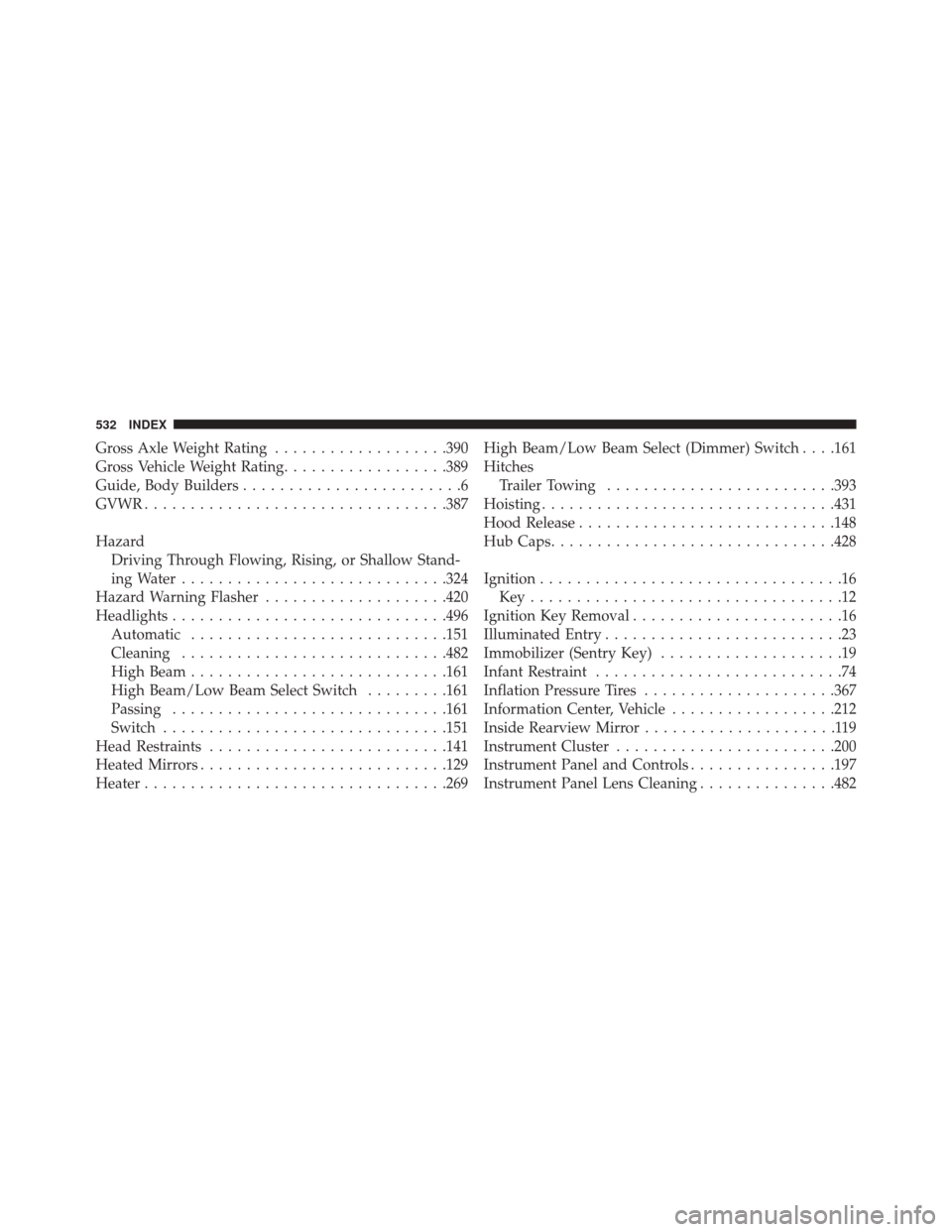
Gross Axle Weight Rating...................390
Gross Vehicle Weight Rating ..................389
Guide, Body Builders ........................6
GVWR ................................ .387
Hazard Driving Through Flowing, Rising, or Shallow Stand-
ing Water ............................ .324
Hazard Warning Flasher ....................420
Headlights ............................. .496
Automatic ........................... .151
Cleaning ............................ .482
High Beam ........................... .161
High Beam/Low Beam Select Switch .........161
Passing ............................. .161
Switch .............................. .151
Head Restraints ......................... .141
Heated Mirrors .......................... .129
Heater ................................ .269High Beam/Low Beam Select (Dimmer) Switch . . . .161
Hitches
Trailer Towing ........................ .393
Hoisting ............................... .431
Hood Release ........................... .148
Hub Caps .............................. .428
Ignition .................................16
Key..................................12
Ignition Key Removal .......................16
Illuminated Entry ..........................23
Immobilizer (Sentry Key) ....................19
Infant Restraint ...........................74
Inflation Pressure Tires .....................367
Information Center, Vehicle ..................212
Inside Rearview Mirror .....................119
Instrument Cluster ....................... .200
Instrument Panel and Controls ................197
Instrument Panel Lens Cleaning ...............482
532 INDEX


