Page 190 of 352

188
Practical information
Place the foot of the jack 2 on the ground and ensure that it is directly below the front A or rear B jacking point provided on the underbody, whichever is closest to the wheel to be changed.
Removing a wheel
Parking the vehicle
Immobilise the vehicle where it does not block traffic: the ground must be level, stable and not slippery. Apply the parking brake unless it has been programmed to automatic mode, switch off the ignition and engage first gear * to block the wheels. Check that the braking warning lamp and the P warning lamp in the parking brake control lever come on. The occupants must get out of the vehicle and wait where they are safe. Never go underneath a vehicle raised using a jack; use an axle stand.
List of operations
Remove the bolt cover from each of the bolts using the tool 3 (according to equipment). Fit the security socket 4 on the wheelbrace 1 to slacken the security bolt (if fitted). Slacken the other bolts using the wheelbrace 1 o n l y.
* Position R for the electronic gear control gearbox; P for the automatic gearbox.
Page 199 of 352
8
197
Practical information
1. Brake lamps (light emittingdiodes - LEDs).2. Reversing lamps (P21W).3. Direction indicators (PY21W amber).4. Sidelamps (light emitting diodes - LEDs).5. Foglamps (H21W ).
Rear lamps (Saloon)
Reversing lamp, direction indicator and foglamp bulbs
Open the boot, then the plastic cover. Remove the two lamp unit fixing nuts. Extract the lamp unit carefully from the outside. Disconnect the electrical connector.
Spread the six tabs and remove the bulb h o l d e r. Turn the bulb a quarter of a turn and pull it out. For reassembly, carry out these operations in reverse order.
Changing the light emitting diode-LED lamps
For replacement, contact a PEUGEOT dealer or qualified workshop.
Page 200 of 352
198
Practical information
1. Brake lamps (light emittingdiodes - LEDs).2. Reversing lamps (W19W).3. Direction indicators (PY21W amber).4. Sidelamps (light emittingdiodes - LEDs).5. Foglamps (light emitting diodes - LEDs).
Rear lamps (SW)
Open the boot then remove the access cover. Remove the sealing foam. Disconnect the lamp connector. Remove the lamp fixing nut.
Direction indicators(on the wings)
Carefully remove the lamp unit from outside. Remove the sealing foam. Unclip the bulb holder. Turn the bulb a quarter of a turn and pull it out. For reassembly, carry out these operations in reverse order.
Changing the light emitting diode-LED lamps
For replacement, contact a PEUGEOT dealer or qualified workshop.
Page 202 of 352
200
Practical information
Third brake lamp (light emitting diodes - LEDs)
Contact a PEUGEOT dealer or qualified workshop.
Number plate lamps
Insert a thin screwdriver into one of the outer holes of the lens. Push it outwards to unclip. Disconnect the lamp connector. Remove the lens. Pull the bulb out and change it.
Page 213 of 352
8
211
Practical information
General
recommendations
Observe the legislation in force in your c o unt r y. Ensure that the weight of the towing vehicle is higher than that of the towed vehicle. The person at the wheel of the towed vehicle must have a valid driving
licence. When towing a vehicle with all four wheels on the ground, always use an approved towing bar; rope and straps are prohibited. When towing a vehicle with the engine off, there is no longer any power assistance for braking or steering. In the following cases, you must always call on a professional recovery service: - vehicle broken down on a motor way or fast road, - 4 wheel drive vehicle, - when it is not possible to put the gearbox into neutral, unlock the steering, or release the parking brake, - towing with only two wheels on the ground, - where there is no approved towing bar available...
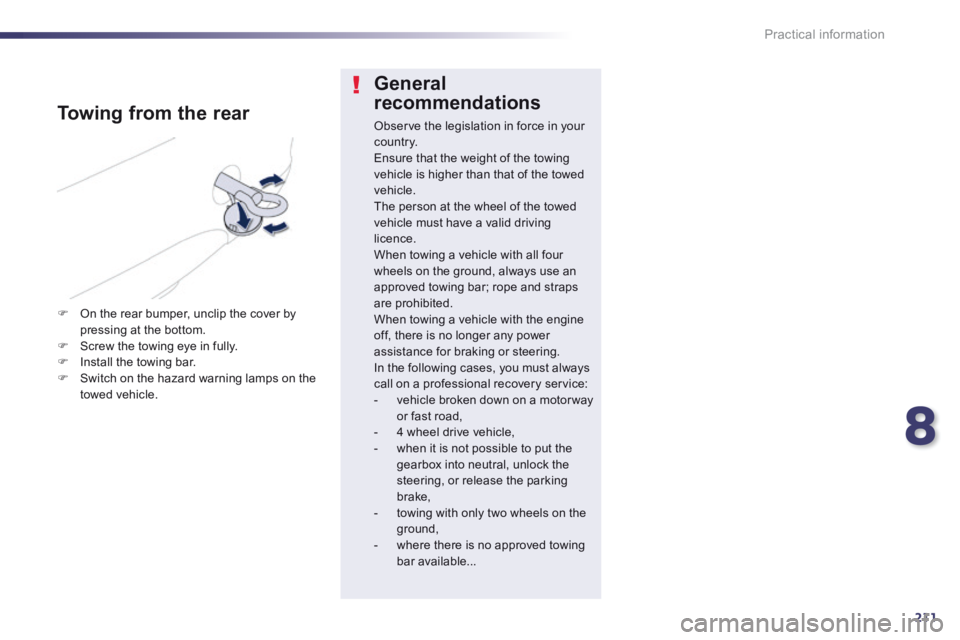
Towing from the rear
On the rear bumper, unclip the cover by pressing at the bottom. Screw the towing eye in fully. Install the towing bar. Switch on the hazard warning lamps on the towed vehicle.
Page 215 of 352

8
213
Practical information
Driving advice
Distribution of loads
Distribute the load in the trailer so that the heaviest items are as close as possible to the axle and the nose weight approaches the maximum permitted without
exceeding it. Air density decreases with altitude, thus reducing engine per formance. Above 1 000 metres, the maximum towed load must be reduced by 10 % for every 1 000 metres of altitude.
Side wind
Take into account the increased sensitivity to side wind.
Cooling
Towing a trailer on a slope increases the temperature of the coolant. As the fan is electrically controlled, its cooling capacity is not dependent on the engine speed.
To lower the engine speed, reduce your speed. The maximum towed load on a long incline depends on the gradient and the ambient temperature. In all cases, keep a check on the coolant temperature.
If the warning lamp and the STOP warning lamp come on, stop the vehicle and switch off the engine as soon as possible.
Braking
Towing a trailer increases the braking distance. To avoid overheating of the brakes on a long mountain type of descent, the use of engine braking is recommended.
Ty r e s
Check the tyre pressures of the towing vehicle and of the trailer, observing the recommended pressures.
Lighting
Check the electrical lighting and signalling on the trailer.
The rear parking sensors will be deactivated automatically if a genuine PEUGEOT towbar is used.
Refer to the "Technical Data" section for details of the weights and towed loads which apply to your vehicle.
Page 223 of 352
9
221
Checks
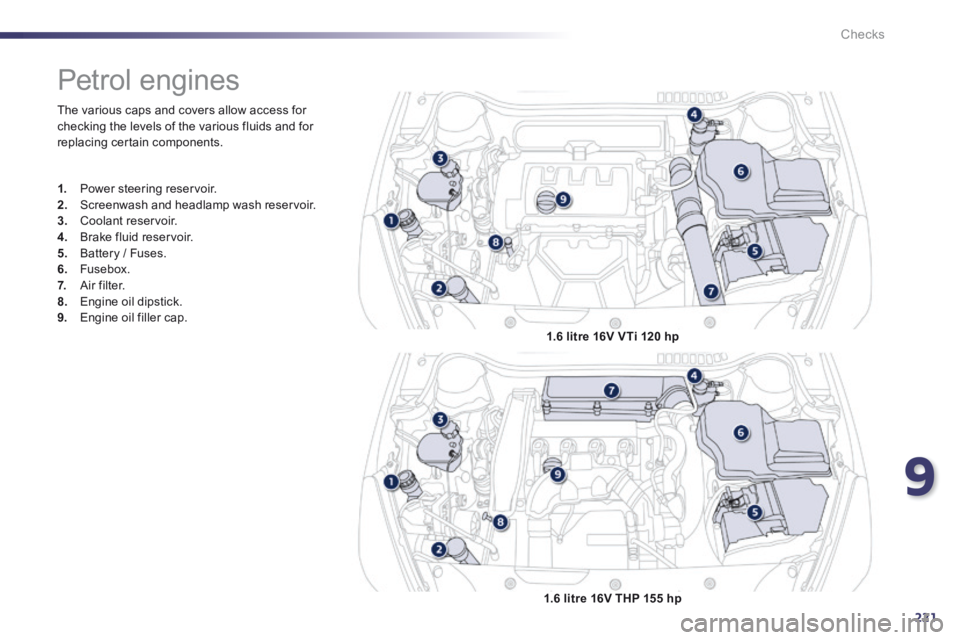
The various caps and covers allow access for checking the levels of the various fluids and for replacing certain components.
Petrol engines
1. Power steering reservoir. 2. Screenwash and headlamp wash reservoir. 3. Coolant reservoir.
4. Brake fluid reservoir. 5. Battery / Fuses. 6. Fusebox. 7. Air filter. 8. Engine oil dipstick. 9. Engine oil filler cap.
1.6 litre 16V VTi 120 hp
1.6 litre 16V THP 155 hp
Page 224 of 352
222
Checks
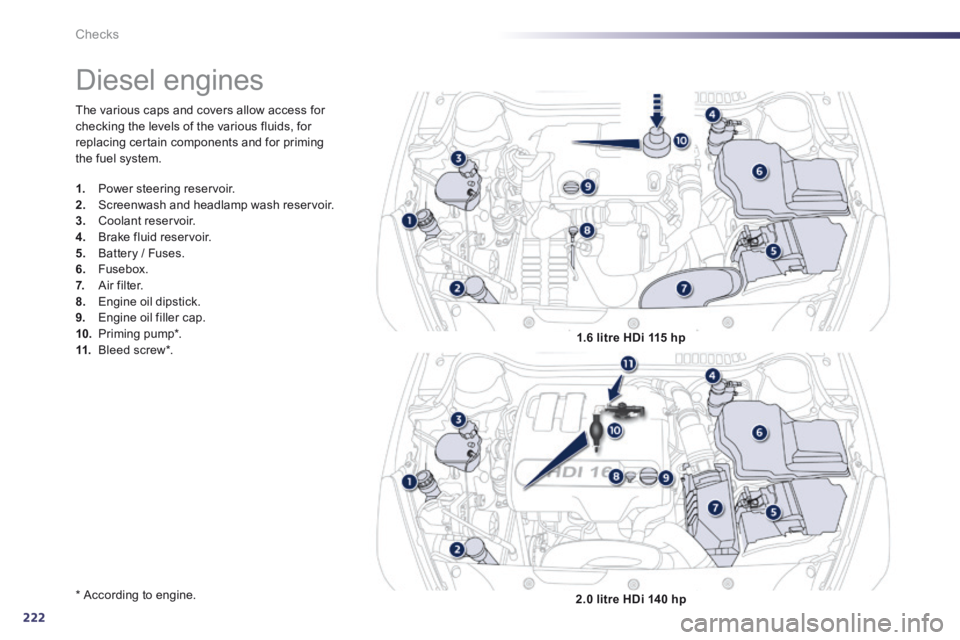
The various caps and covers allow access for checking the levels of the various fluids, for replacing certain components and for priming the fuel system.
* According to engine.
Diesel engines
1. Power steering reservoir. 2. Screenwash and headlamp wash reservoir. 3. Coolant reservoir.
4. Brake fluid reservoir. 5. Battery / Fuses. 6. Fusebox. 7. Air filter. 8. Engine oil dipstick. 9. Engine oil filler cap. 10. Priming pump * . 11. Bleed screw * . 1.6 litre HDi 115 hp
2.0 litre HDi 140 hp