Page 113 of 400
111
4
Driving
308_EN_CHAP04_CONDUITE_ED02-2013
Key left in reader
You are warned by a message if the electronic key is is still in the reader on opening the driver's door.
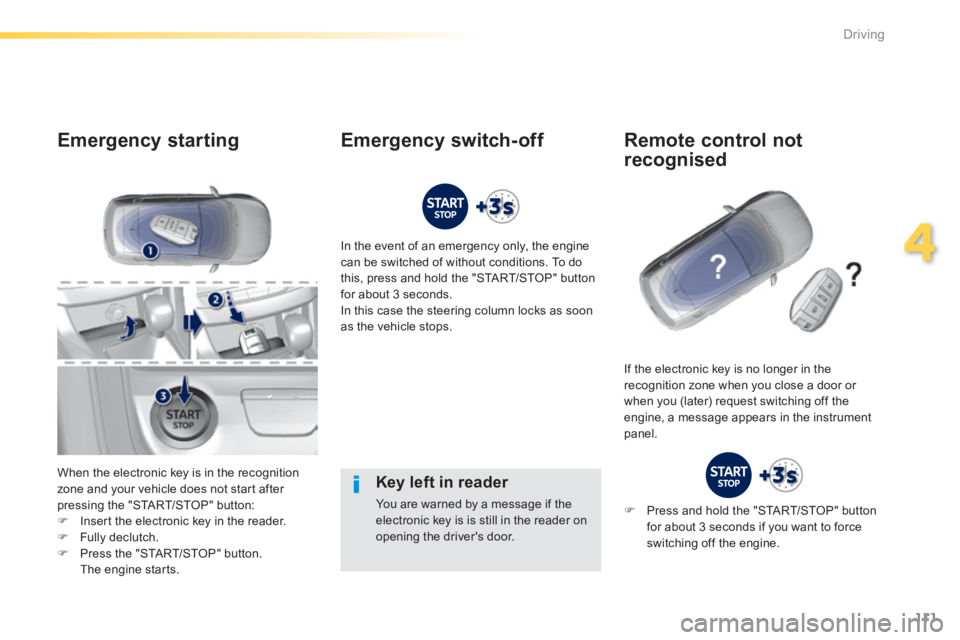
Emergency starting
When the electronic key is in the recognition zone and your vehicle does not start after pressing the "START/STOP" button: Insert the electronic key in the reader.
Fully declutch. Press the "START/STOP" button. The engine starts.
In the event of an emergency only, the engine can be switched of without conditions. To do this, press and hold the "START/STOP" button for about 3 seconds. In this case the steering column locks as soon as the vehicle stops.
If the electronic key is no longer in the recognition zone when you close a door or when you (later) request switching off the engine, a message appears in the instrument panel.
Emergency switch-off Remote control not
recognised
Press and hold the "START/STOP" button for about 3 seconds if you want to force switching off the engine.
Page 114 of 400
112
Driving
308_EN_CHAP04_CONDUITE_ED02-2013
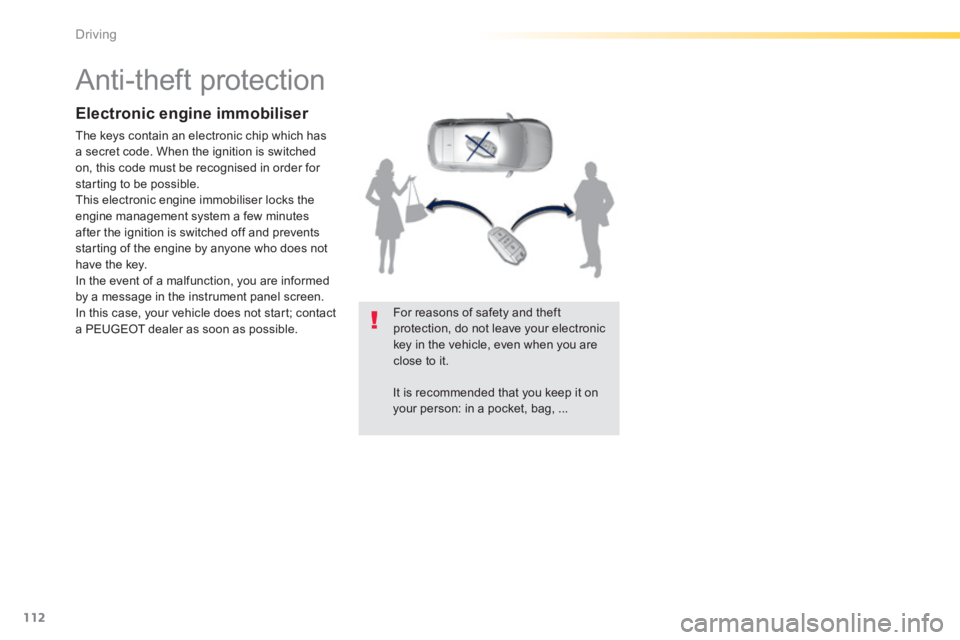
Anti-theft protection
Electronic engine immobiliser
The keys contain an electronic chip which has a secret code. When the ignition is switched on, this code must be recognised in order for starting to be possible. This electronic engine immobiliser locks the engine management system a few minutes
after the ignition is switched off and prevents starting of the engine by anyone who does not have the key. In the event of a malfunction, you are informed by a message in the instrument panel screen. In this case, your vehicle does not start; contact a PEUGEOT dealer as soon as possible.
For reasons of safety and theft protection, do not leave your electronic key in the vehicle, even when you are close to it.
It is recommended that you keep it on your person: in a pocket, bag, ...
Page 116 of 400
114
Driving
308_EN_CHAP04_CONDUITE_ED02-2013
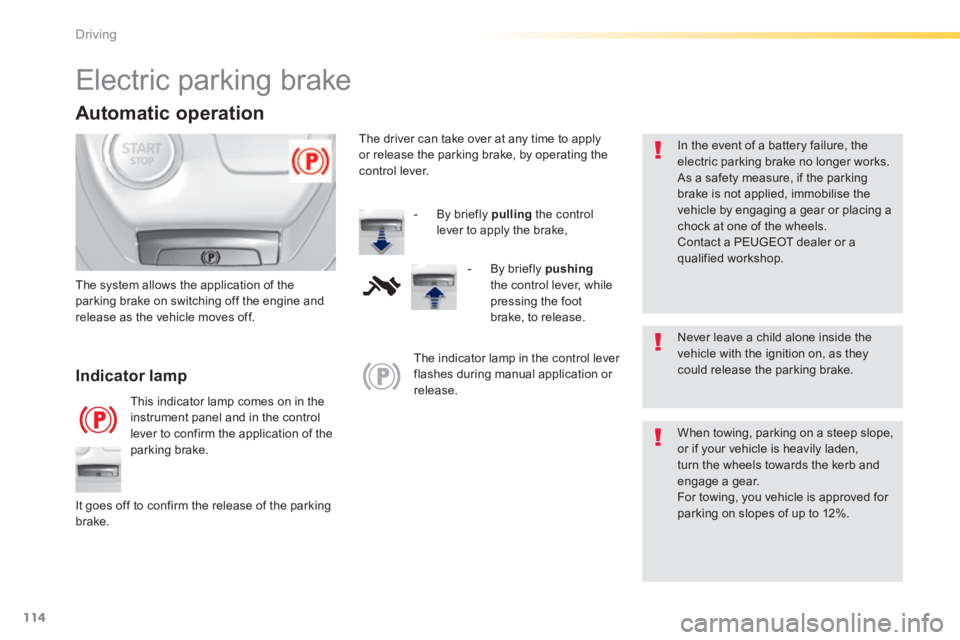
Electric parking brake
Never leave a child alone inside the vehicle with the ignition on, as they could release the parking brake. Indicator lamp
This indicator lamp comes on in the instrument panel and in the control lever to confirm the application of the parking brake.
The system allows the application of the parking brake on switching off the engine and release as the vehicle moves off.
When towing, parking on a steep slope, or if your vehicle is heavily laden, turn the wheels towards the kerb and engage a gear. For towing, you vehicle is approved for parking on slopes of up to 12%. It goes off to confirm the release of the parking brake.
The indicator lamp in the control lever flashes during manual application or release.
In the event of a battery failure, the electric parking brake no longer works. As a safety measure, if the parking brake is not applied, immobilise the vehicle by engaging a gear or placing a chock at one of the wheels. Contact a PEUGEOT dealer or a qualified workshop.
Automatic operation
The driver can take over at any time to apply or release the parking brake, by operating the control lever.
- By briefly pulling the control
lever to apply the brake,
- By briefly pushingthe control lever, while pressing the foot brake, to release.
Page 118 of 400
116
Driving
308_EN_CHAP04_CONDUITE_ED02-2013
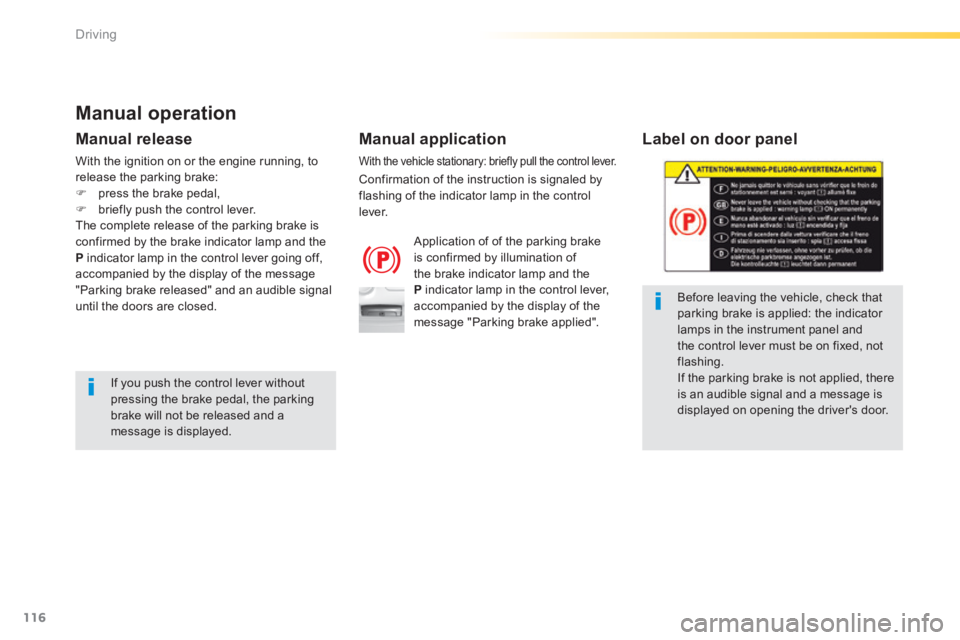
Label on door panel
Before leaving the vehicle, check that parking brake is applied: the indicator lamps in the instrument panel and the control lever must be on fixed, not flashing. If the parking brake is not applied, there is an audible signal and a message is displayed on opening the driver's door.
Manual operation
Application of of the parking brake is confirmed by illumination of the brake indicator lamp and the P indicator lamp in the control lever, accompanied by the display of the message "Parking brake applied".
Manual release
If you push the control lever without pressing the brake pedal, the parking brake will not be released and a
message is displayed.
With the vehicle stationary: briefly pull the control lever.
Confirmation of the instruction is signaled by flashing of the indicator lamp in the control l eve r.
With the ignition on or the engine running, to release the parking brake: press the brake pedal, briefly push the control lever. The complete release of the parking brake is confirmed by the brake indicator lamp and the P indicator lamp in the control lever going off, accompanied by the display of the message "Parking brake released" and an audible signal until the doors are closed.
Manual application
Page 119 of 400
117
4
Driving
308_EN_CHAP04_CONDUITE_ED02-2013
Immobilisation of the vehicle (special cases)
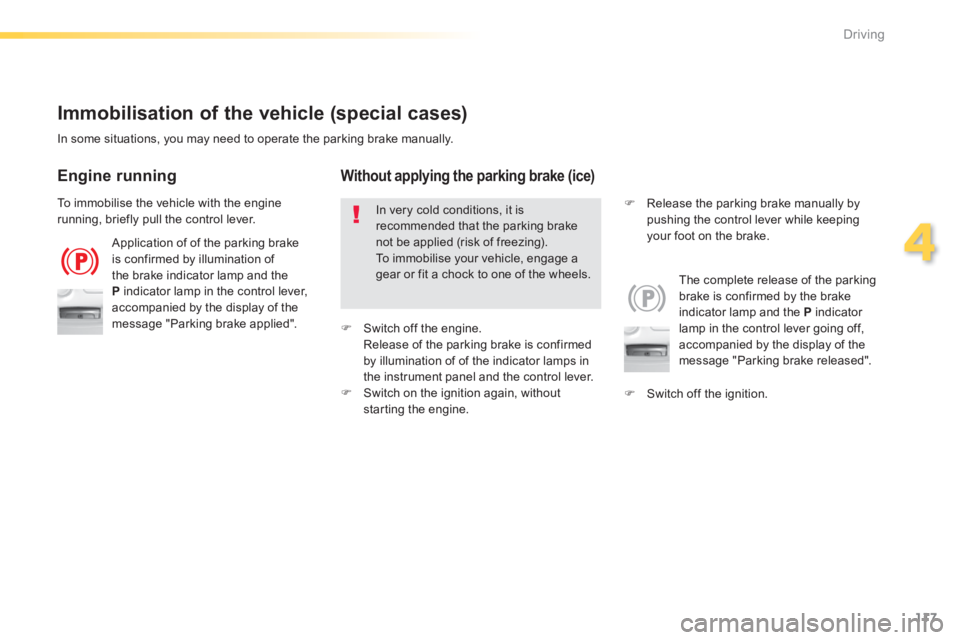
Application of of the parking brake is confirmed by illumination of the brake indicator lamp and the P indicator lamp in the control lever, accompanied by the display of the message "Parking brake applied".
The complete release of the parking brake is confirmed by the brake indicator lamp and the P indicator lamp in the control lever going off, accompanied by the display of the message "Parking brake released".
In some situations, you may need to operate the parking brake manually.
Engine running
In very cold conditions, it is
recommended that the parking brake not be applied (risk of freezing). To immobilise your vehicle, engage a gear or fit a chock to one of the wheels.
Without applying the parking brake (ice)
Switch off the ignition.
Release the parking brake manually by pushing the control lever while keeping your foot on the brake.
To immobilise the vehicle with the engine running, briefly pull the control lever.
Switch off the engine. Release of the parking brake is confirmed by illumination of of the indicator lamps in the instrument panel and the control lever. Switch on the ignition again, without starting the engine.
Page 120 of 400
118
Driving
308_EN_CHAP04_CONDUITE_ED02-2013
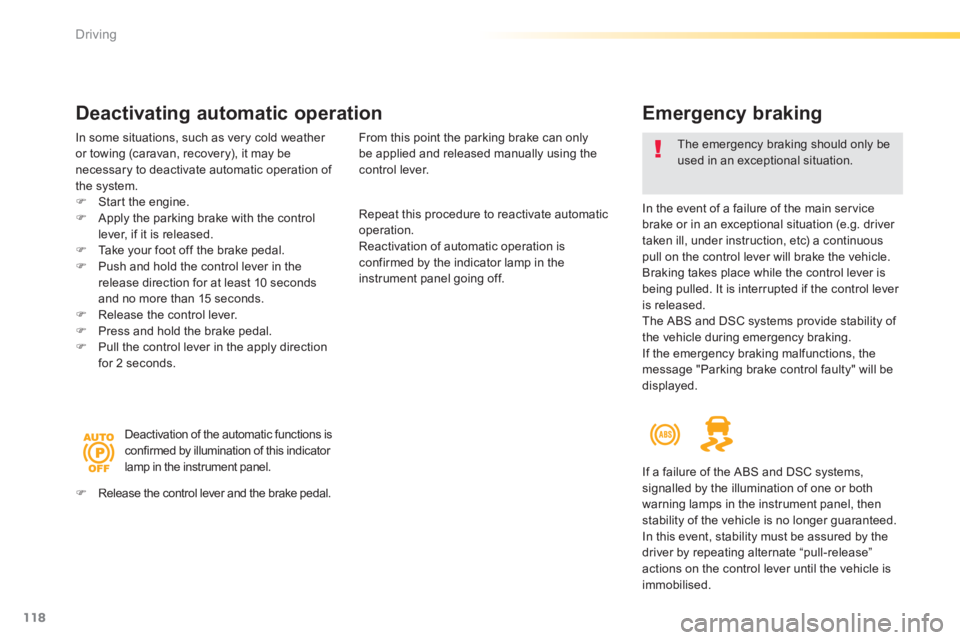
Emergency braking
In the event of a failure of the main service brake or in an exceptional situation (e.g. driver taken ill, under instruction, etc) a continuous pull on the control lever will brake the vehicle. Braking takes place while the control lever is being pulled. It is interrupted if the control lever is released. The ABS and DSC systems provide stability of the vehicle during emergency braking. If the emergency braking malfunctions, the message "Parking brake control faulty" will be displayed.
The emergency braking should only be used in an exceptional situation.
Repeat this procedure to reactivate automatic operation. Reactivation of automatic operation is confirmed by the indicator lamp in the instrument panel going off.
Deactivating automatic operation
In some situations, such as very cold weather or towing (caravan, recovery), it may be necessary to deactivate automatic operation of the system. Start the engine. Apply the parking brake with the control
lever, if it is released. Take your foot off the brake pedal. Push and hold the control lever in the release direction for at least 10 seconds and no more than 15 seconds. Release the control lever. Press and hold the brake pedal. Pull the control lever in the apply direction for 2 seconds.
Deactivation of the automatic functions is confirmed by illumination of this indicator lamp in the instrument panel.
Release the control lever and the brake pedal.
From this point the parking brake can only be applied and released manually using the control lever.
If a failure of the ABS and DSC systems, signalled by the illumination of one or both warning lamps in the instrument panel, then stability of the vehicle is no longer guaranteed. In this event, stability must be assured by the driver by repeating alternate “pull-release” actions on the control lever until the vehicle is
immobilised.
Page 122 of 400
120
Driving
308_EN_CHAP04_CONDUITE_ED02-2013
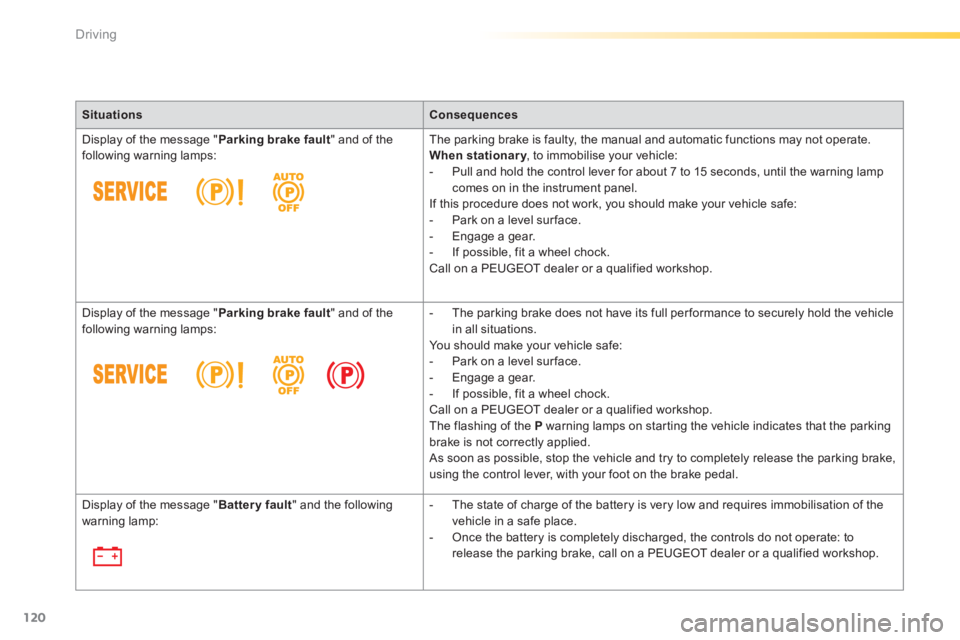
SituationsConsequences
Display of the message " Parking brake fault " and of the following warning lamps: The parking brake is faulty, the manual and automatic functions may not operate. When stationary , to immobilise your vehicle: When stationary , to immobilise your vehicle: When stationary - Pull and hold the control lever for about 7 to 15 seconds, until the warning lamp comes on in the instrument panel. If this procedure does not work, you should make your vehicle safe: - Park on a level sur face. - Engage a gear. - If possible, fit a wheel chock. Call on a PEUGEOT dealer or a qualified workshop.
Display of the message " Parking brake fault " and of the following warning lamps: - The parking brake does not have its full per formance to securely hold the vehicle in all situations. You should make your vehicle safe: - Park on a level sur face. - Engage a gear. - If possible, fit a wheel chock. Call on a PEUGEOT dealer or a qualified workshop. The flashing of the P warning lamps on starting the vehicle indicates that the parking brake is not correctly applied. As soon as possible, stop the vehicle and try to completely release the parking brake, using the control lever, with your foot on the brake pedal.
Display of the message " Battery fault " and the following warning lamp: - The state of charge of the battery is very low and requires immobilisation of the vehicle in a safe place.
- Once the battery is completely discharged, the controls do not operate: to release the parking brake, call on a PEUGEOT dealer or a qualified workshop.
Page 125 of 400
123
4
Driving
308_EN_CHAP04_CONDUITE_ED02-2013
Gear shift indicator
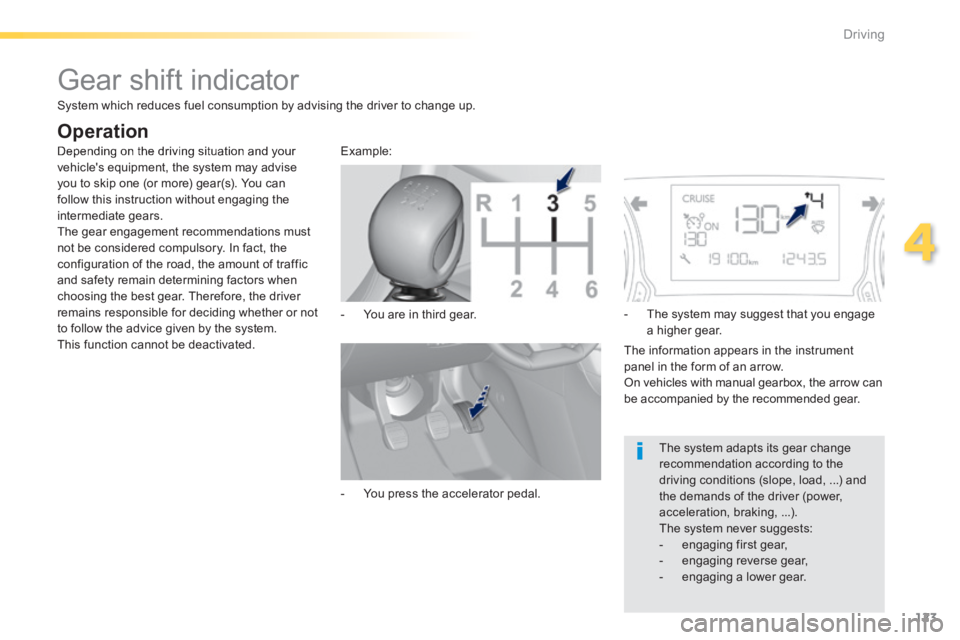
Depending on the driving situation and your vehicle's equipment, the system may advise you to skip one (or more) gear(s). You can follow this instruction without engaging the intermediate gears. The gear engagement recommendations must not be considered compulsory. In fact, the configuration of the road, the amount of traffic and safety remain determining factors when choosing the best gear. Therefore, the driver remains responsible for deciding whether or not to follow the advice given by the system. This function cannot be deactivated.
- You are in third gear.
Example:
- You press the accelerator pedal.
- The system may suggest that you engage a higher gear.
The information appears in the instrument panel in the form of an arrow. On vehicles with manual gearbox, the arrow can be accompanied by the recommended gear.
The system adapts its gear change recommendation according to the driving conditions (slope, load, ...) and the demands of the driver (power, acceleration, braking, ...). The system never suggests: - engaging first gear, - engaging reverse gear, - engaging a lower gear.
System which reduces fuel consumption by advising the driver to change up.
Operation