Page 57 of 245
Seats, restraints55Three-point seat belt
Fastening seat belt
Withdraw the belt from the retractor,
guide it untwisted across the body
and insert the latch plate into the
buckle. Tighten the lap belt regularly
whilst driving by pulling the shoulder
belt.
Seat belt reminder 3 96.
Loose or bulky clothing prevents the
belt from fitting snugly. Do not place
objects such as handbags or mobile
phones between the belt and your body.
9 Warning
The belt must not rest against hard
or fragile objects in the pockets of
your clothing.
Height adjustment
1. Pull belt out slightly.
2. Press button.
3. Adjust height and engage.
Page 58 of 245
56Seats, restraints
Adjust the height so that the belt lies
across the shoulder. It must not lie across the throat or upper arm.
Do not adjust while driving.
Removing seat belt
To release belt, press red button on
belt buckle.
Seat belts on rear seats
Lead seat belts of the outer seats
through holders at the side if they are not being used.
The seat belt for the middle seat can
only be withdrawn from the retractor if
the backrests are upright and are
engaged in their retainers.
TwinTop
To prevent the seat belts from making
flapping noise when the sun roof and/ or the windows are open, the seat
belts of unoccupied rear seats can be
secured behind the armrest.
Using the seat belt whilepregnant9 Warning
The lap belt must be positioned as
low as possible across the pelvis
to prevent pressure on the
abdomen.
Page 64 of 245

62Seats, restraintsChild restraint installation locationsPermissible options for fitting a child restraint systemWeight and age classOn front passenger seat 1)On outer rear seatsOn centre rear seat2)Group 0: up to 10 kg
or approx. 10 months
Group 0+: up to 13 kg or approx. 2 yearsB1
, ++U, +UGroup I: 9 to 18 kg or approx. 8 months to 4 yearsB2
, ++U, +UGroup II: 15 to 25 kg or approx. 3 to 7 years
Group III: 22 to 36 kg or approx. 6 to 12 yearsXUUB1=Limited, only with seat occupancy recognition and Opel child restraint system with transponders.
If the child restraint system is being secured using a three-point seat belt, move seat height adjustment to uppermost position. Move front passenger seat as far back as possible and move front passenger seat belt anchorage point to lowest position.B 2=Limited, only with seat occupancy recognition and Opel child restraint system with transponders.
If the child restraint system is being secured using a three-point seat belt, move seat height adjustment to uppermost position. Move front passenger seat as far back as possible so that vehicle safety belt runs from anchorage point
towards the front.U=Universal suitability in conjunction with three-point seat belt.+=Seat available with ISOFIX and Top-tether mounting brackets.++=Seat available with ISOFIX mounting brackets.X=No child restraint system permitted in this weight class.1) Not allowed on Saloon 4-door.
2) Not allowed on Astra TwinTop.
Page 79 of 245

Storage77Loading assist
On TwinTop: The loading aid Easy
Load makes it possible to comfortably load the load compartment when the
roof is open. Pressing the loading aid
button will raise the roof folded up in
the load compartment 25 cm. This
enlarges the load opening of the load
compartment.
■ Open the boot lid
■ Unhook load compartment blind and attach to rear window frame
with holder
■ Briefly press loading aid button: The folded roof is raised. The roof
remains in this end position for
approx. 9 minutes
■ Observe marked maximum load height
■ Suspend the load compartment blind from the rear window frame
and engage in the recesses. The
load compartment blind must be
flat; objects underneath it must not
push it upwards.
■ Briefly press loading aid button: The folded roof is lowered.
■ Close the boot lid only after the confirmation signal has sounded.
Otherwise the roof could be
damaged.9 Warning
Take care when operating the
loading aid. Risk of injury.
Make sure that nothing can
become trapped.
Make sure no one is in the action
zone during operation. Risk of
injury.
This is especially important for
children. Inform passengers
accordingly.
Page 86 of 245

84StorageLoading information
■ Heavy objects in the loadcompartment should be placedagainst the seat backrests. Ensure
the backrests are securely
engaged. If objects can be stacked, the heavier objects should be
placed at the bottom.
■ Secure objects with lashing straps attached to lashing eyes 3 75.
■ Secure loose objects in load compartment to prevent sliding.
■ When transporting objects in theload compartment, the backrests of
the rear seats must not be angled
forward.
■ Do not allow the load to protrude above the upper edge of the
backrests.
■ Do not place any objects on the load compartment cover or theinstrument panel.
■ The load must not obstruct the operation of the pedals, parking
brake and gear selector, or hinder
the freedom of movement of the
driver. Do not place any unsecured objects in the interior.
■ Do not drive with an open load compartment.
■ Station wagon: fit safety net when objects are being transported in theload compartment. Close load
compartment cover.
■ Astra TwinTop: pay attention to maximum loading height with roof
open. Do not place objects on top
of or next to the load compartmentblind, on the cover of the
deployable anti-roll bars or behind
the rear head restraints.
■ The payload is the difference between the permitted gross
vehicle weight (see identification
plate 3 212) and the EC kerb
weight.
To calculate the EC kerb weight,
enter the data for your vehicle in the
Weights table at the front of this
manual.
The EC kerb weight includes
weights for the driver (68 kg),
luggage (7 kg) and all fluids (tank
90 % full).
Optional equipment and
accessories increase the kerb
weight.
■ Driving with a roof load increases the sensitivity of the vehicle to
cross-winds and has a detrimental
effect on vehicle handling due to
the vehicle’s higher centre of
gravity. Distribute the load evenly
and secure it properly with retaining
straps. Adjust the tyre pressure and vehicle speed according to the load
Page 192 of 245

190Vehicle careTyre designationsE.g. 195/65 R 15 91 H195=Tyre width, mm65=Cross-section ratio (tyre
height to tyre width), %R=Belt type: RadialRF=Type: RunFlat15=Wheel diameter, inches91=Load index e.g. 91 is
equivalent to 618 kgH=Speed code letter
Speed code letter:
Q=up to 160 km/hS=up to 180 km/hT=up to 190 km/hH=up to 210 km/hV=up to 240 km/hW=up to 270 km/h
Tyre pressure
Check the pressure of cold tyres at
least every 14 days and before any
long journey. Do not forget the spare
wheel. This also applies to vehicles
with tyre pressure monitoring.
Remove the valve cap key from the
fuel filler flap and use it to unscrew the
valve cap.
On vehicles with tyre pressure
monitoring system, screw the adapter
to the valve.
Tyre pressure 3 225 and on the label
on the inside of the fuel filler flap.
The tyre pressure data refer to cold
tyres. It applies to summer and winter tyres.
Always inflate the spare wheel to the
pressure specified for full load.
The ECO tyre pressure serves to
achieve the smallest amount of fuel
consumption possible. It must not be used with run-flat tyres.
Incorrect tyre pressures will impair
safety, vehicle handling, comfort and
fuel economy and will increase tyre
wear.
Tyre pressures differ depending on
various options. For the correct tyre
pressure value, follow the procedure
below:
1. Identify drive axle and body style.
2. Identify the engine identifier code.
Engine data 3 216.
3. Identify the respective tyre.
Page 200 of 245
198Vehicle care
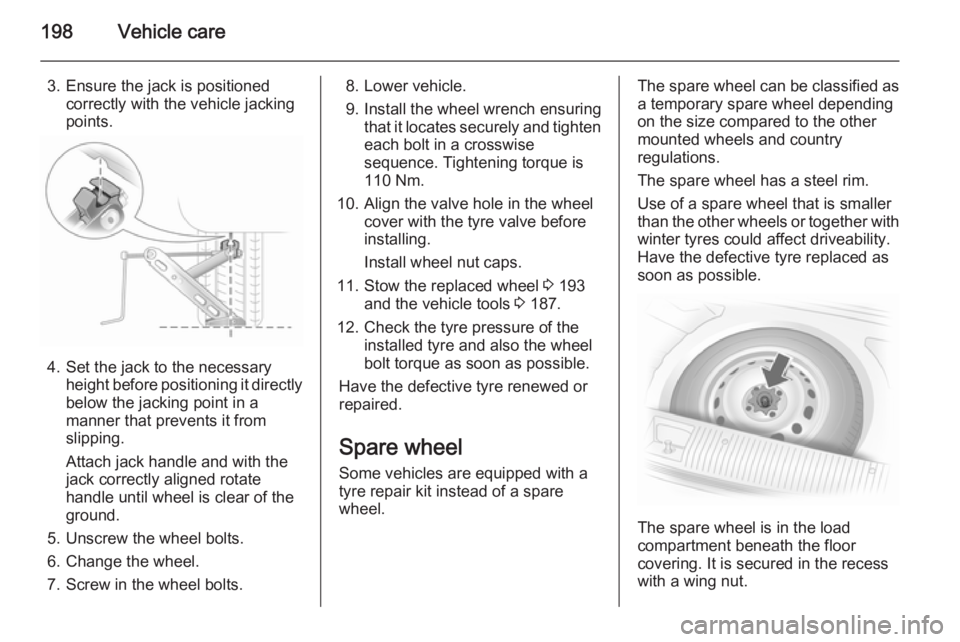
3. Ensure the jack is positionedcorrectly with the vehicle jacking
points.
4. Set the jack to the necessary height before positioning it directly
below the jacking point in a
manner that prevents it from
slipping.
Attach jack handle and with the
jack correctly aligned rotate
handle until wheel is clear of the
ground.
5. Unscrew the wheel bolts.
6. Change the wheel.
7. Screw in the wheel bolts.
8. Lower vehicle.
9. Install the wheel wrench ensuring that it locates securely and tighten
each bolt in a crosswise
sequence. Tightening torque is
110 Nm.
10. Align the valve hole in the wheel cover with the tyre valve before
installing.
Install wheel nut caps.
11. Stow the replaced wheel 3 193
and the vehicle tools 3 187.
12. Check the tyre pressure of the installed tyre and also the wheelbolt torque as soon as possible.
Have the defective tyre renewed or repaired.
Spare wheel
Some vehicles are equipped with a
tyre repair kit instead of a spare
wheel.The spare wheel can be classified as
a temporary spare wheel depending
on the size compared to the other
mounted wheels and country
regulations.
The spare wheel has a steel rim.
Use of a spare wheel that is smaller
than the other wheels or together with winter tyres could affect driveability.
Have the defective tyre replaced as
soon as possible.
The spare wheel is in the load
compartment beneath the floor
covering. It is secured in the recess
with a wing nut.
Page 225 of 245
Technical data223
Heavy accessoriesAccessoriesSun roofTowing equipmentSplit rear seat backrestHeadlamp washer systemWeight [kg]23 (not on Saloon 4-door)
17 (Saloon 4-door)21 (not on TwinTop)
26 (TwinTop)20 (Station wagon)
9 (Saloon 3-door / 5-door)2 (Saloon 4-door / 5-door)Vehicle dimensionsSaloon 5-doorSaloon 3-doorSaloon 4-doorStation wagonVanTwinTopLength [mm]424942904587451545154476Width without exterior mirrors [mm]175317531753175317531759Width with two exterior mirrors [mm]203220322033203220322021Height (without antenna) [mm]146014351458150015001411Length of load compartment floor [mm]81981990510851825805Load compartment width [mm]944944102710881103734Height of load compartment opening [mm]614555–766775–Wheelbase [mm]261426142703270327032614Turning circle diameter [m]11.2011.2011.5011.5011.5011.20


![OPEL ASTRA SALOON 2014 Owners Manual Technical data223
Heavy accessoriesAccessoriesSun roofTowing equipmentSplit rear seat backrestHeadlamp washer systemWeight [kg]23 (not on Saloon 4-door)
17 (Saloon 4-door)21 (not on TwinTop)
26 (TwinT](/manual-img/37/58218/w960_58218-224.png "OPEL ASTRA SALOON 2014 Owners Manual Technical data223
Heavy accessoriesAccessoriesSun roofTowing equipmentSplit rear seat backrestHeadlamp washer systemWeight [kg]23 (not on Saloon 4-door)
17 (Saloon 4-door)21 (not on TwinTop)
26 (TwinT")