2014 NISSAN LEAF service
[x] Cancel search: servicePage 268 of 397
You can connect up to 5 different Bluetooth®
cellular phones to the in-vehicle phone module.
However, you can talk on only one cellular phone
at a time.
Before using the Bluetooth® Hands-Free Phone
System, refer to the following notes.
• Set up the wireless connection between a com-
patible cellular phone and the in-vehicle phone
module before using the hands-free phone sys-
tem.
• Some Bluetooth® enabled cellular phones may
not be recognized or work properly. Please visit
www.nissanusa.com/bluetooth for a recom-
mended phone list and connecting instructions.
• You will not be able to use a hands-free phone
under the following conditions:
– Your vehicle is outside of the cellular service
area.
– Your vehicle is in an area where it is difficult
to receive a cellular signal; such as in a
tunnel, in an underground parking garage,
near a tall building or in a mountainous area.
– Your cellular phone is locked to prevent it
from being dialed.
–• When the radio wave condition is not ideal or
ambient sound is too loud, it may be difficult to
hear the other person’s voice during a call.
• Do not place the cellular phone in an area
surrounded by metal or far away from the in-
vehicle phone module to prevent tone quality
degradation and wireless connection disrup-
tion.
• While a cellular phone is connected through the
Bluetooth® wireless connection, the battery
power of the cellular phone may discharge
quicker than usual. The Bluetooth® Hands-
Free Phone System cannot charge cellular
phones.
• If the hands-free phone system seems to be
malfunctioning, see “Troubleshooting guide” in
this section. You can also visit
www.nissanusa.com/bluetooth for trouble-
shooting help.
• Some cellular phones or other devices may
cause interference or a buzzing noise to come
from the audio system speakers. Storing the
device in a different location may reduce or
eliminate the noise.
• Refer to the cellular phone Owner’s Manual
regarding the telephone charges, cellular phone
antenna and body, etc.REGULATORY INFORMATION
FCC Regulatory information
CAUTION: To maintain compliance with FCC’s
RF exposure guidelines, use only the supplied
antenna. Unauthorized antenna, modification, or
attachments could damage the transmitter and
may violate FCC regulations.
Operation is subject to the following two condi-
tions:
1. This device may not cause interference and
2. this device must accept any interference, in-
cluding interference that may cause unde-
sired operation of the device.
IC Regulatory information
• Operation is subject to the following two condi-
tions: (1) this device may not cause interfer-
ence, and (2) this device must accept any inter-
ference, including interference that may cause
undesired operation of the device.
• This Class B digital apparatus meets all require-
ments of the Canadian Interference-Causing
Equipment Regulations.
BLUETOOTH® is a trademark
owned by Bluetooth SIG, Inc. and licensed to
Visteon.
4-44Heater, air conditioner, audio and phone systems
Page 286 of 397
6. When it is safe to do so, gradually turn the
steering wheel until both tires return to the
road surface. When all tires are on the road
surface, steer the vehicle to stay in the appro-
priate driving lane.
• If you decide that it is not safe to return the
vehicle to the road surface based on vehicle,
road or traffic conditions, gradually slow the
vehicle to a stop in a safe place off the road.
RAPID AIR PRESSURE LOSS
Rapid air pressure loss or a “blow-out” can occur
if the tire is punctured or is damaged due to
hitting a curb or pothole. Rapid air pressure loss
can also be caused by driving on under-inflated
tires.
Rapid air pressure loss can affect the handling
and stability of the vehicle, especially at highway
speeds.
Help prevent rapid air pressure loss by maintain-
ing the correct air pressure and visually inspect
the tires for wear and damage. See “Wheels and
tires” in the “Maintenance and do-it-yourself”
section of this manual.
If a tire rapidly loses air pressure or “blows-out”
while driving maintain control of the vehicle by
following the procedure below. Please note thatthis procedure is only a general guide. The ve-
hicle must be driven as appropriate based on the
conditions of the vehicle, road and traffic.
WARNING
The following actions can increase the
chance of losing control of the vehicle if
there is a sudden loss of tire air pressure.
Losing control of the vehicle may cause a
collision and result in personal injury.
• The vehicle generally moves or pulls in
the direction of the flat tire.
• Do not rapidly apply the brakes.
• Do not rapidly release the accelerator
pedal.
• Do not rapidly turn the steering wheel.
1. Remain calm and do not overreact.
2. Maintain a firm grip on the steering wheel with
both hands and try to hold a straight course.
3. When appropriate, slowly release the accel-
erator pedal to gradually slow the vehicle.
4. Gradually steer the vehicle to a safe location
off the road and away from traffic if possible.
5. Lightly apply the brake pedal to gradually stop
the vehicle.
6. Turn on the hazard warning flashers and either
contact a roadside emergency service tochange the tire or see “Flat tire” in the “In case
of emergency” section of this Owner’s
Manual.DRINKING ALCOHOL/DRUGS AND
DRIVING
WARNING
Never drive under the influence of alco-
hol or drugs. Alcohol in the bloodstream
reduces coordination, delays reaction
time and impairs judgement. Driving af-
ter drinking alcohol increases the likeli-
hood of being involved in an accident
injuring yourself and others. Additionally,
if you are injured in an accident, alcohol
can increase the severity of the injury.
NISSAN is committed to safe driving. However,
you must choose not to drive under the influence
of alcohol. Every year thousands of people are
injured or killed in alcohol-related accidents. Al-
though the local laws vary on what is considered
to be legally intoxicated, the fact is that alcohol
affects all people differently and most people
underestimate the effects of alcohol.
5-6Starting and driving
Page 310 of 397
In the event of a roadside emergency, Roadside
Assistance Service is available to you. Please
refer to your Warranty Information Booklet (U.S.)
or Warranty & Roadside Assistance Information
Booklet (Canada) for details.To shut off the EV (Electric Vehicle) system in an
emergency situation while driving, perform the
following procedure.
• Rapidly push the power switch 3 consecutive
times in less than 1.5 seconds, or
• Push and hold the power switch for more than 2
seconds.
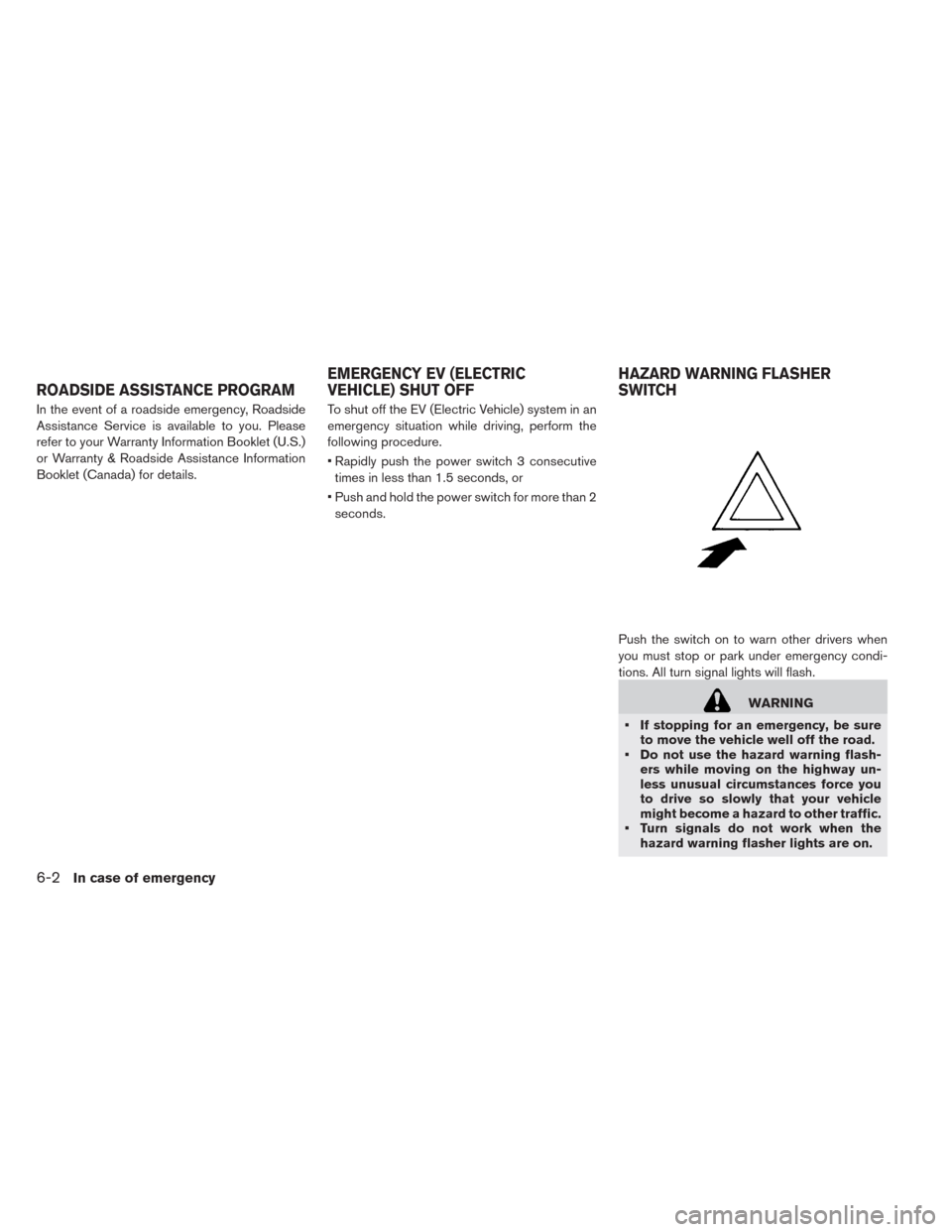
Push the switch on to warn other drivers when
you must stop or park under emergency condi-
tions. All turn signal lights will flash.
WARNING
• If stopping for an emergency, be sure
to move the vehicle well off the road.
• Do not use the hazard warning flash-
ers while moving on the highway un-
less unusual circumstances force you
to drive so slowly that your vehicle
might become a hazard to other traffic.
• Turn signals do not work when the
hazard warning flasher lights are on.
ROADSIDE ASSISTANCE PROGRAMEMERGENCY EV (ELECTRIC
VEHICLE) SHUT OFFHAZARD WARNING FLASHER
SWITCH
6-2In case of emergency
Page 321 of 397
When towing your vehicle, all State (Provincial in
Canada) and local regulations for towing must be
followed. Incorrect towing equipment could dam-
age your vehicle. Towing instructions are avail-
able from a NISSAN certified LEAF dealer. Local
service operators are familiar with the applicable
laws and procedures for towing. To assure
proper towing and to prevent accidental damage
to your vehicle, NISSAN recommends that you
have a service operator tow your vehicle. It is
advisable to have the service operator carefully
read the following precautions.
WARNING
• Never ride in a vehicle that is being
towed.
• Never get under your vehicle after it
has been lifted by a tow truck.
CAUTION
• When towing, make sure that the ax-
les, steering system and power train
are in working condition. If any unit is
damaged, dollies must be used.
• Always attach safety chains before
towing.For information about towing your vehicle behind
a recreational vehicle (RV) , see “Flat towing” in
the “Technical and consumer information” sec-
tion.
TOWING RECOMMENDED BY
NISSAN
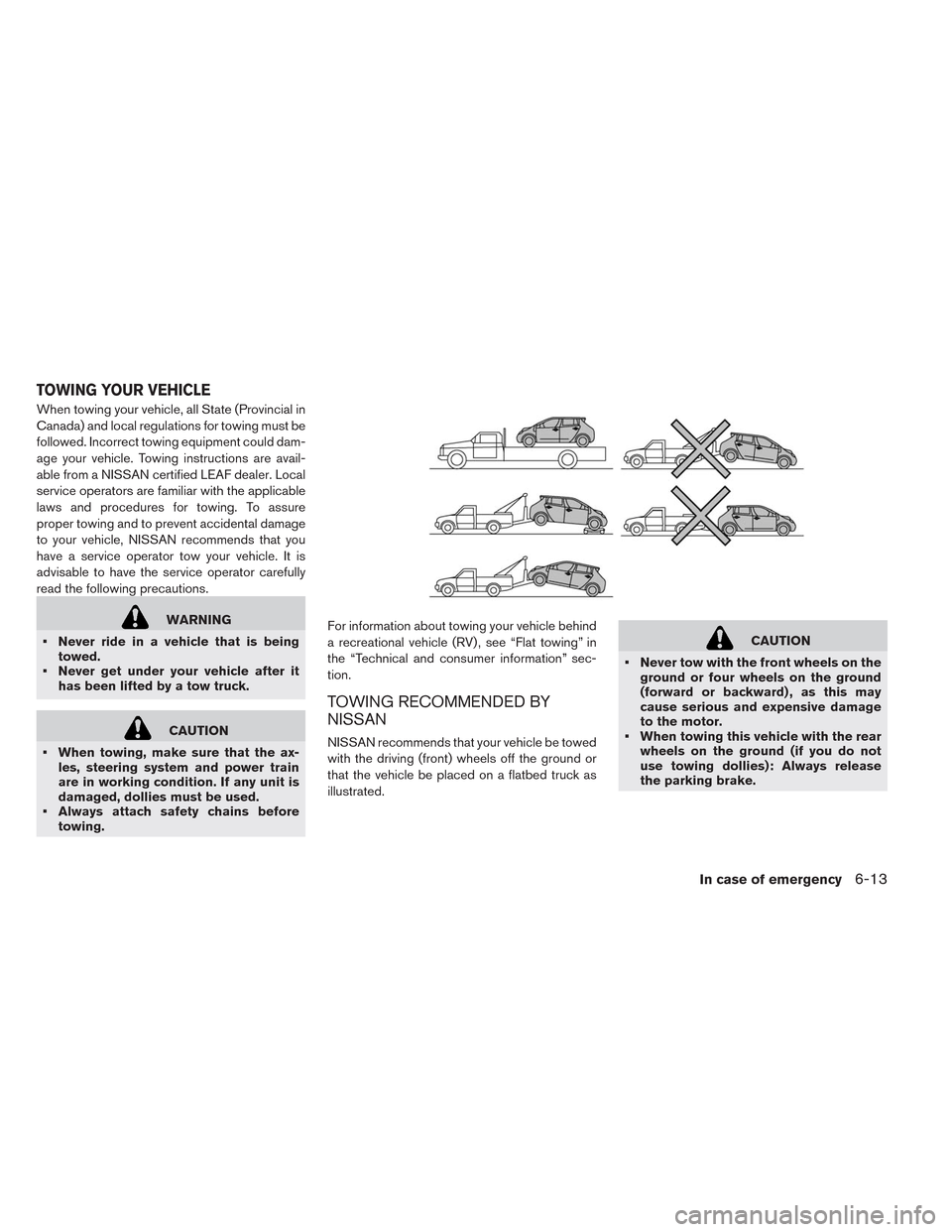
NISSAN recommends that your vehicle be towed
with the driving (front) wheels off the ground or
that the vehicle be placed on a flatbed truck as
illustrated.
CAUTION
• Never tow with the front wheels on the
ground or four wheels on the ground
(forward or backward) , as this may
cause serious and expensive damage
to the motor.
• When towing this vehicle with the rear
wheels on the ground (if you do not
use towing dollies): Always release
the parking brake.
TOWING YOUR VEHICLE
In case of emergency6-13
Page 323 of 397
Pulling a stuck vehicle
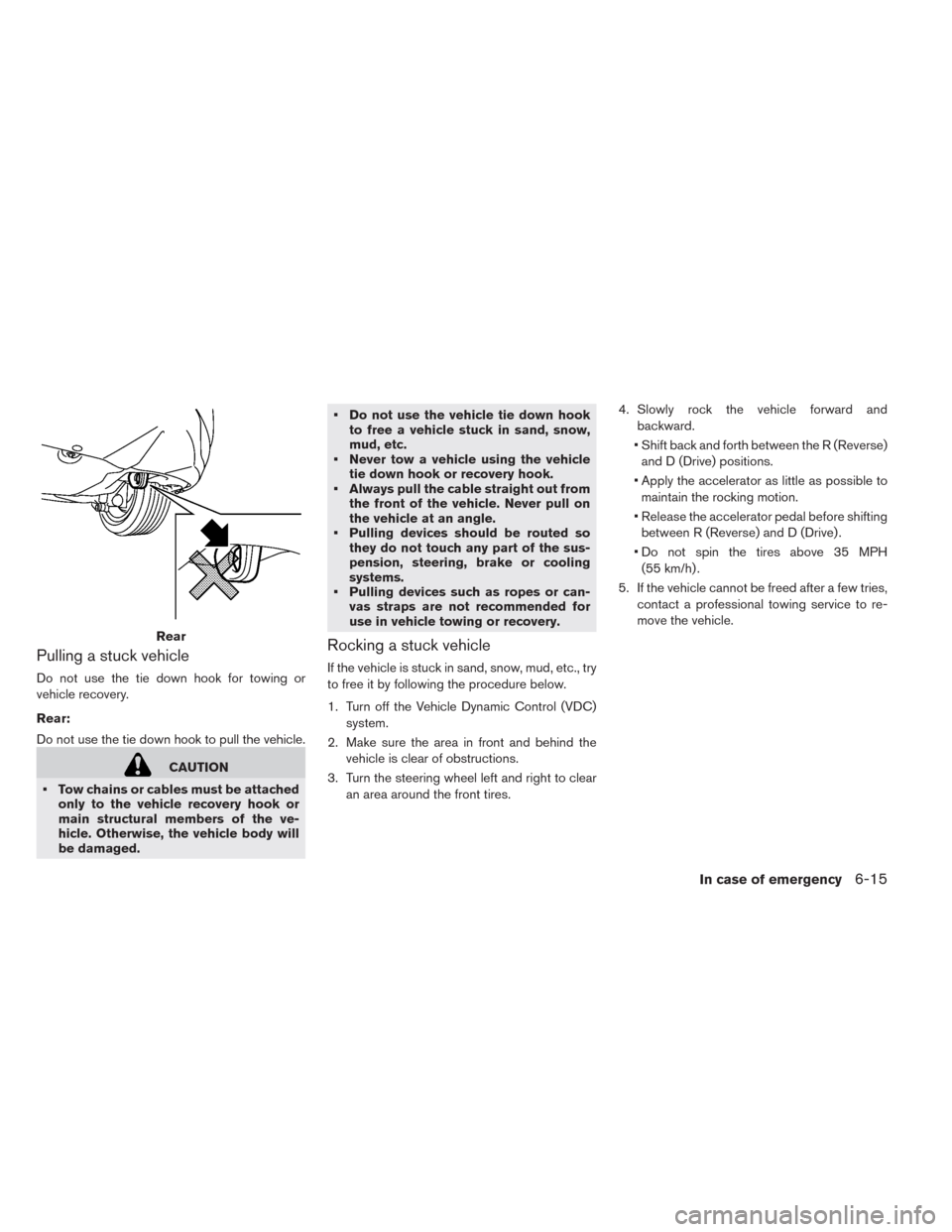
Do not use the tie down hook for towing or
vehicle recovery.
Rear:
Do not use the tie down hook to pull the vehicle.
CAUTION
• Tow chains or cables must be attached
only to the vehicle recovery hook or
main structural members of the ve-
hicle. Otherwise, the vehicle body will
be damaged.• Do not use the vehicle tie down hook
to free a vehicle stuck in sand, snow,
mud, etc.
• Never tow a vehicle using the vehicle
tie down hook or recovery hook.
• Always pull the cable straight out from
the front of the vehicle. Never pull on
the vehicle at an angle.
• Pulling devices should be routed so
they do not touch any part of the sus-
pension, steering, brake or cooling
systems.
• Pulling devices such as ropes or can-
vas straps are not recommended for
use in vehicle towing or recovery.
Rocking a stuck vehicle
If the vehicle is stuck in sand, snow, mud, etc., try
to free it by following the procedure below.
1. Turn off the Vehicle Dynamic Control (VDC)
system.
2. Make sure the area in front and behind the
vehicle is clear of obstructions.
3. Turn the steering wheel left and right to clear
an area around the front tires.4. Slowly rock the vehicle forward and
backward.
• Shift back and forth between the R (Reverse)
and D (Drive) positions.
• Apply the accelerator as little as possible to
maintain the rocking motion.
• Release the accelerator pedal before shifting
between R (Reverse) and D (Drive) .
• Do not spin the tires above 35 MPH
(55 km/h) .
5. If the vehicle cannot be freed after a few tries,
contact a professional towing service to re-
move the vehicle.
Rear
In case of emergency6-15
Page 333 of 397
8 Maintenance and do-it yourself
Maintenance requirement..................8-2
Scheduled maintenance.................8-2
General maintenance...................8-2
Where to go for service.................8-2
General maintenance.....................8-2
Explanation of maintenance items...........8-2
Maintenance precautions..................8-5
Motor compartment check locations............8-7
Cooling system........................8-8
Checking coolant level..................8-9
Changing coolant.....................8-9
Reduction gear fluid.....................8-10
Brake fluid..........................8-10
Window washer fluid....................8-11
12-volt battery........................8-12
Jump starting.......................8-13
Windshield wiper blades..................8-13
Cleaning.........................8-13
Replacing.........................8-13Rear window wiper blade.................8-15
Brakes............................8-15
Brake pad wear warning................8-16
Fuses.............................8-16
Motor compartment...................8-16
Passenger compartment................8-18
Nissan Intelligent Key® battery replacement......8-19
Lights.............................8-21
Headlights........................8-22
Exterior and interior lights...............8-23
Wheels and tires......................8-26
Tire pressure.......................8-26
Tire labeling.......................8-28
Types of tires.......................8-30
Tire chains.......................
.8-31
Changing wheels and tires...............8-32
Emergency tire puncture repair kit..........8-34
Page 334 of 397
Your new NISSAN has been designed to have
minimum maintenance requirements with long
service intervals to save you both time and
money. However, some day-to-day and regular
maintenance is essential to maintain your NIS-
SAN’s fine mechanical condition, as well as its
EV (Electric Vehicle) system performance.
It is the owner’s responsibility to make sure that
the scheduled maintenance, as well as general
maintenance, is performed.
As the vehicle owner, you are the only one who
can ensure that your vehicle receives the proper
maintenance care. You are a vital link in the main-
tenance chain.
SCHEDULED MAINTENANCE
For your convenience, both required and optional
scheduled maintenance items are described and
listed in your “NISSAN Service and Maintenance
Guide”. You must refer to that guide to ensure
that necessary maintenance is performed on your
NISSAN at regular intervals.
GENERAL MAINTENANCE
General maintenance includes those items which
should be checked during normal day-to-day op-
eration. They are essential for proper vehicle op-eration. It is your responsibility to perform these
procedures regularly as prescribed.
Performing general maintenance checks requires
minimal mechanical skill and only a few general
automotive tools.
These checks or inspections can be done by
yourself, a qualified technician or, if you prefer, a
NISSAN certified LEAF dealer.
WHERE TO GO FOR SERVICE
If maintenance service is required or your vehicle
appears to malfunction, have the systems
checked and serviced by a NISSAN certified
LEAF dealer.
NISSAN technicians are well-trained specialists
and are kept up-to-date with the latest service
information through technical bulletins, service
tips, and in-dealership information systems. They
are completely qualified to work on NISSAN ve-
hiclesbeforework begins.
You can be confident that a NISSAN certified
LEAF dealer’s service department performs the
best job to meet the maintenance requirements
on your vehicle — in a reliable and economical
way.During the normal day-to-day operation of the
vehicle, general maintenance should be per-
formed regularly as prescribed in this section. If
you detect any unusual sounds, vibrations or
smell, be sure to check for the cause or have a
NISSAN certified LEAF dealer do it promptly. In
addition, you should notify a NISSAN certified
LEAF dealer if you think that repairs are required.
When performing any checks or maintenance
work, see “Maintenance precautions”.EXPLANATION OF MAINTENANCE
ITEMS
Additional information on the following
items with “*” is found later in this section.
Outside vehicle
The maintenance items listed here should be
performed from time to time, unless otherwise
specified.
Doors and motor hood:Check that all doors
and the motor hood operate properly. Also en-
sure that all latches lock securely. Lubricate
hinges, latches, latch pins, rollers and links if
necessary. Make sure that the secondary latch
keeps the motor hood from opening when the
primary latch is released.
MAINTENANCE REQUIREMENT GENERAL MAINTENANCE
8-2Maintenance and do-it yourself
Page 336 of 397
Seat belts:Check that all parts of the seat belt
system (for example, buckles, anchors, adjusters
and retractors) operate properly and smoothly,
and are installed securely. Check the belt web-
bing for cuts, fraying, wear or damage.
Steering wheel:Check for changes in the
steering conditions, such as excessive free play,
hard steering or strange noises.
Warning lights and chimes:Make sure that all
warning lights and chimes are operating properly.
Windshield defroster:Check that the air emits
from the defroster outlets properly and in suffi-
cient quantity when operating the heater or air
conditioner.
Windshield wiper and washer*:Check that
the wipers and washers operate properly and
that the wipers do not streak.
Under hood and vehicle
The maintenance items listed here should be
checked periodically.
12-volt battery (for serviceable battery)*:
Check the fluid level in each cell.
It should be between the MAX and MIN lines.
Vehicles operated in high temperatures or undersevere conditions require frequent checks of the
12-volt battery fluid level.
NOTE:
Care should be taken to avoid situations
that can lead to potential battery discharge
and potential no-start conditions such as:
1. Installation or extended use of electronic ac-
cessories that consume battery power when
the engine is not running (Phone chargers,
GPS, DVD players, etc.)
2. Vehicle is not driven regularly and/or only
driven short distances.
In these cases, the battery may need to be
charged to maintain battery health.
Brake fluid level*:Make sure that the brake
fluid level is between the MAX and MIN lines on
the reservoir.
Coolant level*:Check the coolant level when
the motor compartment is cold.
Fluid leaks:Check under the vehicle for water
or other fluid leaks after the vehicle has been
parked for a short period of time. Water dripping
from the air conditioner after use is normal. If you
notice any leaks, check for the cause and have it
corrected immediately.Radiator and hoses:Check the front of the
radiator and clean off any dirt, insects, leaves,
etc., that may have accumulated. Make sure that
the hoses have no cracks, deformation, rot or
loose connections.
Underbody:The underbody is frequently ex-
posed to corrosive substances such as those
used on icy roads or to control dust. It is very
important to remove these substances, other-
wise rust will form on the floor pan and frame. At
the end of winter, the underbody should be thor-
oughly flushed with plain water, being careful to
clean those areas where mud and dirt may accu-
mulate. For additional information, see “Cleaning
exterior” in the “Appearance and care” section.
Windshield washer fluid*:Check that there is
an adequate amount of fluid in the reservoir.
8-4Maintenance and do-it yourself