If the 12-volt battery is discharged, the
power switch cannot be moved from the
OFF position. Connect the jumper cables
to the booster vehicle
�Bbefore pushing
the power switch.
3. Push the P (Park)position switch to place the
vehicle in the P (Park) position.
4. Switch off all unnecessary electrical systems
(headlights, heater, air conditioner, etc.) .
5. Place the power switch in the OFF position.
6. Remove the vent caps on the 12-volt battery
(if so equipped) . Cover the battery with a
firmly wrung out moist cloth to reduce the
hazard of an explosion.
7. Connect jumper cables in the sequence as
illustrated (
�1→�2→�3→�4).
CAUTION
•Always connect positive (+) to positive
(+) and negative (−) to body ground (for
example, as illustrated) , not to the 12-
volt battery.
•Make sure the jumper cables do not
touch moving parts in the motor com-
partment and that the cable clamps do
not contact any other metal.
8. Start the engine of the booster vehicle
�B.9. While the booster vehicle
�Bengine is run-
ning, place the EV system in the READY to
drive position.
CAUTION
If the system does not start right away,
push the power switch to the OFF posi-
tion and wait 10 seconds before trying
again.
10. After starting your EV system, carefully dis-
connect the negative cable and then the
positive cable (
�4→�3→�2→�1) and
keep the READY to drive position over 20
minutes to charge the 12-volt battery.
11. Replace the vent caps (if so equipped) . Be
sure to dispose of the cloth used to cover
the vent holes because it may be contami-
nated with corrosive acid.
12. If necessary, connect the vehicle to a charg-
ing station or EVSE (Electric Vehicle Supply
Equipment) to charge the Li-ion battery.
(See “Charge” section.) The vehicle can not
be driven until the Li-ion battery is charged.
NOTE:
If it is not possible to turn the system ON by
following this procedure, contact a NISSAN
certified LEAF dealer immediately.If the power limitation indicator light
illumi-
nates, the traction motor output is limited result-
ing in reduced vehicle speed. Stop the vehicle in
a safe location before the Li-ion battery becomes
completely discharged and no power is available
to drive the vehicle. Contact Roadside assis-
tance; see your NISSAN Warranty Information
Booklet.
If possible, place the power switch in the OFF
position while waiting for assistance to prevent
discharging the 12-volt battery.
NOTE:
If the Li-ion battery becomes completely
discharged:
•The vehicle is automatically placed in the
ON position and it will not be possible to
switch to the READY position.
•The vehicle is automatically switched to
the N (Neutral) position and it will not be
possible to drive the vehicle.
WARNING
If the vehicle is in the N (Neutral) position
and the Li-ion battery and the 12-volt
battery become completely discharged,
the vehicle can not be placed in the P
IF THE LI-ION BATTERY BECOMES
COMPLETELY DISCHARGED
In case of emergency6-11
8 Maintenance and do-it yourself
Maintenance requirement..................8-2
Scheduled maintenance.................8-2
General maintenance...................8-2
Where to go for service.................8-2
General maintenance.....................8-2
Explanation of maintenance items...........8-2
Maintenance precautions..................8-5
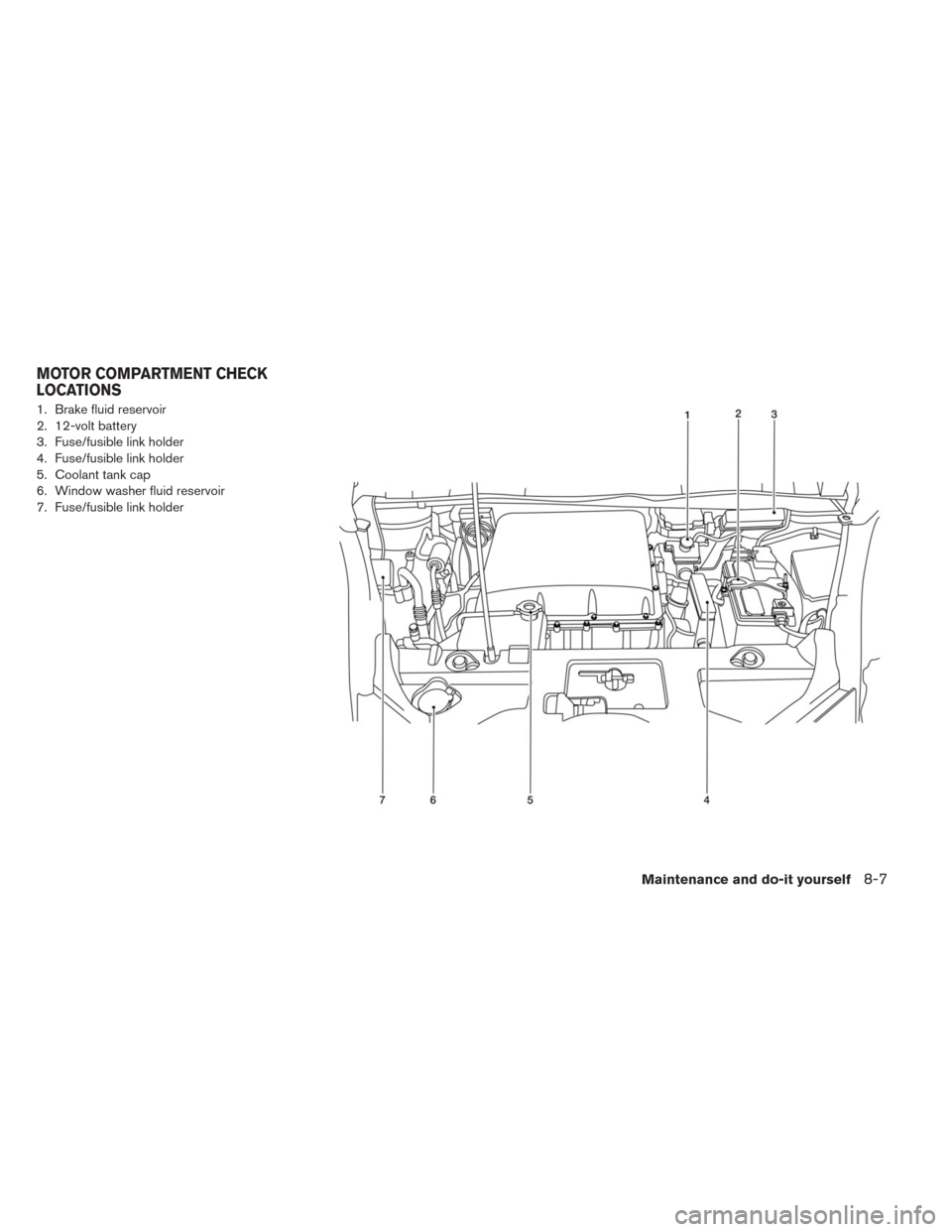
Motor compartment check locations............8-7
Cooling system........................8-8
Checking coolant level..................8-9
Changing coolant.....................8-9
Reduction gear fluid.....................8-10
Brake fluid..........................8-10
Window washer fluid....................8-11
12-volt battery........................8-12
Jump starting.......................8-13
Windshield wiper blades..................8-13
Cleaning.........................8-13
Replacing.........................8-13Rear window wiper blade.................8-15
Brakes............................8-15
Brake pad wear warning................8-16
Fuses.............................8-16
Motor compartment...................8-16
Passenger compartment................8-18
Nissan Intelligent Key® battery replacement......8-19
Lights.............................8-21
Headlights........................8-22
Exterior and interior lights...............8-23
Wheels and tires......................8-26
Tire pressure.......................8-26
Tire labeling.......................8-28
Types of tires.......................8-30
Tire chains.......................
.8-31
Changing wheels and tires...............8-32
Emergency tire puncture repair kit..........8-34
For USA
If you believe that your vehicle has a defect which
could cause a crash or could cause injury or
death, you should immediately inform the Na-
tional Highway Traffic Safety Administration
(NHTSA) in addition to notifying NISSAN.
If NHTSA receives similar complaints, it may
open an investigation, and if it finds that a safety
defect exists in a group of vehicles, it may order a
recall and remedy campaign. However, NHTSA
cannot become involved in individual problems
between you, your dealer, or NISSAN.
To contact NHTSA, you may call the Vehicle
Safety Hotline toll-free at 1-888-327-4236 (TTY:
1-800-424-9153); go to http://
www.safercar.gov; or write to: Administrator,
NHTSA, 400 Seventh Street, SW., Washington,
D.C. 20590. You can also obtain other informa-
tion about motor vehicle safety from http://
www.safercar.gov.
You may notify NISSAN by contacting our Con-
sumer Affairs Department, toll-free, at 1-877-
NOGASEV (1-877-664-2738) .For Canada
If you believe that your vehicle has a defect which
could cause a crash or could cause injury or
death, you should immediately inform Transport
Canada in addition to notifying NISSAN.
If Transport Canada receives complaints, it may
open an investigation, and if it finds that a safety
defect exists in a group of vehicles, it may request
a recall campaign. However, Transport Canada
cannot become involved in individual problems
between you, your dealer, or NISSAN.
You may contact Transport Canada’s Defect In-
vestigations and Recall Division toll free at
1-800-333-0510. You may also report safety
defects online at; https://wwwapps.tc.gc.ca/
Saf-Sec-Sur/7/PCDB-BDPP/Index.aspx.
Additional information concerning motor vehicle
safety may be obtained from Transport Canada’s
Road Safety Information Centre at
1-800-333-0371 or online at www.tc.gc.ca/
roadsafety (English speakers) or www.tc.gc.ca/
securiteroutiere (French speakers) .
To notify NISSAN of any safety concerns please
contact our Consumer Information Centre toll
free at 1-800-387-0122.In addition to Event Data Recorders (EDRs) dis-
cussed elsewhere in this Owner’s Manual, this
vehicle is equipped with electronic modules that
monitor, control and record data concerning vari-
ous vehicle systems, including the motor, batter-
ies, braking and electrical systems. Other elec-
tronic modules record information concerning
driving conditions, including idling, braking, ac-
celeration, trip and other related data, information
about your use of the car and its features such as
air conditioner or headlight usage, diagnostic
trouble codes, vehicle charging, vehicle speed,
direction and/or location.
Some of this data is stored by the vehicle for use
during vehicle servicing. Other data concerning
your vehicle’s operation and performance is wire-
lessly transmitted by cellular connection through
the vehicle onboard telematics system upon ve-
hicle start-up or at other intervals to NISSAN.
This data may be used by NISSAN for various
purposes, including: to provide you with CAR-
WINGS™ services (see LEAF Navigation System
Owner’s Manual for details); troubleshooting;
evaluation of your vehicle’s quality, functionality
and performance; analysis and research by
NISSAN designed to, among other things, opti-
mize performance of future electric vehicles in-
cluding improvements in future battery life; to
REPORTING SAFETY DEFECTS TELEMATICS OVERVIEW
Technical and consumer information9-15