2014 NISSAN LEAF warning
[x] Cancel search: warningPage 364 of 397
CHANGING WHEELS AND TIRES
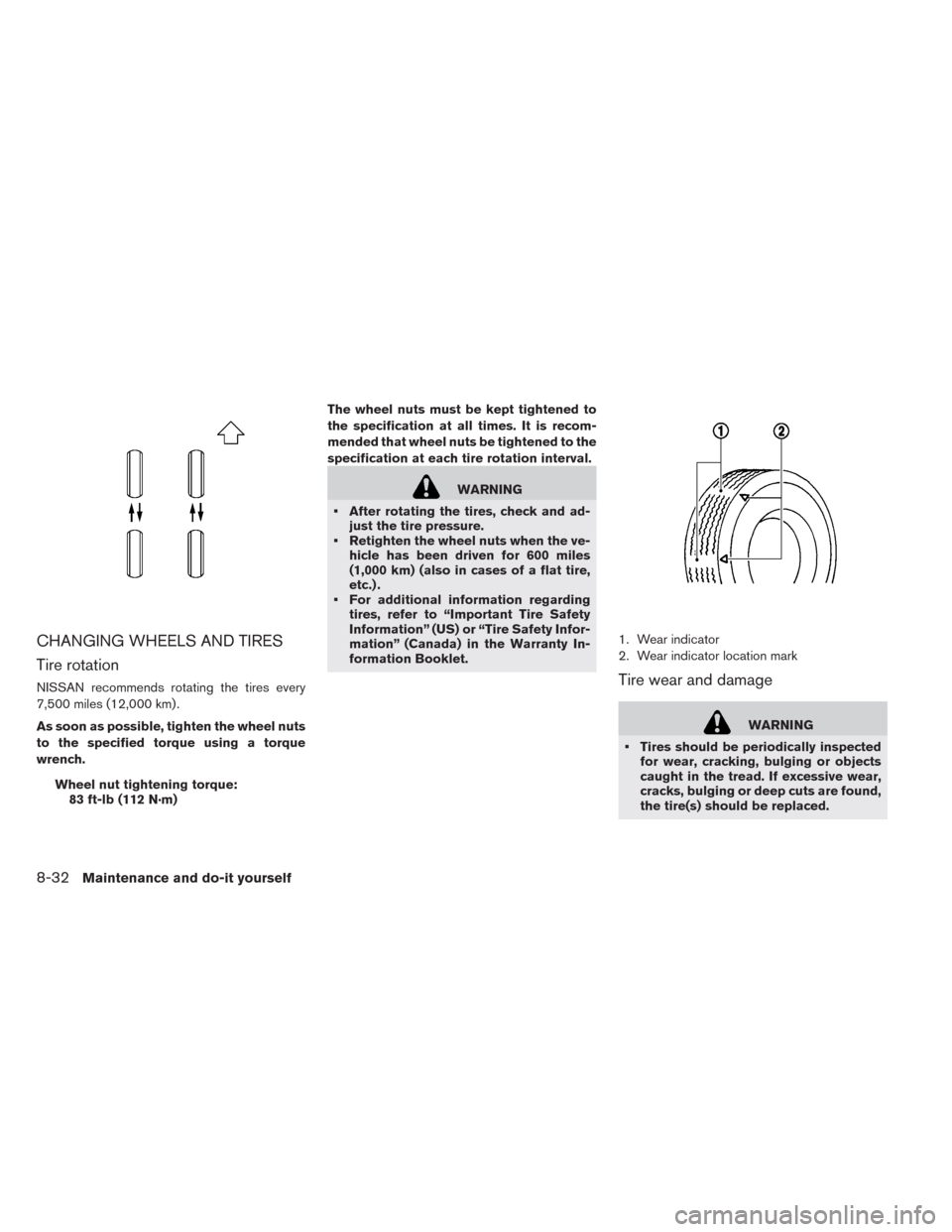
Tire rotation
NISSAN recommends rotating the tires every
7,500 miles (12,000 km) .
As soon as possible, tighten the wheel nuts
to the specified torque using a torque
wrench.
Wheel nut tightening torque:
83 ft-lb (112 N·m)The wheel nuts must be kept tightened to
the specification at all times. It is recom-
mended that wheel nuts be tightened to the
specification at each tire rotation interval.
WARNING
• After rotating the tires, check and ad-
just the tire pressure.
• Retighten the wheel nuts when the ve-
hicle has been driven for 600 miles
(1,000 km) (also in cases of a flat tire,
etc.) .
• For additional information regarding
tires, refer to “Important Tire Safety
Information” (US) or “Tire Safety Infor-
mation” (Canada) in the Warranty In-
formation Booklet.1. Wear indicator
2. Wear indicator location mark
Tire wear and damage
WARNING
• Tires should be periodically inspected
for wear, cracking, bulging or objects
caught in the tread. If excessive wear,
cracks, bulging or deep cuts are found,
the tire(s) should be replaced.
8-32Maintenance and do-it yourself
Page 365 of 397
• The original tires have built-in tread
wear indicators. When wear indicators
are visible, the tire(s) should be re-
placed.
• Tires degrade with age and use. Have
tires, over 6 years old checked by a
qualified technician, because some
tire damage may not be obvious. Re-
place the tires as necessary to prevent
tire failure and possible personal in-
jury.
• For additional information regarding
tires, refer to “Important Tire Safety
Information” (US) or “Tire Safety Infor-
mation” (Canada) in the Warranty In-
formation Booklet.
Replacing wheels and tires
When replacing a tire, use the same size, tread
design, speed rating and load carrying capacity
as originally equipped. See “Specifications” in
the “Technical and consumer information” sec-
tion for recommended types and sizes of tires
and wheels.
WARNING
• The use of tires other than those rec-
ommended or the mixed use of tires of
different brands, construction (bias,
bias-belted or radial) , or tread patterns
can adversely affect the ride, braking,
handling, ground clearance, body-to-
tire clearance, tire chain clearance,
speedometer calibration, headlight
aim and bumper height. Some of these
effects may lead to accidents and
could result in serious personal injury.
• If your vehicle was originally equipped
with 4 tires that were the same size
and you are only replacing 2 of the 4
tires, install the new tires on the rear
axle. Placing new tires on the front
axle may cause loss of vehicle control
in some driving conditions and cause
an accident and personal injury.• If the wheels are changed for any rea-
son, always replace with wheels which
have the same off-set dimension.
Wheels of a different off-set could
cause premature tire wear, degrade
vehicle handling characteristics
and/or interference with the brake
discs. Such interference can lead to
decreased braking efficiency and/or
early brake pad/shoe wear. See
“Wheels and tires” in the “Technical
and consumer information” section of
this manual for wheel off-set dimen-
sions.
• When a wheel is replaced, the TPMS
will not function and the low tire pres-
sure warning light will flash for ap-
proximately 1 minute. The light will re-
main on after 1 minute. Contact your
NISSAN certified LEAF dealer as soon
as possible for tire replacement
and/or system resetting.
• Replacing tires with those not origi-
nally specified by NISSAN could affect
the proper operation of the TPMS.
• Do not install a damaged or deformed
wheel or tire even if it has been re-
paired. Such wheels or tires could have
structural damage and could fail with-
out warning.
Maintenance and do-it yourself8-33
Page 366 of 397
• The use of retread tire is not recom-
mended.
• For additional information regarding
tires, refer to “Important Tire Safety
Information” (US) or “Tire Safety Infor-
mation” (Canada) in the Warranty In-
formation Booklet.
Wheel balance
Unbalanced wheels may affect vehicle handling
and tire life. Even with regular use, wheels can get
out of balance. Therefore, they should be bal-
anced as required.
Wheel balance service should be per-
formed with the wheels off the vehicle.
Spin balancing the wheels on the vehicle
could lead to mechanical damage.
For additional information regarding tires, refer to
“Important Tire Safety Information” (US) or “Tire
Safety Information” (Canada) in the Warranty In-
formation Booklet.
Care of wheels
See “Cleaning exterior” in the “Appearance and
care” section for details about care of the wheels.
EMERGENCY TIRE PUNCTURE
REPAIR KIT
The emergency tire puncture repair kit (Emer-
gency Tire Sealant) is supplied with the vehicle
instead of a spare tire. It can be used to tempo-
rarily repair minor tire punctures.
If possible, have the vehicle towed to a facility that
can repair or replace the flat tire. Using the emer-
gency tire puncture repair kit may cause a mal-
function of the tire pressure sensor and cause the
low tire pressure warning light to illuminate.
See “Flat tire” for more details.
8-34Maintenance and do-it yourself
Page 376 of 397
3. Remove the license plate bracket and con-
nect the arcs from the ovals. Mark the point in
the center of each oval. These are pilot drilling
locations.
Use a 0.49 in (12.5 mm) drill bit for the license
plate screw holes and carefully open holes in
the places marked. (Make sure that the drill
only goes through the fascia.)
4. Install the license plate with two 0.23 in (6
mm) screws.
WARNING
• It is extremely dangerous to ride in the
cargo area inside the vehicle. In a col-
lision, people riding in these areas are
more likely to be seriously injured or
killed.
• Do not allow people to ride in any area
of your vehicle that is not equipped
with seats and seat belts.
• Be sure everyone in your vehicle is in a
seat and using a seat belt properly.
TERMS
It is important to familiarize yourself with the fol-
lowing terms before loading your vehicle:
• Curb Weight (actual weight of your vehicle) -
vehicle weight including: standard and optional
equipment, fluids, emergency tools, and spare
tire assembly. This weightdoes notinclude
passengers and cargo.
• GVW (Gross Vehicle Weight) - curb weight
plus the combined weight of passengers and
cargo.
• GVWR (Gross Vehicle Weight Rating) - maxi-
mum total combined weight of the unloaded
vehicle, passengers, luggage, hitch, trailer
tongue load and any other optional equipment.This information is located on the F.M.V.S.S./
C.M.V.S.S. label.
• GAWR (Gross Axle Weight Rating) - maximum
weight (load) limit specified for the front or rear
axle. This information is located on the
F.M.V.S.S./C.M.V.S.S. label.
• GCWR (Gross Combined Weight Rating) - The
maximum total weight rating of the vehicle, pas-
sengers, cargo, and trailer.
• Vehicle Capacity Weight, Load limit, Total load
capacity - maximum total weight limit specified
of the load (passengers and cargo) for the ve-
hicle. This is the maximum combined weight of
occupants and cargo that can be loaded into
the vehicle. If the vehicle is used to tow a trailer,
the trailer tongue weight must be included as
part of the cargo load. This information is lo-
cated on the Tire and Loading Information label.
• Cargo capacity - permissible weight of cargo,
the subtracted weight of occupants from the
load limit.
VEHICLE LOAD CAPACITY
Do not exceed the load limit of your vehicle
shown as “The combined weight of occupants
and cargo” on the Tire and Loading Information
label. Do not exceed the number of occupants
VEHICLE LOADING INFORMATION
9-10Technical and consumer information
Page 378 of 397
SECURING THE LOAD
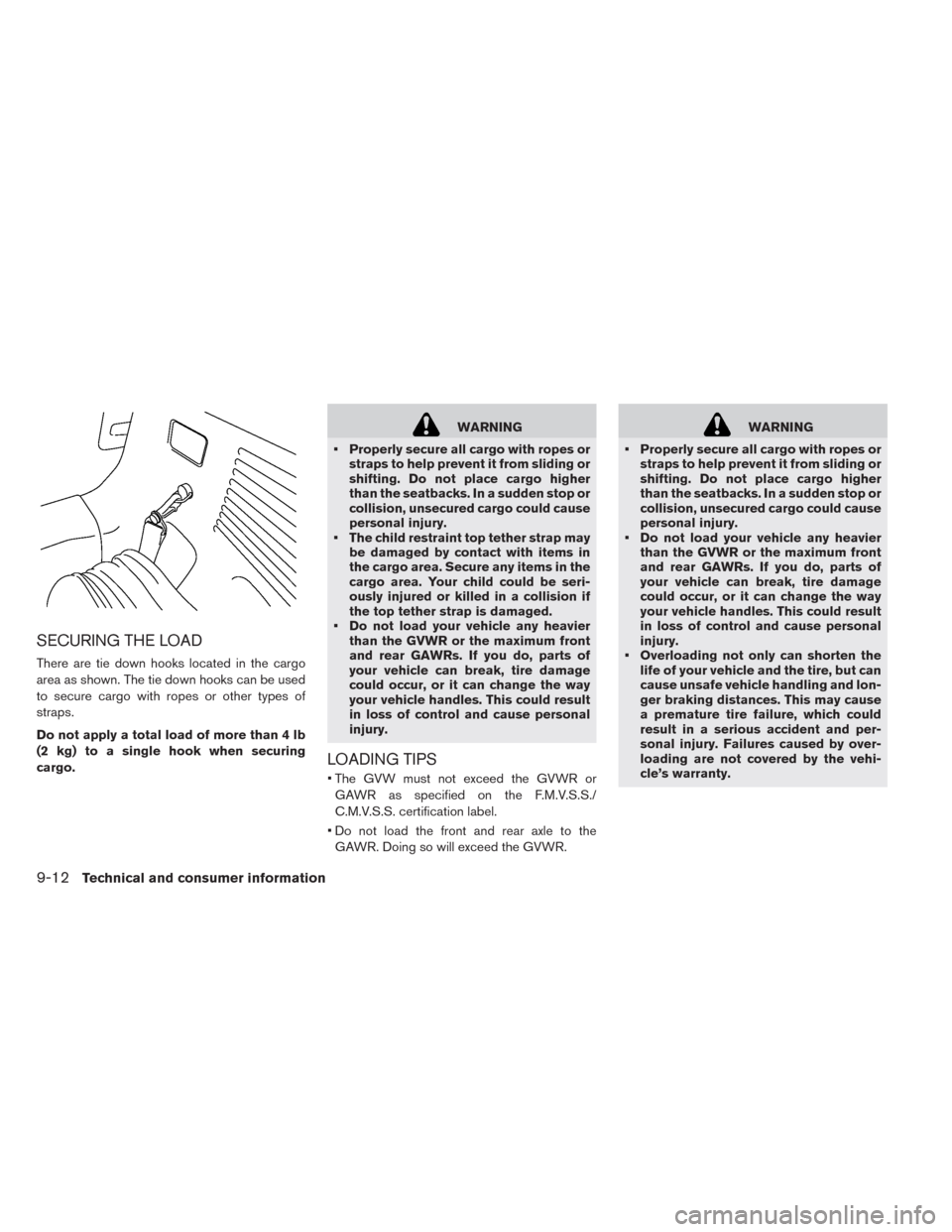
There are tie down hooks located in the cargo
area as shown. The tie down hooks can be used
to secure cargo with ropes or other types of
straps.
Do not apply a total load of more than 4 lb
(2 kg) to a single hook when securing
cargo.
WARNING
• Properly secure all cargo with ropes or
straps to help prevent it from sliding or
shifting. Do not place cargo higher
than the seatbacks. In a sudden stop or
collision, unsecured cargo could cause
personal injury.
• The child restraint top tether strap may
be damaged by contact with items in
the cargo area. Secure any items in the
cargo area. Your child could be seri-
ously injured or killed in a collision if
the top tether strap is damaged.
• Do not load your vehicle any heavier
than the GVWR or the maximum front
and rear GAWRs. If you do, parts of
your vehicle can break, tire damage
could occur, or it can change the way
your vehicle handles. This could result
in loss of control and cause personal
injury.
LOADING TIPS
• The GVW must not exceed the GVWR or
GAWR as specified on the F.M.V.S.S./
C.M.V.S.S. certification label.
• Do not load the front and rear axle to the
GAWR. Doing so will exceed the GVWR.
WARNING
• Properly secure all cargo with ropes or
straps to help prevent it from sliding or
shifting. Do not place cargo higher
than the seatbacks. In a sudden stop or
collision, unsecured cargo could cause
personal injury.
• Do not load your vehicle any heavier
than the GVWR or the maximum front
and rear GAWRs. If you do, parts of
your vehicle can break, tire damage
could occur, or it can change the way
your vehicle handles. This could result
in loss of control and cause personal
injury.
• Overloading not only can shorten the
life of your vehicle and the tire, but can
cause unsafe vehicle handling and lon-
ger braking distances. This may cause
a premature tire failure, which could
result in a serious accident and per-
sonal injury. Failures caused by over-
loading are not covered by the vehi-
cle’s warranty.
9-12Technical and consumer information
Page 380 of 397
DOT (Department Of Transportation) Quality
Grades: All passenger car tires must conform to
federal safety requirements in addition to these
grades.
Quality grades can be found where applicable on
the tire sidewall between tread shoulder and
maximum section width. For example:
Treadwear 200 Traction AA Temperature A
TREADWEAR
The treadwear grade is a comparative rating
based on the wear rate of the tire when tested
under controlled conditions on a specified gov-
ernment test course. For example, a tire graded
150 would wear one and one-half (1 1/2) times
as well on the government course as a tire graded
100. The relative performance of tires depends
upon actual conditions of their use however, and
may depart significantly from the norm due to
variations in driving habits, service practices and
differences in road characteristics and climate.
TRACTION AA, A, B AND C
The traction grades, from highest to lowest, are
AA, A, B and C. Those grades represent the tire’s
ability to stop on wet pavement as measured
under controlled conditions on specified govern-
ment test surfaces of asphalt and concrete. A tire
marked C may have poor traction performance.
WARNING
The traction grade assigned to this tire is
based on straight-ahead braking traction
tests, and does not include acceleration,
cornering, hydroplaning, or peak traction
characteristics.
TEMPERATURE A, B AND C
The temperature grades A (the highest) , B, and
C, representing the tire’s resistance to the gen-
eration of heat and its ability to dissipate heat
when tested under controlled conditions on a
specified indoor laboratory test wheel. Sustained
high temperature can cause the material of the
tire to degenerate and reduce tire life, and exces-
sive temperature can lead to sudden tire failure.
The grade C corresponds to a level of perfor-
mance which all passenger car tires must meet
under the Federal Motor Vehicle Safety Standard
No. 109. Grades B and A represent higher levels
of performance on the laboratory test wheel than
the minimum required by law.
WARNING
The temperature grade for this tire is es-
tablished for a tire that is properly in-
flated and not overloaded. Excessive
speed, under-inflation, or excessive load-
ing, either separately or in combination,
can cause heat build-up and possible tire
failure.
UNIFORM TIRE QUALITY GRADING
9-14Technical and consumer information
Page 389 of 397
10 Index
A
ABS (Anti-lock Braking System)........5-22
Advanced air bag system............1-41
Air bag system..................1-41
Advanced air bag system..........1-41
Front passenger air bag and status light . .1-42
Front-seat mounted side-impact
supplemental air bag system........1-45
Roof-mounted curtain side-impact
supplemental air bag system........1-45
Airbagwarninglabels..............1-48
Airbagwarninglight...........1-48,2-19
Air conditioner...................9-9
Air conditioner specification label.......9-9
Air conditioning system refrigerant and lubricant
recommendations...............9-3
Alarm, How to stop alarm (see vehicle security
system)......................2-38
Alcohol, drugs and driving............5-6
Anti-lock Braking System (ABS)........5-22
Anti-lock braking system (ABS) warning light .2-15
Appearance care.................7-2
Exterior appearance care...........7-2
Interior appearance care............7-4Audible reminders................2-22
Autolight system.................2-43
Automatic.....................3-5
Door locks...................3-5
Automatic climate control (models with
Navigation System)...............4-16
Automatic climate control (models without
Navigation System)...............4-10
Avoiding collision and rollover..........5-5
B
Battery......................8-12
12-volt battery................8-12
Battery saver system.............2-44
Intelligent Key battery............8-19
Li-ion battery.................EV-2
Li-ion battery temperature gauge.......2-7
Before starting system.............5-10
Boosterseats ..................1-32
Brake.......................5-15
Anti-lock Braking System (ABS)......5-22
Brake fluid...................8-10
Brakes.....................8-15
Brake system.................5-20
BRAKE system warning light (yellow)....2-15
BRAKE warning light (red)..........2-16
BRAKE system warning light (yellow).....2-15BRAKE warning light (red)...........2-16
Bulb replacement................8-21
C
Cabin air filter..................4-15
Capacities and recommended lubricants....9-2
Cargocover...................2-53
Ceiling light...................2-58
Charge......................2-50
ChargetimerOFFswitch..........2-50
Charge connector lock switch.........2-50
Charge port lid switch..............2-49
Charging.....................3-18
Chargeportlid................3-18
Charging related indicator light......CH-28
Chargingtimer...............CH-21
Cleaning....................7-6
Normalcharge................CH-9
Precautions on charging..........CH-2
Quickcharge................CH-15
Specifications.................9-4
Trickle charge...............CH-11
Charging methods..............CH-21
Charging related indicator light........CH-28
Charging related remote function......CH-26
Charging status indicator light........CH-28
Charging timer.................CH-21
Page 390 of 397
Charging troubleshooting guide.......CH-33
Checking.....................2-14
Checkingbulbs................2-14
Checkingcoolantlevel ............8-9
Child restraints..................1-17
Boosterseats.................1-32
Precautions on child restraints.......1-17
Top tether strap................1-21
Childsafety....................1-15
Child safety rear door lock............3-6
Circuit breaker, Fusible link...........8-17
Cleaning exterior and interior........7-2,7-4
Climatecontrol..................4-15
Climate control service............4-15
Climate control system refrigerant and
lubricant recommendations.........4-15
In-cabin microfilter..............4-15
Climate control system..............4-7
Climate control operation...........4-7
Climate Ctrl. Timer............4-12,4-18
Clock.......................2-11
Cockpit.......................2-3
Cold weather driving..............5-25
Consolebox...................2-53
Coolant.......................9-2
Capacities and recommended
lubricants....................9-2
Changingcoolant...............8-9Checking coolant level............8-9
Cooling system..................8-8
Corrosion protection...............7-6
Cruisecontrol..................5-15
Cupholders...................2-51
D
Defroster switch, Rear window and outside
mirror defroster switch.............2-42
Dimensionsandweights.............9-6
Display, vehicle information...........2-23
Driving......................5-25
Cold weather driving.............5-25
Driving vehicle................5-11
Precautions when starting and driving....5-2
Driving range...................2-8
Driving vehicle..................5-11
E
ECO .......................2-47
ECO switch..................2-47
ECOindicator..................2-10
Efficient use of your vehicle..........EV-23
Emergency charge..............CH-11
Emergency EV (Electric Vehicle)
shutoff....................5-9,6-2Emergency shutoff system...........EV-9
Emission control information label........9-8
EV Characteristics...............EV-9
Event Data Recorder (EDR)...........9-17
EVSE (Electric Vehicle Supply
Equipment)...................CH-11
EVSE (Electric Vehicle Supply
Equipment) cleaning...............7-6
EV system....................EV-2
EV unique information.............EV-25
F
Flashers (See hazard warning flasher switch) . .6-2
Flat tire.......................6-3
Flattowing....................9-13
Floormatcleaning.................7-5
Fluid.......................8-10
Brake fluid...................8-10
Capacities and recommended
lubricants....................9-2
coolant.....................8-8
Reductiongearfluid.............8-10
Window washer fluid.............8-11
F.M.V.S.S./C.M.V.S.S. certification label.....9-8
Foglightswitch.................2-45
Frontmanualseatadjustment ..........1-3