2014 NISSAN LEAF warning
[x] Cancel search: warningPage 322 of 397
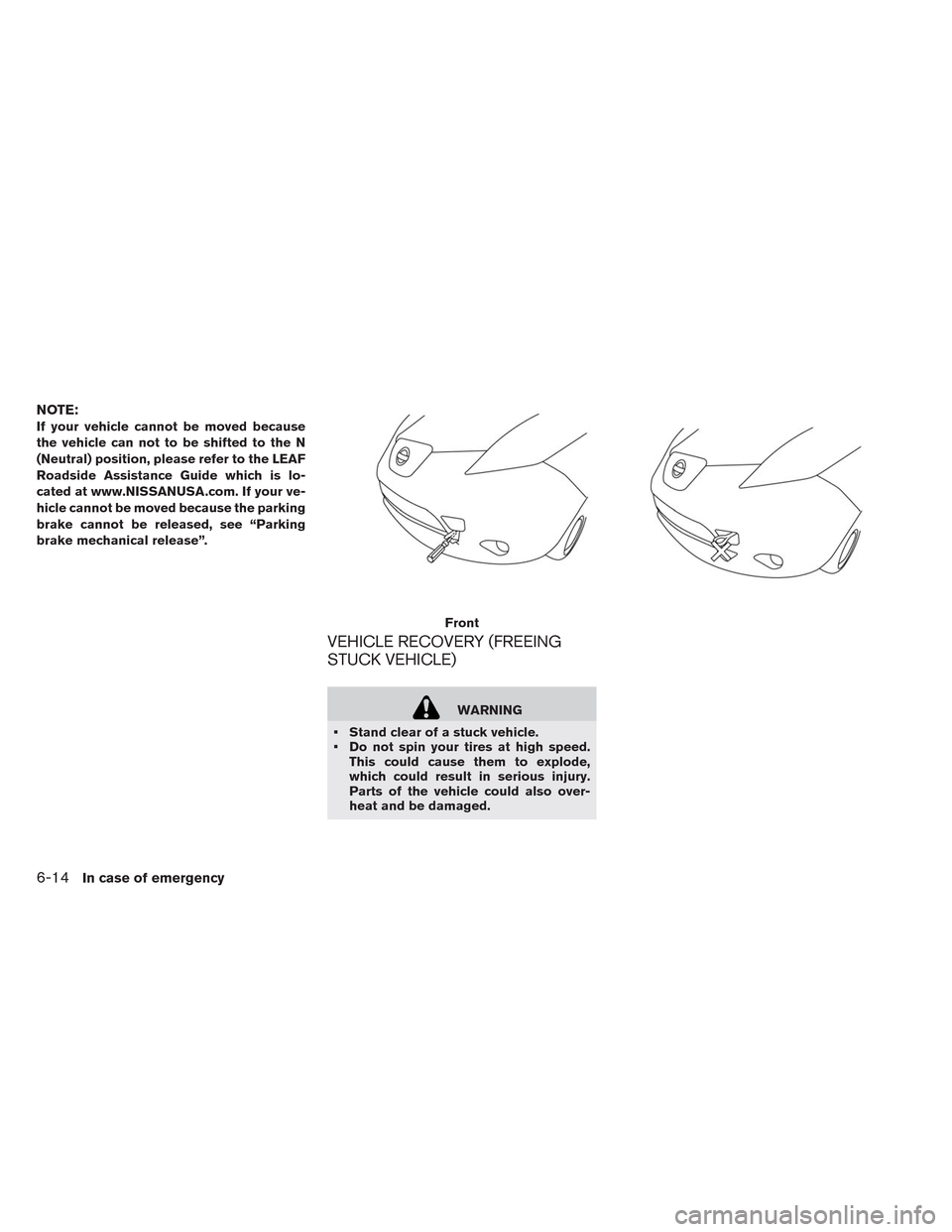
NOTE:
If your vehicle cannot be moved because
the vehicle can not to be shifted to the N
(Neutral) position, please refer to the LEAF
Roadside Assistance Guide which is lo-
cated at www.NISSANUSA.com. If your ve-
hicle cannot be moved because the parking
brake cannot be released, see “Parking
brake mechanical release”.
VEHICLE RECOVERY (FREEING
STUCK VEHICLE)
WARNING
• Stand clear of a stuck vehicle.
• Do not spin your tires at high speed.
This could cause them to explode,
which could result in serious injury.
Parts of the vehicle could also over-
heat and be damaged.
Front
6-14In case of emergency
Page 328 of 397
CHROME PARTS
Clean chrome parts regularly with a non- abrasive
chrome polish to maintain the finish.
TIRE DRESSING
NISSAN does not recommend the use of tire
dressings. Tire manufacturers apply a coating to
the tires to help reduce discoloration of the rub-
ber. If a tire dressing is applied to the tires, it may
react with the coating and form a compound. This
compound may come off the tire while driving and
stain the vehicle paint.
If you choose to use a tire dressing, take the
following precautions:
• Use a water-based tire dressing. The coating on
the tire dissolves more easily with an oil-based
tire dressing.
• Apply a light coat of tire dressing to help prevent
it from entering the tire tread/grooves (where it
would be difficult to remove) .
• Wipe off excess tire dressing using a dry towel.
Make sure the tire dressing is completely re-
moved from the tire tread/grooves.
• Allow the tire dressing to dry as recommended
by the tire dressing manufacturer.Occasionally remove loose dust from the interior
trim, plastic parts and seats using a vacuum
cleaner or soft bristled brush. Wipe the vinyl and
leather surfaces with a clean, soft cloth damp-
ened in mild soap solution, then wipe clean with a
dry soft cloth.
Regular care and cleaning is required in order to
maintain the appearance of the leather.
Before using any fabric protector, read the manu-
facturer’s recommendations. Some fabric pro-
tectors contain chemicals that may stain or
bleach the seat material.
Use a cloth dampened only with water to clean
the meter and gauge lens.
WARNING
Do not use water or acidic cleaners (hot
steam cleaners) on the seat. This can
damage the seat or occupant classifica-
tion sensor. This can also affect the op-
eration of the air bag system and result in
serious personal injury.
CAUTION
• Never use benzine, thinner, or any
similar material.• Small dirt particles can be abrasive
and damaging to the leather surfaces
and should be removed promptly. Do
not use saddle soap, car waxes, pol-
ishes, oils, cleaning fluids, solvents,
detergents or ammonia-based clean-
ers as they may damage the leather’s
natural finish.
• Never use fabric protectors unless rec-
ommended by the manufacturer.
• Do not use glass or plastic cleaner on
meter or gauge lens covers. It may
damage the lens cover.
AIR FRESHENERS
Most air fresheners use a solvent that could affect
the vehicle interior. If you use an air freshener,
take the following precautions:
• Hanging-type air fresheners can cause perma-
nent discoloration when they contact vehicle
interior surfaces. Place the air freshener in a
location that allows it to hang free and not
contact an interior surface.
• Liquid-type air fresheners typically clip on the
vents. These products can cause immediate
damage and discoloration when spilled on inte-
rior surfaces.
CLEANING INTERIOR
7-4Appearance and care
Page 329 of 397
Carefully read and follow the manufacturer’s in-
structions before using air fresheners.
FLOOR MATS
WARNING
To avoid potential pedal interference that
may result in a collision or injury:
• NEVER place a floor mat on top of
another floor mat in the driver front
position.
• Use only genuine NISSAN floor mats
specifically designed for use in your
vehicle model. See your NISSAN certi-
fied LEAF dealer for more information.
• Properly position the mats in the floor-
well using the floor mat positioning
aid. See “Floor mat positioning aid
(driver’s side only)”.
The use of genuine NISSAN floor mats can ex-
tend the life of your vehicle carpet and make it
easier to clean the interior. Mats should be main-
tained with regular cleaning and replaced if they
become excessively worn.
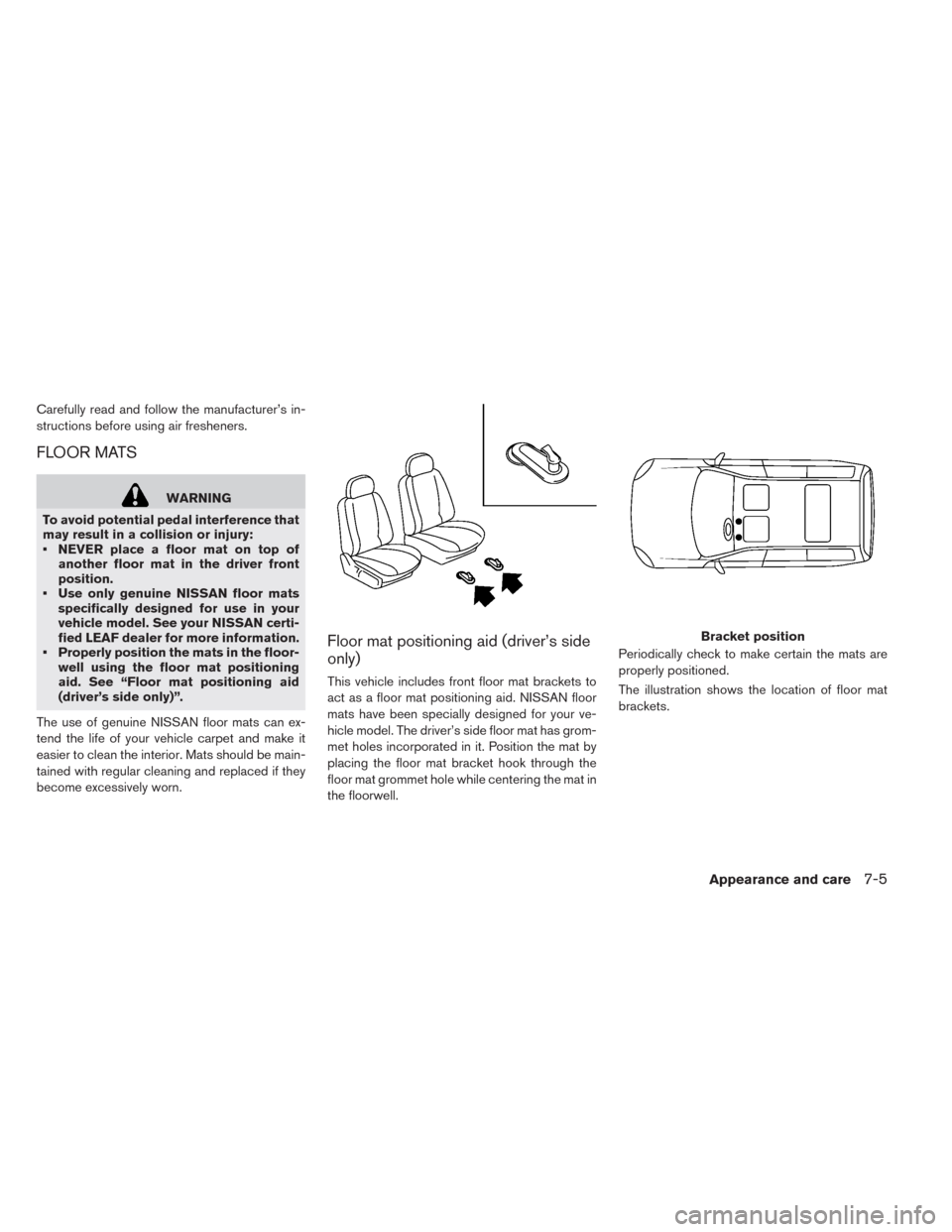
Floor mat positioning aid (driver’s side
only)
This vehicle includes front floor mat brackets to
act as a floor mat positioning aid. NISSAN floor
mats have been specially designed for your ve-
hicle model. The driver’s side floor mat has grom-
met holes incorporated in it. Position the mat by
placing the floor mat bracket hook through the
floor mat grommet hole while centering the mat in
the floorwell.Periodically check to make certain the mats are
properly positioned.
The illustration shows the location of floor mat
brackets.
Bracket position
Appearance and care7-5
Page 330 of 397
SEAT BELTS
The seat belts can be cleaned by wiping them
with a sponge dampened in a mild soap solution.
Allow the belts to dry completely in the shade
before using them.
See “Seat belts” in the “Safety-Seats seat belts
and supplemental restraint system” section.
WARNING
Do not allow wet seat belts to roll up in
the retractor. NEVER use bleach, dye, or
chemical solvents to clean the seat belts,
since these materials may severely
weaken the seat belt webbing.
ELECTRIC VEHICLE SUPPLY
EQUIPMENT (EVSE)
The Electric Vehicle Supply Equipment (EVSE)
can be cleaned by wiping gently with a soft cloth
dampened in a 3% mild soap solution. Wipe and
rinse the soap solution off with a cloth dampened
with water and allow the EVSE to dry in a shady
and well-ventilated place.
MOST COMMON FACTORS
CONTRIBUTING TO VEHICLE
CORROSION
• The accumulation of moisture-retaining dirt and
debris in body panel sections, cavities, and
other areas.
• Damage to paint and other protective coatings
caused by gravel and stone chips or minor
traffic accidents.
ENVIRONMENTAL FACTORS
INFLUENCE THE RATE OF
CORROSION
Moisture
Accumulation of sand, dirt and water on the ve-
hicle body underside can accelerate corrosion.
Wet floor coverings will not dry completely inside
the vehicle, and should be removed for drying to
avoid floor panel corrosion.
Relative humidity
Corrosion will be accelerated in areas of high
relative humidity, especially those areas where
the temperatures stay above freezing, where at-
mospheric pollution exists, or where road salt is
used.
Temperature
A temperature increase will accelerate the rate of
corrosion to those parts which are not well ven-
tilated.
Air pollution
Industrial pollution, the presence of salt in the air
in coastal areas, or heavy road salt use will accel-
erate the corrosion process. Road salt will also
accelerate the disintegration of paint surfaces.
TO PROTECT YOUR VEHICLE FROM
CORROSION
• Wash and wax your vehicle often to keep the
vehicle clean.
• Always check for minor damage to the paint and
repair it as soon as possible.
• Keep drain holes at the bottom of the doors
open to avoid water accumulation.
• Check the underbody for accumulation of sand,
dirt or salt. If present, wash with water as soon
as possible.
CORROSION PROTECTION
7-6Appearance and care
Page 333 of 397
8 Maintenance and do-it yourself
Maintenance requirement..................8-2
Scheduled maintenance.................8-2
General maintenance...................8-2
Where to go for service.................8-2
General maintenance.....................8-2
Explanation of maintenance items...........8-2
Maintenance precautions..................8-5
Motor compartment check locations............8-7
Cooling system........................8-8
Checking coolant level..................8-9
Changing coolant.....................8-9
Reduction gear fluid.....................8-10
Brake fluid..........................8-10
Window washer fluid....................8-11
12-volt battery........................8-12
Jump starting.......................8-13
Windshield wiper blades..................8-13
Cleaning.........................8-13
Replacing.........................8-13Rear window wiper blade.................8-15
Brakes............................8-15
Brake pad wear warning................8-16
Fuses.............................8-16
Motor compartment...................8-16
Passenger compartment................8-18
Nissan Intelligent Key® battery replacement......8-19
Lights.............................8-21
Headlights........................8-22
Exterior and interior lights...............8-23
Wheels and tires......................8-26
Tire pressure.......................8-26
Tire labeling.......................8-28
Types of tires.......................8-30
Tire chains.......................
.8-31
Changing wheels and tires...............8-32
Emergency tire puncture repair kit..........8-34
Page 336 of 397
Seat belts:Check that all parts of the seat belt
system (for example, buckles, anchors, adjusters
and retractors) operate properly and smoothly,
and are installed securely. Check the belt web-
bing for cuts, fraying, wear or damage.
Steering wheel:Check for changes in the
steering conditions, such as excessive free play,
hard steering or strange noises.
Warning lights and chimes:Make sure that all
warning lights and chimes are operating properly.
Windshield defroster:Check that the air emits
from the defroster outlets properly and in suffi-
cient quantity when operating the heater or air
conditioner.
Windshield wiper and washer*:Check that
the wipers and washers operate properly and
that the wipers do not streak.
Under hood and vehicle
The maintenance items listed here should be
checked periodically.
12-volt battery (for serviceable battery)*:
Check the fluid level in each cell.
It should be between the MAX and MIN lines.
Vehicles operated in high temperatures or undersevere conditions require frequent checks of the
12-volt battery fluid level.
NOTE:
Care should be taken to avoid situations
that can lead to potential battery discharge
and potential no-start conditions such as:
1. Installation or extended use of electronic ac-
cessories that consume battery power when
the engine is not running (Phone chargers,
GPS, DVD players, etc.)
2. Vehicle is not driven regularly and/or only
driven short distances.
In these cases, the battery may need to be
charged to maintain battery health.
Brake fluid level*:Make sure that the brake
fluid level is between the MAX and MIN lines on
the reservoir.
Coolant level*:Check the coolant level when
the motor compartment is cold.
Fluid leaks:Check under the vehicle for water
or other fluid leaks after the vehicle has been
parked for a short period of time. Water dripping
from the air conditioner after use is normal. If you
notice any leaks, check for the cause and have it
corrected immediately.Radiator and hoses:Check the front of the
radiator and clean off any dirt, insects, leaves,
etc., that may have accumulated. Make sure that
the hoses have no cracks, deformation, rot or
loose connections.
Underbody:The underbody is frequently ex-
posed to corrosive substances such as those
used on icy roads or to control dust. It is very
important to remove these substances, other-
wise rust will form on the floor pan and frame. At
the end of winter, the underbody should be thor-
oughly flushed with plain water, being careful to
clean those areas where mud and dirt may accu-
mulate. For additional information, see “Cleaning
exterior” in the “Appearance and care” section.
Windshield washer fluid*:Check that there is
an adequate amount of fluid in the reservoir.
8-4Maintenance and do-it yourself
Page 337 of 397
When performing any inspection or maintenance
work on your vehicle, always take care to prevent
serious accidental injury to yourself or damage to
the vehicle. The following are general precau-
tions that should be closely observed.
WARNING
• The EV (Electric Vehicle) system uses
high voltage up to approximately DC
400 volt. The system can be hot during
and after starting and when the vehicle
is shut off. Be careful of both the high
voltage and the high temperature.
Obey the labels that are attached to
the vehicle.
• Never disassemble, remove or replace
high-voltage parts and cables as well
as their connectors. High-voltage
cables are colored orange.
• Disassembling, removing or replacing
those parts or cables can cause severe
burns or electric shock that may result
in serious injury or death. The vehicle
high voltage system has no user ser-
viceable parts. Take your vehicle to the
NISSAN certified LEAF dealer for any
necessary maintenance.• Park the vehicle on a level surface,
apply the parking brake securely and
chock the wheels to prevent the ve-
hicle from moving. Push the P (Park)
position switch on the shift lever or
place the vehicle into the N (Neutral)
position.
• If you must work with the EV (Electric
vehicle) system is turned on, keep
hands, clothing, hair and tools away
from moving fans and any other mov-
ing parts.
• Make sure that the power switch is in
the OFF or LOCK position when per-
forming any part replacement or re-
pairs.
• It is advisable to secure or remove any
loose clothing and remove any jewelry,
such as rings, watches, etc. before
working on your vehicle.
• Always wear eye protection whenever
you work on your vehicle.
• Never get under the vehicle while it is
supported only by a jack. If it is neces-
sary to work under the vehicle, support
it with safety stands.
• Keep smoking materials, flames and
sparks away from the 12-volt battery.
CAUTION
• Do not work under the hood while the
motor compartment is hot. Push the
power switch in the OFF position and
wait until it cools down.
• Avoid direct contact with used coolant.
Improperly disposed coolant and/or
other vehicle fluids can damage the
environment. Always conform to local
regulations for the disposal of vehicle
fluids.
• Never connect or disconnect the bat-
tery or any transistorized component
while the power switch is in the ON
position.
• Your vehicle is equipped with an auto-
matic cooling fan. It may come on at
any time without warning, even if the
power switch is not in the ACC, ON or
READY to drive position. To avoid in-
jury, always disconnect the negative
12-volt battery cable before working
near the fan.
• Before performing any electrical main-
tenance work on the vehicle such as
the battery, fuses or bulb replacement,
confirm the following:
– The charge connector is removed
from the vehicle.
MAINTENANCE PRECAUTIONS
Maintenance and do-it yourself8-5
Page 340 of 397
The cooling system is filled at the factory with a
pre-diluted mixture of 50% genuine NISSAN
Long Life Antifreeze/Coolant (blue) and 50% wa-
ter to provide year-round anti-freeze and coolant
protection. The antifreeze solution contains rust
and corrosion inhibitors. Additional cooling sys-
tem additives are not necessary.
WARNING
• Never remove the coolant tank cap
when the motor compartment is hot.
Wait until the motor compartment cool
down.
• The coolant tank is equipped with a
special type coolant tank cap. To pre-
vent damage to the motor compart-
ment, use only a Genuine NISSAN
coolant tank cap.
CAUTION
• Never use any additives in the coolant
such as radiator sealer in the cooling
system. This may cause damage to
electrical equipment such as the motor
and inverter.• When adding or replacing coolant, be
sure to use only a Genuine NISSAN
Long Life Antifreeze/Coolant (blue) or
equivalent. Genuine NISSAN Long Life
Antifreeze/Coolant (blue) is pre-
diluted to provide antifreeze protec-
tion to −34°F (−37°C) . If additional
freeze protection is needed due to the
weather conditions where you operate
your vehicle, add Genuine NISSAN
Long Life Antifreeze/Coolant (blue)
concentrate following the directions
on the container. If and equivalent
coolant other than Genuine NISSAN
Long Life Antifreeze/Coolant (blue) is
used, follow the coolant manufacture’s
instructions to maintain minimum an-
tifreeze protection to −34°F (−37°C) .
The use of other types of coolant solu-
tions other than Genuine NISSAN
Long Life Antifreeze/Coolant (blue) or
equivalent may damage the cooling
system.• The life expectancy of the factory-fill
coolant is 125,000 miles (200,000 km)
or 15 years. Mixing any other type of
coolant other than Genuine NISSAN
Long Life Antifreeze/Coolant (blue) ,
including Genuine NISSAN Long Life
Antifreeze/Coolant (green) , or the use
of non-distilled water will reduce the
life expectancy of the factory-filled
coolant. Refer to the NISSAN Service
and Maintenance Guide for more de-
tails.
COOLING SYSTEM
8-8Maintenance and do-it yourself