2014 NISSAN LEAF mirror
[x] Cancel search: mirrorPage 226 of 397
When the shift lever is shifted into the R (Re-
verse) position, the monitor display shows a rear-
ward view from the vehicle.
WARNING
Failure to follow the warnings and in-
structions for proper use of the Rear View
Monitor could result in serious injury or
death.
• The RearView Monitor is a conve-
nience but it is not a substitute for
proper backing. Always turn and look
out the windows, and check mirrors to
be sure that it is safe to move before
operating the vehicle. Always back up
slowly.
• The system is designed as an aid to the
driver in showing large stationary ob-
jects directly behind the vehicle, to
help avoid damaging the vehicle.
• The system will not detect small ob-
jects below the bumper, and may not
detect objects close to the bumper or
on the ground.
• The system cannot completely elimi-
nate blind spots and may not show
every object.• Underneath the bumper and the corner
areas of the bumper cannot be viewed
on the RearView Monitor because of
its monitoring range limitation. The
system will not show objects below
the bumper, and may not show objects
close to the bumper or on the ground.
• Objects viewed in the RearView Moni-
tor differ from actual distance because
a wide-angle lens is used.
• Objects in the RearView Monitor will
appear visually opposite than when
viewed in the rear view and outside
mirrors.
• Make sure that the hatch is securely
closed when backing up.
• Do not put anything on the rearview
camera. The rearview camera is in-
stalled on top of the hatch.
• When washing the vehicle with high
pressure water, be sure not to spray it
around the camera. Otherwise, water
may enter the camera unit causing wa-
ter condensation on the lens, a mal-
function, fire or an electric shock.
• Do not strike the camera. It is a preci-
sion instrument. Otherwise, it may
malfunction or cause damage result-
ing in a fire or an electric shock.
CAUTION
There is a plastic cover over the camera.
Do not scratch the cover when cleaning
dirt or snow from the cover.
REARVIEW MONITOR (IF SO
EQUIPPED)
4-2Heater, air conditioner, audio and phone systems
Page 234 of 397
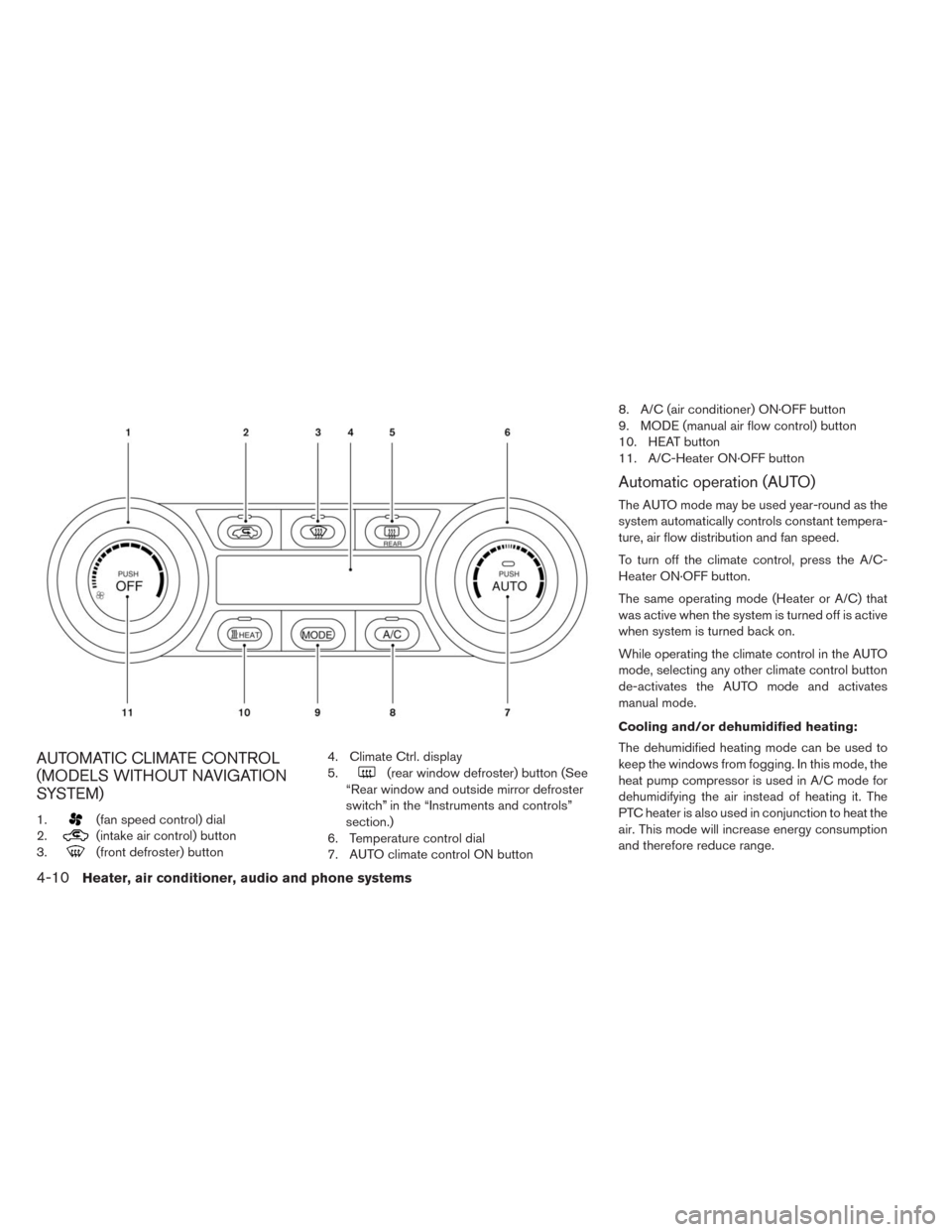
AUTOMATIC CLIMATE CONTROL
(MODELS WITHOUT NAVIGATION
SYSTEM)
1.(fan speed control) dial
2.
(intake air control) button
3.
(front defroster) button4. Climate Ctrl. display
5.
(rear window defroster) button (See
“Rear window and outside mirror defroster
switch” in the “Instruments and controls”
section.)
6. Temperature control dial
7. AUTO climate control ON button8. A/C (air conditioner) ON·OFF button
9. MODE (manual air flow control) button
10. HEAT button
11. A/C-Heater ON·OFF button
Automatic operation (AUTO)
The AUTO mode may be used year-round as the
system automatically controls constant tempera-
ture, air flow distribution and fan speed.
To turn off the climate control, press the A/C-
Heater ON·OFF button.
The same operating mode (Heater or A/C) that
was active when the system is turned off is active
when system is turned back on.
While operating the climate control in the AUTO
mode, selecting any other climate control button
de-activates the AUTO mode and activates
manual mode.
Cooling and/or dehumidified heating:
The dehumidified heating mode can be used to
keep the windows from fogging. In this mode, the
heat pump compressor is used in A/C mode for
dehumidifying the air instead of heating it. The
PTC heater is also used in conjunction to heat the
air. This mode will increase energy consumption
and therefore reduce range.
4-10Heater, air conditioner, audio and phone systems
Page 240 of 397
A NISSAN certified LEAF dealer will be able to
service your environmentally friendly climate con-
trol system.
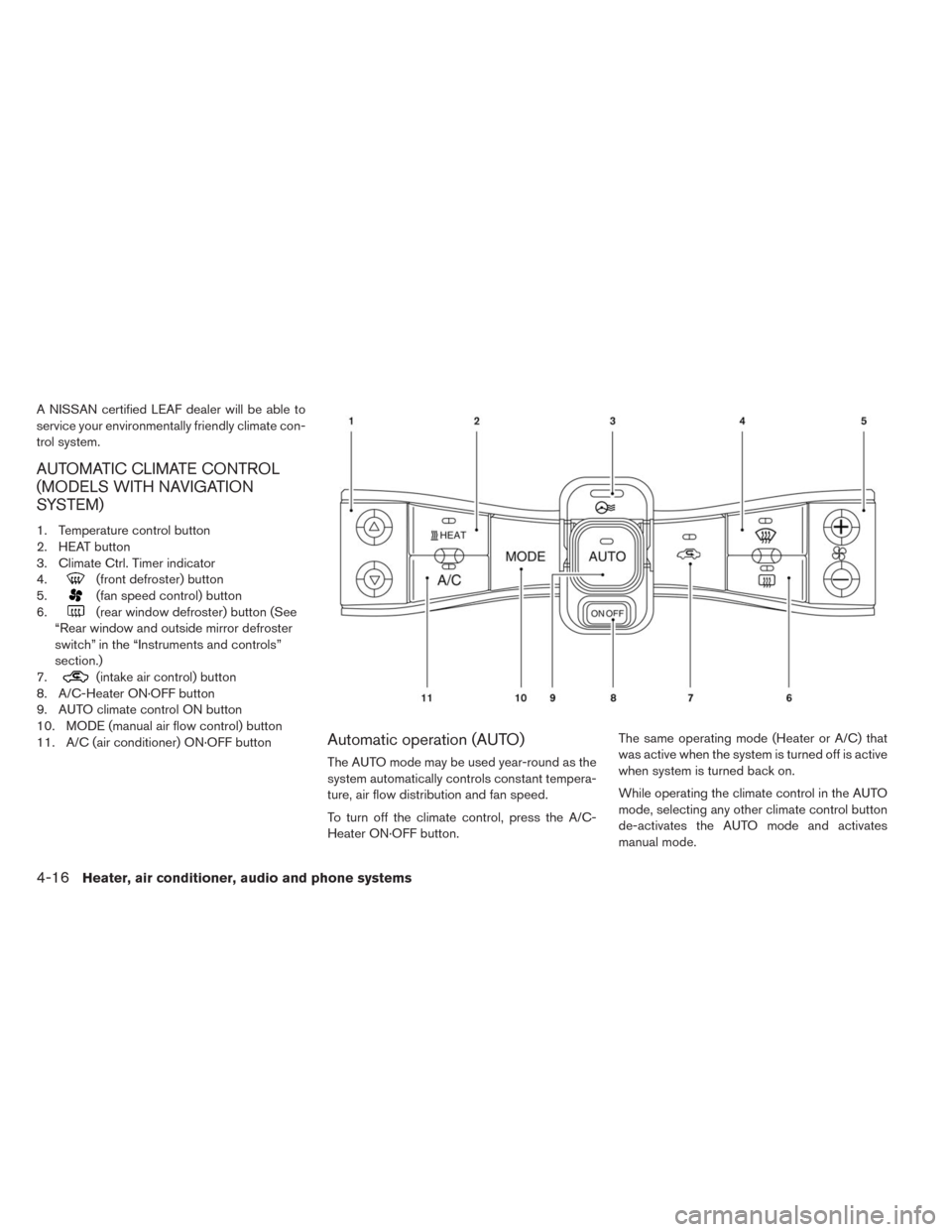
AUTOMATIC CLIMATE CONTROL
(MODELS WITH NAVIGATION
SYSTEM)
1. Temperature control button
2. HEAT button
3. Climate Ctrl. Timer indicator
4.
(front defroster) button
5.
(fan speed control) button
6.
(rear window defroster) button (See
“Rear window and outside mirror defroster
switch” in the “Instruments and controls”
section.)
7.
(intake air control) button
8. A/C-Heater ON·OFF button
9. AUTO climate control ON button
10. MODE (manual air flow control) button
11. A/C (air conditioner) ON·OFF button
Automatic operation (AUTO)
The AUTO mode may be used year-round as the
system automatically controls constant tempera-
ture, air flow distribution and fan speed.
To turn off the climate control, press the A/C-
Heater ON·OFF button.The same operating mode (Heater or A/C) that
was active when the system is turned off is active
when system is turned back on.
While operating the climate control in the AUTO
mode, selecting any other climate control button
de-activates the AUTO mode and activates
manual mode.
4-16Heater, air conditioner, audio and phone systems
Page 290 of 397
NISSAN INTELLIGENT KEY®
BATTERY DISCHARGE
If the Intelligent Key battery is discharged, or
environmental conditions interfere with the Intel-
ligent Key operation, start the EV (Electric Ve-
hicle) system in the READY to drive mode ac-
cording to the following procedure:
1. Push the P (Park) position switch on the shift
lever.
2. Firmly apply the foot brake.
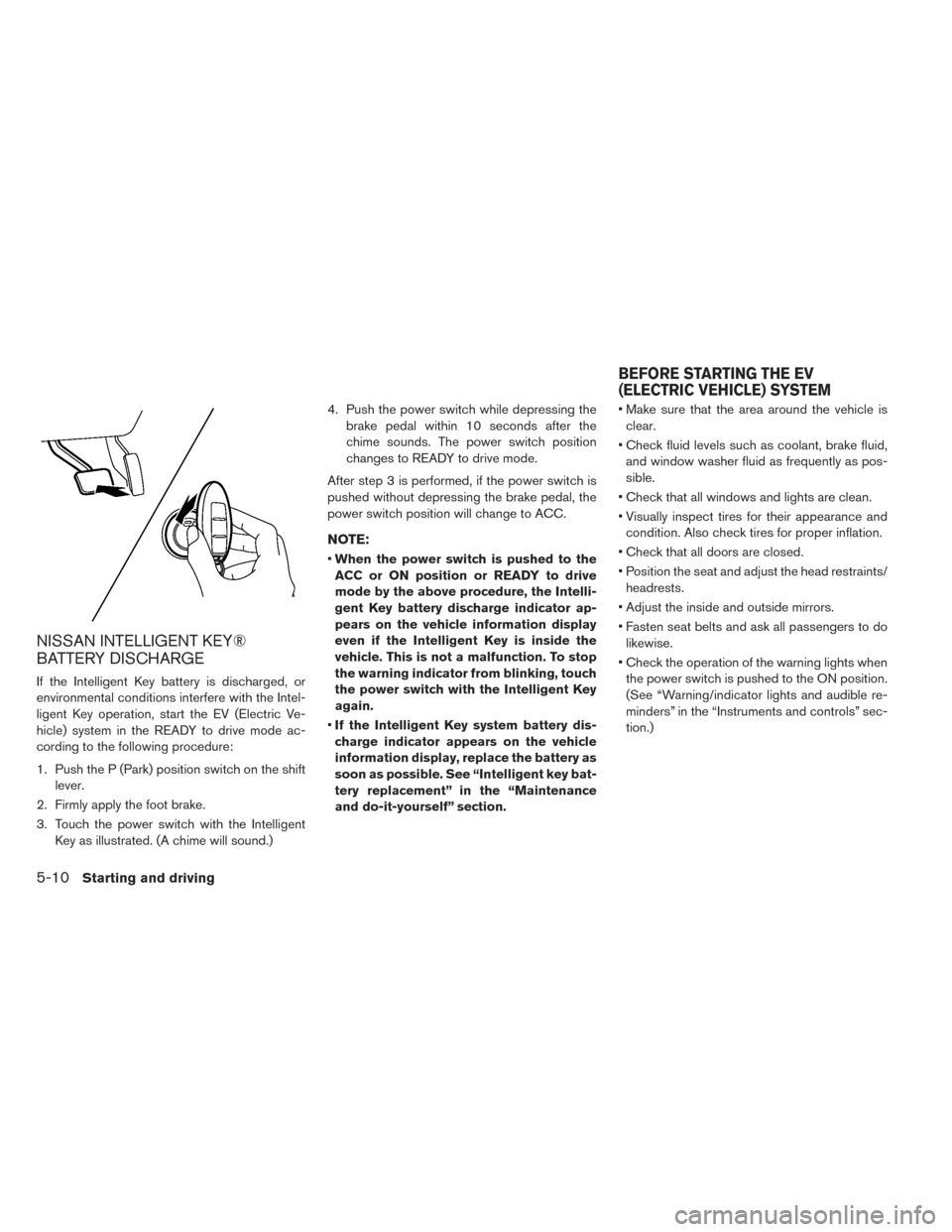
3. Touch the power switch with the Intelligent
Key as illustrated. (A chime will sound.)4. Push the power switch while depressing the
brake pedal within 10 seconds after the
chime sounds. The power switch position
changes to READY to drive mode.
After step 3 is performed, if the power switch is
pushed without depressing the brake pedal, the
power switch position will change to ACC.
NOTE:
•When the power switch is pushed to the
ACC or ON position or READY to drive
mode by the above procedure, the Intelli-
gent Key battery discharge indicator ap-
pears on the vehicle information display
even if the Intelligent Key is inside the
vehicle. This is not a malfunction. To stop
the warning indicator from blinking, touch
the power switch with the Intelligent Key
again.
•If the Intelligent Key system battery dis-
charge indicator appears on the vehicle
information display, replace the battery as
soon as possible. See “Intelligent key bat-
tery replacement” in the “Maintenance
and do-it-yourself” section.• Make sure that the area around the vehicle is
clear.
• Check fluid levels such as coolant, brake fluid,
and window washer fluid as frequently as pos-
sible.
• Check that all windows and lights are clean.
• Visually inspect tires for their appearance and
condition. Also check tires for proper inflation.
• Check that all doors are closed.
• Position the seat and adjust the head restraints/
headrests.
• Adjust the inside and outside mirrors.
• Fasten seat belts and ask all passengers to do
likewise.
• Check the operation of the warning lights when
the power switch is pushed to the ON position.
(See “Warning/indicator lights and audible re-
minders” in the “Instruments and controls” sec-
tion.)
BEFORE STARTING THE EV
(ELECTRIC VEHICLE) SYSTEM
5-10Starting and driving
Page 390 of 397
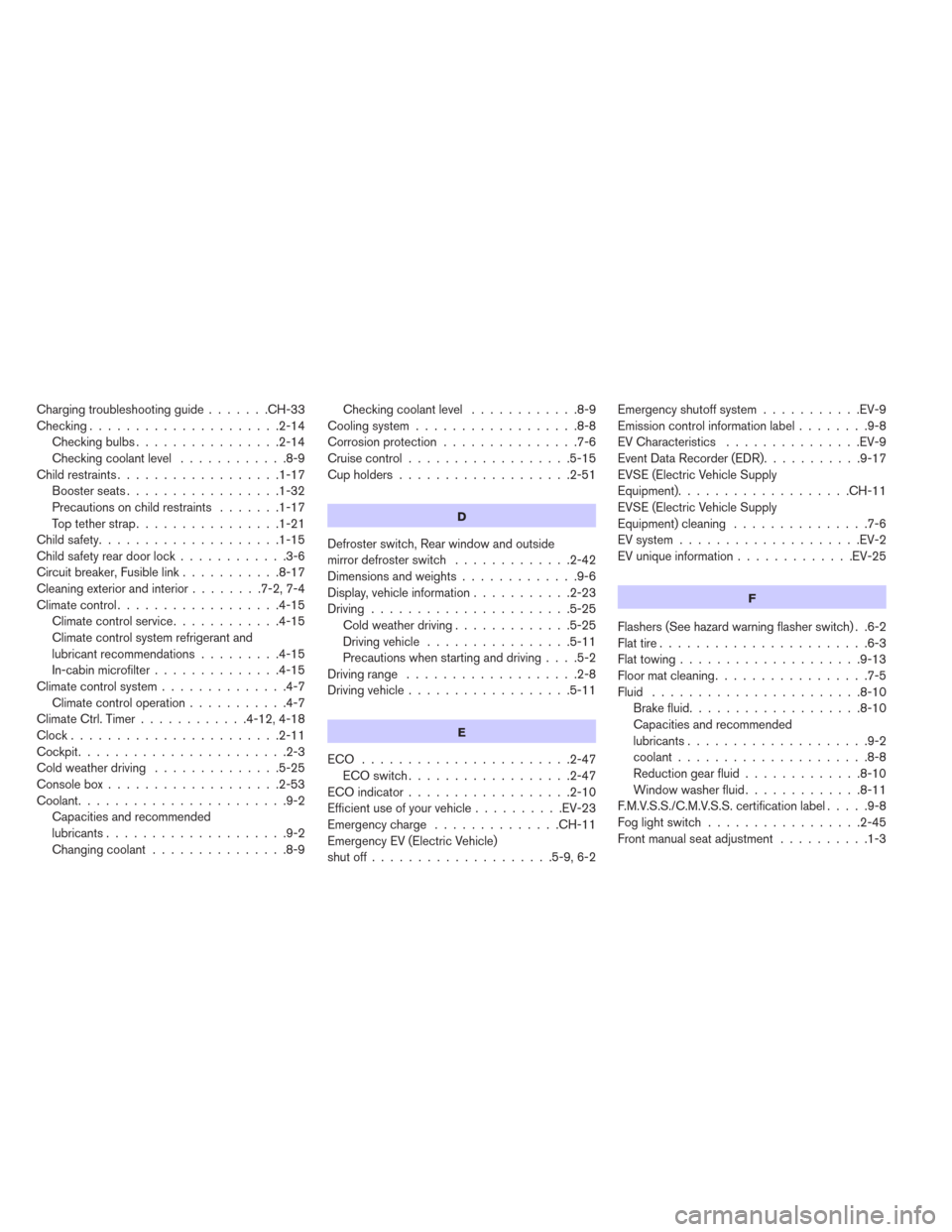
Charging troubleshooting guide.......CH-33
Checking.....................2-14
Checkingbulbs................2-14
Checkingcoolantlevel ............8-9
Child restraints..................1-17
Boosterseats.................1-32
Precautions on child restraints.......1-17
Top tether strap................1-21
Childsafety....................1-15
Child safety rear door lock............3-6
Circuit breaker, Fusible link...........8-17
Cleaning exterior and interior........7-2,7-4
Climatecontrol..................4-15
Climate control service............4-15
Climate control system refrigerant and
lubricant recommendations.........4-15
In-cabin microfilter..............4-15
Climate control system..............4-7
Climate control operation...........4-7
Climate Ctrl. Timer............4-12,4-18
Clock.......................2-11
Cockpit.......................2-3
Cold weather driving..............5-25
Consolebox...................2-53
Coolant.......................9-2
Capacities and recommended
lubricants....................9-2
Changingcoolant...............8-9Checking coolant level............8-9
Cooling system..................8-8
Corrosion protection...............7-6
Cruisecontrol..................5-15
Cupholders...................2-51
D
Defroster switch, Rear window and outside
mirror defroster switch.............2-42
Dimensionsandweights.............9-6
Display, vehicle information...........2-23
Driving......................5-25
Cold weather driving.............5-25
Driving vehicle................5-11
Precautions when starting and driving....5-2
Driving range...................2-8
Driving vehicle..................5-11
E
ECO .......................2-47
ECO switch..................2-47
ECOindicator..................2-10
Efficient use of your vehicle..........EV-23
Emergency charge..............CH-11
Emergency EV (Electric Vehicle)
shutoff....................5-9,6-2Emergency shutoff system...........EV-9
Emission control information label........9-8
EV Characteristics...............EV-9
Event Data Recorder (EDR)...........9-17
EVSE (Electric Vehicle Supply
Equipment)...................CH-11
EVSE (Electric Vehicle Supply
Equipment) cleaning...............7-6
EV system....................EV-2
EV unique information.............EV-25
F
Flashers (See hazard warning flasher switch) . .6-2
Flat tire.......................6-3
Flattowing....................9-13
Floormatcleaning.................7-5
Fluid.......................8-10
Brake fluid...................8-10
Capacities and recommended
lubricants....................9-2
coolant.....................8-8
Reductiongearfluid.............8-10
Window washer fluid.............8-11
F.M.V.S.S./C.M.V.S.S. certification label.....9-8
Foglightswitch.................2-45
Frontmanualseatadjustment ..........1-3
Page 391 of 397
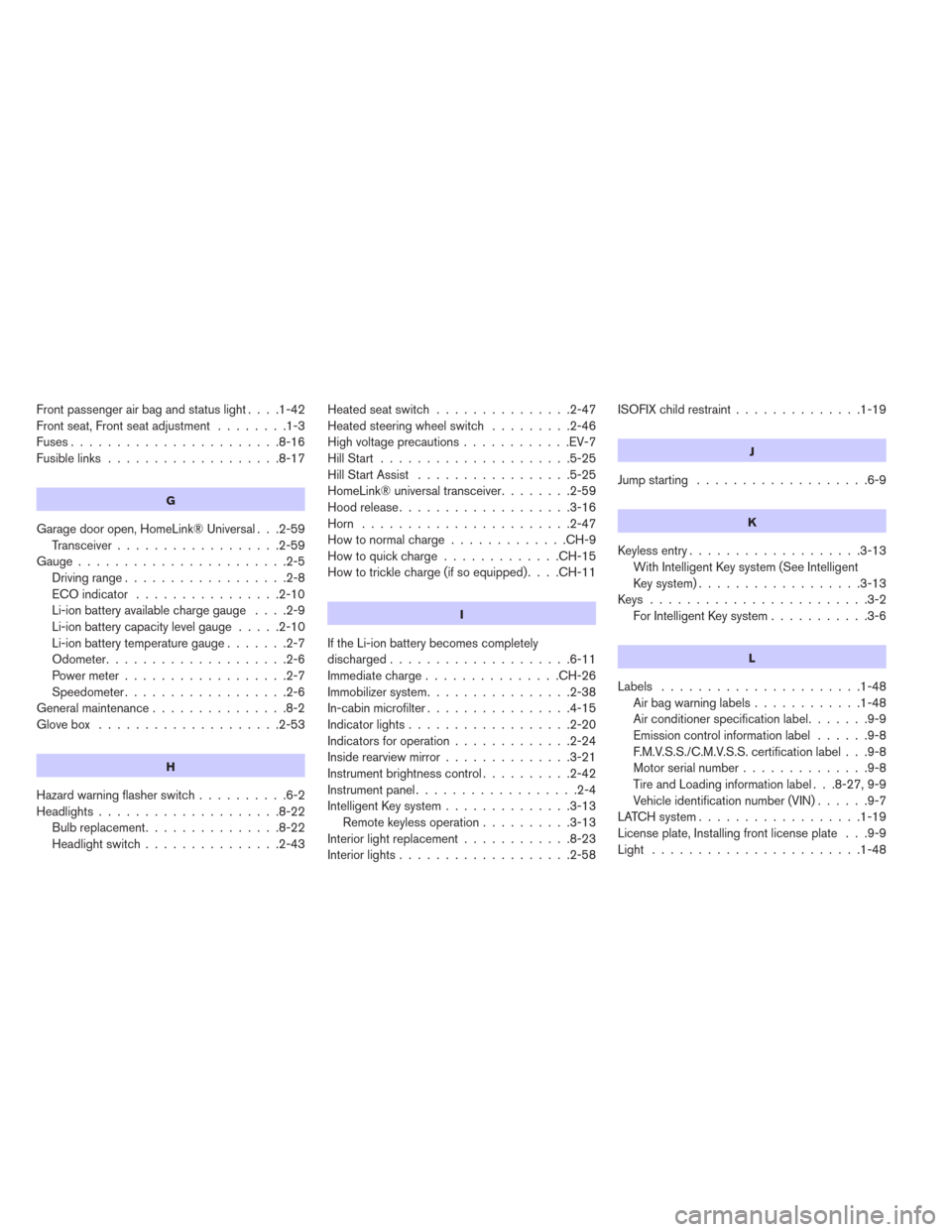
Front passenger air bag and status light....1-42
Front seat, Front seat adjustment........1-3
Fuses.......................8-16
Fusiblelinks ...................8-17
G
Garage door open, HomeLink® Universal . . .2-59
Transceiver..................2-59
Gauge.......................2-5
Driving range..................2-8
ECOindicator ................2-10
Li-ion battery available charge gauge....2-9
Li-ion battery capacity level gauge.....2-10
Li-ion battery temperature gauge.......2-7
Odometer....................2-6
Power meter..................2-7
Speedometer..................2-6
Generalmaintenance...............8-2
Glovebox ....................2-53
H
Hazard warning flasher switch..........6-2
Headlights....................8-22
Bulb replacement...............8-22
Headlightswitch...............2-43Heated seat switch...............2-47
Heated steering wheel switch.........2-46
Highvoltageprecautions............EV-7
HillStart .....................5-25
Hill Start Assist.................5-25
HomeLink® universal transceiver........2-59
Hood release...................3-16
Horn .......................2-47
How to normal charge.............CH-9
How to quick charge.............CH-15
How to trickle charge (if so equipped)....CH-11
I
If the Li-ion battery becomes completely
discharged....................6-11
Immediate charge...............CH-26
Immobilizer system................2-38
In-cabin microfilter................4-15
Indicatorlights..................2-20
Indicators for operation.............2-24
Inside rearview mirror..............3-21
Instrument brightness control..........2-42
Instrument panel..................2-4
Intelligent Key system..............3-13
Remote keyless operation..........3-13
Interior light replacement............8-23
Interior lights...................2-58ISOFIX child restraint..............1-19
J
Jump starting...................6-9
K
Keyless entry...................3-13
With Intelligent Key system (See Intelligent
Key system)..................3-13
Keys ........................3-2
For Intelligent Key system...........3-6
L
Labels ......................1-48
Airbagwarninglabels............1-48
Air conditioner specification label.......9-9
Emission control information label......9-8
F.M.V.S.S./C.M.V.S.S. certification label . . .9-8
Motor serial number..............9-8
Tire and Loading information label . . .8-27, 9-9
Vehicle identification number (VIN)......9-7
LATCH system..................1-19
License plate, Installing front license plate . . .9-9
Light .......................1-48
Page 392 of 397
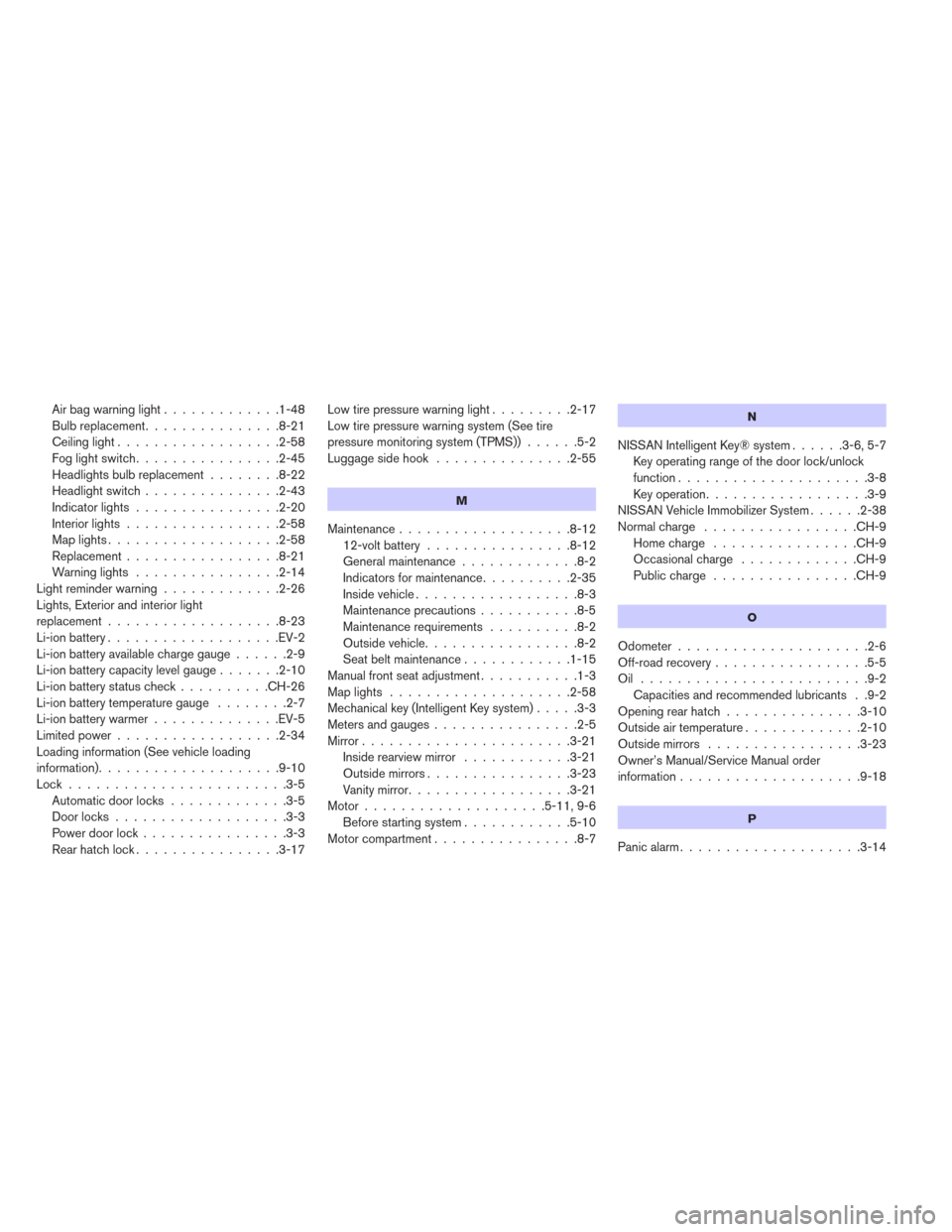
Airbagwarninglight.............1-48
Bulb replacement...............8-21
Ceiling light..................2-58
Foglightswitch................2-45
Headlights bulb replacement........8-22
Headlightswitch...............2-43
Indicatorlights................2-20
Interior lights.................2-58
Maplights...................2-58
Replacement.................8-21
Warninglights ................2-14
Light reminder warning.............2-26
Lights, Exterior and interior light
replacement...................8-23
Li-ion battery...................EV-2
Li-ion battery available charge gauge......2-9
Li-ion battery capacity level gauge.......2-10
Li-ion battery status check..........CH-26
Li-ion battery temperature gauge........2-7
Li-ion battery warmer..............EV-5
Limited power..................2-34
Loading information (See vehicle loading
information)....................9-10
Lock........................3-5
Automatic door locks.............3-5
Door locks...................3-3
Power door lock................3-3
Rearhatchlock................3-17Low tire pressure warning light.........2-17
Low tire pressure warning system (See tire
pressure monitoring system (TPMS))......5-2
Luggage side hook...............2-55
M
Maintenance...................8-12
12-volt battery................8-12
General maintenance.............8-2
Indicators for maintenance..........2-35
Insidevehicle..................8-3
Maintenanceprecautions...........8-5
Maintenance requirements..........8-2
Outside vehicle.................8-2
Seat belt maintenance............1-15
Manual front seat adjustment...........1-3
Maplights ....................2-58
Mechanical key (Intelligent Key system).....3-3
Meters and gauges................2-5
Mirror.......................3-21
Inside rearview mirror............3-21
Outside mirrors................3-23
Vanity mirror..................3-21
Motor....................5-11,9-6
Before starting system............5-10
Motor compartment................8-7
N
NISSAN Intelligent Key® system......3-6,5-7
Key operating range of the door lock/unlock
function.....................3-8
Key operation..................3-9
NISSAN Vehicle Immobilizer System......2-38
Normal charge.................CH-9
Home charge................CH-9
Occasional charge.............CH-9
Publiccharge ................CH-9
O
Odometer.....................2-6
Off-road recovery.................5-5
Oil .........................9-2
Capacities and recommended lubricants . .9-2
Opening rear hatch...............3-10
Outside air temperature.............2-10
Outside mirrors.................3-23
Owner’s Manual/Service Manual order
information....................9-18
P
Panic alarm....................3-14
Page 393 of 397
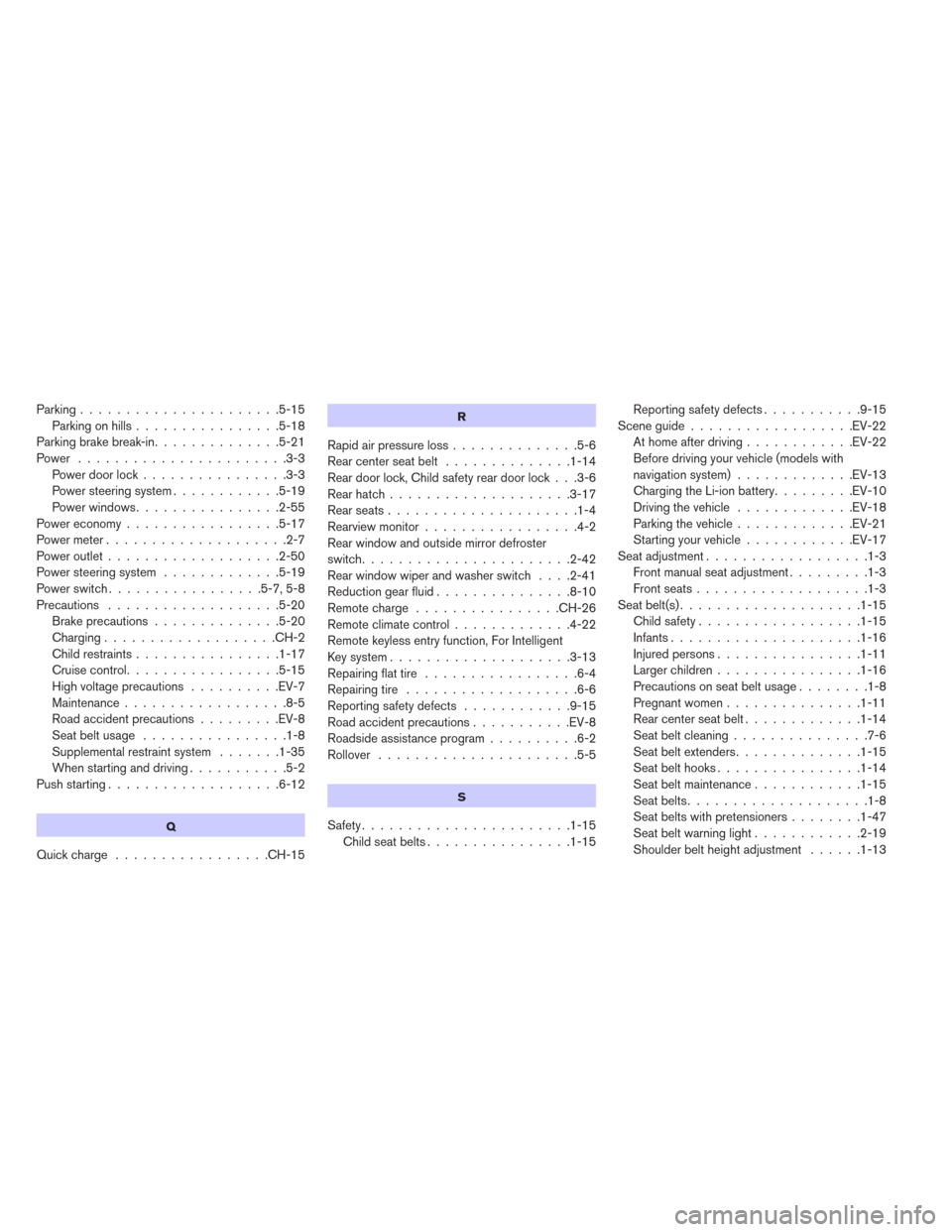
Parking......................5-15
Parking on hills................5-18
Parking brake break-in..............5-21
Power .......................3-3
Power door lock................3-3
Power steering system............5-19
Power windows................2-55
Power economy.................5-17
Powermeter....................2-7
Poweroutlet...................2-50
Power steering system.............5-19
Powerswitch.................5-7,5-8
Precautions ...................5-20
Brake precautions..............5-20
Charging...................CH-2
Child restraints................1-17
Cruisecontrol.................5-15
High voltage precautions..........EV-7
Maintenance..................8-5
Road accident precautions.........EV-8
Seatbeltusage ................1-8
Supplemental restraint system.......1-35
When starting and driving...........5-2
Push starting...................6-12
Q
Quickcharge .................CH-15
R
Rapid air pressure loss..............5-6
Rear center seat belt..............1-14
Rear door lock, Child safety rear door lock . . .3-6
Rearhatch....................3-17
Rearseats.....................1-4
Rearview monitor.................4-2
Rear window and outside mirror defroster
switch.......................2-42
Rear window wiper and washer switch....2-41
Reduction gear fluid...............8-10
Remote charge................CH-26
Remote climate control.............4-22
Remote keyless entry function, For Intelligent
Key system....................3-13
Repairing flat tire.................6-4
Repairing tire...................6-6
Reporting safety defects............9-15
Road accident precautions...........EV-8
Roadside assistance program..........6-2
Rollover ......................5-5
S
Safety.......................1-15
Childseatbelts................1-15Reporting safety defects...........9-15
Sceneguide..................EV-22
At home after driving............EV-22
Before driving your vehicle (models with
navigation system).............EV-13
Charging the Li-ion battery.........EV-10
Driving the vehicle.............EV-18
Parking the vehicle.............EV-21
Starting your vehicle............EV-17
Seat adjustment..................1-3
Frontmanualseatadjustment.........1-3
Frontseats...................1-3
Seat belt(s)....................1-15
Child safety..................1-15
Infants.....................1-16
Injured persons................1-11
Larger children................1-16
Precautions on seat belt usage........1-8
Pregnant women...............1-11
Rearcenterseatbelt.............1-14
Seat belt cleaning...............7-6
Seat belt extenders..............1-15
Seat belt hooks................1-14
Seatbeltmaintenance............1-15
Seatbelts....................1-8
Seat belts with pretensioners........1-47
Seatbeltwarninglight............2-19
Shoulder belt height adjustment......1-13