2014 NISSAN JUKE roof
[x] Cancel search: roofPage 70 of 402
*The SRS wiring harness connectors are
yellow and orange for easy identification.
When selling your vehicle, we request that you
inform the buyer about the front air bag system
and guide the buyer to the appropriate sections
in this Owner’s Manual.
SSS0978
FRONT SEAT-MOUNTED SIDE-IM-
PACT SUPPLEMENTAL AIR BAG AND
ROOF-MOUNTED CURTAIN SIDE-IM-
PACT SUPPLEMENTAL AIR BAG SYS-
TEMS
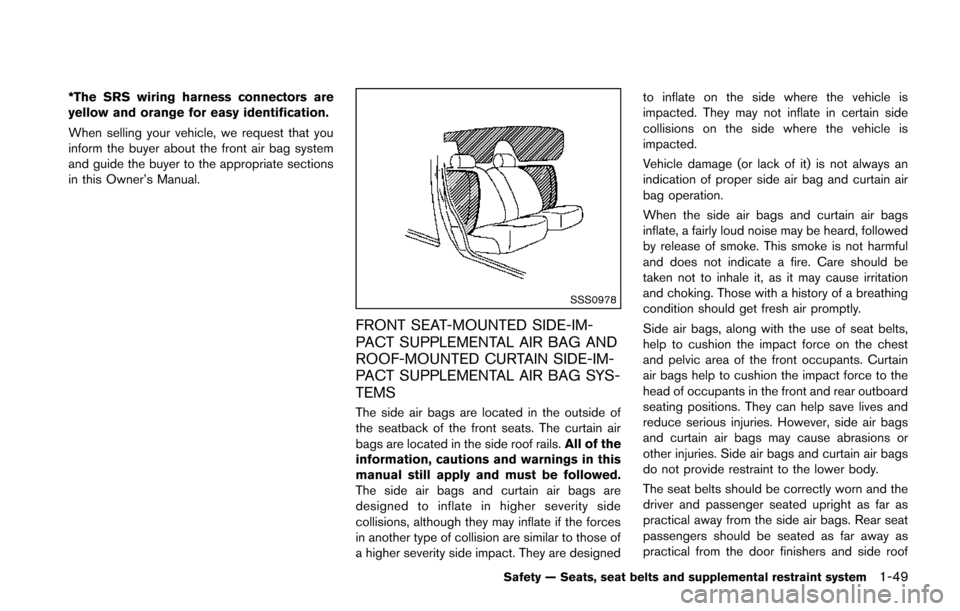
The side air bags are located in the outside of
the seatback of the front seats. The curtain air
bags are located in the side roof rails.All of the
information, cautions and warnings in this
manual still apply and must be followed.
The side air bags and curtain air bags are
designed to inflate in higher severity side
collisions, although they may inflate if the forces
in another type of collision are similar to those of
a higher severity side impact. They are designed to inflate on the side where the vehicle is
impacted. They may not inflate in certain side
collisions on the side where the vehicle is
impacted.
Vehicle damage (or lack of it) is not always an
indication of proper side air bag and curtain air
bag operation.
When the side air bags and curtain air bags
inflate, a fairly loud noise may be heard, followed
by release of smoke. This smoke is not harmful
and does not indicate a fire. Care should be
taken not to inhale it, as it may cause irritation
and choking. Those with a history of a breathing
condition should get fresh air promptly.
Side air bags, along with the use of seat belts,
help to cushion the impact force on the chest
and pelvic area of the front occupants. Curtain
air bags help to cushion the impact force to the
head of occupants in the front and rear outboard
seating positions. They can help save lives and
reduce serious injuries. However, side air bags
and curtain air bags may cause abrasions or
other injuries. Side air bags and curtain air bags
do not provide restraint to the lower body.
The seat belts should be correctly worn and the
driver and passenger seated upright as far as
practical away from the side air bags. Rear seat
passengers should be seated as far away as
practical from the door finishers and side roof
Safety — Seats, seat belts and supplemental restraint system1-49
Page 77 of 402

Windows ........................................................................\
.......... 2-45Power windows ................................................................ 2-45
Moonroof (if so equipped) ................................................... 2-48 Power moonroof ............................................................... 2-48 Interior lights ........................................................................\
.. 2-49
Map lights (if so equipped) ......................................... 2-50
Map light control switch (if so equipped) ............... 2-50
Cargo light ....................................................................... 2-51
Page 123 of 402
2-48Instruments and controls
WARNING
.In an accident you could be thrown
from the vehicle through an open
moonroof. Always use seat belts
and child restraints.
. Do not allow anyone to stand up or
extend any portion of their body out
of the moonroof opening while the
vehicle is in motion or while the
moonroof is closing.
CAUTION
.Remove water drops, snow, ice or
sand from the moonroof before
opening.
. Do not place any heavy object on
the moonroof or surrounding area.
POWER MOONROOF
The moonroof only operates when the ignition
switch is in the ON position.
The moonroof is operational for about 45
seconds, even if the ignition switch is turned to
the OFF position. If the driver’s door or the
passenger’s door is opened during this period of
about 45 seconds, power to the moonroof is
canceled.
Sunshade
The sunshade will open automatically when the
moonroof is opened. However, it must be closed
manually.
SIC4624
Sliding the moonroof
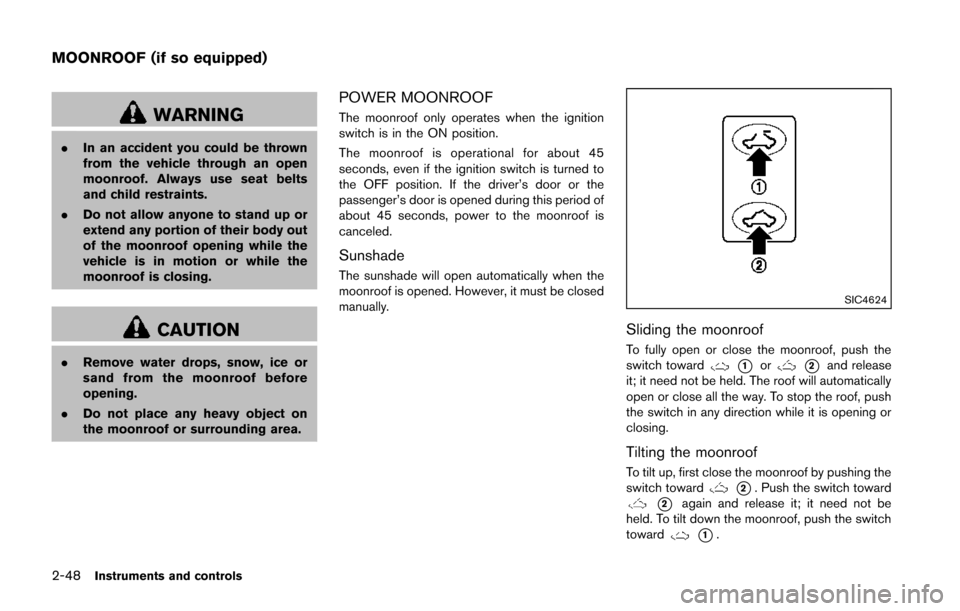
To fully open or close the moonroof, push the
switch toward
*1or*2and release
it; it need not be held. The roof will automatically
open or close all the way. To stop the roof, push
the switch in any direction while it is opening or
closing.
Tilting the moonroof
To tilt up, first close the moonroof by pushing the
switch toward
*2. Push the switch toward
*2again and release it; it need not be
held. To tilt down the moonroof, push the switch
toward
*1.
MOONROOF (if so equipped)
Page 124 of 402
Auto reverse function
WARNING
There are some small distances imme-
diately before the closed position which
cannot be detected. Make sure that all
passengers have their hands, etc., in-
side the vehicle before closing the
moonroof.
If the control unit detects something caught in
the moonroof when it is closing, the moonroof
will be immediately opened.
The auto reverse function can be activated when
the moonroof is closed by automatic operation
when the ignition switch is in the ON position or
for about 45 seconds after the ignition switch is
turned to the OFF position.
If the moonroof cannot be closed automatically
when the auto reverse function activates due to
a malfunction, push and hold the switch toward
*2.
Depending on the environment or driving
conditions, the auto reverse function may
be activated if an impact or load similar to
something being caught in the moonroof
occurs.
If the moonroof does not operate
If the moonroof does not operate properly,
perform the following procedure to initialize the
moonroof operation system.
1. If the moonroof is open, close it fully by repeatedly pushing the switch toward
*2.
2. Push and hold the switch toward
*2to
tilt the moonroof up.
3. Release the moonroof switch after the moonroof moves slightly up and down.
4. Push and hold the switch toward
*1to
fully tilt the moonroof down.
5. Check if the moonroof switch operates normally.
If the moonroof does not operate properly after
performing the procedure above, have your
vehicle checked by a NISSAN dealer.
CAUTION
Do not use for extended periods of time
with the engine stopped. This could
result in a discharged battery.
Instruments and controls2-49
INTERIOR LIGHTS
Page 184 of 402
Static and flutter: During signal interference from
buildings, large hills or due to antenna position,
usually in conjunction with increased distance
from the station transmitter, static or flutter can
be heard. This can be reduced by lowering the
treble setting to reduce the treble response.
Multipath reception: Because of the reflective
characteristics of FM signals, direct and re-
flected signals reach the receiver at the same
time. The signals may cancel each other,
resulting in momentary flutter or loss of sound.
AM radio reception:
AM signals, because of their low frequency, can
bend around objects and skip along the ground.
In addition, the signals can be bounced off the
ionosphere and bent back to earth. Because of
these characteristics. AM signals are also
subject to interference as they travel from
transmitter to receiver.
Fading: Occurs while the vehicle is passing
through freeway underpasses or in areas with
many tall buildings. It can also occur for several
seconds during ionospheric turbulence even in
areas where no obstacles exist.
Static: Caused by thunderstorms, electrical
power lines, electric signs and even traffic lights.Satellite radio reception (if so equipped):
When the satellite radio is used for the first time
or the battery has been replaced, the satellite
radio may not work properly. This is not a
malfunction. Wait more than 10 minutes with the
satellite radio ON and the vehicle away from any
metal or large buildings for the satellite radio to
receive all of the necessary data.
The satellite radio mode requires an active
SiriusXM Satellite Radio subscription. The sa-
tellite radio is not available in Alaska, Hawaii and
Guam.
Satellite radio performance may be affected if
cargo carried on the roof blocks the satellite
radio signal.
If possible, do not put cargo near the satellite
antenna.
A buildup of ice on the satellite radio antenna
can affect satellite radio performance. Remove
the ice to restore satellite radio reception.
SAA0480
Compact Disc (CD) player
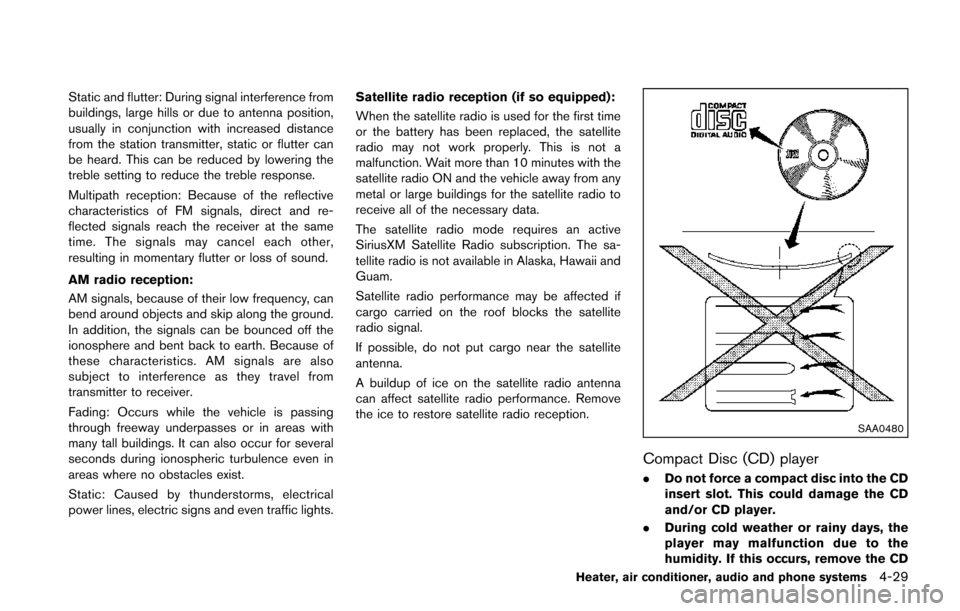
. Do not force a compact disc into the CD
insert slot. This could damage the CD
and/or CD player.
. During cold weather or rainy days, the
player may malfunction due to the
humidity. If this occurs, remove the CD
Heater, air conditioner, audio and phone systems4-29
Page 262 of 402
.Do not drive across steep slopes.
Instead drive either straight up or
straight down the slopes. Off-road
vehicles can tip over sideways much
more easily than they can forward or
backward.
. Many hills are too steep for any
vehicle. If you drive up them, you
may stall. If you drive down them,
you may not be able to control your
speed. If you drive across them, you
may roll over.
. Do not shift ranges while driving on
downhill grades as this could cause
loss of control of the vehicle.
. Stay alert when driving to the top of
a hill. At the top there could be a
drop-off or other hazard that could
cause an accident.
. If your engine stalls or you cannot
make it to the top of a steep hill,
never attempt to turn around. Your
vehicle could tip or roll over. Always
back straight down in R (Reverse)
range. Never back down in N (Neu-
tral) , using only the brake, as this
could cause loss of control. .
Heavy braking going down a hill
could cause your brakes to overheat
and fade, resulting in loss of control
and an accident. Apply brakes
lightly and use a low range to
control your speed.
. Unsecured cargo can be thrown
around when driving over rough
terrain. Properly secure all cargo
so it will not be thrown forward
and cause injury to you or your
passengers.
. To avoid raising the center of gravity
excessively, do not exceed the rated
capacity of the roof rack (if so
equipped) and evenly distribute the
load. Secure heavy loads in the
cargo area as far forward and as
low as possible. Do not equip the
vehicle with tires larger than speci-
fied in this manual. This could cause
your vehicle to roll over.
. Do not grip the inside or spokes of
the steering wheel when driving off-
road. The steering wheel could
move suddenly and injure your
hands. Instead drive with your fin-
gers and thumbs on the outside of
the rim. .
Before operating the vehicle, ensure
that the driver and all passengers
have their seat belts fastened.
. Always drive with the floor mats in
place as the floor may became hot.
. Lower your speed when encounter-
ing strong crosswinds. With a higher
center of gravity, your NISSAN is
more affected by strong side winds.
Slower speeds ensure better vehicle
control.
. Do not drive beyond the perfor-
mance capability of the tires, even
with AWD engaged.
. For AWD equipped vehicles, do not
attempt to raise two wheels off the
ground and shift the transmission to
any drive or reverse position with
the engine running. Doing so may
result in drivetrain damage or un-
expected vehicle movement which
could result in serious vehicle da-
mage or personal injury.
. Do not attempt to test an AWD
equipped vehicle on a 2-wheel dy-
namometer (such as the dynam-
ometers used by some states for
emissions testing) , or similar equip-
Starting and driving5-9
Page 388 of 402
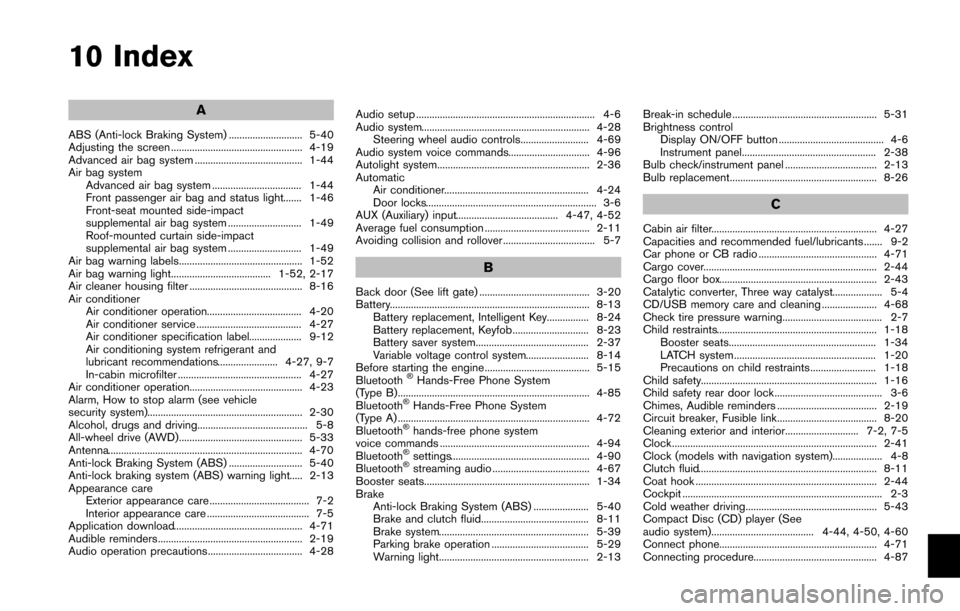
10 Index
A
ABS (Anti-lock Braking System) ............................ 5-40
Adjusting the screen .................................................. 4-19
Advanced air bag system ......................................... 1-44
Air bag systemAdvanced air bag system .................................. 1-44
Front passenger air bag and status light....... 1-46
Front-seat mounted side-impact
supplemental air bag system ............................ 1-49
Roof-mounted curtain side-impact
supplemental air bag system ............................ 1-49
Air bag warning labels............................................... 1-52
Air bag warning light...................................... 1-52, 2-17
Air cleaner housing filter ........................................... 8-16
Air conditioner Air conditioner operation.................................... 4-20
Air conditioner service ........................................ 4-27
Air conditioner specification label.................... 9-12
Air conditioning system refrigerant and
lubricant recommendations....................... 4-27, 9-7
In-cabin microfilter ............................................... 4-27
Air conditioner operation........................................... 4-23
Alarm, How to stop alarm (see vehicle
security system)........................................................... 2-30
Alcohol, drugs and driving.......................................... 5-8
All-wheel drive (AWD)............................................... 5-33
Antenna.......................................................................... 4-70
Anti-lock Braking System (ABS) ............................ 5-40
Anti-lock braking system (ABS) warning light..... 2-13
Appearance care Exterior appearance care ...................................... 7-2
Interior appearance care ....................................... 7-5
Application download................................................. 4-71
Audible reminders....................................................... 2-19
Audio operation precautions.................................... 4-28 Audio setup .................................................................... 4-6
Audio system................................................................ 4-28
Steering wheel audio controls.......................... 4-69
Audio system voice commands............................... 4-96
Autolight system.......................................................... 2-36
Automatic Air conditioner....................................................... 4-24
Door locks................................................................. 3-6
AUX (Auxiliary) input....................................... 4-47, 4-52
Average fuel consumption ........................................ 2-11
Avoiding collision and rollover ................................... 5-7
B
Back door (See lift gate) .......................................... 3-20
Battery............................................................................ 8-13 Battery replacement, Intelligent Key................ 8-24
Battery replacement, Keyfob............................. 8-23
Battery saver system........................................... 2-37
Variable voltage control system........................ 8-14
Before starting the engine........................................ 5-15
Bluetooth
®Hands-Free Phone System
(Type B)......................................................................... 4-85
Bluetooth
®Hands-Free Phone System
(Type A) ......................................................................... 4-72
Bluetooth
®hands-free phone system
voice commands ......................................................... 4-94
Bluetooth
®settings..................................................... 4-90
Bluetooth®streaming audio ..................................... 4-67
Booster seats............................................................... 1-34
Brake Anti-lock Braking System (ABS) ..................... 5-40
Brake and clutch fluid......................................... 8-11
Brake system......................................................... 5-39
Parking brake operation ..................................... 5-29
Warning light......................................................... 2-13 Break-in schedule ....................................................... 5-31
Brightness control
Display ON/OFF button ........................................ 4-6
Instrument panel................................................... 2-38
Bulb check/instrument panel ................................... 2-13
Bulb replacement........................................................ 8-26
C
Cabin air filter............................................................... 4-27
Capacities and recommended fuel/lubricants ....... 9-2
Car phone or CB radio ............................................. 4-71
Cargo cover.................................................................. 2-44
Cargo floor box............................................................ 2-43
Catalytic converter, Three way catalyst................... 5-4
CD/USB memory care and cleaning ..................... 4-68
Check tire pressure warning...................................... 2-7
Child restraints............................................................. 1-18 Booster seats........................................................ 1-34
LATCH system...................................................... 1-20
Precautions on child restraints......................... 1-18
Child safety................................................................... 1-16
Child safety rear door lock ......................................... 3-6
Chimes, Audible reminders ...................................... 2-19
Circuit breaker, Fusible link...................................... 8-20
Cleaning exterior and interior............................ 7-2, 7-5
Clock.............................................................................. 2-41
Clock (models with navigation system)................... 4-8
Clutch fluid.................................................................... 8-11
Coat hook ..................................................................... 2-44
Cockpit ............................................................................ 2-3
Cold weather driving.................................................. 5-43
Compact Disc (CD) player (See
audio system)....................................... 4-44, 4-50, 4-60
Connect phone............................................................ 4-71
Connecting procedure............................................... 4-87
Page 391 of 402
10-4
Warning/indicator lights and
audible reminders................................................. 2-13
Lights, Exterior and interior light replacement ..... 8-28
Loading information (See vehicle
loading information) .................................................... 9-14
Lock Automatic door locks ............................................. 3-6
Door locks................................................................. 3-4
Lift gate lock.......................................................... 3-20
Power door lock...................................................... 3-4
Loose fuel cap warning.................................... 2-7, 3-23
Low fuel warning light................................................ 2-15
Low tire pressure warning light............................... 2-15
Low tire pressure warning system
(See tire pressure monitoring system (TPMS)) .... 5-4
M
Maintenance Battery..................................................................... 8-13
General maintenance ............................................. 8-2
Inside the vehicle .................................................... 8-3
Maintenance precautions...................................... 8-5
Maintenance requirements.................................... 8-2
Outside the vehicle................................................. 8-2
Seat belt maintenance........................................ 1-15
Making a call ................................................................ 4-87
Malfunction indicator light (MIL).............................. 2-18
Manual air conditioner................................................ 4-21
Manual front seat adjustment..................................... 1-3
Map lights ..................................................................... 2-50
Mechanical key (Intelligent Key system) ................. 3-4
Meter Trip computer........................................................ 2-10
Meters and gauges....................................................... 2-5 Instrument brightness control ........................... 2-38 Mirror
Inside mirror........................................................... 3-25
Outside mirrors..................................................... 3-25
Vanity mirror........................................................... 3-27
Monitor, RearView monitor ....................................... 4-15
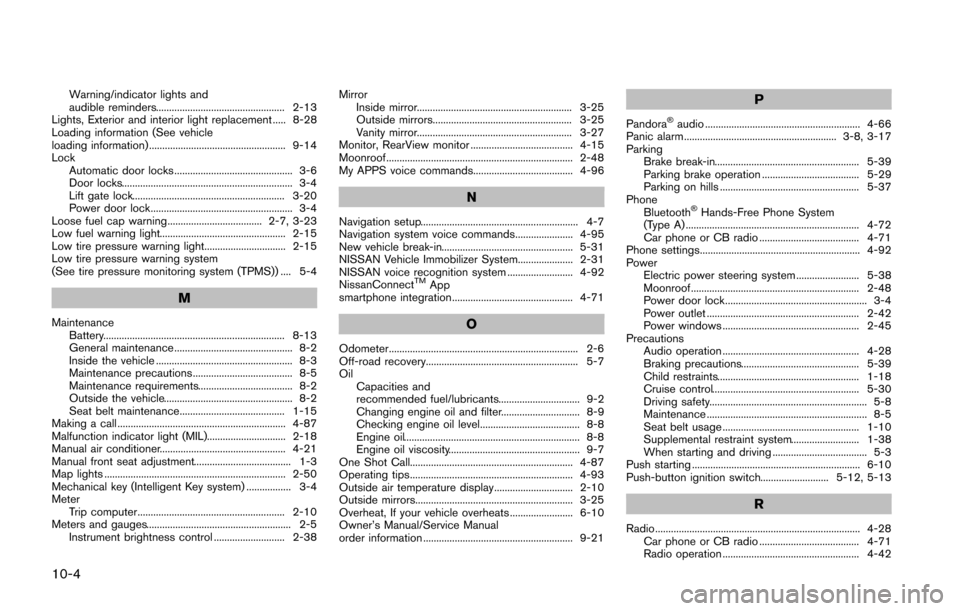
Moonroof....................................................................... 2-48
My APPS voice commands...................................... 4-96
N
Navigation setup............................................................ 4-7
Navigation system voice commands...................... 4-95
New vehicle break-in.................................................. 5-31
NISSAN Vehicle Immobilizer System..................... 2-31
NISSAN voice recognition system ......................... 4-92
NissanConnect
TMApp
smartphone integration.............................................. 4-71
O
Odometer........................................................................ 2-6
Off-road recovery.......................................................... 5-7
Oil Capacities and
recommended fuel/lubricants............................... 9-2
Changing engine oil and filter.............................. 8-9
Checking engine oil level...................................... 8-8
Engine oil................................................................... 8-8
Engine oil viscosity.................................................. 9-7
One Shot Call.............................................................. 4-87
Operating tips.............................................................. 4-93
Outside air temperature display.............................. 2-10
Outside mirrors............................................................ 3-25
Overheat, If your vehicle overheats ........................ 6-10
Owner’s Manual/Service Manual
order information ......................................................... 9-21
P
Pandora®audio ........................................................... 4-66
Panic alarm.......................................................... 3-8, 3-17
Parking Brake break-in....................................................... 5-39
Parking brake operation ..................................... 5-29
Parking on hills ..................................................... 5-37
Phone Bluetooth
®Hands-Free Phone System
(Type A) .................................................................. 4-72
Car phone or CB radio ...................................... 4-71
Phone settings............................................................. 4-92
Power Electric power steering system ........................ 5-38
Moonroof................................................................ 2-48
Power door lock...................................................... 3-4
Power outlet .......................................................... 2-42
Power windows .................................................... 2-45
Precautions Audio operation .................................................... 4-28
Braking precautions............................................. 5-39
Child restraints...................................................... 1-18
Cruise control........................................................ 5-30
Driving safety............................................................ 5-8
Maintenance ............................................................. 8-5
Seat belt usage .................................................... 1-10
Supplemental restraint system.......................... 1-38
When starting and driving .................................... 5-3
Push starting ................................................................ 6-10
Push-button ignition switch.......................... 5-12, 5-13
R
Radio.............................................................................. 4-28 Car phone or CB radio ...................................... 4-71
Radio operation .................................................... 4-42