2014 NISSAN GT-R height
[x] Cancel search: heightPage 17 of 354
GTR-10GT-R Overview
.Drive with the suspension setup switch in
the COMF mode to allow more suspension
stroke.
600 to 1,200 miles (1,000 to 2,000 km):
. Drive with the engine speed kept relatively
high with the shift lever in the
&Mposition.
Shifting is recommended between 1st and
4th gears.
. Avoid unnecessary quick steering and
abrupt braking.
. Drive with the suspension setup switch in
the COMF mode to allow more suspension
stroke.
Even though the mileage reaches over 1,200
miles (2,000 km) , the clutch may take longer to
properly engage if the vehicle is mainly driven in
town at a low speed. NISSAN recommends
breaking in the clutch at a GT-R certified
NISSAN dealer. Always perform the transmis-
sion setting after breaking in the clutch. If the
transmission setting is not complete, excessive
loads may be applied to the transmission and
power train system parts during starting and
shifting, which may result in a malfunction or
damage.
WHEEL ALIGNMENT
Do not adjust the wheel alignment until the
mileage reaches 1,000 miles (1,600 km). Until
then, the suspension may not engage enough
and the height may be higher.
However, make sure to adjust the alignment
after 1,000 miles (1,600 km) .
The wheel alignment can be adjusted by a GT-R
certified NISSAN dealer in accordance with
specifications for city driving to high perfor-
mance driving.
The tires on the GT-R may have different wear
rates and wear patterns in comparison to
conventional passenger vehicles. Contact a
GT-R certified NISSAN dealer to confirm that
the alignment is within specifications.VEHICLE DYNAMIC CONTROL (VDC)
OFF MODE
Always make sure the VDC is ON before driving
the vehicle by checking that the VDC OFF
indicator lights on the meter and the VDC set-up
switch are not illuminated. The GT-R is a high
performance vehicle and the VDC must be on/
activated to provide proper powertrain operation
and intended drivability.
WARNING
. The VDC OFF mode should ONLY be
used briefly to help free the vehicle
if stuck in snow or mud by tempora-
rily stopping operation of the VDC
to maintain wheel torque.
. Driving the GT-R with the VDC off
may lead to handling issues related
to steering maneuvers, acceleration,
or deceleration. Moreover, driving
with the VDC off can result in an
inoperative vehicle by causing ser-
ious damage to the powertrain,
including damage to the Transaxle
Assembly including Transfer, Clutch,
Gears, Transaxle case and all of its
components and other drivetrain
PRECAUTIONS BEFORE DRIVING
Page 63 of 354
1-14Safety — Seats, seat belts and supplemental restraint system
systems:
.Rear-facing child restraint (must not be
installed in models without rear seat)
. Forward-facing child restraint
. Booster seat
The proper restraint depends on the child’s size.
Generally, infants (up to about 1 year and less
than 20 lb (9 kg)) should be placed in rear-
facing child restraints. Forward-facing child
restraints are available for children who outgrow
rear-facing child restraints and are at least 1
year old. Booster seats are used to help position
a vehicle lap/shoulder belt on a child who can no
longer use a forward-facing child restraint.
WARNING
Infants and children need special pro-
tection. The vehicle’s seat belts may not
fit them properly. The shoulder belt may
come too close to the face or neck. The
lap belt may not fit over their small hip
bones. In an accident, an improperly
fitting seat belt could cause serious or
fatal injury. Always use appropriate
child restraints.
All U.S. states and Canadian provinces or territories require the use of approved child
restraints for infants and small children.
(
“Child restraints” page 1-15)
A child restraint may be secured in the vehicle
by using either the LATCH (Lower Anchor and
Tethers for CHildren) system (if so equipped) or
with the vehicle seat belt. (
“Child re-
straints” page 1-15)
NISSAN recommends that all pre-teens
and children be restrained in the rear seat
(models with rear seat) . According to
accident statistics, children are safer when
properly restrained in the rear seat than in
the front seat.
This is especially important because your
vehicle has a supplemental restraint sys-
tem (air bag system) for the front passen-
ger. (
“Supplemental restraint system”
page 1-34)
INFANTS
Infants up to at least one year old should be
placed in a rear-facing child restraint (models
with rear seat). NISSAN recommends that
infants be placed in child restraints that comply
with Federal Motor Vehicle Safety Standards or
Canadian Motor Vehicle Safety Standards. You
should choose a child restraint which fits your
vehicle and always follow the manufacturer’s instructions for installation and use.
SMALL CHILDREN
Children that are over 1 year old and weigh at
least 20 lb (9 kg) should remain in a rear-facing
child restraint as long as possible up to the
height or weight limit of the child restraint
(models with rear seat) . Children who outgrow
the height or weight limit of the rear-facing child
restraint and are at least 1 year old should be
secured in a forward-facing child restraint with a
harness. Refer to the manufacturer’s instructions
for minimum and maximum weight and height
recommendations. NISSAN recommends that
small children be placed in child restraints that
comply with Federal Motor Vehicle Safety
Standards or Canadian Motor Vehicle Safety
Standards. You should choose a child restraint
that fits your vehicle and always follow the
manufacturer’s instructions for installation and
use.
Page 64 of 354
LARGER CHILDREN
Children should remain in a forward-facing child
restraint with a harness until they reach the
maximum height or weight limit allowed by the
child restraint manufacturer.
Once a child outgrows the height or weight limit
of the harness-equipped forward-facing child
restraint, NISSAN recommends that the child be
placed in a commercially available booster seat
to obtain proper seat belt fit. For a seat belt to fit
properly, the booster seat should raise the child
so that the shoulder belt is properly positioned
across the chest and the top, middle portion of
the shoulder. The shoulder belt should not cross
the neck or face and should not fall off the
shoulder. The lap belt should lie snugly across
the lower hips or upper thighs, not the abdomen.
A booster seat can only be used in seating
positions that have a three-point type seat belt.
The booster seat should fit the vehicle seat and
have a label certifying that it complies with
Federal Motor Vehicle Safety Standards or
Canadian Motor Vehicle Safety Standards.
Once the child has grown so the shoulder belt
is no longer on or near the face and neck, and
the lap belt can be positioned properly across
the lower hips or upper thighs, use the seat belt
without the booster seat.WARNING
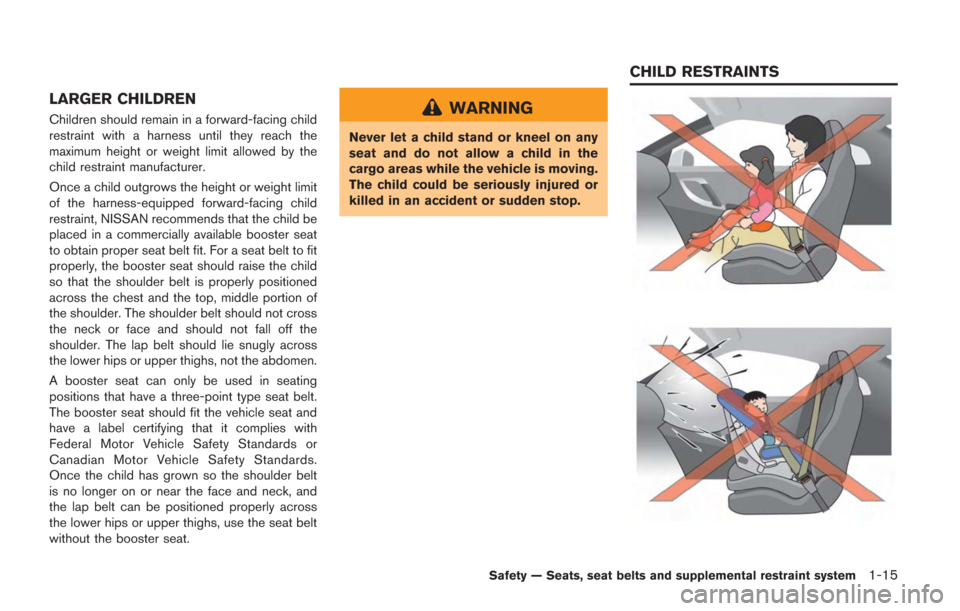
Never let a child stand or kneel on any
seat and do not allow a child in the
cargo areas while the vehicle is moving.
The child could be seriously injured or
killed in an accident or sudden stop.
Safety — Seats, seat belts and supplemental restraint system1-15
CHILD RESTRAINTS
Page 66 of 354
to as the LATCH (Lower Anchors and Tethers for
CHildren) system. Some child restraints include
rigid or webbing-mounted attachments that can
be connected to these anchors. (See
“Lower Anchors and Tethers for CHildren
System (LATCH) (models with rear seat)” page
1-17.)
If you do not have a LATCH compatible child
restraint, the vehicle seat belts can be used.
For the models without rear seat, the child
restraint is installed on the front passenger’s
seat using the seat belt and tether anchorages
(if required) . (See
“Forward-facing child
restraint installation using the seat belts” page
1-26 and
“Installing top tether strap” page
1-30.)
Several manufacturers offer child restraints for
infants and small children of various sizes. When
selecting any child restraint, keep the following
points in mind:
. Choose only a restraint with a label certifying
that it complies with Federal Motor Vehicle
Safety Standard 213 or Canadian Motor
Vehicle Safety Standard 213.
. Check the child restraint in your vehicle to
be sure it is compatible with the vehicle’s
seat and seat belt system.
. If the child restraint is compatible with your vehicle, place your child in the child restraint
and check the various adjustments to be
sure the child restraint is compatible with
your child. Choose a child restraint that is
designed for your child’s height and weight.
Always follow all recommended procedures.
All U.S. states and Canadian provinces or
territories require that infants and small
children be restrained in an approved child
restraint at all times while the vehicle is
being operated. Canadian law requires the
top tether strap on forward-facing child
restraints be secured to the designated
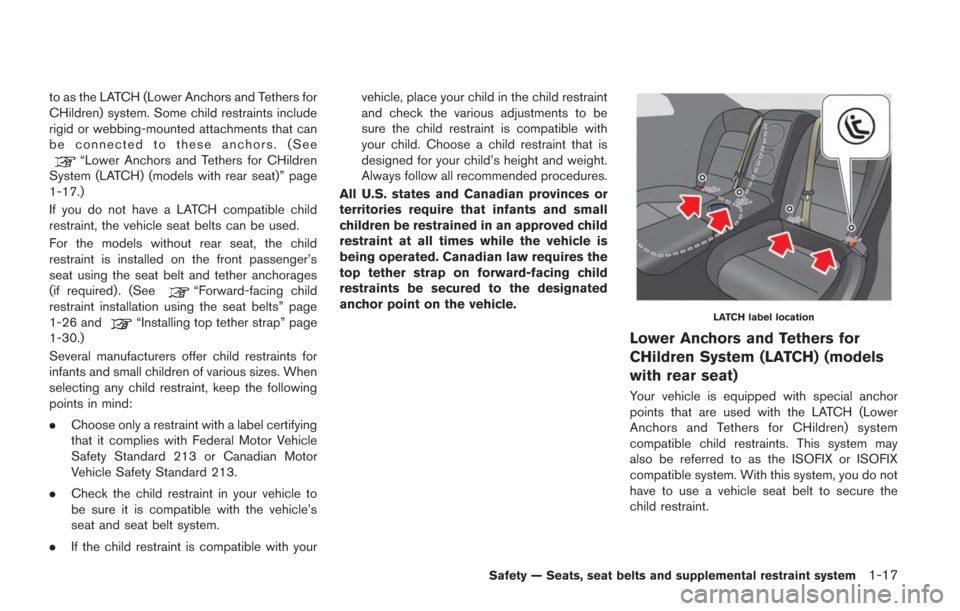
anchor point on the vehicle.LATCH label location
Lower Anchors and Tethers for
CHildren System (LATCH) (models
with rear seat)
Your vehicle is equipped with special anchor
points that are used with the LATCH (Lower
Anchors and Tethers for CHildren) system
compatible child restraints. This system may
also be referred to as the ISOFIX or ISOFIX
compatible system. With this system, you do not
have to use a vehicle seat belt to secure the
child restraint.
Safety — Seats, seat belts and supplemental restraint system1-17
Page 184 of 354
CAUTION
.Do not insert hands, clothing, tools
or other items into the engine
compartment while the engine is
running.
. Do not touch the exhaust system
parts, radiator or other hot parts
until the engine and the parts have
cooled.
NOTICE
Do not open the hood while the wiper
arms are lifted away from the wind-
shield. The hood and wipers will be
damaged.CLOSING THE HOOD
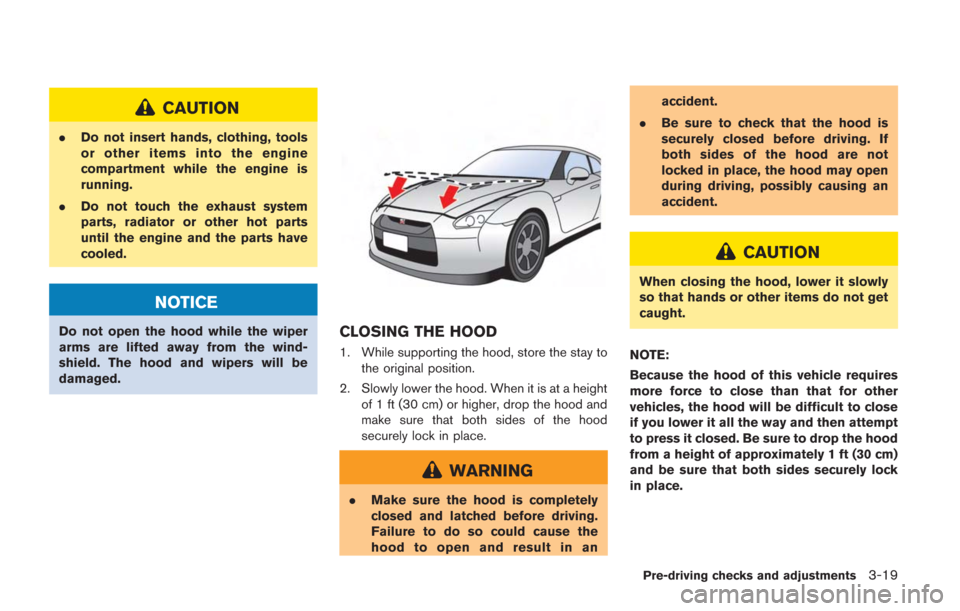
1. While supporting the hood, store the stay to
the original position.
2. Slowly lower the hood. When it is at a height of 1 ft (30 cm) or higher, drop the hood and
make sure that both sides of the hood
securely lock in place.
WARNING
. Make sure the hood is completely
closed and latched before driving.
Failure to do so could cause the
hood to open and result in an accident.
. Be sure to check that the hood is
securely closed before driving. If
both sides of the hood are not
locked in place, the hood may open
during driving, possibly causing an
accident.
CAUTION
When closing the hood, lower it slowly
so that hands or other items do not get
caught.
NOTE:
Because the hood of this vehicle requires
more force to close than that for other
vehicles, the hood will be difficult to close
if you lower it all the way and then attempt
to press it closed. Be sure to drop the hood
from a height of approximately 1 ft (30 cm)
and be sure that both sides securely lock
in place.
Pre-driving checks and adjustments3-19
Page 235 of 354
5-38Starting and driving
hill start assist will stop operating completely.
Hill start assist will not operate when the shift
lever is moved to the
&Nor&Pposition or on a
flat and level road.
NOTE:
This system does not function when the
Vehicle Dynamic Control VDC) system
warning appears on the vehicle informa-
tion display located in the tachometer.
(
“Vehicle Dynamic Control (VDC) sys-
tem warning” page 2-37)
NOTICE
Follow these recommendations to ob-
tain maximum engine performance and
ensure the future reliability and econo-
my of your new vehicle. Failure to
follow these recommendations may
result in shortened engine life and
reduced vehicle performance.
Please observe the following types of driving
until the mileage shown below has been
reached.
Until 300 miles (500 km):
. Do not depress the accelerator pedal more
than halfway and avoid rapid acceleration.
. Drive with the engine speed kept at less
than 3,500 RPM.
. Avoid unnecessary quick steering, abrupt
braking and driving on poor roads.
300 to 600 miles (500 to 1,000 km)
. Avoid rapid acceleration in a low gear (1st to
3rd gears) with the accelerator pedal fully
depressed. Depress the pedal slowly.
. Avoid unnecessary quick steering and
abrupt braking. .
Drive with the suspension setup switch in
the COMF mode to allow more suspension
stroke.
600 to 1,200 miles (1,000 to 2,000 km)
. Drive with the engine speed kept relatively
high with the shift lever in the
&Mposition.
Shifting is recommended between 1st and
4th gears.
. Avoid unnecessary quick steering and
abrupt braking.
. Drive with the suspension setup switch in
the COMF mode to allow more suspension
stroke.
Even though the mileage reaches over 1,200
miles (2,000 km) , the clutch may take longer to
properly engage if the vehicle is mainly driven in
town at a low speed. NISSAN recommends
breaking in the clutch at a GT-R certified
NISSAN dealer.
WHEEL ALIGNMENT
Do not adjust the wheel alignment until the
mileage reaches 1,000 miles (1,600 km). Until
then, the suspension may not engage enough
and the height may be higher.
However, make sure to adjust the alignment
after 1,000 miles (1,600 km) .
The wheel alignment can be adjusted by a GT-R
BREAK-IN SCHEDULE
Page 294 of 354
If the brakes do not operate properly, have the
brakes checked by a GT-R certified NISSAN
dealer.
SELF-ADJUSTING BRAKES
Your vehicle is equipped with self-adjusting
brakes.
The disc-type brakes self-adjust every time the
brake pedal is applied.
WARNING
See a GT-R certified NISSAN dealer for
a brake system check if the brake pedal
height does not return to normal.
BRAKE PAD WEAR WARNING
The disc brake pads have audible wear warn-
ings. When a brake pad requires replacement, it
will make a high pitched scraping sound when
the vehicle is in motion. This scraping sound will
first occur only when the brake pedal is
depressed. After more wear of the brake pad,
the sound will always be heard even if the brake
pedal is not depressed. Have the brakes
checked as soon as possible if the wear warning
sound is heard.
Under some driving or climate conditions,occasional brake squeak, squeal or other noise
may be heard. Occasional brake noise during
light to moderate stops is normal and does not
affect the function or performance of the brake
system.
Proper brake inspection intervals should
be followed.
For additional information, see the
maintenance log section of your NISSAN
Service and Maintenance Guide for mainte-
nance intervals.
HIGH PERFORMANCE BRAKE SYS-
TEM
This vehicle is equipped with high performance
brake pads that provide appropriate braking
force in a broad range of driving environments.
Due to the material used for the brake pads, the
road wheels may become more easily covered
by brake dust, however this does not indicate
that there is a malfunction.
The GT-R brake pads use material that contains
a lot of iron to maintain steady braking perfor-
mance even in high and low temperatures.
However, if the brake system is wet and the
parking brake is applied for a long time, the iron
in this material may get rusty and the brake pad
and disc rotor may be fixed together. This may
cause noise and vibration while driving. Before
parking the vehicle, dry the brake by driving on a dry road, especially after washing the vehicle or
driving in rain. Contact a GT-R certified NISSAN
dealer if the noise and vibration continue.
Frequent hard braking may cause scorching of
the brake pads. This will require the brake pads
to be replaced, even if the wear limit has not
been reached. Have the brake pads and disc
rotors inspected at the regular vehicle inspec-
tions.
For more details, contact a GT-R certified
NISSAN dealer.
REPLACING THE BRAKE PADS
NISSAN generally recommends to replace all
four sets of brake pads and disc rotors at the
same time to maintain maximum brake perfor-
mance.
However, replacing only the brake pads may be
allowed in some cases (four wheels or only front
wheels depending on the conditions). A GT-R
certified technician must inspect the vehicle and
determine that only the brake pads need to be
replaced. In this case, replacing all brake pads
and disc rotors as a set is not necessary.
Note that the replacement of brake pads and the
disc rotors as a set on all four wheels should be
performed when a GT-R certified technician
determines that this is the correct repair.
Maintenance and do-it-yourself8-23
BRAKES
Page 307 of 354
8-36Maintenance and do-it-yourself
filling with nitrogen for maximum
tire performance.
Summer tires:
SIZE COLD TIRE
INFLATION
PRESSURE
FRONT ORI- GINAL TIRE 255/40ZR-
F20 (97Y) 29 PSI (200
kPa)
REAR ORI-
GINAL TIRE 285/35ZR-
F20 (100Y) 29 PSI (200
kPa)
All-season tires:
SIZE
COLD TIRE
INFLATION
PRESSURE
FRONT ORI- GINAL TIRE 255/40RF20
97W 29 PSI (200
kPa)
REAR ORI-
GINAL TIRE 285/35RF20
100W 29 PSI (200
kPa)
See “Additional maintenance items” in the
“GT-R Overview” section for the tire pressure
specifications necessary for the driving condi-
tions listed in that section. (
“Wheels and
tires” page GTR-17)
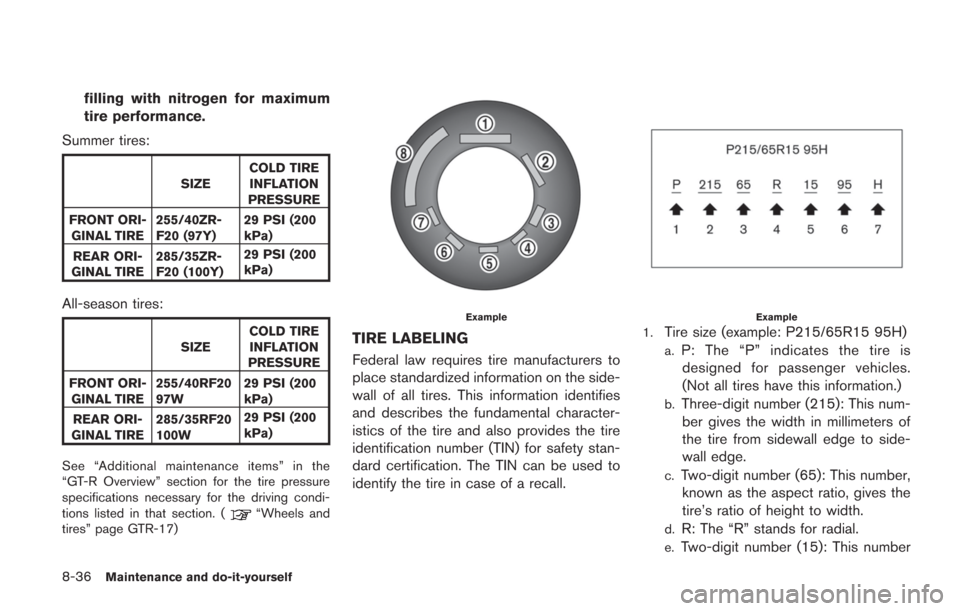
Example
TIRE LABELING
Federal law requires tire manufacturers to
place standardized information on the side-
wall of all tires. This information identifies
and describes the fundamental character-
istics of the tire and also provides the tire
identification number (TIN) for safety stan-
dard certification. The TIN can be used to
identify the tire in case of a recall.
Example
1.Tire size (example: P215/65R15 95H)
a.P: The “P” indicates the tire is designed for passenger vehicles.
(Not all tires have this information.)
b.Three-digit number (215): This num-
ber gives the width in millimeters of
the tire from sidewall edge to side-
wall edge.
c.Two-digit number (65): This number, known as the aspect ratio, gives the
tire’s ratio of height to width.
d.R: The “R” stands for radial.
e.Two-digit number (15): This number