2014 NISSAN GT-R change time
[x] Cancel search: change timePage 236 of 354
certified NISSAN dealer in accordance with
specifications for city driving to high perfor-
mance driving.
The tires on the GT-R may have different wear
rates and wear patterns in comparison to
conventional passenger vehicles. Contact a
GT-R certified NISSAN dealer to confirm that
the alignment is within specifications.Follow these easy-to-use Fuel Efficient Driving
Tips to help you achieve the most fuel economy
from your vehicle.
1. Use smooth accelerator and brake pedalapplication.
.Avoid rapid starts and stops..Use smooth, gentle accelerator and
brake application whenever possible.
.Maintain constant speed while commut-
ing and coast whenever possible.
2. Maintain constant speed.
.Look ahead to try and anticipate and
minimize stops.
.Synchronizing your speed with traffic
lights allows you to reduce your number
of stops.
.Maintaining a steady speed can minimize
red light stops and improve fuel effi-
ciency.
3. Use air conditioning (A/C) at higher vehicle speeds.
.Below 40 MPH (64 km/h), it is more
efficient to open windows to cool the
vehicle due to reduced engine load.
.Above 40 MPH (64 km/h), it is more
efficient to use A/C to cool the vehicle
due to increased aerodynamic drag.
.Recirculating the cool air in the cabin when the A/C is on reduces cooling load.
4. Drive at economical speeds and distances.
.Observing the speed limit and not
exceeding 60 MPH (97 km/h) (where
legally allowed) can improve fuel effi-
ciency due to reduced aerodynamic
drag.
.Maintaining a safe following distance
behind other vehicles reduces unneces-
sary braking.
.Safely monitoring traffic to anticipate
changes in speed permits reduced brak-
ing and smooth acceleration changes.
.Select a gear range suitable to road
conditions.
5. Use cruise control.
.Using cruise control during highway
driving helps maintain a steady speed.
.Cruise control is particularly effective in
providing fuel savings when driving on
flat terrains.
6. Plan for the shortest route.
.Utilize a map or navigation system to
determine the best route to save time.
7. Avoid idling.
.Shutting off your engine when safe for
stops exceeding 30-60 seconds saves
fuel and reduces emissions.
Starting and driving5-39
FUEL EFFICIENT DRIVING TIPS
Page 246 of 354
The Vehicle Dynamic Control (VDC) system
uses various sensors to monitor driver inputs
and vehicle motion. Under certain driving con-
ditions, the VDC system helps to perform the
following functions.
.Controls brake pressure to reduce wheel
slip on one slipping drive wheel so power is
transferred to a non slipping drive wheel on
the same axle.
. Controls brake pressure and engine output
to reduce drive wheel slip based on vehicle
speed (traction control function) .
. Controls brake pressure at individual wheels
and engine output to help the driver maintain
control of the vehicle in the following
conditions:
— understeer (vehicle tends to not follow
the steered path despite increased
steering input)
— oversteer (vehicle tends to spin due to certain road or driving conditions) .
The VDC system can help the driver to maintain
control of the vehicle, but it cannot prevent loss
of vehicle control in all driving situations.
When the VDC system operates, the VDC
warning light
in the instrument panel flashes
so note the following: .
The road may be slippery or the system may
determine some action is required to help
keep the vehicle on the steered path.
. You may feel a pulsation in the brake pedal
and hear a noise or vibration from under the
hood. This is normal and indicates that the
VDC system is working properly.
. Adjust your speed and driving to the road
conditions.
. The VDC mode can be changed using the
VDC setup switch. (
“VDC, transmis-
sion and suspension setup switches” page
5-24)
(
“Vehicle Dynamic Control (VDC) warning
light” page 2-31,“Vehicle Dynamic Con-
trol (VDC) off indicator light” page 2-32)
If a malfunction occurs in the system, the VDC
warning light
illuminates in the instrument
panel. The VDC system automatically turns off.
The VDC setup switch is used to turn off the
VDC system. The VDC off indicator
illuminates to indicate the VDC system is off.
When the VDC setup switch is used to turn off
the system, the VDC system still operates to
prevent one drive wheel from slipping by
transferring power to a non slipping drive wheel.
The VDC warning light
flashes if this
occurs. All other VDC functions are off and the VDC warning light
will not flash. The VDC
system is automatically reset to on when the
ignition switch is placed in the off position then
back to the on position.
(
“Vehicle Dynamic Control (VDC) warning
light” page 2-31,“Vehicle Dynamic Con-
trol (VDC) off indicator light” page 2-32)
The computer has a built-in diagnostic feature
that tests the system each time you start the
engine and move the vehicle forward or in
reverse at a slow speed. When the self-test
occurs, you may hear a “clunk” noise and/or feel
a pulsation in the brake pedal. This is normal and
is not an indication of a malfunction.
WARNING
. The VDC system is designed to help
the driver maintain stability but
does not prevent accidents due to
abrupt steering operation at high
speeds or by careless or dangerous
driving techniques. Reduce vehicle
speed and be especially careful
when driving and cornering on slip-
pery surfaces and always drive care-
fully.
. Do not modify the vehicle’s suspen-
sion. If suspension parts such as
Starting and driving5-49
VEHICLE DYNAMIC CONTROL (VDC)
SYSTEM
Page 276 of 354
Inside the vehicle
The maintenance items listed here should be
checked on a regular basis, such as when
performing scheduled maintenance, cleaning
the vehicle, etc.
Accelerator pedal:Check the pedal for
smooth operation and make sure the pedal
does not catch or require uneven effort. Keep
the floor mat away from the pedal.
Transmission
&Pmechanism: On a fairly
steep hill, check that your vehicle is held
securely with the shift lever in the
&Pposition
without applying any brakes.
Brake pedal: Check the pedal for smooth
operation. If the brake pedal suddenly goes
down further than normal, the pedal feels
spongy or the vehicle seems to take longer to
stop, see a GT-R certified NISSAN dealer
immediately. Keep the floor mat away from the
pedal.
Brakes: Check that the brakes do not pull the
vehicle to one side when applied.
Parking brake: Check the parking brake
operation regularly. The vehicle should be
securely held on a fairly steep hill with only the
parking brake applied. If the parking brake needs
to be adjusted, see a GT-R certified NISSAN
dealer. Seat belts:
Check that all parts of the seat belt
system (for example, buckles, anchors, adjuster
and retractors) operate properly and smoothly,
and are installed securely. Check the belt
webbing for cuts, fraying, wear or damage.
Seats: Check seat position controls such as
seat adjusters, seatback recliner, etc. to ensure
they operate smoothly and that all latches lock
securely in every position.
Steering wheel: Check for changes in the
steering conditions, such as excessive free play,
hard steering or strange noises.
Warning lights and chimes: Make sure that
all warning lights and chimes are operating
properly.
Windshield defroster: Check that the air
comes out of the defroster outlets properly and
in sufficient quantity when operating the heater
or air conditioner.
Windshield wiper and washer*: Check that
the wipers and washer operate properly and that
the wipers do not streak.
Under the hood and vehicle
The maintenance items listed here should be
checked periodically (for example, each time you
check the engine oil or refuel) . Battery*:
Check the fluid level in each cell. It
should be between the MAX and MIN lines.
Vehicles operated in high temperatures or under
severe condition require frequent checks of the
battery fluid level.
Brake fluid level*: Make sure that the brake
fluid level is between the MAX and MIN lines on
the reservoir.
Engine coolant level*: Check the coolant level
when the engine is cold.
Engine drive belts*: Make sure that no belt is
frayed, worn, cracked or oily.
Engine oil level*: Check the level after parking
the vehicle on a level spot and turning off the
engine. Wait at least 5 minutes for the oil to
drain back into the oil pan before checking the
oil.
Exhaust system: Make sure there are no loose
supports, cracks or holes. If the sound of the
exhaust seems unusual or there is a smell of
exhaust fumes in the engine compartment,
immediately have the exhaust system inspected
by a GT-R certified NISSAN dealer.
(“Exhaust gas (carbon monoxide)” page
5-3)
Fluid leaks: Check under the vehicle for fuel,
oil, water or other fluid leaks after the vehicle has
been parked for a while. Water dripping from the
Maintenance and do-it-yourself8-5
Page 303 of 354
8-32Maintenance and do-it-yourself
If you have a flat tire, see the following
section. (“Flat tire” page 6-3)
CAUTION
A GT-R certified NISSAN dealer should
perform a tire change. It will be neces-
sary to reset the tire pressure sensors.
To change the tires, contact a GT-R
certified NISSAN dealer.
Be sure to use the tires and wheels together as
a set that are designated for use with this
vehicle.
When tire replacement is required, replacing the
tires as a set of four with new tires is
recommended. However, if a tire is punctured
or damaged, it may be possible to replace only
the damaged tire. Determining whether one tire
or a complete set of tires should be replaced is
based on a number of factors including tire wear
and condition. Contact your GT-R certified
NISSAN dealer. They can recommend if an
individual tire or a complete set should be
replaced.
NOTICE
Make sure the tire valve stem cap is
installed and that the valve stem is
tight. When installing the cap, make
sure to tighten the cap by hand. If a tool
is used to tighten the cap, the cap may
be damaged.
TIRE PRESSURE
Tire Pressure Monitoring System
(TPMS)
This vehicle is equipped with the Tire Pressure
Monitoring System (TPMS) . It monitors tire
pressure of all tires. When the low tire pressure
warning light is lit, one or more of your tires is
significantly under-inflated. The system also
displays pressure of all tires on the multi function
display by sending a signal from a sensor that is
installed in each wheel.
The TPMS will activate only when the vehicle is
driven at speeds above 16 MPH (25 km/h).
Also, this system may not detect a sudden drop
in tire pressure. (
“Low tire pressure warn-
ing light” page 2-27) (“Tire Pressure
Monitoring System (TPMS)” page 5-4)
(
“Flat tire” page 6-3)
Tire inflation pressure
Check the tire pressure often and always
prior to long distance trips. The recom-
mended tire pressure specifications are
shown on the F.M.V.S.S./C.M.V.S.S. label
or the Tire and Loading Information label (if
so equipped) under the “Cold Tire Pres-
sure” heading. The Tire and Loading
Information label is affixed to the driver
side door end. Tire pressures should be
checked regularly because:
.Most tires naturally lose air over time.
.Tires can lose air suddenly when driven
over potholes or other objects or if the
vehicle strikes a curb while parking.
NOTE:
. You can check the pressure of all four
tires on the multi function display. See
the separate Multi Function Display
Owner’s Manual.
. The tires of this vehicle are filled with
nitrogen gas. When the tire pressure is
low, fill the tires with nitrogen. Contact
a GT-R certified NISSAN dealer for
information on filling the tires with
nitrogen.
WHEELS AND TIRES
Page 312 of 354
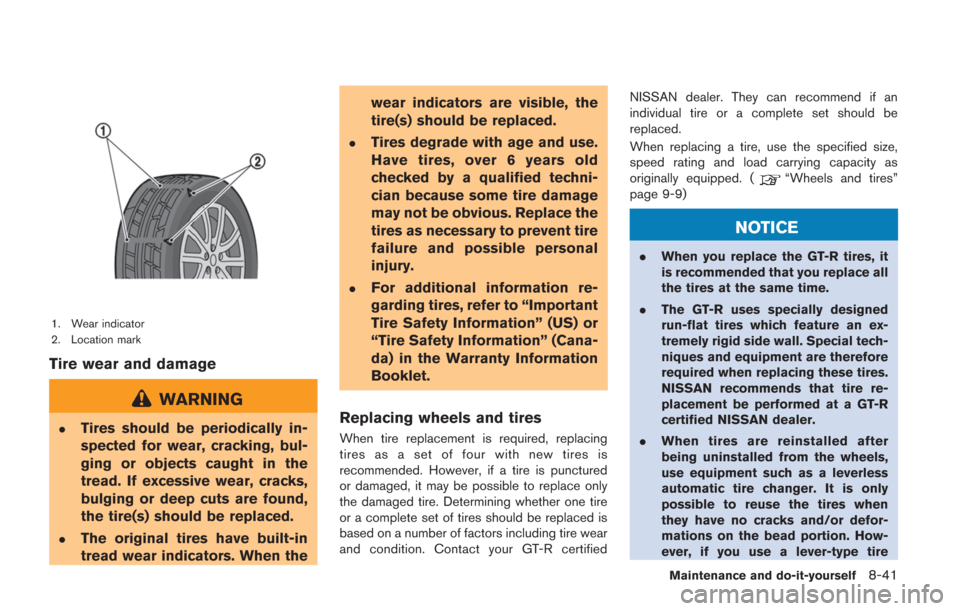
1. Wear indicator
2. Location mark
Tire wear and damage
WARNING
.Tires should be periodically in-
spected for wear, cracking, bul-
ging or objects caught in the
tread. If excessive wear, cracks,
bulging or deep cuts are found,
the tire(s) should be replaced.
.The original tires have built-in
tread wear indicators. When thewear indicators are visible, the
tire(s) should be replaced.
.Tires degrade with age and use.
Have tires, over 6 years old
checked by a qualified techni-
cian because some tire damage
may not be obvious. Replace the
tires as necessary to prevent tire
failure and possible personal
injury.
.For additional information re-
garding tires, refer to “Important
Tire Safety Information” (US) or
“Tire Safety Information” (Cana-
da) in the Warranty Information
Booklet.
Replacing wheels and tires
When tire replacement is required, replacing
tires as a set of four with new tires is
recommended. However, if a tire is punctured
or damaged, it may be possible to replace only
the damaged tire. Determining whether one tire
or a complete set of tires should be replaced is
based on a number of factors including tire wear
and condition. Contact your GT-R certified NISSAN dealer. They can recommend if an
individual tire or a complete set should be
replaced.
When replacing a tire, use the specified size,
speed rating and load carrying capacity as
originally equipped. (
“Wheels and tires”
page 9-9)
NOTICE
. When you replace the GT-R tires, it
is recommended that you replace all
the tires at the same time.
. The GT-R uses specially designed
run-flat tires which feature an ex-
tremely rigid side wall. Special tech-
niques and equipment are therefore
required when replacing these tires.
NISSAN recommends that tire re-
placement be performed at a GT-R
certified NISSAN dealer.
. When tires are reinstalled after
being uninstalled from the wheels,
use equipment such as a leverless
automatic tire changer. It is only
possible to reuse the tires when
they have no cracks and/or defor-
mations on the bead portion. How-
ever, if you use a lever-type tire
Maintenance and do-it-yourself8-41
Page 324 of 354
fuels may cause vehicle performance problems
and/or fuel system damage.
.The fuel should be unleaded and have
an octane rating no lower than that
recommended for unleaded gasoline.
. If an oxygenate-blend, excepting a
methanol blend, is used, it should
contain no more than 10% oxygenate.
(MTBE may, however, be added up to
15%.)
. E-15 fuel contains more than 10%
oxygenate. E-15 fuel will adversely
affect the emission control devices
and systems of the vehicle and should
not be used. Damage caused by such
fuel is not covered under the NISSAN
new vehicle limited warranty.
. If a methanol blend is used, it should
contain no more than 5% methanol
(methyl alcohol and wood alcohol) . It
should also contain a suitable amount
of appropriate cosolvents and corro-
sion inhibitors. If not properly formu-
lated with the appropriate cosolvents
and corrosion inhibitors, such metha-
nol blends may cause fuel system
damage and/or vehicle performance
malfunctions. At this time, sufficient data is not available to ensure that all
methanol blends are suitable for use in
NISSAN vehicles.
If any undesirable driveability problems such as
engine stalling or hard hot starting are experi-
enced after using oxygenate-blend fuels, im-
mediately change to a non-oxygenate fuel or a
fuel with a low blend of MTBE.
NOTICE
Take care not to spill gasoline during
refueling. Gasoline containing oxyge-
nates can cause paint damage.
E-15 fuel
E-15 fuel is a mixture of approximately 15% fuel
ethanol and 85% unleaded gasoline. E-15 can
only be used in vehicles designed to run on E-
15 fuel. Do not use E-15 in your vehicle. U.S.
government regulations require fuel ethanol
dispensing pumps to be identified with small,
square, orange and black label with the common
abbreviation or the appropriate percentage for
that region.
E-85 fuel
E-85 fuel is a mixture of approximately 85% fuel
ethanol and 15% unleaded gasoline. E-85 can
only be used in a Flexible Fuel Vehicle (FFV) . Do
not use E-85 fuel in your vehicle. U.S. govern-
ment regulations require fuel ethanol dispensing
pumps to be identified by a small, square,
orange and black label with the common
abbreviation or the appropriate percentage for
that region.
Aftermarket fuel additives
NOTICE
NISSAN does not recommend the use
of any aftermarket fuel additives (Ex-
ample: fuel injector cleaner, intake
valve deposit removers, etc.) which are
sold commercially. Many of these ad-
ditives intended for gum, varnish or
deposit removal may contain active
solvent or similar ingredients that can
be harmful to the fuel system and
engine.
Technical and consumer information9-5
Page 325 of 354
9-6Technical and consumer information
Octane rating tips
Using unleaded gasoline with an octane
rating lower than recommended above can
cause persistent, heavy spark knock.
(Spark knock is a metallic rapping noise.)
If severe, this can lead to engine damage.
If you detect a persistent heavy spark
knock even when using gasoline of the
stated octane rating, or if you hear steady
spark knock while holding a steady speed
on level roads, have a GT-R certified
NISSAN dealer correct the condition. Fail-
ure to correct the condition is misuse of
the vehicle, for which NISSAN is not
responsible.
Incorrect ignition timing will result in knocking,
after-run or overheating. This in turn may cause
excessive fuel consumption or damage to the
engine. If any of the above symptoms are
encountered, have your vehicle checked at a
GT-R certified NISSAN dealer or other compe-
tent service facility.
However, now and then you may notice
light spark knock for a short time while
accelerating or driving up hills. This is no
cause for concern, because you get the
greatest fuel benefit when there is light
spark knock for a short time under heavy
engine load.
ENGINE OIL AND OIL FILTER RE-
COMMENDATION
Selecting the correct oil
It is essential to choose the correct grade,
quality, and viscosity engine oil to ensure
satisfactory engine life and performance.
(
“Capacities and recommended fuel/lubri-
cants” page 9-2)
Mobil 1 (0W-40) (100% synthetic) is the factory
fill oil. The VR38 engine with its plasma-sprayed
bores was developed using this oil. NISSAN
cannot ensure proper engine operation and
durability if other 0W-40 synthetic oil is used.
If Mobil 1 (0W-40) is not available, Mobil 1
(10W-40) (100% synthetic) may be used;
however, some performance loss may be
noticed.
NOTICE
Using an engine oil other than that
specified could adversely affect the
engine. See the 2014 NISSAN GT-R
Warranty Information Booklet for de-
tails and exclusions.
Oil additives
NISSAN does not recommend the use of oil
additives. The use of an oil additive is not
necessary when the proper oil type is used and
maintenance intervals are followed.
Oil which may contain foreign matter or has
been previously used should not be used.
Oil viscosity
The engine oil viscosity or thickness changes
with temperature. Because of this, it is important
that the engine oil viscosity be selected based
on the temperatures at which the vehicle will be
operated before the next oil change. Choosing
an oil viscosity other than that recommended
could cause serious engine damage.
Selecting the correct oil filter
Your new vehicle is equipped with a high-quality
genuine NISSAN oil filter. NISSAN recommends
to use the genuine NISSAN oil filter for the
reason described in change intervals.
Change intervals
The oil and oil filter change intervals for your
engine are based on the use of the specified
quality oils and filters. Oil and filter other than the
specified quality, or oil and filter change intervals
longer than recommended could reduce engine