2014 MITSUBISHI OUTLANDER Motor oil
[x] Cancel search: Motor oilPage 313 of 451

Trailer towing
Driving safety 6-13
6
Choose a proper hitch and ball, and make sure it is installed at a height that is compati- ble with the trailer.Use a good equalizing hitch which uniformly distributes the trailer tongue load throughout the frame. A safety chain must al
ways be used between
the towing vehicle and the trailer. Leave suf- ficient slack in the chain for turns. The chain
should cross under the trailer tongue to pre- vent the tongue from dropping to the groundin case it becomes damaged or separated. For correct safety chai
n procedures, consult
your authorized Mitsub
ishi Motors dealer.
Your vehicle will need service more often when you’re towing a trailer. Refer to “WAR- RANTY AND MAINTENANCE MAN-UAL”. Especially important in trailer operation are manual transaxle oil, automatic transaxle fluid, engine oi
l, rear axle oil, belt,
cooling system and brake system. Each of these is covered in this manual. For details, please refer to the “Vehicle careand maintenance” section. Check periodically to se
e that all hitch nuts
and bolts are tight.
Mitsubishi Motors recommends that any trailer having a total we
ight of 1,250 lbs (567
kg) or more (2400 models), 1,400 lbs (635kg) or more (3000 mode
ls) be equipped with
its own electric or surge-type brakes. If you choose electric br
akes, be sure they are
electrically actuated. Do not attempt to tap into your vehicle’s hydraulic system. No mat- ter how successful it
may seem, any attempt
to attach trailer brakes to your vehicle’s hydraulic system will lower braking effec- tiveness and create a potential hazard. Trailer lights and equipment must comply with federal, state,
and local regulations.
Check with your local
recreational vehicle
dealer for the requirements in your area, and use only equipment designed for your vehi-cle. Since lighting and wiring vary by trailer type and brand, you should have a qualified tech- nician install a suitable
connector between the
vehicle and the trailer. Improper equipment or installation can cause
damage to your vehi-
Trailer hitches
WA R N I N GIf you make any holes in the body of your vehicle for installing
a trailer hitch, be
sure to seal the holes later when you remove the hitch. If
you don’t seal them,
deadly carbon monoxide (CO) from your exhaust can enter your vehicle. Refer to “Exhaust system” on page 9-24.NOTE
Mitsubishi Motors recommends that sway control be used whenever you are towing, to improve towing stability. For further informati
on, please contact your
authorized Mitsubish
i Motors dealer.
Safety chains
CAUTIONNever tow a trailer wi
thout using a safety
chain securely attached to both the trailer and the vehicle. If the
coupling unit or hitch
ball experiences a probl
em, the trailer may
separate from
your vehicle.
Maintenance when trailer tow- ing
Trailer brakes Trailer lights
BK0200500US.book 13 ページ 2013年2月12日 火曜日 午前9時46分
Page 391 of 451
Engine oil and oil filter
Vehicle care and maintenance 9-7
9
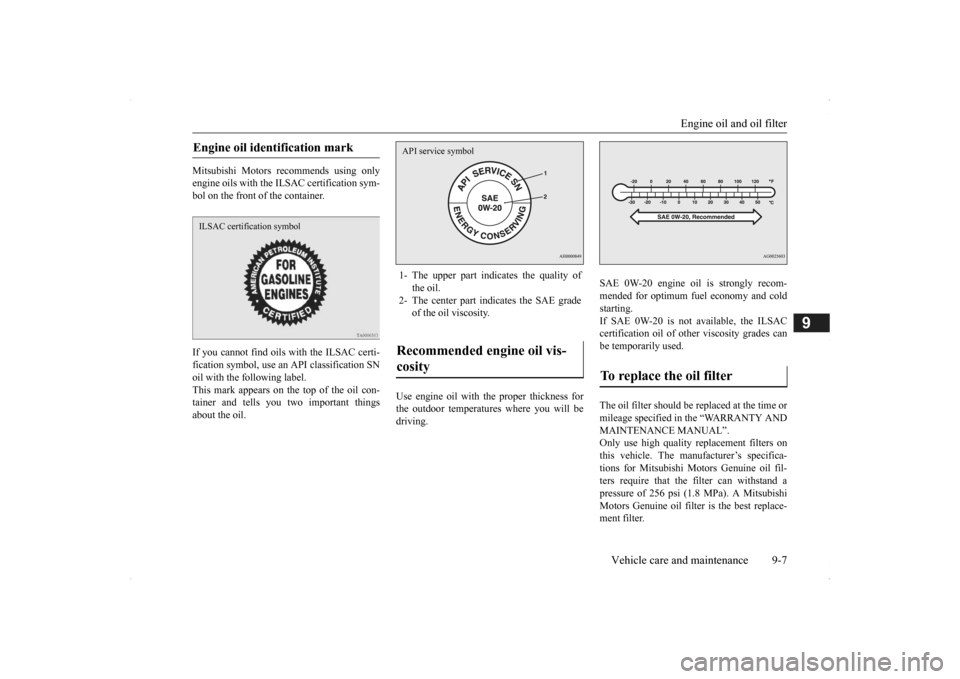
Mitsubishi Motors re
commends using only
engine oils with the ILSAC certification sym- bol on the front of the container. If you cannot find oils
with the ILSAC certi-
fication symbol, use an
API classification SN
oil with the following label. This mark appears on the top of the oil con-tainer and tells you two important things about the oil.
Use engine oil with the proper thickness for the outdoor temperatures where you will bedriving.
SAE 0W-20 engine oil is strongly recom- mended for optimum fuel economy and coldstarting. If SAE 0W-20 is not available, the ILSAC certification oil of othe
r viscosity grades can
be temporarily used. The oil filter should be replaced at the time or mileage specified in the “WARRANTY AND MAINTENANCE MANUAL”. Only use high quality replacement filters onthis vehicle. The manufacturer’s specifica- tions for Mitsubishi Mo
tors Genuine oil fil-
ters require that the
filter can withstand a
pressure of 256 psi (1.8 MPa). A Mitsubishi Motors Genuine oil filter is the best replace- ment filter.
Engine oil identification mark ILSAC certification symbol
1- The upper part indi
cates the quality of
the oil.
2- The center part i
ndicates the SAE grade
of the oil viscosity.
Recommended engine oil vis- cosity API service symbol
To replace the oil filter
BK0200500US.book 7 ページ 2013年2月12日 火曜日 午前9時46分
Page 393 of 451

Air cleaner filter
Vehicle care and maintenance 9-9
9
The radiator cap must be sealed tight to pre- vent losing coolant, which may result in engine damage. Only use a Mitsubishi Motors Genuine Parts radiator cap, or anapproved equivalent. Do not overfill the reserve tank.
Your vehicle uses a
special radiator cap
that stays sealed and lets the coolant flowfrom the reserve tank back to the radiator when the engine cools down. If you need to change the cap, use the exact samekind. Check the coolant freeze point in the radi- ator with the proper gauge, and only whenit is safe. If you add antifreeze, the con- tents of the reserve ta
nk must be protected
against freezing. Keep the front of the radiator and con- denser clean. If the engine coolan
t temperature does not
rise after the engine
is warmed-up, take
your vehicle to an au
thorized Mitsubishi
Motors dealer or a repair facility of your choice to have the thermostat checked, and replaced if necessary.
N00937901410
The air cleaner filter
will get dirty and dusty
from use and not filter
properly. Replace it
with a new filter using the schedule in the “WARRANTY AND MAINTENANCE MANUAL”.
1. For 2.4 L models, remove the two clips (A), then remove the Air duct (B). 2. For 2.4 L models,
while holding down the
tab (C), pull out the connector (D).
Do not top off the tank with plain water only. Water by itself boils at
a lower temperature
and does not stop rust or freezing. If thewater freezes, it will
damage your cooling
system. Do not use ta
pwater. It can cause
corrosion and rust.
Radiator cap
WA R N I N G Wait for the engine to cool down before opening the radiator
cap. Otherwise hot
steam or boiling c
oolant could spray up
from the radiator and scald you.
Points to remember
CAUTION
Air cleaner filter
BK0200500US.book 9 ページ 2013年2月12日 火曜日 午前9時46分
Page 395 of 451

Continuously variable transmission (CVT) fluid (if so equipped)
Vehicle care and maintenance 9-11
9
1. With the brake pedal fully depressed and the engine idling,
select each gear
momentarily, ending with the selectorlever in the “P” (PARK) position. 2. The fluid level should be at the HOT mark, but never a
bove the HOT mark
when the engine is warmed up. Add or drain fluid to get to the correct level. 3. Make certain that the dipstick cap is installed properly to
keep dirt and water
out of the transaxle.
Use only “Mitsubishi Motors Genuine ATF- J3” transaxle fluid to
ensure optimum trans-
axle performance. Mitsubishi Motors Cor
poration does not rec-
ommend the addition of
any fluid additives to
the transaxle.
N00938100076
The continuously variable transmission (CVT) should be maintained and serviced byan authorized Mitsubishi Motors dealer or a repair facility of your choice to obtain the best performance and longest life. It is impor-tant that the transmission fluid is kept at the correct level.
Use only “Mitsubish
i Motors Genuine
CVTF-J4” transmission fluid to ensure opti- mum transmission performance. Do not use any fluid additives to the trans- mission.
N00938401281
Whenever the transfer oil level is checked,add oil as necessary to
maintain the proper
level. Fill with the oil according to the table below.
Procedure for checking the fluid level
WA R N I N G Transaxle fluid is extremely flammable and poisonous. Do not spill fluid when adding or draining.
Good (Hot)
Fluid type
CAUTION Using the improper transaxle fluid may dam- age the transaxle.
Special additives
Continuously variable transmission (CVT) fluid
(if
so equipped)
Fluid type
Special additives
Transfer oil (All-wheel drive models) Fluid type Lubricant
Mitsubishi Motors Genuine Super Hypoid Gear Oil API
classification GL-5
Viscosity range
SAE 80
BK0200500US.book 11 ページ 2013年2月12日 火曜日 午前9時46分
Page 396 of 451

Rear axle oil (All-wheel drive models) 9-12 Vehicle care and maintenance
9
N00915201279
Whenever the oil level is checked, add oil as necessary to maintain the proper level. Fill with the oil according to the table below.
N00938601313
The windshield and rear
window washer fluid
reservoir is in the engine compartment.
Check the washer fluid
level at regular inter-
vals and add washer fluid to reservoir if nec-essary. Open the reservoir cap and check the fluid level with the dipstick. When freezing weather is anticipated, flush out the water in the reservoir by operating thepump. Fill the reservoir with windshield anti- freeze (not radiator
antifreeze), and operate
the system for a few se
conds to flush out the
residual water.
N00938701271
Check the fluid level in the reservoir.The fluid level must be between the “MAX” and “MIN” marks on the reservoir.
The fluid level falls slightly with wear of the brake pads, but this
does not indicate any
abnormality. If the fluid level falls se
aled tight in a short
length of time, it indi
cates leaks from the
brake system. If this occurs, have the vehicle checked by an authorized Mitsubishi Motors dealer or arepair facility of your choice. Use the recommended brake fluid conform- ing to DOT 3 or DOT
4. The reservoir cap
must be tightly sealed to keep dirt and water out.
Rear axle oil (All-wheel drive models) Fluid type Lubricant
Mitsubishi Motors Genuine Super Hypoid Gear Oil API
classification GL-5
Viscosity range
SAE 80
Washer fluid
Brake fluid To check the fluid level
EMPTY
FULL
Fluid type
BK0200500US.book 12 ページ 2013年2月12日 火曜日 午前9時46分
Page 403 of 451

Tires
Vehicle care and maintenance 9-19
9
Keep your tires inflated to the recom- mended pressures. (See the tire and load-ing information placard attached to the driver’s door sill.) Stay within the recommended load limits. Make sure that the weight of any load in your vehicle is evenly distributed. Drive at safe speeds. After filling your tires to the correct pres- sure, check them for damage and air leaks. Be sure to reinstall the caps on the valve stems.
N00939600241
N00939700141
The following maintenance steps are recom- mended: Check tire pressures regularly. Have regular maintenance done on the wheel balance and front
and rear suspen-
sion alignment. Rotate your tires regularly as described in the “Tire rotation” se
ction on page 9-20.
N00939800184
Tread wear indicators ar
e built into the origi-
nal equipment tires on
your vehicle to help
you know when your tires should be replaced. Many states have la
ws requiring that you
replace your tires at this point.These indicators are molded into the bottom of the tread grooves and will appear when the tire tread is worn down to 1/16 inch (1.6mm). When the bands appear next to one another in two or more places
, replace your tires.
Replacing tires and wheels
CAUTIONAvoid using different size tires from the one listed and the combined use of different types of tires, as this can affect driving safety.Refer to “Tires and wheels” on page 11-7. On all-wheel drive vehi
cles, always use tires
of the same size, same
type, and same brand,
and which have no wear differences. Using tires that differ in si
ze, type, brand or the
degree of wear, will increase the differential oil temperature, resulting in possible damage to the driving system. Further, the drive trainwill be subjected to ex
cessive loading, possi-
bly leading to oil leakage, component sei- zure, or other serious problems.
Only Mitsubishi Motors Authorized wheels should be used, beca
use your vehicle is
equipped with a tire pr
essure monitoring sys-
tem. Use of another type of
wheel risks air leaks
and sensor damage, as
it will not be possible
to install the tire pressure sensor properly.
Tire maintenance
CAUTION
Tread wear indicator 1- Location of the tread wear indicator 2- Tread wear indicator
NOTE
Tire wear indicators ca
n have different marks
and locations dependi
ng on the tire manufac-
turer.
BK0200500US.book 19 ページ 2013年2月12日 火曜日 午前9時46分
Page 411 of 451

Fuses
Vehicle care and maintenance 9-27
9
Engine compartment fuse location table No.
Sym- bol
Electrical sys-
tem
Capacity
SBF1
Air condition- ing condenser fan motor
30 A*
SBF2 Starter 30 A*Behind the fuse block cover
SBF3
Air condition- ing condenser fan motor
30 A*
SBF4
Radiator fan
motor
40 A*
SBF5
Anti-lock brak- ing system
40 A*
SBF6 VLC 40 A* SBF7
Anti-lock brak- ing system
30 A*
BF1 Power liftgate 30 A BF2
Audio system amplifier
30 A
BF3 IOD IOD 30 A BF4 Diesel 30 A F1
Automatic transaxle
20 A
F2 Wiper de-icer 15A F3 — — — F4
Daytime run- ning lights
10 A
F5 Front fog lights 15 A F6 Air conditioner 10 ANo.
Sym- bol
Electrical sys-
tem
Capacity
F7
Headlight washer
20 A
F8 Security horn 20 A F9 Horn 10 AF10 ETV 15 A F11 Alternator 7.5 A F12 Engine 7.5 A F13
ENG/POWER 20 A Fuel line heater 25 A
F14 Fuel pump 15 A F15 Ignition coil 10 A F16 ENG/POWER 10 A F17
Headlight (high beam) (left)
10 A
F18
Headlight (high beam) (right)
10 A
F19
Head- light (low beam) (left)
Dis- charge
20 A
No.
Sym- bol
Electrical sys-
tem
Capacity
BK0200500US.book 27 ページ 2013年2月12日 火曜日 午前9時46分
Page 413 of 451

Replacement of light bulbs
Vehicle care and maintenance 9-29
9
3. Clamp it on the fuse you wish to remove, and pull the fuse straight out from the fuseblock. 4. Use the fuse location diagrams and the matching tables, to check the fuse that isrelated to the problem. If the fuse is not blown, something else must be causing the problem. Have the system inspectedby your authorized Mitsubishi Motors dealer or a repair facility of your choice.
5. Insert a new fuse
of the same capacity
securely into the appropriate slot.
N00942901359
Before replacing the bulb, be sure the light is off. Do not touch the glass part of the new bulb with your bare fingers; the oil from your skin will stay on the glass and dim or destroythe bulb when it gets hot.
B- Fuse is OK
C- Blown fuseCAUTION Never use a fuse with a capacity greater than the one listed or any s
ubstitute, such as wire,
foil etc. This would
cause the circuit wiring
to heat up and could cause a fire. If the replacement fuse blows again after a short time, have the electrical system checked by an authorized Mitsubishi Motors dealer or a repair faci
lity of your choice to
find and correct
the cause.
Replacement of light bulbs
CAUTIONBulbs are extremely hot immediately after being turned off.When replacing the bulb, wait for it to cool sufficiently before
touching it. You could
otherwise be burned.
Handle halogen light bul
b with care. The gas
inside a halogen light
bulb is highly pressur-
ized, so dropping, knocki
ng, or scratching a
halogen light bulb can
cause it to shatter.
Never hold the halogen
light bulb with a bare
hand, dirty glove, etc. The oil from your hand could cause the bulb to break the next time the headlights areused. If the glass surface is dirty, clean it with alcohol and let it dry completely beforeinstalling the bulb.NOTE
If you are unsure of how to carry out the work as required, it is recommended that these procedures be carried out by an autho- rized Mitsubishi Motors dealer or a repairfacility of your choice. Be careful not to scratch the vehicle body when removing a light and lens.CAUTION
BK0200500US.book 29 ページ 2013年2月12日 火曜日 午前9時46分