Page 264 of 460

4-6 Driving safety
4Safe driving techniques
N00629200137
Even this vehicle’s safety equipment, and your safest driving,
cannot guarantee that you can avoid an accident or injury.
However, if you give extra attention to the following areas, you
can better protect yourself and your passengers:
�Drive defensively. Be aware of traffic, road and weather
conditions. Leave plenty of stopping distance between
your vehicle and the vehicle ahead.
�Before changing lanes, check your mirrors, your blind
spots, and use your turn-signal light.
�While driving, watch the behavior of other drivers, bicy-
clists, and pedestrians.
�Always obey applicable laws and regulations. Be a polite
and alert driver. Always leave room for unexpected
events, such as sudden braking.
�If you plan to drive in another country, obey their vehicle
registration laws and make sure you will be able to get the
right fuel.
Driving during cold weather
N00629400474
�Check the battery. At the same time, check the terminals
and wiring. During extremely cold weather, the battery
will not be as strong. Also, the battery power level may
drop because more power is used for cold starting and
driving.
Before driving the vehicle, check to see if the engine runs
at the proper speed and if the headlights are as bright as
normally. Charge or replace the battery if necessary. Dur-
ing extreme cold weather, it is possible that a very low
battery could freeze.
�Warm the engine sufficiently. After starting the engine,
allow a short warm-up time to distribute oil to all cylin-
ders. Then drive your vehicle slowly.
�Stay at low speeds at first so that the manual transaxle oil
or the automatic transaxle fluid has time to spread to all
the lubrication points.
�Manual transaxle can be harder to shift in cold weather
conditions. This is normal and shifting will get easier as
the transaxle warms up.
WA R N I N G
!�The battery gives off explosive hydrogen gas. Any
spark or flame can cause the battery to explode,
which could cause serious injury or death.
Always wear protective clothes and a face mask
when working with your battery, or let a skilled
mechanic do it.
BK0162600US.book 6 ページ 2013年3月22日 金曜日 午後2時41分
Page 417 of 460
Vehicle care and maintenance
7-43
7 Replacement of light bulbs
N00942900349
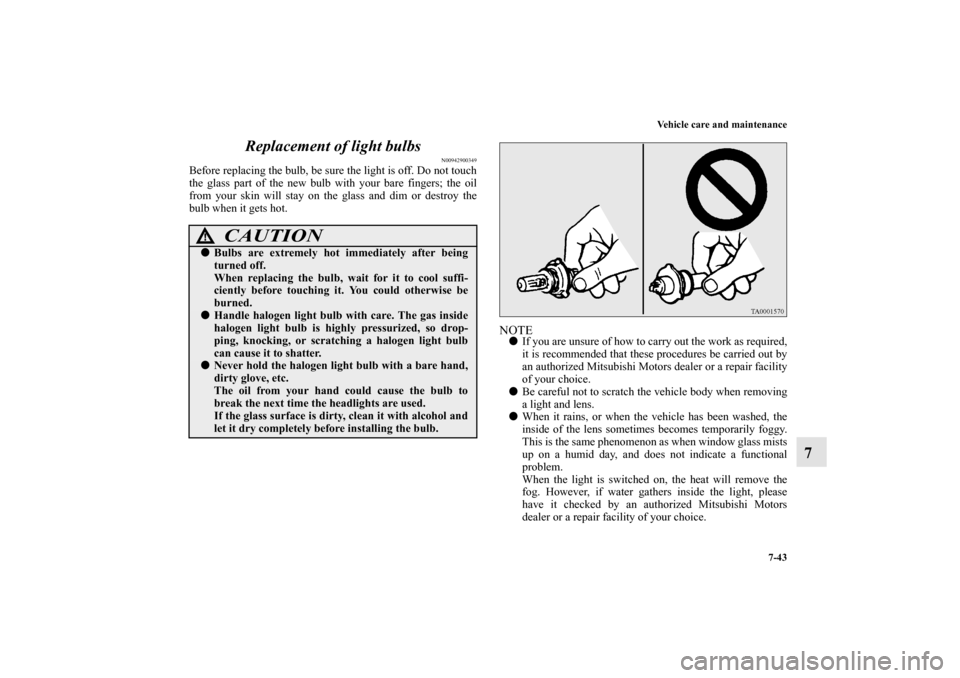
Before replacing the bulb, be sure the light is off. Do not touch
the glass part of the new bulb with your bare fingers; the oil
from your skin will stay on the glass and dim or destroy the
bulb when it gets hot.
NOTE�If you are unsure of how to carry out the work as required,
it is recommended that these procedures be carried out by
an authorized Mitsubishi Motors dealer or a repair facility
of your choice.
�Be careful not to scratch the vehicle body when removing
a light and lens.
�When it rains, or when the vehicle has been washed, the
inside of the lens sometimes becomes temporarily foggy.
This is the same phenomenon as when window glass mists
up on a humid day, and does not indicate a functional
problem.
When the light is switched on, the heat will remove the
fog. However, if water gathers inside the light, please
have it checked by an authorized Mitsubishi Motors
dealer or a repair facility of your choice.
CAUTION
!�Bulbs are extremely hot immediately after being
turned off.
When replacing the bulb, wait for it to cool suffi-
ciently before touching it. You could otherwise be
burned.�Handle halogen light bulb with care. The gas inside
halogen light bulb is highly pressurized, so drop-
ping, knocking, or scratching a halogen light bulb
can cause it to shatter.�Never hold the halogen light bulb with a bare hand,
dirty glove, etc.
The oil from your hand could cause the bulb to
break the next time the headlights are used.
If the glass surface is dirty, clean it with alcohol and
let it dry completely before installing the bulb.
BK0162600US.book 43 ページ 2013年3月22日 金曜日 午後2時41分
Page 420 of 460
7-46 Vehicle care and maintenance
7
Headlights/Daytime running lights
(if so equipped)
N00901800121
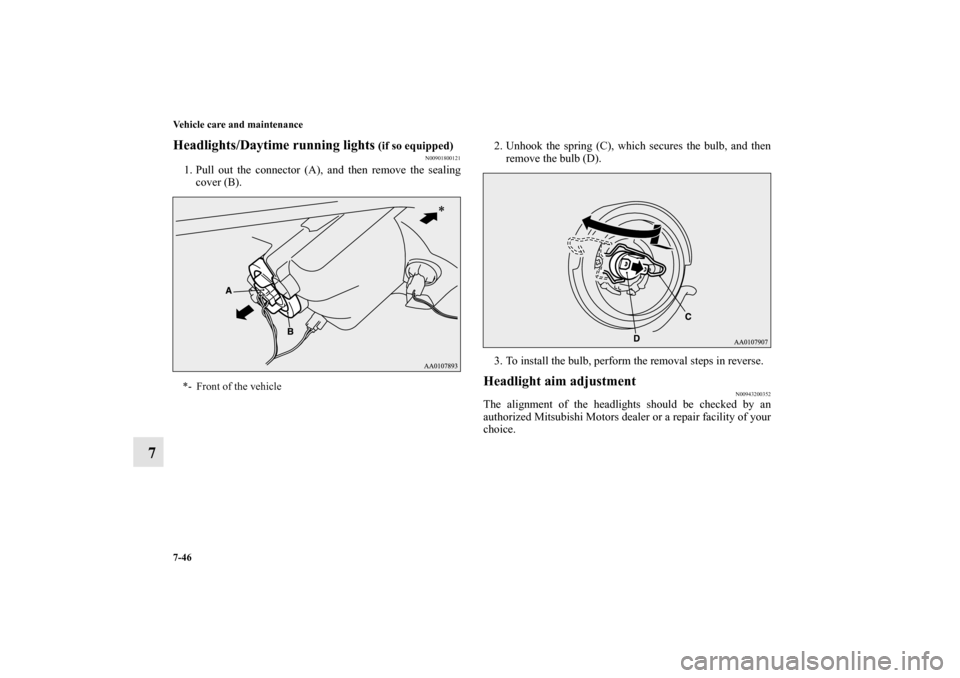
1. Pull out the connector (A), and then remove the sealing
cover (B).2. Unhook the spring (C), which secures the bulb, and then
remove the bulb (D).
3. To install the bulb, perform the removal steps in reverse.
Headlight aim adjustment
N00943200352
The alignment of the headlights should be checked by an
authorized Mitsubishi Motors dealer or a repair facility of your
choice.
*- Front of the vehicle
BK0162600US.book 46 ページ 2013年3月22日 金曜日 午後2時41分
Page 455 of 460

Alphabetical index
3
F
Floor mat 4-3
Fluid
Brake fluid 9-9
Continuously variable transmission (CVT) fluid 7-15
,9-9
Engine coolant 7-11
,9-9
Manual transaxle 9-9
Washer fluid 7-15
,9-9
Fluid capacities and lubricants 9-9
Free-hand advanced security transmitter (F.A.S.T.-key) 3-13
Front fog lights
Bulb capacity 7-44
Indicators 3-110
Replacement 7-50
Switch 3-120
Front seat adjustment 2-3
Front side-marker lights
Bulb capacity 7-44
Replacement 7-47
Front turn signal light
Bulb capacity 7-44
Replacement 7-48
Fuel
Filling the fuel tank 1-4
Fuel economy 4-2
Fuel hoses 7-31
Fuel remaining warning display 3-103
Fuel selection 1-2Tank capacity 9-9
Fuel remaining display 3-102
Fuses 7-36
Fusible links 7-35
G
General maintenance
Maintenance 7-33
General vehicle data 9-5
Genuine parts 1-9
Glove compartment 3-165
H
Hazard warning flasher switch 3-119
Hazard warning lights 3-110
Head restraints 2-11
Headlights
Bulb capacity 7-44
Dimmer 3-117
Headlight flasher 3-118
Switch 3-114
Heater without air conditioning function 5-6
High beam indicator 3-110
High coolant temperature warning light 3-113
High-mounted stop light
Bulb capacity 7-44
Hill start assist 3-69
Hood lock release mechanism and safety catch 7-34
Hook
BK0162600US.book 3 ページ 2013年3月22日 金曜日 午後2時41分
Page:
< prev 1-8 9-16 17-24