Page 346 of 460

6-6 For emergencies
6
5. If you do not see steam or spray coming from under the
hood, leave the engine on until the high coolant tempera-
ture warning light goes off. After the high coolant temper-
ature warning light has gone off, you can start driving
again. If the high coolant temperature warning light stays
on, turn off the engine.
6. When you do not see any more steam or spray, open the
hood. Look for obvious leaks, such as a split radiator
hose. Be careful as components will be hot. Any leak
source must be repaired.
7. If there is no obvious leak source, check the coolant level
in the engine coolant reserve tank. If there is none, or if it
is too low, slowly add coolant.8. If the engine coolant reserve tank needs coolant, you will
probably also need to add coolant to the radiator. Do not
loosen or remove the radiator cap until the engine has
cooled down.
9. Start the engine, and slowly add coolant, up to the bottom
of the filler neck. Use plain water if you have to (and
replace it with the right coolant as soon as possible).
10. Replace the radiator cap and tighten it fully. Check the
coolant temperature warning light. You can start driving
again when the high coolant temperature warning light
does not come on.
11. Have the system inspected by your authorized Mitsubishi
Motors dealer or a repair facility of your choice.
WA R N I N G
!�Before raising the engine hood, check to see if there
is steam or spray coming from under the hood.
Steam or spray coming from an overheated engine
could seriously scald you.
Do not open the hood until there is no steam or
spray.
WA R N I N G
!�Removing the radiator cap could scald you with
escaping hot water or steam. When checking the
radiator level, cover the cap with a cloth before try-
ing to remove it. Turn it slowly counterclockwise,
without pressing down, to the first notch. The pres-
sure in the system will then be let out. When the
pressure is COMPLETELY LET OUT, press down
and keep turning the cap counterclockwise until it
comes off.
BK0162600US.book 6 ページ 2013年3月22日 金曜日 午後2時41分
Page 352 of 460
6-12 For emergencies
6
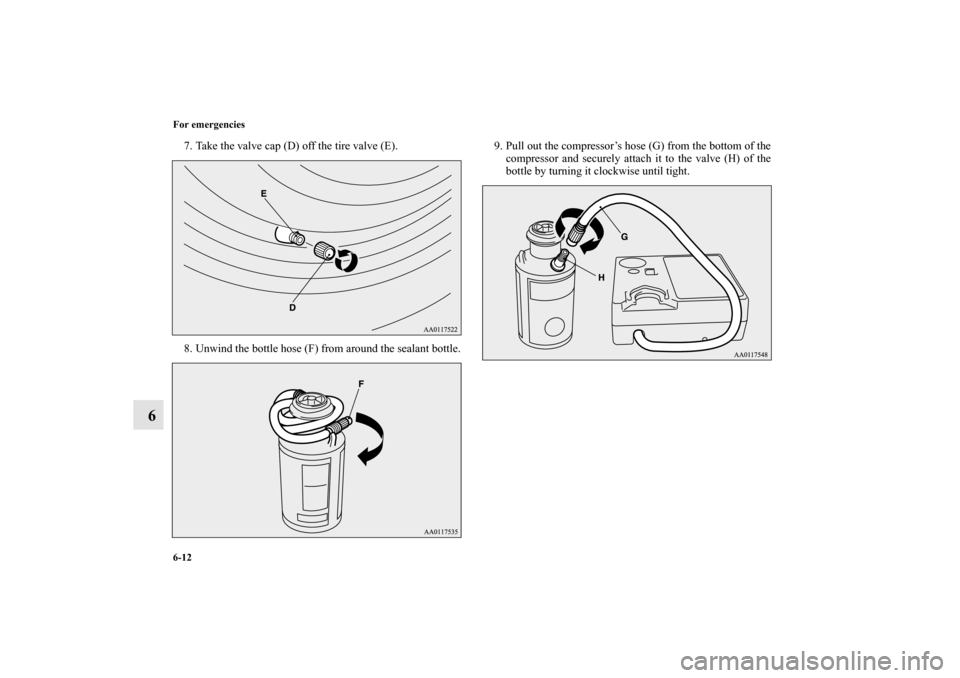
7. Take the valve cap (D) off the tire valve (E).
8. Unwind the bottle hose (F) from around the sealant bottle.9. Pull out the compressor’s hose (G) from the bottom of the
compressor and securely attach it to the valve (H) of the
bottle by turning it clockwise until tight.
BK0162600US.book 12 ページ 2013年3月22日 金曜日 午後2時41分
Page 358 of 460

6-18 For emergencies
6How to change a tire (Vehicles equipped
with spare tire)
N00836900819
Before changing a tire, first stop your vehicle in a safe, flat
location.
1. Park the vehicle on level and stable ground.
2. Set the parking brake firmly.
3. On vehicles equipped with manual transaxle, stop the
engine and move the gearshift lever to the “R” (Reverse)
position.
On vehicles equipped with continuously variable trans-
mission (CVT), move the selector lever to the “P”
(PARK) position, and stop the engine.
4. Turn on the hazard flashers and set up a warning triangle,
flashing signal light, etc., at an adequate distance from the
vehicle, and have all your passengers exit the vehicle.5. To prevent the vehicle from rolling when it is raised on the
jack, place chocks or blocks (A) at the tire that is diago-
nally opposite from the tire (B) you are changing.
WA R N I N G
!�The jack should not be used for any purpose other
than to change a tire.�Never get under the vehicle or put any portion of
your body under the vehicle while it is supported by
the jack.
BK0162600US.book 18 ページ 2013年3月22日 金曜日 午後2時41分
Page 359 of 460

For emergencies
6-19
6
NOTE�The chocks shown in the illustration do not come with
your vehicle. It is recommended that you purchase chocks
or blocks and keep them in the vehicle for use if needed.
�If chocks or blocks are not available, use stones or any
other objects that are large enough to hold the wheel in
position.
6. Get the jack, bar and wheel nut wrench ready.
(Refer to “Jack and tools” on page 6-7.)
Spare tire information
N00849600344
Compact spare tireThe compact spare tire is stowed beneath the floor board of the
cargo area. It is designed to save space in the cargo area. Its
lighter weight makes it easier to use if a flat tire occurs.
WA R N I N G
!�Be sure to apply chocks or blocks to the correct tire
when jacking up the vehicle. If the vehicle moves
while jacked up, the jack could slip out of position,
leading to an accident.
WA R N I N G
!�Tires, including spare tire, degrade over time with
age even when they are not being used. It is recom-
mended that tires over 6 years generally be replaced
even if damage is not obvious.
CAUTION
!�While the compact spare tire is stowed, the inflation
pressure should be checked at least once a month to
assure that it remains at the recommended inflation
pressure. See the tire and loading information plac-
ard attached to the driver’s door sill. Refer to “Tire
and loading information placard” on page 9-4.�Driving with an improperly inflated tire can cause
an accident. If you have no choice but to drive with
an under-inflated tire, keep your speed down and
avoid sudden steering or braking, if possible. Inflate
the tire to the correct pressure as soon as possible.
Refer to “Tire inflation pressures” on page 7-23.
BK0162600US.book 19 ページ 2013年3月22日 金曜日 午後2時41分
Page 360 of 460

6-20 For emergencies
6
To remove spare tire
N00849700286
1. Lift up the floor board of the cargo area.
2. To remove the spare tire, remove the installation clamp
(A) by turning it counterclockwise.NOTE�The flat tire with a normal size wheel cannot be stored
beneath the floor board. Store the flat tire in the cargo
area.
�The compact spare tire should be used only tempo-
rarily. While the compact spare tire is being used,
the tire pressure monitoring system will not function
properly. Have the tire replaced or repaired at an
authorized Mitsubishi Motors dealer or a repair
facility of your choice as soon as possible.�Do not go over 50 mph (80 km/h) when driving with
the compact spare tire.�Avoid sudden starting and braking when driving
with the compact spare tire.�Do not drive through automatic car washes and over
obstacles that could possibly damage the underside
of your vehicle. Because the compact spare tire is
smaller than the original tire, there is less clearance
between the ground and your vehicle.�Because the compact spare tire is designed only for
your vehicle, do not use it on any other vehicle.�Do not put the compact spare tire on a different
wheel, and do not put standard tires, snow tires,
wheel covers or trim rings on the compact spare
wheel. Otherwise, you could damage these parts or
other parts on your vehicle.�Do not use tire chains with your compact spare tire.
Using a chain could cause damage to your vehicle
and loss of the chains.
CAUTION
!
BK0162600US.book 20 ページ 2013年3月22日 金曜日 午後2時41分
Page 365 of 460
For emergencies
6-25
6
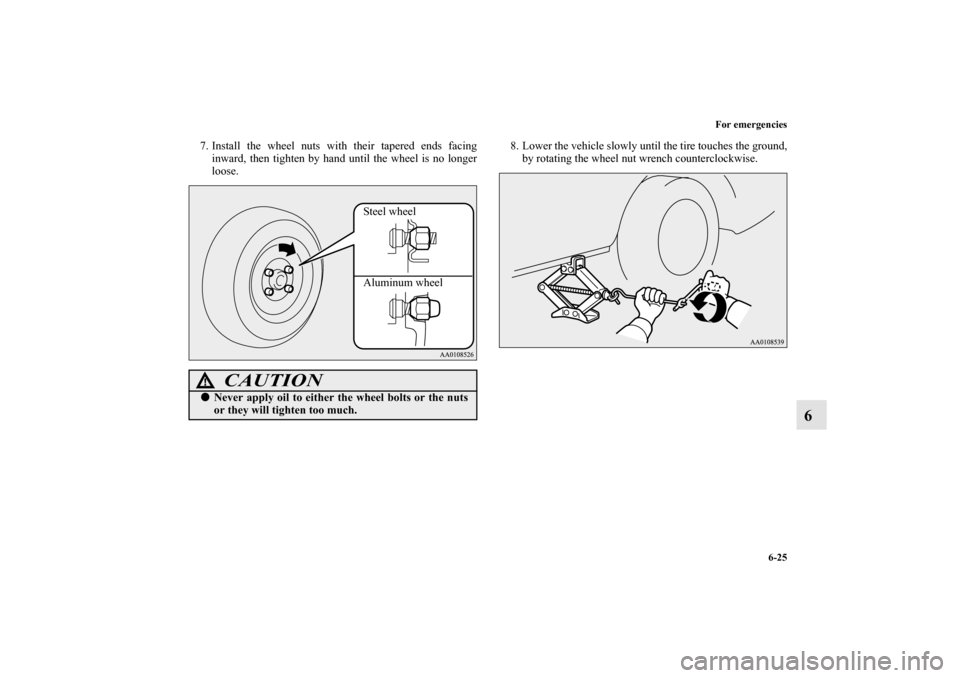
7. Install the wheel nuts with their tapered ends facing
inward, then tighten by hand until the wheel is no longer
loose.8. Lower the vehicle slowly until the tire touches the ground,
by rotating the wheel nut wrench counterclockwise.
CAUTION
!�Never apply oil to either the wheel bolts or the nuts
or they will tighten too much.
Steel wheel
Aluminum wheel
BK0162600US.book 25 ページ 2013年3月22日 金曜日 午後2時41分
Page 373 of 460

For emergencies
6-33
6
On snowy or icy roads�When driving on a road covered with snow or ice, use
snow tires. Tire chains cannot be used on your vehicle.
There may be state or local regulations about using snow
tires. Always check the regulations in your local area
before using them. Refer to “Snow tires” on page 7-28
and “Tire chains” on page 7-28.
�Drive slowly. Do not make sudden starts or stops, sharp
turns, or slam on the brakes.
�Allow extra distance between your vehicle and the vehicle
in front of you, and avoid sudden braking.
�If a skid occurs when the accelerator pedal is depressed,
take your foot off the pedal. Steer gently in the direction
of the skid.
�Your vehicle is equipped with an anti-lock braking system
(ABS). Hold the brake pedal down firmly and keep it
depressed. Do not pump the brake pedal which will result
in reduced braking performance.
�After parking on snowy or icy roads, it may be difficult to
move your vehicle due to the brake being frozen. Depress
the accelerator pedal little by little to move the vehicle
when safe to do so.
On a bumpy or rutted road�Drive as slow as possible when driving on bumpy, rutted
roads or over potholes etc.
CAUTION
!�Do not depress the accelerator pedal rapidly. The
vehicle could start moving when it breaks free from
the ice, possibly resulting in an accident.
CAUTION
!�Driving on bumpy, rutted roads or over potholes can
damage the tires and wheels.
Wheels with low-profiles tires or under-inflated tires
are especially at risk for damage.�The vehicle’s body, bumper, muffler and other parts
may be damaged if the vehicle is:
• driven over a step (for example, at the entrance or
exit of a parking lot);
• parked too closely against a curb or parking block,
or by the side of a road with curbstones;
• driven on a steep slope.
BK0162600US.book 33 ページ 2013年3月22日 金曜日 午後2時41分
Page 379 of 460
Vehicle care and maintenance
7-5
7 Engine hood
N00937500552
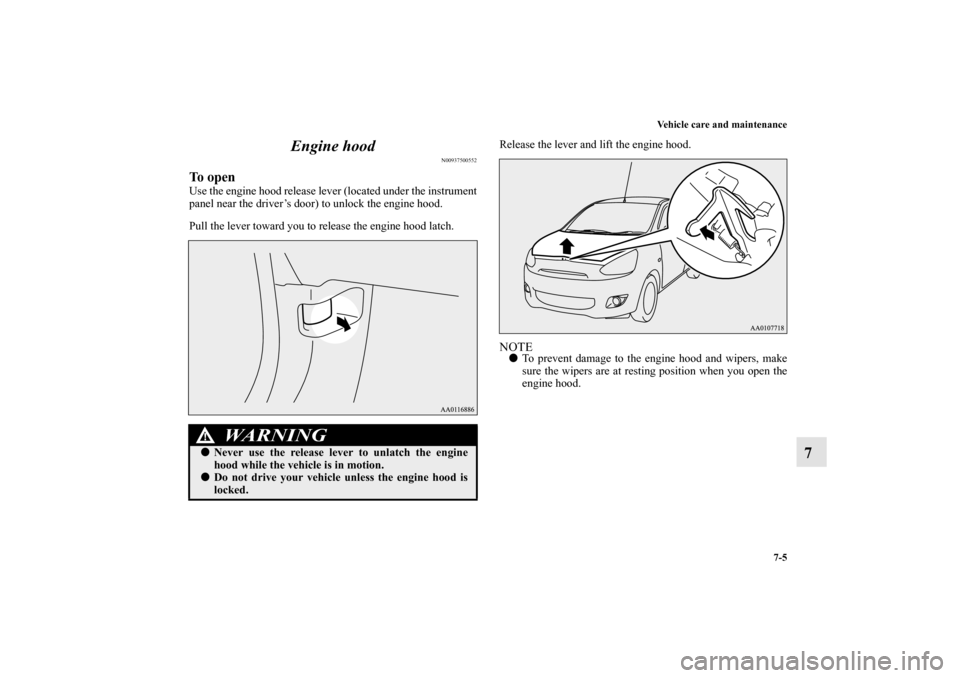
To openUse the engine hood release lever (located under the instrument
panel near the driver’s door) to unlock the engine hood.
Pull the lever toward you to release the engine hood latch.Release the lever and lift the engine hood.
NOTE�To prevent damage to the engine hood and wipers, make
sure the wipers are at resting position when you open the
engine hood.
WA R N I N G
!�Never use the release lever to unlatch the engine
hood while the vehicle is in motion.�Do not drive your vehicle unless the engine hood is
locked.
BK0162600US.book 5 ページ 2013年3月22日 金曜日 午後2時41分