2014 MITSUBISHI LANCER EVOLUTION belt
[x] Cancel search: beltPage 40 of 338
Child restraint systems
Seat and restraint systems 4-15
4
N00418800102
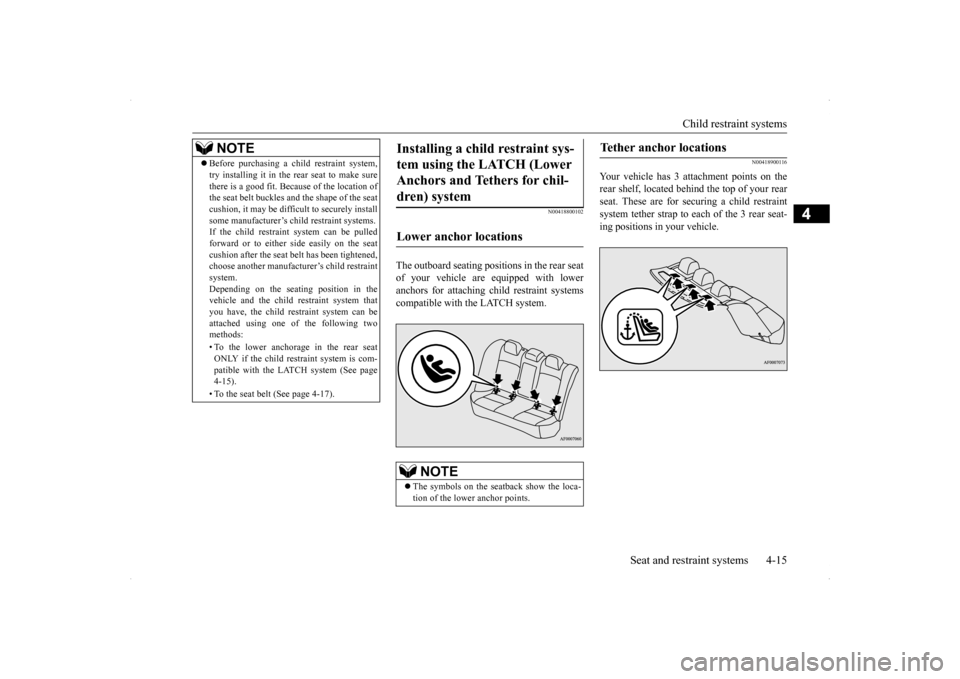
The outboard seating positions in the rear seat of your vehicle are equipped with loweranchors for attaching child restraint systemscompatible with the LATCH system.
N00418900116
Your vehicle has 3 attachment points on therear shelf, located behind the top of your rearseat. These are for securing a child restraint system tether strap to
each of the 3 rear seat-
ing positions in your vehicle.
NOTE
Before purchasing a child restraint system, try installing it in the
rear seat to make sure
there is a good fit. Because of the location of the seat belt buckles and the shape of the seat cushion, it may be difficult to securely installsome manufacturer’s child restraint systems. If the child restraint system can be pulled forward or to either side easily on the seatcushion after the seat belt has been tightened, choose another manufacturer’s child restraint system.Depending on the seating position in the vehicle and the child restraint system that you have, the child restraint system can beattached using one of the following two methods: • To the lower anchorage in the rear seat ONLY if the child restraint system is com- patible with the LATCH system (See page4-15). • To the seat belt (See page 4-17).
Installing a child restraint sys- tem using the LATCH (Lower Anchors and Tethers for chil- dren) system Lower anchor locations
NOTE
The symbols on the seatback show the loca- tion of the lower anchor points.
Tether anchor locations
BK0200800US.bo
ok 15 ページ 2013年2月14日 木曜日 午後2時28分
Page 41 of 338
Child restraint systems 4-16 Seat and restraint systems
4
N00419000172 N00419100160
1. In order to securely fasten the tether strap, remove the head restraint from the loca- tion where you wish to install the childrestraint system.
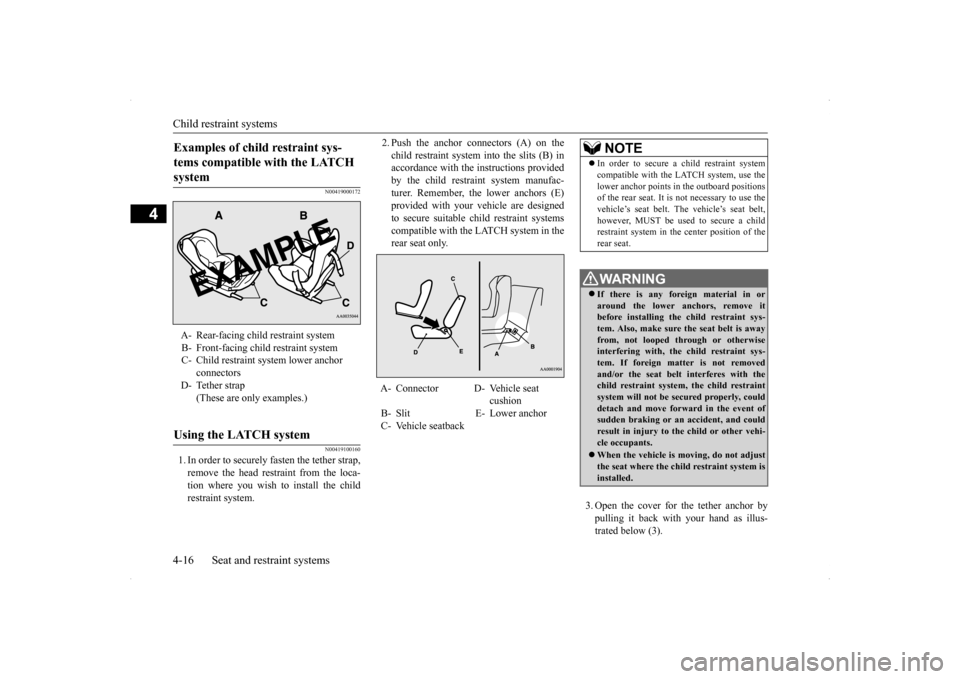
2. Push the anchor connectors (A) on the child restraint system into the slits (B) in accordance with the instructions provided by the child restraint system manufac-turer. Remember, the lower anchors (E) provided with your vehicle are designed to secure suitable child restraint systemscompatible with the LATCH system in the rear seat only.
3. Open the cover for the tether anchor by pulling it back with your hand as illus-trated below (3).
Examples of child restraint sys- tems compatible with the LATCH system A- Rear-facing child restraint system B- Front-facing child restraint systemC- Child restraint system lower anchor
connectors
D- Tether strap
(These are only examples.)
Using the LATCH system
A- Connector D- Vehicle seat
cushion
B- Slit E- Lower anchorC- Vehicle seatback
NOTE
In order to secure a child restraint system compatible with the LATCH system, use the lower anchor points in the outboard positions of the rear seat. It is not necessary to use the vehicle’s seat belt. The vehicle’s seat belt,however, MUST be used to secure a child restraint system in the center position of the rear seat.WA R N I N G If there is any foreign material in or around the lower anchors, remove it before installing the child restraint sys-tem. Also, make sure the seat belt is away from, not looped through or otherwise interfering with, the child restraint sys-tem. If foreign matter is not removed and/or the seat belt interferes with the child restraint system, the child restraintsystem will not be secured properly, could detach and move forward in the event of sudden braking or an accident, and couldresult in injury to the child or other vehi- cle occupants. When the vehicle is moving, do not adjust the seat where the child restraint system isinstalled.
BK0200800US.bo
ok 16 ページ 2013年2月14日 木曜日 午後2時28分
Page 42 of 338
Child restraint systems
Seat and restraint systems 4-17
4
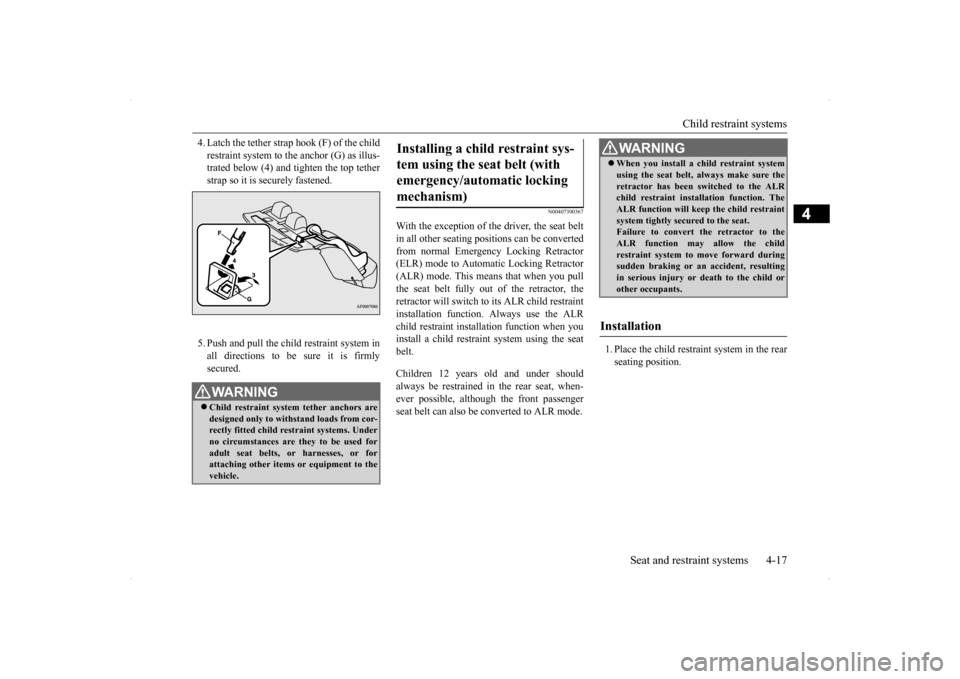
4. Latch the tether strap hook (F) of the child restraint system to the anchor (G) as illus- trated below (4) and tighten the top tether strap so it is securely fastened. 5. Push and pull the ch
ild restraint system in
all directions to be sure it is firmlysecured.
N00407300367
With the exception of the driver, the seat beltin all other seating positions can be convertedfrom normal Emergency Locking Retractor (ELR) mode to Automatic Locking Retractor (ALR) mode. This means that when you pullthe seat belt fully out of the retractor, theretractor will switch to its ALR child restraint installation function. Always use the ALR child restraint installa
tion function when you
install a child restraint system using the seat belt. Children 12 years old and under should always be restrained in the rear seat, when-ever possible, although the front passenger seat belt can also be converted to ALR mode.
1. Place the child restraint system in the rear seating position.
WA R N I N G Child restraint system tether anchors are designed only to withstand loads from cor-rectly fitted child restraint systems. Under no circumstances are they to be used for adult seat belts, or harnesses, or forattaching other items or equipment to the vehicle.
Installing a child restraint sys- tem using the seat belt (with emergency/automatic locking mechanism)
WA R N I N G When you install a child restraint system using the seat belt, always make sure the retractor has been switched to the ALR child restraint installation function. The ALR function will keep the child restraintsystem tightly secured to the seat. Failure to convert the retractor to the ALR function may allow the childrestraint system to move forward during sudden braking or an accident, resulting in serious injury or death to the child orother occupants.
Installation
BK0200800US.bo
ok 17 ページ 2013年2月14日 木曜日 午後2時28分
Page 43 of 338
Child restraint systems 4-18 Seat and restraint systems
4
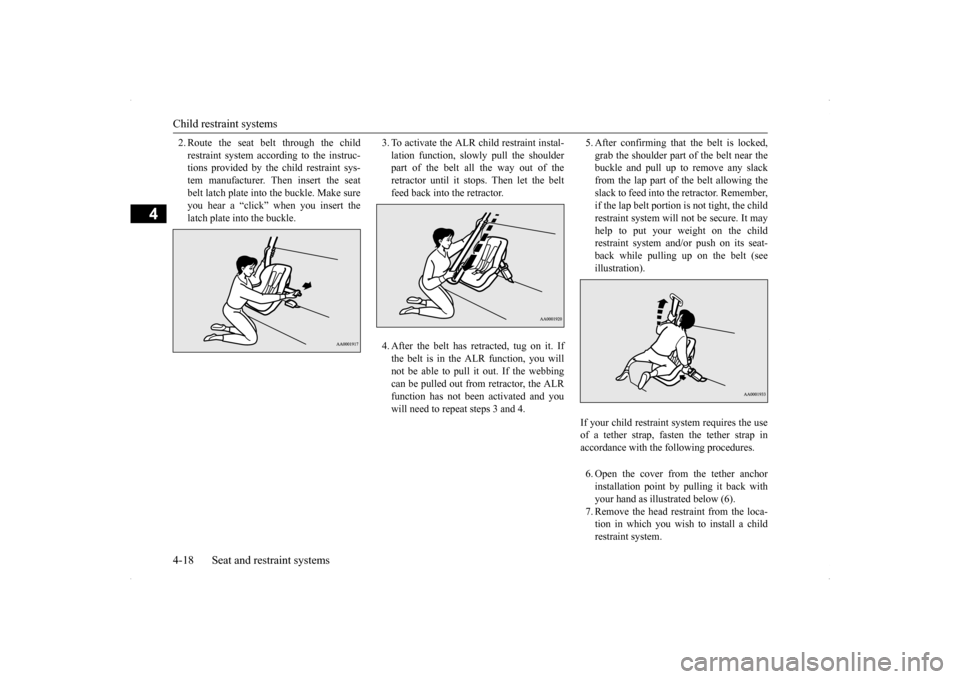
2. Route the seat belt through the child restraint system according to the instruc- tions provided by the child restraint sys- tem manufacturer. Then insert the seatbelt latch plate into the buckle. Make sure you hear a “click” when you insert the latch plate into the buckle.
3. To activate the ALR child restraint instal- lation function, slow
ly pull the shoulder
part of the belt all the way out of the retractor until it stops. Then let the beltfeed back into the retractor. 4. After the belt has retracted, tug on it. If the belt is in the ALR function, you willnot be able to pull it out. If the webbing can be pulled out from retractor, the ALR function has not been activated and youwill need to repeat steps 3 and 4.
5. After confirming that the belt is locked, grab the shoulder part of the belt near the buckle and pull up to remove any slack from the lap part of the belt allowing theslack to feed into the retractor. Remember, if the lap belt portion is not tight, the child restraint system will not be secure. It mayhelp to put your weight on the child restraint system and/or push on its seat- back while pulling up on the belt (seeillustration). 6. Open the cover from the tether anchor installation point by pulling it back with your hand as illustrated below (6).7. Remove the head restraint from the loca- tion in which you wish to install a child restraint system.
If your child restraint system requires the use of a tether strap, fasten the tether strap in accordance with the following procedures.
BK0200800US.bo
ok 18 ページ 2013年2月14日 木曜日 午後2時28分
Page 44 of 338

Maintenance and inspection of seat belts
Seat and restraint systems 4-19
4
8. Latch the tether strap hook (A) of the child restraint system to the tether anchor (B) as illustrated below (8) and tighten the top tether strap so it is securely fastened. 9. Before putting your child in the restraint, push and pull the restraint in all directions to be sure it is firmly secured. Do this before each use. If the child restraint sys-tem is not firmly secure, repeat steps 1 through 8.
10. To remove a child restraint system from
the vehicle and deactivate the ALR mode, remove the child from the restraint. Unlatch the buckle. Then remove the beltfrom the restraint and let the belt fully retract.
N00407600575
Children who have outgrown a child restraintsystem should be seated in the rear seat and wear the seat belt. If the shoulder belt crossestheir face or neck, and/or the lap belt crosses their stomach, a commercially available booster seat (including a booster cushion)must be used, to raise the child so that the shoulder belt crosses their shoulder and the lap belt remains positioned low across theirhips. The booster seat (including a booster cushion) should fit the vehicle seat and have a label certifying compliance with FederalMotor Vehicle Safety Standards or Motor Vehicle Restraint Systems and Booster Cush- ions Safety Regulations.
N00407000221
The seat belt webbing may be cleaned withmild soap or detergent solution. Do not use anorganic solvent. Allow the belts to dry in the shade. Do not allow them to retract until com- pletely dry. Do not attempt to bleach or re-dye the belts. The color may rub off and the webbing strength may be affected.
WA R N I N G Child restraint system tether anchors are designed only to withstand loads from cor-rectly fitted child restraint systems. Under no circumstances are they to be used for adult seat belts, or harnesses, or forattaching other items or equipment to the vehicle.
Children who have outgrown child restraint systems
WA R N I N G Any child who is too small to properly wear a seat belt must be properly restrained in an appropriate child restraint system, to reduce their risk of serious injury or death in an accident. A child should never be left unattended in, or unsupervised, around your vehicle.When you leave the vehicle, always take the child out as well. Children can die from he
at stroke if left or
trapped inside the vehicle, especially on hot days. Keep your vehicle locked and the trunk lid closed when not in use. Keep your vehiclekeys away from children. Never allow children to play in the trunk of your vehicle.
Maintenance and inspection of seat belts
BK0200800US.bo
ok 19 ページ 2013年2月14日 木曜日 午後2時28分
Page 45 of 338

Supplemental Restraint System (SRS) - airbag 4-20 Seat and restraint systems
4
Regularly check your seat belt buckles and their release mechanisms for positive engage- ment and release of the latch plate. Check the retractors for automatic locking when in theAutomatic Locking Retractor function. The entire seat belt assembly should be replaced if the webbing shows any obvious cuts, tears, increase in thickness in any sec-tion of the webbing from broken fibers, or severe fading from sunlight. All of these con- ditions indicate a weakening of the belt,which may adversely affect seat belt perfor-mance in an accident.
N00407701746
This vehicle is equipped with a SupplementalRestraint System (SRS), which includes air-bags for the driver and passengers.
The SRS front airbags are designed to supple- ment the primary protection of the driver and front passenger seat belt systems by provid- ing those occupants with protection againsthead and chest injuries in certain moderate to severe frontal collisions. The SRS front airbags, together with sensorsat the front of the vehicle and sensors attached to the front seats, form an advanced airbag system. The SRS driver’s knee airbag is designed to supplement the primary protection of thedriver’s seat belt system. It can reduce the forward movement of the driver’s lower legs and provide increased overall body protectionin certain moderate to severe frontal colli- sions. The SRS side airbags and the curtain airbags are also designed to supplement the seat belts.The SRS side airbags provide the driver and front passenger with protection against chest injuries by deploying the bag on the sideimpacted in moderate to severe side impact collisions. The SRS curtain airbags provide the driver and passengers on the front seatand rear outboard seat with protection against head injuries by deploying a bag on the side impacted in moderate to severe side impactcollisions.
The SRS airbags are NOT
a substitute for use
of the seat belts. For maximum protection in all types of accidents, seat belts must ALWAYS be worn by everyone who drives orrides in this vehicle (with infants and small children in an appropriate child restraint sys- tem in the rear seat, and older children buck-led in the rear seat). Refer to “Child restraint systems” on page 4-12.
WA R N I N G Do not attempt to repair or replace any part of the seat belt assemblies. This work should be done by an authorized Mitsubishi Motors dealer. Failure to havean authorized Mitsubishi Motors dealer perform the work could reduce the effec- tiveness of the belts and could result in aserious injury or death in an accident.
Supplemental Restraint Sys- tem (SRS) - airbag
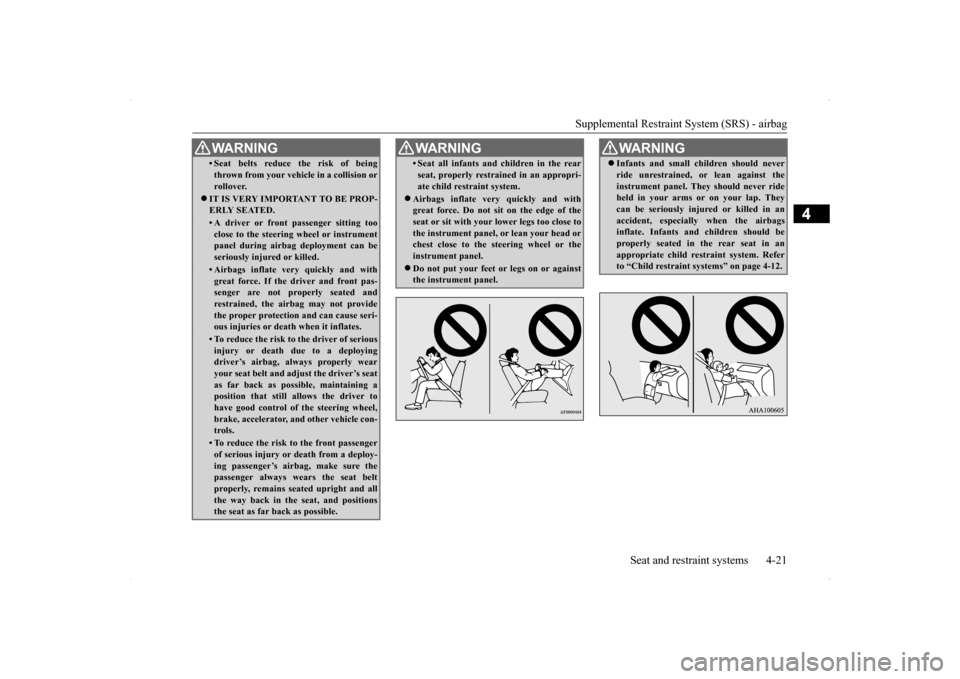
WA R N I N G IT IS VERY IMPORTANT TO ALWAYS WEAR YOUR SEAT BELT PROPERLY EVEN WITH AN AIRBAG.• Seat belts help keep the driver and pas-sengers properly positioned. This reduces the risk of injury in all collisions,and reduces the risk of serious injuries or death when the airbags inflate. During sudden braking just before a col-lision, an unrestrained or improperly restrained driver or passengers can move forward into direct contact with, orwithin close proximity to, the airbag when it begins to inflate. The beginning stage of airbag inflation isthe most forceful and can cause serious injuries or death if the occupant comes in contact with the airbag at this time. • Seat belts reduce the risk of injury inrollovers, rear impact collisions, and in lower-speed frontal collisions, because the airbags are not designed to inflate inthose situations.
BK0200800US.bo
ok 20 ページ 2013年2月14日 木曜日 午後2時28分
Page 46 of 338
Supplemental Restraint System (SRS) - airbag
Seat and restraint systems 4-21
4
• Seat belts reduce the risk of being thrown from your vehicle in a collision or rollover.
IT IS VERY IMPORTANT TO BE PROP- ERLY SEATED.• A driver or front passenger sitting tooclose to the steering wheel or instrument panel during airbag deployment can be seriously injured or killed.• Airbags inflate very quickly and withgreat force. If the driver and front pas-senger are not properly seated and restrained, the airbag may not provide the proper protection and can cause seri-ous injuries or death when it inflates.• To reduce the risk to the driver of seriousinjury or death due to a deploying driver’s airbag, always properly wear your seat belt and adjust the driver’s seatas far back as possible, maintaining a position that still allows the driver to have good control of the steering wheel,brake, accelerator, and other vehicle con- trols.• To reduce the risk to the front passengerof serious injury or death from a deploy- ing passenger’s airbag, make sure the passenger always wears the seat belt properly, remains seated upright and allthe way back in the seat, and positions the seat as far back as possible. WA R N I N G
• Seat all infants and children in the rearseat, properly restrained in an appropri- ate child restraint system.
Airbags inflate very quickly and with great force. Do not sit on the edge of the seat or sit with your lower legs too close to the instrument panel, or lean your head orchest close to the steering wheel or the instrument panel. Do not put your feet or legs on or against the instrument panel.WA R N I N G
WA R N I N G Infants and small children should never ride unrestrained, or lean against the instrument panel. They should never ride held in your arms or on your lap. They can be seriously injured or killed in anaccident, especially when the airbags inflate. Infants and children should be properly seated in the rear seat in anappropriate child restraint system. Refer to “Child restraint systems” on page 4-12.
BK0200800US.bo
ok 21 ページ 2013年2月14日 木曜日 午後2時28分
Page 47 of 338

Supplemental Restraint System (SRS) - airbag 4-22 Seat and restraint systems
4
N00407800519
The SRS includes the following components:
WA R N I N G NEVER put REAR-FACING CHILD RESTRAINT SYSTEMS or INFANT RESTRAINT SYSTEMS in the front pas- senger seat. This places the infant too close to the passenger airbag. Duringdeployment of the airbag, the infant can be seriously injured or killed. Rear-facing child restraint systems orinfant restraint systems must only be used in the rear seat.Airbag
WA R N I N G FRONT-FACING CHILD RESTRAINT SYSTEMS should be used in the rear seat whenever possible. If they must be used in the front passenger seat, move the seat to the most rearward position and make surethe child stays in the child restraint sys- tem, properly restrained. Failure to follow these instructions could result in seriousinjury or death to the child.WA R N I N G Older children should be seated in the rear seat with their seat belt properlyworn, and with an appropriate booster seat (including a booster cushion) if needed.Refer to “Children who have outgrown child restraint systems” on page 4-19.
How the Supplemental Restraint System works 1- Driver’s airbag 2- SRS warning light 3- Passenger’s airbag off indicator 4- Passenger’s front airbag5- Front impact sensors6- Driver’s knee airbag 7- Driver’s seat position sensor 8- Seat belt buckle switches9- Passenger’s seat weight sensors 10- Airbag control unit
BK0200800US.bo
ok 22 ページ 2013年2月14日 木曜日 午後2時28分