2014 MITSUBISHI LANCER EVOLUTION engine oil
[x] Cancel search: engine oilPage 276 of 338

View of the engine compartment
Vehicle care and maintenance 9-5
9
Unlatch the prop from the engine hood and put it back in its retainer. Slowly lower the engine hood about 8 inches (20 cm), then let it drop from its own weight.
N00937600641
N00937701971
It is normal for an engi
ne to use oil. You may
need to add oil between the recommended oil change intervals. Before starting the engine,check the engine oil level. Refill if necessary. To check the oil level, remove the dipstick, wipe it off, and gently insert it all the way into the crankcase. Slowly remove it again.The oil level must not go above the line on the dipstick. If the level does not reach the line, which shows the smallest amount of oil required,remove the oil filler cap on the engine valve cover, and fill to with
in the “Good” range.
To close
CAUTIONBe careful not to trap your hands or fingers when closing the engine hood. Make sure the engine hood is firmly closed before driving.If you drive without the engine hood com- pletely closed, it could open up while driv- ing.NOTE
If this does not close the engine hood prop- erly, drop it again from a slightly higher position.
Do not push down strongly on the engine hood. Depending on how strongly or where you push down, you could create a dent in the vehicle body. If you drive with the engine hood left open, warning display is displayed on the informa- tion screen in the multi-information display.
View of the engine compart- ment 1- Power steering fluid reservoir 2- Air cleaner filter 3- Brake fluid/Clutch fluid reservoir (if so
equipped)NOTE
4- Engine coolant reservoir 5- Engine oil level dipstick6- Radiator cap 7- Engine oil filler capEngine oil and oil filter To check and refill engine oil
BK0200800US.bo
ok 5 ページ 2013年2月14日 木曜日 午後2時28分
Page 277 of 338
Engine oil and oil filter 9-6 Vehicle care and maintenance
9
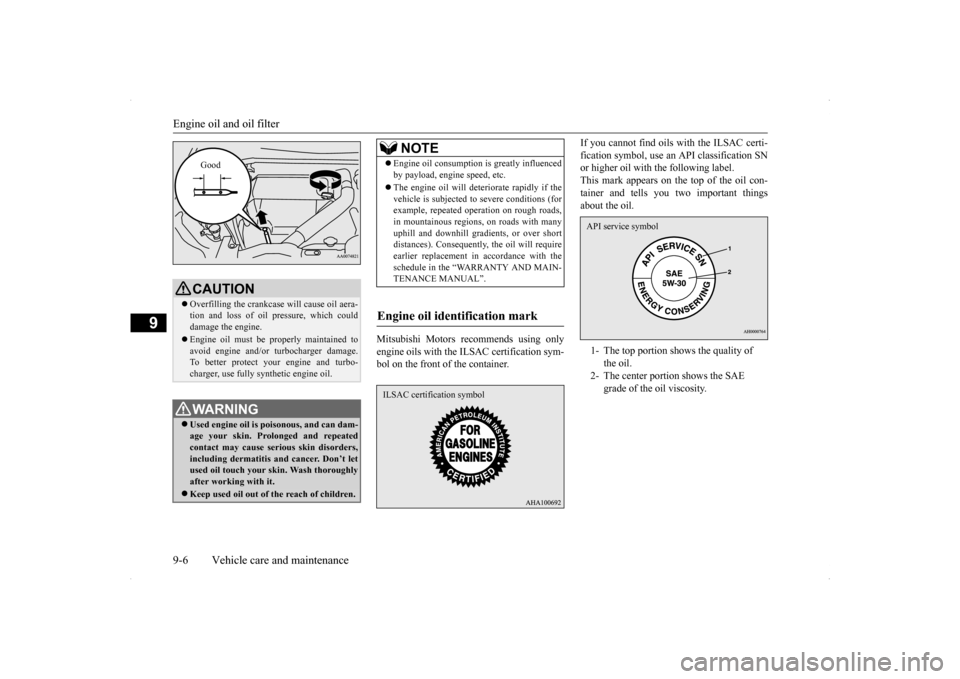
Mitsubishi Motors recommends using only engine oils with the ILSAC certification sym- bol on the front of the container.
If you cannot find oils with the ILSAC certi- fication symbol, use an API classification SN or higher oil with the following label. This mark appears on th
e top of the oil con-
tainer and tells you two important things about the oil.
CAUTION Overfilling the crankcase will cause oil aera- tion and loss of oil pressure, which could damage the engine. Engine oil must be properly maintained to avoid engine and/or turbocharger damage. To better protect your engine and turbo-charger, use fully synthetic engine oil.WA R N I N G Used engine oil is poisonous, and can dam- age your skin. Prolonged and repeatedcontact may cause serious skin disorders, including dermatitis and cancer. Don’t let used oil touch your skin. Wash thoroughlyafter working with it. Keep used oil out of the reach of children.Good
NOTE
Engine oil consumption is greatly influenced by payload, engine speed, etc. The engine oil will deteriorate rapidly if the vehicle is subjected to severe conditions (forexample, repeated operation on rough roads, in mountainous regions, on roads with many uphill and downhill gradients, or over shortdistances). Consequently, the oil will require earlier replacement in accordance with the schedule in the “WARRANTY AND MAIN-TENANCE MANUAL”.
Engine oil identification mark ILSAC certification symbol
1- The top portion shows the quality of
the oil.
2- The center portion shows the SAE
grade of the oil viscosity.
API service symbol
BK0200800US.bo
ok 6 ページ 2013年2月14日 木曜日 午後2時28分
Page 278 of 338

Engine coolant
Vehicle care and maintenance 9-7
9
N00955000100
Always use SAE 5W-30 engine oil.
N00955100042
The oil filter should be replaced at the time or mileage specified in the “WARRANTY ANDMAINTENANCE MANUAL”. Only use high quality replacement filters on this vehicle. The manufacturer’s specifica-tions for Genuine Mitsubishi oil filters require that the filter can withstand a pressure of 256 psi (1.8 MPa). A Genuine Mitsubishioil filter is the best replacement filter. Follow the installation
instructions printed on
the filter.
N00937800568
The coolant reserve tank (A) lets you quickly see when you need to add coolant. When the engine is cold, the level in the reserve tankshould be between the “FULL” and “LOW” marks. The radiator usually stays full so there is no reason to remove
the radiator cap (B)
except when you check the coolant freezepoint or replace the antifreeze coolant.
Mitsubishi Motors Genuine Coolant provides excellent protection against corrosion and rust formation on all metals, including alumi- num, and prevents blockages in some parts ofengine. If you need to add co
olant often, or if the
level in the reserve tank does not drop whenthe engine cools, the cooling system shouldbe pressure-tested for leaks. Take your vehi- cle to an authorized Mitsubishi Motors dealer or a repair facility of your choice for testing.
Required engine oil viscosity To replace the oil filter
Engine coolant To check the coolant level To add coolant Use “Mitsubishi Motors Genuine Super Long Life Coolant Premium” or equivalent
*.
FULL LOW
*: similar high quality ethylene glycol based non-silicate, non-amine, non-nitrate and non-borate coolant with long life hybrid organic acid technologyCAUTION Do not use alcohol or methanol antifreeze or any engine coolants that contain them. Using the wrong antifreeze can corrode aluminumparts. The required concentration of anti-freeze dif- fers depending on the expected ambient tem- perature. Above -31 °F (-35 °C) : 50 %concentration of anti-freeze Below -31 °F (-35 °C) : 60 %concentrationof anti-freeze You can check the concentration level with a gauge from an automotive supply store, oryour authorized Mitsubishi Motors dealer or service station can check it for you.
BK0200800US.bo
ok 7 ページ 2013年2月14日 木曜日 午後2時28分
Page 279 of 338

Air cleaner filter 9-8 Vehicle care and maintenance
9
The radiator cap must be tight sealed to pre- vent losing coolant which may result in engine damage. Only use a Genuine Mitsubi-shi Parts radiator cap, or an approved equiva- lent. Do not overfill the reserve tank.
Your vehicle uses a special radiator cap that stays sealed and lets the coolant flow from the reserve tank back to the radiator when the engine cools down. If you needto change the cap, use the exact same kind. Check the coolant freeze point in the radi- ator with the proper gauge, and only when it is safe. If you add antifreeze, the con- tents of the reserve tank must be protectedagainst freezing. Keep the front of the radiator and con- denser clean. If the temperature of the engine coolant does not rise after the engine is warmed- up, take your vehicle to an authorized Mitsubishi Motors dealer or a repair facil-ity of your choice to have the thermostat checked, and replaced if necessary.
N00937901449
The air cleaner filter w
ill get dirty and dusty
from use and not filter properly. Replace it with a new filter using the schedule in the“WARRANTY AND MAINTENANCE MANUAL”.
1. Unclamp and take out the air cleaner fil- ter. 2. Install the air cleaner filter and put the cover back on in its original position.
Do not use water to adjust the concentration of coolant. Do not top off the tank with plain water only. Water by itself boils at a lower temperatureand does not stop rust or freezing. If the water freezes, it will damage your cooling system. Do not use tapwater. It can causecorrosion and rust.
Radiator cap
WA R N I N G Wait for the engine to cool down before opening the radiator cap. Otherwise hotsteam or boiling coolant could spray up from the radiator and scald you.
Points to remember
CAUTION
Air cleaner filter
NOTE
Genuine Mitsubishi Moto
rs Parts are recom-
mended when replacing the air cleaner filter. After replacing the air cleaner filter, make sure that the hinges at the bottom of coverare firmly set.
BK0200800US.bo
ok 8 ページ 2013年2月14日 木曜日 午後2時28分
Page 293 of 338

General maintenance 9-22 Vehicle care and maintenance
9
there are other parts which do not usually need regular maintenance. But, if any of these pa
rts stops working prop-
erly, your vehicle performance could suffer.Have these items checked if you notice a problem with them. See your authorized Mitsubishi Motors dealer for assistance, if you have any questions.
N00941600062
Good brakes are essential to safe driving. Check the brake pads for wear. For good braking performance, replace the brake padswith the same type pads as the originals.
N00941700047
Brake hoses and tubing should be checkedfor: Severe surface cracking, scuffing or worn spots. If the fabric casing of the hose is showing through any cracks or worn spotsin the rubber hose cover, the hose should be replaced. The brakes can fail if the hose wears through. Improper installation may cause twisting, or wheel, tire or chassis interference.
N00941800077
Check the following parts for damage and grease leaks: Ball joint boots of the front suspension and steering linkage Bellows on both ends of the drive shaft
N00942200108
The best way to k
eep carbon monoxide gas
from entering inside your vehicle is to have the engine exhaust system properly serviced. Have a competent mechanic inspect the com-plete exhaust system and nearby body areas for broken, damaged, deteriorated, or mispo- sitioned parts if you notice any of the follow-ing: A change in the sound of the exhaust sys- tem The smell of exhaust fumes inside the vehicle
The underside or rear of the vehicle is damaged
Also check the exhaust system each time the vehicle is raised for lubrication, oil changes, or required service. Any open seams or looseconnections could let dangerous exhaust fumes seep into the luggage compartment and passenger compartments. Check for holes or exhaust gas leaks caused by corrosion or damage. Check the joints and connections for looseness or exhaust gas leaks. Check the rubber hangers and brackets for damage.
N00942500042
The hood lock release mechanism and hood safety catch should be checked, cleaned, and oiled when needed for easy movement and tostop rust and wear. Use Multipurpose Grease NLGI Grade 2 sparingly for all sliding parts of the hood latch and release lever. Work thegrease into the hood lock mechanism until all the movable surfaces are covered.
Disc brake pads Brake hoses
Ball joint, steering linkage seals and drive shaft boots Exhaust system
WA R N I N G Carbon monoxide gas from your vehicle’s exhaust is poisonous. Breathing these fumes can cause unconsciousness or death.
Check for any of the following conditions: Hood lock release mechanism and safety catch
BK0200800US.bo
ok 22 ページ 2013年2月14日 木曜日 午後2時28分
Page 297 of 338
Fuses 9-26 Vehicle care and maintenance
9
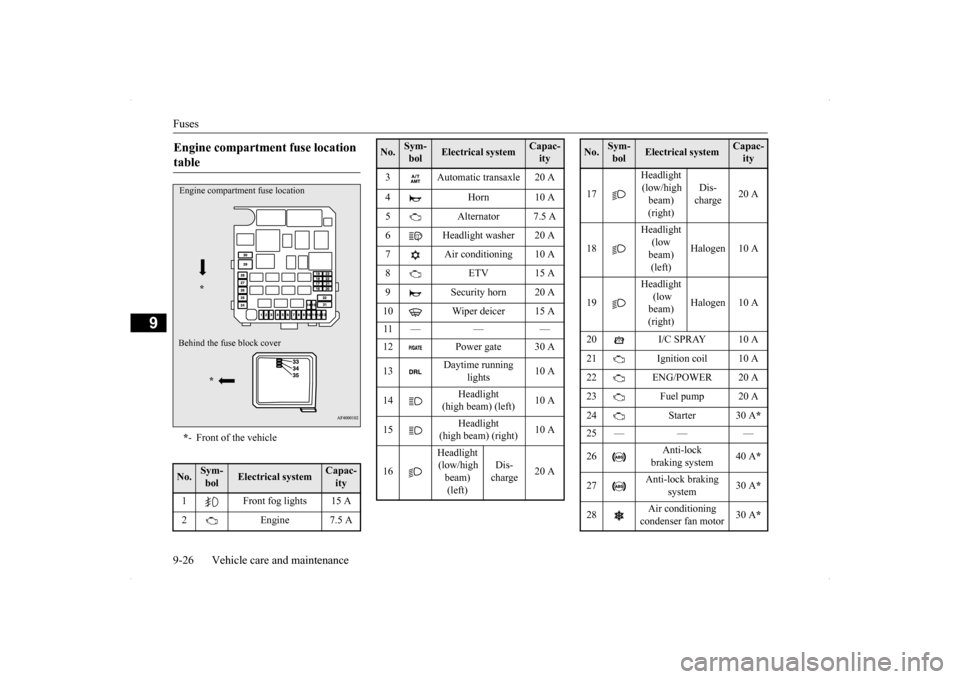
Engine compartment fuse location table * - Front of the vehicle
No.
Sym- bol
Electrical system
Capac-ity
1 Front fog lights 15 A 2 Engine 7.5 AEngine compartment fuse location
*
Behind the fuse block cover
*
3 Automatic transaxle 20 A 4 Horn 10 A 5 Alternator 7.5 A 6 Headlight washer 20 A 7 Air conditioning 10 A8 ETV 15 A 9 Security horn 20 A 10 Wiper deicer 15 A 11 — — — 12 Power gate 30 A 13
Daytime running
lights
10 A
14
Headlight
(high beam) (left)
10 A
15
Headlight
(high beam) (right)
10 A
16
Headlight (low/high beam) (left)
Dis- charge
20 A
No.
Sym- bol
Electrical system
Capac-ity
17
Headlight (low/high beam) (right)
Dis- charge
20 A
18
Headlight (low beam) (left)
Halogen 10 A
19
Headlight (low beam) (right)
Halogen 10 A
20 I/C SPRAY 10 A 21 Ignition coil 10 A 22 ENG/POWER 20 A 23 Fuel pump 20 A24 Starter 30 A
*
25 — — — 26
Anti-lock
braking system
40 A
*
27
Anti-lock braking
system
30 A
*
28
Air conditioning condenser fan motor
30 A
*
No.
Sym- bol
Electrical system
Capac-ity
BK0200800US.bo
ok 26 ページ 2013年2月14日 木曜日 午後2時28分
Page 313 of 338

Cleaning the outside of your vehicle 9-42 Vehicle care and maintenance
9
N00945700016
To protect your vehicle’s finish, wash it often and thoroughly. If desired, you may wax your vehicle using a nonabrasive automobile wax.
N00945800017
Industrial pollution, road tar, bird droppings,tree sap, insect remains, sea water and otherforeign matters can damage the finish on your vehicle. Generally, the longer any foreign materialstays on the finish, the worse the damage. Wash your vehicle as soon as possible when- ever the finish gets soiled.
N00945900601
Chemicals contained in the dirt and dustpicked up from air, rain, snow or road sur-faces can damage the paint and body of your vehicle if left on. Frequent washing and waxing is the best wayto protect your vehicle from this damage. Do not wash the vehicle in direct sunlight. Park the vehicle in the shade and spray it withwater to remove dust. Next, using plenty ofclean water and a car washing mitt or sponge, wash the vehicle from top to bottom. Use a mild car washing soap if necessary.Rinse thoroughly and wipe dry with a cham- ois or soft cloth. After washing the vehicle, carefully clean the joints and flanges of thedoors, hood, etc., where dirt is likely to remain.
The genuine leather surface may harden and shrink if it is exposed to the direct sunlight for long hours. When your vehicle is parked, place it in the shade as much as possible. When the temperature of the vehicle interior rises in summer, vinyl products left on the genuine leather seat may deteriorate andstick to the seat.
Cleaning the outside of your vehicle Foreign material
NOTE
Wa s h i n g
CAUTION When washing the underside of your vehicle or the wheels, wear a pair of gloves to pro-tect your hands. This vehicle is equipped with a high perfor- mance brakes. Wash the wheels frequently to remove brake dust. The dust will be difficultto remove if left on the wheels for too long.
If your vehicle has rain sensor wipers, place the wiper switch lever in the “OFF” position to deactivate the rain sensor before washing the vehicle. Otherwise, the wipers will oper- ate in the presence of water spray on thewindshield and become damaged as a result. Never spray or splash water on the electrical parts in the engine compartment. This may damage them. Be careful also when washing the underbody. Do not spray water into theengine compartment. Avoid automatic car washers that use rotat- ing brushes. These brushes may scratch the paint surface and make it dull. Scratches are more noticeable on darker col-ored vehicles. Some hot water washing equipment uses high pressure and heat to clean your vehicle. This heated water may damage your vehi- cle’s resin parts. It can flood the interior ofthe vehicle. Therefore, be sure of the follow- ing:• Keep the washing nozzle at least 20 inches(50 cm) away from the vehicle body.• When washing around the door glass, holdthe nozzle at a distance of more than 20 inches (50 cm) and at
right angles to the
glass surface. CAUTION
BK0200800US.bo
ok 42 ページ 2013年2月14日 木曜日 午後2時28分
Page 315 of 338

Cleaning the outside of your vehicle 9-44 Vehicle care and maintenance
9
cloth in one direction. After polishing, flush the compound from the surface and apply a coat of wax to regain a beautiful luster.
N00946200018
Small cracks and scratches in the paint coatshould be touched up as soon as possible with touch-up paint to prevent corrosion.Check body areas facing the road or the tirescarefully for damage to the paint caused by flying stones, etc. The
paint code number for
your vehicle can be found on the vehicleinformation code plate in the engine compart- ment.
N00946300178
Use a sponge or chamois to clean these parts.If a vehicle wax sticks to a gray or black rough surface of the bumper, molding orlights, the surface may appear white in color. In this case, wipe it off using lukewarm water and a soft cloth or chamois.
N00946400010
To prevent spots and corrosion of chromeparts, wash with water, dry thoroughly, and apply a nonabrasive automotive wax. If the chrome is severely damaged or pitted, use acommercially available chrome polish.
N00946500109
1. Remove dirt using a wet sponge.2. Use a mild detergent on any dirt that can- not be removed easily with water. Rinse off the detergent after washing thewheel. 3. Dry the wheel thoroug
hly using a chamois
leather or a soft cloth.
N00946600012
The window glass can
usually be cleaned
using only a sponge and water. Glass cleanercan be used to remove wax, oil, grease, dead insects, etc. After washing the glass, wipe it dry with a clean, dry, soft cloth.
N00946700084
Use a soft cloth and gl
ass cleaner to remove
grease, dead insects, etc., from the wiperblades. Replace the wiper blades when they no longer clean the windshield properly.
Damaged paint Cleaning plastic parts
CAUTION Do not use a scrubbing brush or other rough scrubber as these may damage the plasticsurface.
Do not use wax containing compounds (pol- ishing powder) which may damage the plas- tic surface. Do not let the plastic parts get soiled with gasoline, oil, brake fluids, engine oils, greases, paint thinner, and sulfuric acid (bat- tery electrolyte). These fluids, etc., maycrack, stain or discolor the plastic parts. If any of these get on the plastic parts, wipe them up with a soft cloth or chamois and amild solution of soap and water. Then rinse them immediately with water.
Chrome parts Aluminum wheels
CAUTION
CAUTION Do not use a brush or other hard implement on the wheels. Doing so could scratch the wheels. Do not use any cleaner that contains an abra- sive substance or is acidic or alkaline. Doing so could cause the coating on the wheels to peel or become discolored or stained. Do not directly apply hot water using a steam cleaner or by any other means. Contact with seawater or road salt used for de-icing can cause corrosion. Rinse off suchsubstances as soon as possible.
Window glass Wiper blades
BK0200800US.bo
ok 44 ページ 2013年2月14日 木曜日 午後2時28分