2014 MERCEDES-BENZ SL-CLASS ROADSTER weight
[x] Cancel search: weightPage 58 of 284
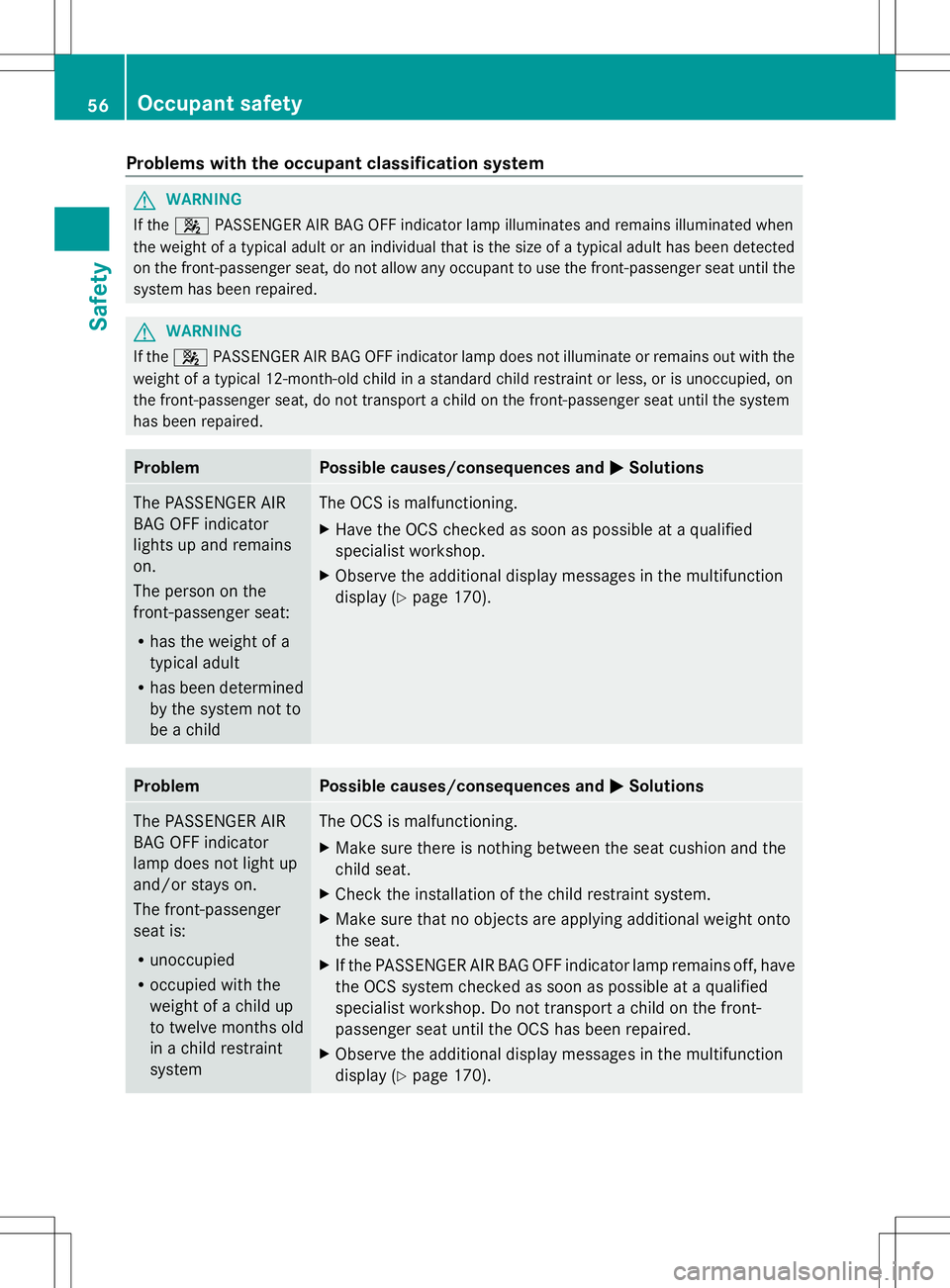
Problems with the occupant classification system
G
WARNING
If the 4 PASSENGER AIR BAG OFF indicator lamp illuminates and remains illuminated when
the weight of a typical adult or an individual that is the size of a typical adult has been detected
on the front-passenger seat, do not allow any occupant to use the front-passenger seat until the
system has been repaired. G
WARNING
If the 4 PASSENGER AIR BAG OFF indicator lamp does not illuminate or remains out with the
weight of a typical 12-month-old child in a standard child restraint or less, or is unoccupied, on
the front-passenger seat, do not transport a child on the front-passenger seat until the system
has been repaired. Problem Possible causes/consequences and
M MSolutions The PASSENGER AIR
BAG OFF indicator
lights up and remains
on.
The person on the
front-passenger seat:
R has the weight of a
typical adult
R has been determined
by the system not to
be a child The OCS is malfunctioning.
X
Have the OCS checked as soon as possible at a qualified
specialist workshop.
X Observe the additional display messages in the multifunction
display (Y page 170). Problem Possible causes/consequences and
M MSolutions The PASSENGER AIR
BAG OFF indicator
lamp does not light up
and/or stays on.
The front-passenger
seat is:
R unoccupied
R occupied with the
weight of a child up
to twelve months old
in a child restraint
system The OCS is malfunctioning.
X
Make sure there is nothing between the seat cushion and the
child seat.
X Check the installation of the child restraint system.
X Make sure that no objects are applying additional weight onto
the seat.
X If the PASSENGER AIR BAG OFF indicator lamp remains off, have
the OCS system checked as soon as possible at a qualified
specialist workshop. Do not transport a child on the front-
passenger seat until the OCS has been repaired.
X Observe the additional display messages in the multifunction
display (Y page 170). 56
Occupant safetySafety
Page 64 of 284

Emergency Tensioning Devices, seat
belt force limiters G
WARNING
Pyrotechnic Emergency Tensioning Devices
that have been deployed are no longer
operational and are unable to perform their
intended protective function. This poses an
increased risk of injury or even fatal injury.
Therefore, have pyrotechnic Emergency
Tensioning Devices which have been
triggered immediately replaced at a qualified
specialist workshop.
! If the co-driver's seat is unoccupied, do
not insert the belt tongue into the buckle of
the co-driver's seat. This may otherwise
lead to the triggering of the Emergency
Tensioning Device in the event of an
accident, which will then need to be
replaced.
i Vehicles with PRE-SAFE ®
: Emergency
Tensioning Devices that are triggered by an
electric motor can be deployed as often as
desired and do not need to be replaced.
The seat belts are equipped with Emergency
Tensioning Devices and seat belt force
limiters.
The ETDs tighten the seat belts in an accident,
pulling them close against the body.
The ETDs do not correct incorrect seat
positions or incorrectly fastened seat belts.
The ETDs do not pull vehicle occupants back
towards the backrest.
The ETDs can only be activated when:
R the ignition is switched on
R the restraint systems are operational; see
"SRS warning lamp "( Ypage 45)
R the belt tongue is engaged in the buckle on
each of the three-point seat belts.
The ETDs are triggered depending on the type
and severity of an accident:
R in the event of a head-on or rear-end
collision if the vehicle decelerates or
accelerates rapidly in a longitudinal direction during the initial stages of the
impact.
R in the event of a side impact if the vehicle
decelerates or accelerates rapidly in a
lateral direction on the side opposite to the
impact..
R in certain situations where the vehicle rolls
over if the system determines that it can
provide additional protection.
If the ETDs are deployed, you will hear a bang,
and a small amount of powder may also be
released. Only in rare cases will the bang
affect your hearing. The powder that is
released generally does not constitute a
health hazard and does not indicate that there
is a fire in the vehicle. The dust might cause
some temporary breathing difficulty for
people with asthma or other breathing
trouble. To avoid this, you may wish to get out
of the vehicle as soon as it is safe to do so.
You can also open the window to allow fresh
air to enter the vehicle interior. The 6SRS
warning lamp lights up.
When triggered, seat belt force limiters help
to reduce the force exerted by the seat belt
on the vehicle occupant.
The seat belt force limiters are synchronized
with the front air bags, which take on a part
of the deceleration force. Thus, the force
exerted on the occupant is distributed over a
greater area. Child restraint systems
Important safety notes
G
WARNING
Children 12 years old and under must be
seated and properly secured in an appropriate
infant restraint, toddler restraint, or booster
seat recommended for the size and weight of
the child.
The infant or child restraint system must be
correctly secured using the vehicle's seat belt
in complete accordance with the child seat
manufacturer's instructions. 62
Child restraint systemsSafety
Page 65 of 284

Occupants, in particular children, must sit as
upright as possible, fasten the seat belt
correctly and use a suitable infant restraint
system, child restraint system or booster seat
suitable for the size and weight of the child.
Children can be seriously or even fatally
injured by an air bag deploying. Observe the
following information:
R Your vehicle is equipped with air bag
technology designed to deactivate the
front-passenger front air bag in your vehicle
when the system senses the weight of a
typical 12-month-old child or less along
with the weight of a standard appropriate
child restraint on the passenger seat.
R A child in a rearward-facing child restraint
system on the front-passenger seat could
be seriously injured or even killed if the
front-passenger air bag inflates in a
collision despite the air bag technology
installed in your vehicle, which could occur
under some circumstances.
R If you install a rearward-facing child
restraint on the front-passenger seat, make
sure that the 4PASSENGER AIR BAG
OFF indicator lamp is illuminated,
indicating that the front-passenger front air
bag is deactivated. Should the 4
PASSENGER AIR BAG OFF indicator lamp
not illuminate or go out while a rearward-
facing child restraint system is installed,
please check installation. Periodically
check the 4PASSENGER AIR BAG OFF
indicator lamp while driving to make sure it
is illuminated. If the 4PASSENGER AIR
BAG OFF indicator lamp goes out or
remains out, do not transport a child on the
front-passenger seat.
R A child in a rearward-facing child restraint
system on the front-passenger seat can be
seriously injured or even killed if the front-
passenger air bag is deployed. R
When securing a child in a child restraint
system on the front-passenger seat, you
must:
-move the front-passenger seat as far
back as possible
- use a child restraint system that is
suitable for the age, size and weight of
the child
- observe the manufacturer's installation
instructions in order to install and secure
the child restraint system correctly.
R For children larger than the typical 12-
month-old child, the front-passenger front
air bag may or may not be activated. G
WARNING
If the child restraint system is installed
incorrectly on a suitable seat, it cannot
protect as intended. The child cannot then be
restrained in the event of an accident, heavy
braking or sudden changes of direction. There
is an increased risk of injury, possibly even
fatal.
Make sure that you observe the child restraint
system manufacturer's installation
instructions and the notes on use. Please
ensure, that the base of the child restraint
system is always resting completely on the
seat cushion. Never place objects, e.g.
cushions, under or behind the child restraint
system. Only use child restraint systems with
the original cover designed for them. Only
replace damaged covers with genuine covers. G
WARNING
If the child restraint system is installed
incorrectly or is not secured, it can come
loose in the event of an accident, heavy
braking or a sudden change in direction. The
child restraint system could be thrown about,
striking vehicle occupants. There is an
increased risk of injury, possibly even fatal.
Always install child restraint systems
properly, even if they are not being used.
Make sure that you observe the child restraint Child restraint systems
63Safety
Z
Page 67 of 284

If an infant or child is traveling in the vehicle:
X Secure the child with a child or infant seat
restraint system appropriate to the age and
weight of the child.
X Make sure that the infant or child is
properly secured at all times while the
vehicle is in motion.
Mercedes-Benz recommends that you always
properly secure all infants and children with
a child or infant seat restraint system for the
trip.
The use of seat belts and infant and child
restraint systems is required by law in:
R all 50 states
R the U.S. territories
R the District of Columbia
R all Canadian provinces
Infants and children must always be seated in
an appropriate infant or child restraint system
recommended for the size and weight of the
child. The infant or child restraint system
must be properly secured with a three-point
seat belt in accordance with the
manufacturer's instructions.
All infant or child restraint systems must meet
the following standards:
R U.S. Federal Motor Vehicle Safety
Standards 213 and 225
R Canadian Motor Vehicle Safety Standards
213 and 210.2
Confirmation that the child restraint system
corresponds to the standards can be found
on an instruction label on the child restraint
system. This confirmation can also be found
in the installation instructions that are
included with the child restraint system.
Always read and follow the manufacturer's
instructions when using an infant or child
restraint system or booster seat.
Observe the warning labels in the vehicle
interior or on the infant or child restraint. LATCH-type (ISOFIX) child seat
securing system
G
WARNING
LATCH-type (ISOFIX) child restraint systems
do not offer sufficient protective effect for
children whose weight is greater than 48 lbs
(22 kg) who are secured using the safety belt
integrated in the child restraint system. In the
event of an accident, a child might not be
restrained correctly. This poses an increased
risk of injury or even fatal injury.
If the child weighs more than 48 lbs (22 kg),
only use LATCH-type (ISOFIX) child restraint
systems with which the child is also secured
with the vehicle seat belt. Also secure the
child restraint system with the Top Tether
belt, if available.
When installing a child restraint system, be
sure to observe the manufacturer's
installation instructions and the instructions
for correct use of the child restraint system. X
Install the LATCH-type (ISOFIX) child
restraint system on both LATCH-type
(ISOFIX) securing loops :. Comply with
the child restraint system manufacturer's
instructions when installing the LATCH-
type (ISOFIX) child restraint system.
LATCH-type (ISOFIX) is a standardized
securing system for specially designed child
restraint systems. LATCH-type (ISOFIX)
retaining loops :for a LATCH-type (ISOFIX)
child restraint system are installed on the
front-passenger seat. Child restraint systems
65Safety Z
Page 171 of 284

Display messages Possible causes/consequences and
M
MSolutions Front Passenger
Front Passenger
Airbag Disabled Airbag Disabled
See Operator's See Operator's
Manual Manual The front-passenger air bag and front-passenger knee bag are
deactivated during the journey, although:
R
an adult
or
R a person larger than a certain size is occupying the front-
passenger seat
If additional forces are applied to the seat, the system may
interpret the occupant's weight as lower than it actually is.
G WARNING
The front-passenger front air bag and front passenger knee bag
may not be triggered in the event of an accident.
There is an increased risk of injury.
X Pull over and stop the vehicle safely as soon as possible, paying
attention to road and traffic conditions.
X Secure the vehicle against rolling away ( Ypage 130).
X Switch the ignition off.
X Have the occupant get out of the vehicle.
X Keep the seat unoccupied, close the front-passenger door and
switch on the ignition.
X Observe the PASSENGER AIR BAG OFF indicator lamp in the
center console and the multifunction display and check the
following:
Seat unoccupied and ignition switched on:
R the PASSENGER AIR BAG OFF indicator lamp must light up and
remain lit. If the indicator lamp is on, OCS has disabled the front-
passenger air bag and front-passenger knee bag ( Ypage 51).
R the Front Passenger Airbag Enabled See Operator's
Front Passenger Airbag Enabled See Operator's
Manual Manual orFront Passenger Airbag Disabled See
Front Passenger Airbag Disabled See
Operator's Manual
Operator's Manual display messages must not be shown in
the multifunction display.
X Wait for a period of at least 60 seconds until the necessary
system checks have been completed.
X Make sure that the display messages do not appear in the
multifunction display.
If these conditions are fulfilled, the front-passenger seat can be
occupied again. Whether the PASSENGER AIR BAG OFF indicator
lamp remains lit or goes out depends on how OCS classifies the
occupant.
If the conditions are not fulfilled, the system is not operating
correctly. Display
messages
169On-board computer and displays Z
Page 172 of 284
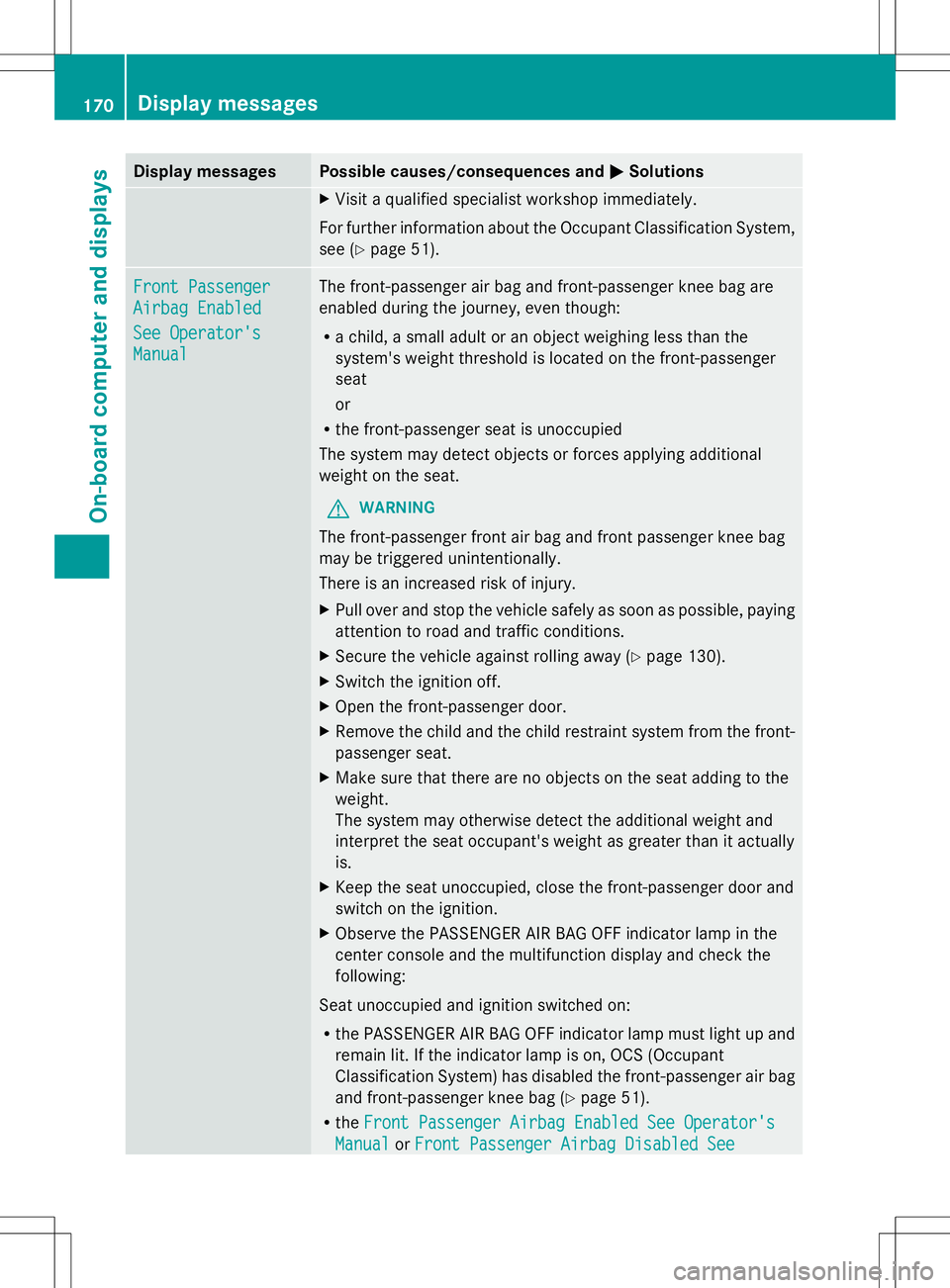
Display messages Possible causes/consequences and
M
MSolutions X
Visit a qualified specialist workshop immediately.
For further information about the Occupant Classification System,
see (Y page 51). Front Passenger Front Passenger
Airbag Enabled Airbag Enabled
See Operator's See Operator's
Manual Manual The front-passenger air bag and front-passenger knee bag are
enabled during the journey, even though:
R
a child, a small adult or an object weighing less than the
system's weight threshold is located on the front-passenger
seat
or
R the front-passenger seat is unoccupied
The system may detect objects or forces applying additional
weight on the seat.
G WARNING
The front-passenger front air bag and front passenger knee bag
may be triggered unintentionally.
There is an increased risk of injury.
X Pull over and stop the vehicle safely as soon as possible, paying
attention to road and traffic conditions.
X Secure the vehicle against rolling away ( Ypage 130).
X Switch the ignition off.
X Open the front-passenger door.
X Remove the child and the child restraint system from the front-
passenger seat.
X Make sure that there are no objects on the seat adding to the
weight.
The system may otherwise detect the additional weight and
interpret the seat occupant's weight as greater than it actually
is.
X Keep the seat unoccupied, close the front-passenger door and
switch on the ignition.
X Observe the PASSENGER AIR BAG OFF indicator lamp in the
center console and the multifunction display and check the
following:
Seat unoccupied and ignition switched on:
R the PASSENGER AIR BAG OFF indicator lamp must light up and
remain lit. If the indicator lamp is on, OCS (Occupant
Classification System) has disabled the front-passenger air bag
and front-passenger knee bag (Y page 51).
R the Front Passenger Airbag Enabled See Operator's
Front Passenger Airbag Enabled See Operator's
Manual Manual orFront Passenger Airbag Disabled See
Front Passenger Airbag Disabled See 170
Display
messagesOn-board computer and displays
Page 239 of 284

Position number
Bidentifies the charged battery of the other vehicle or an equivalent jump-
starting device.
X Press cover :of positive terminal ;down (in the direction of the arrow) and turn it
clockwise. Cover :is held down in the lowered position, which exposes positive
terminal ;.
X Connect positive terminal ;on your vehicle to positive terminal =of donor battery B
using the jumper cable, always begin with positive terminal ;on your own vehicle first.
X Start the engine of the donor vehicle and run it at idling speed.
X Connect negative terminal ?of donor battery Bto ground point Aof your vehicle using
the jumper cable, connecting the jumper cable to battery of other vehicle Bfirst.
X Start the engine.
X Before disconnecting the jumper cables, let the engine run for several minutes.
X First, remove the jumper cables from ground point Aand negative terminal ?, then from
positive clamp ;and positive terminal =. Begin each time at the contacts on your own
vehicle first.
X After removing the jumper cables, press down cover :of positive terminal ;and turn it
counter-clockwise. Cover :returns to its original position. Positive terminal ;is covered
up and thus insulated again.
X Have the battery checked at a qualified specialist workshop.
i Jump-starting is not considered to be a normal operating condition.
i Jumper cables and further information regarding jump-starting can be obtained at any
qualified specialist workshop. Towing and tow-starting
Important safety notes
G
WARNING
If the weight of the vehicle to be towed or tow-
started is greater than the permissible gross
weight of your vehicle:
R the towing eye could detach itself
R the vehicle/trailer combination could
rollover.
There is a risk of an accident.
When towing or tow-starting another vehicle,
its weight should not be greater than the
permissible gross weight of your vehicle. !
If DISTRONIC PLUS or the HOLD function
is activated, the vehicle brakes
automatically in certain situations. To
prevent damage to the vehicle, deactivate
DISTRONIC PLUS and the HOLD function in
the following or other similar situations:
R when towing the vehicle
R in the car wash
! Only secure the tow rope or tow bar at the
towing eyes. Otherwise, the vehicle could
be damaged.
! Do not use the towing eye for recovery,
this could damage the vehicle. If in doubt,
recover the vehicle with a crane.
! When towing, pull away slowly and
smoothly. If the tractive power is too high,
the vehicles could be damaged. Towing and tow-starting
237Breakdown assistance Z
Page 240 of 284

!
Do not tow with sling-type equipment.
This could damage the vehicle.
! When towing vehicles with KEYLESS-GO,
use the key instead of the Start/Stop
button. Otherwise, the automatic
transmission may shift to position Pwhen
the driver's or front-passenger door are
opened, which could lead to damage to the
transmission.
! Make sure that the electric parking brake
is released. If the electric parking brake is
faulty, visit a qualified specialist workshop.
! The vehicle can be towed a maximum of
30 miles (50km). The towing speed of
30 mph (50 km/h) must not be exceeded.
If the vehicle has to be towed more than
30 miles (50km), the entire vehicle must be
raised and transported.
! If you tow or tow-start another vehicle, its
weight must not exceed the maximum
permissible gross vehicle weight of your
vehicle.
Information on your vehicle's gross vehicle
weight rating can be found on the vehicle
identification plate (Y page 274).
It is better to have the vehicle transported
than to have it towed.
The automatic transmission must be in
position Nwhen the vehicle is being towed.
The battery must be connected and charged.
Otherwise, you:
R cannot turn the SmartKey to position 2in
the ignition lock
R cannot shift the automatic transmission to
position N
i Disarm the automatic locking feature
before the vehicle is towed (Y page 161).
You could otherwise be locked out when
pushing or towing the vehicle. Installing/removing the towing eye
Installing the towing eye G
WARNING
The exhaust tail pipe may be very hot. There
is a risk of burns when removing the rear
cover.
Do not touch the exhaust pipe. Take particular
care when removing the rear cover. Example: towing eye mounting covers
The mountings for the screw-in towing eyes
are located in the bumpers. They are at the
front and at the rear, behind the covers.
X Remove the towing eye from the vehicle
tool kit (Y page 226).
X Front bumper: insert a finger into the
recess on the bottom edge of cover :.
X Pull cover :out of the bumper towards
you in the direction of the arrow.
Cover :is attached to the opening with a
strap.
X Rear bumper: press the mark on
cover ;inwards in the direction of the
arrow.
X Take cover ;off the opening.
X Screw in and tighten the towing eye
clockwise to the stop. 238
Towing and tow-startingBreakdown assistance