Page 130 of 462
Useful information
iThis Operator's Manual describes all
models and all standard and optional
equipment of your vehicle available at the
time of publication of the Operator's
Manual. Country-specific differences are
possible. Please note that your vehicle may
not be equipped with all features
described. This also applies to safety-
related systems and functions.
iRead the information on qualified
specialist workshops: (Ypage 28).
Exterior lighting
General notes
For reasons of safety, Mercedes-Benz
recommends that you drive with the lights
switched on even during the daytime. In some
countries, operation of the headlamps varies
due to legal requirements and self-imposed
obligations.
Driving abroad
Conversion to symmetrical low beam
Switch the headlamps to symmetrical low
beam in countries in which traffic drives on
the opposite side of the road from the country
where the vehicle is registered. This prevents
glare to oncoming traffic. When using
symmetrical lights, the edge of the road is not
lit as widely and as far ahead as normal.
Have the headlamps converted at a qualified
specialist workshop as close to the border as
possible before driving in these countries.
Conversion to asymmetrical low beam
after returning
Have the headlamps converted back to
asymmetrical low-beam headlamps at a
qualified specialist workshop as soon as
possible after crossing the border again.
Setting the exterior lighting
Setting options
Exterior lighting can be set using:
Rthe light switch
Rthe combination switch (Ypage 131)
Rthe on-board computer (Ypage 283)
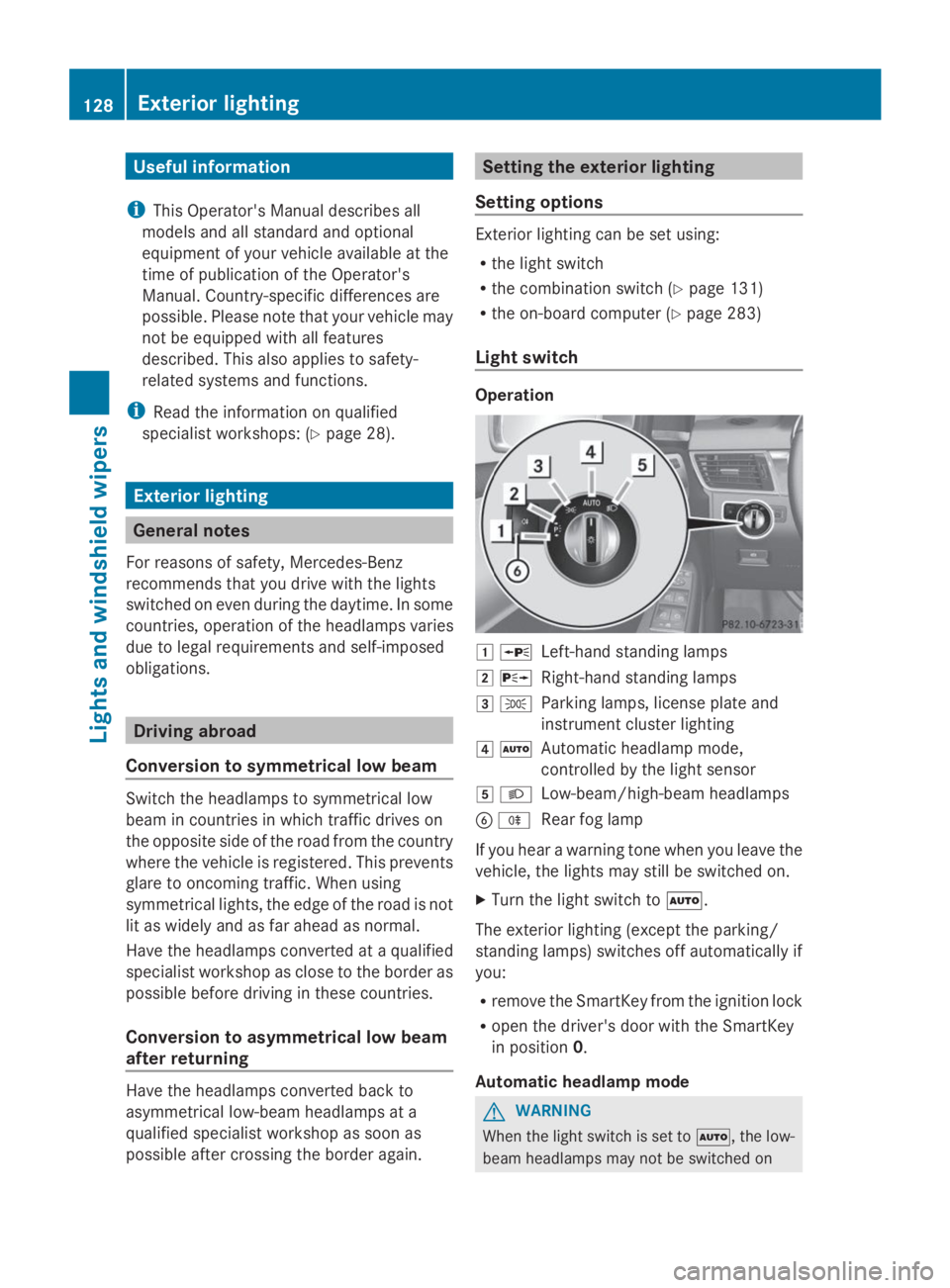
Light switch
Operation
GcLeft-hand standing lamps
HdRight-hand standing lamps
I`Parking lamps, license plate and
instrument cluster lighting
JXAutomatic headlamp mode,
controlled by the light sensor
KXLow-beam/high-beam headlamps
Page 135 of 462
The hazard warning lamps automatically
switch on if:
Ran air bag is deployed or
Rthe vehicle decelerates rapidly from a
speed of above 45 mph (70 km/h) and
comes to a standstill
The hazard warning lamps switch off
automatically if the vehicle reaches a speed
of above 6 mph (10 km/h) again after a full
brake application.
iThe hazard warning lamps still operate if
the ignition is switched off.
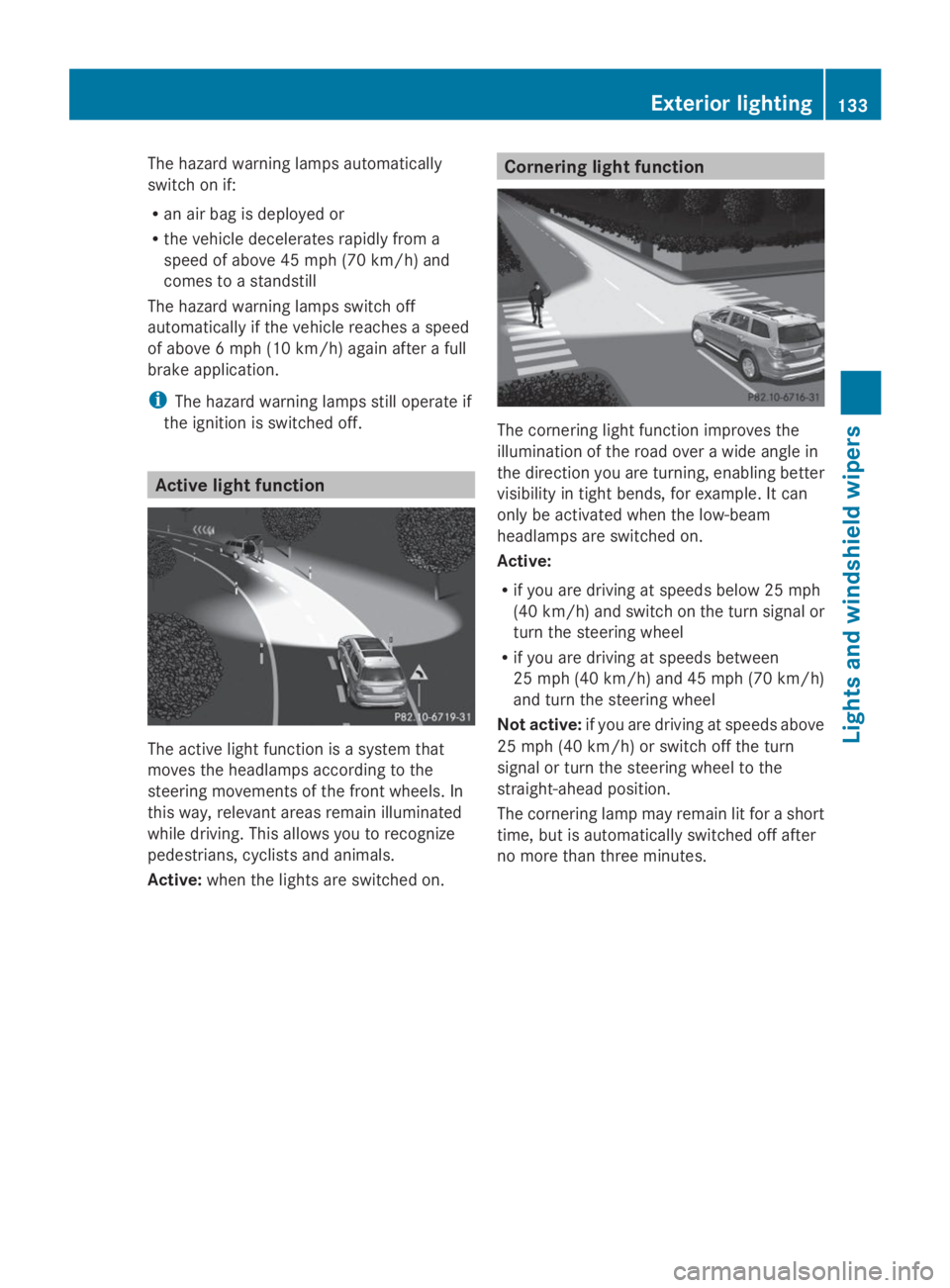
Active light function
The active light function is a system that
moves the headlamps according to the
steering movements of the front wheels. In
this way, relevant areas remain illuminated
while driving. This allows you to recognize
pedestrians, cyclists and animals.
Active:when the lights are switched on.
Cornering light function
The cornering light function improves the
illumination of the road over a wide angle in
the direction you are turning, enabling better
visibility in tight bends, for example. It can
only be activated when the low-beam
headlamps are switched on.
Active:
Rif you are driving at speeds below 25 mph
(40 km/h)and switch on the turn signal or
turn the steering wheel
Rif you are driving at speeds between
25 mph(40 km/h) and 45 mph(70 km/h)
and turn the steering wheel
Not active:if you are driving at speeds above
25 mph (40 km/h) or switch off the turn
signal or turn the steering wheel to the
straight-ahead position.
The cornering lamp may remain lit for a short
time, but is automatically switched off after
no more than three minutes.
Exterior lighting133
Lights and windshield wipers
Z
Page 136 of 462
Adaptive Highbeam Assist
General notes
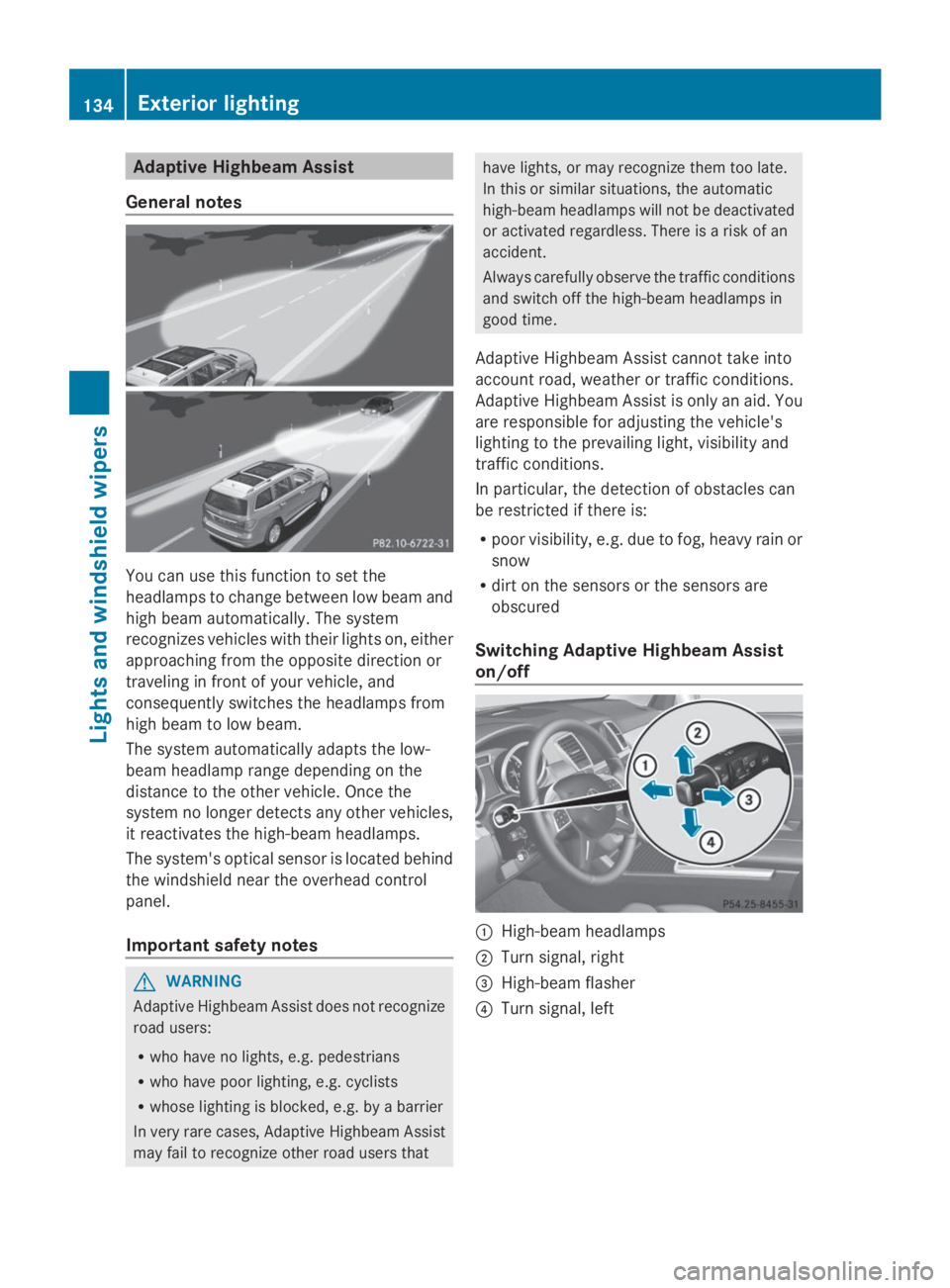
You can use this function to set the
headlamps to change between low beam and
high beam automatically. The system
recognizes vehicles with their lights on, either
approaching from the opposite direction or
traveling in front of your vehicle, and
consequently switches the headlamps from
high beam to low beam.
The system automatically adapts the low-
beam headlamp range depending on the
distance to the other vehicle. Once the
system no longer detects any other vehicles,
it reactivates the high-beam headlamps.
The system's optical sensor is located behind
the windshield near the overhead control
panel.
Important safety notes
GWARNING
Adaptive Highbeam Assist does not recognize
road users:
Rwho have no lights, e.g. pedestrians
Rwho have poor lighting, e.g. cyclists
Rwhose lighting is blocked, e.g. by a barrier
In very rare cases, Adaptive Highbeam Assist
may fail to recognize other road users that
have lights, or may recognize them too late.
In this or similar situations, the automatic
high-beam headlamps will not be deactivated
or activated regardless. There is a risk of an
accident.
Always carefully observe the traffic conditions
and switch off the high-beam headlamps in
good time.
Adaptive Highbeam Assist cannot take into
account road, weather or traffic conditions.
Adaptive Highbeam Assist is only an aid. You
are responsible for adjusting the vehicle's
lighting to the prevailing light, visibility and
traffic conditions.
In particular, the detection of obstacles can
be restricted if there is:
Rpoor visibility, e.g. due to fog, heavy rain or
snow
Rdirt on the sensors or the sensors are
obscured
Switching Adaptive Highbeam Assist
on/off
CHigh-beam headlamps
DTurn signal, right
Page 140 of 462
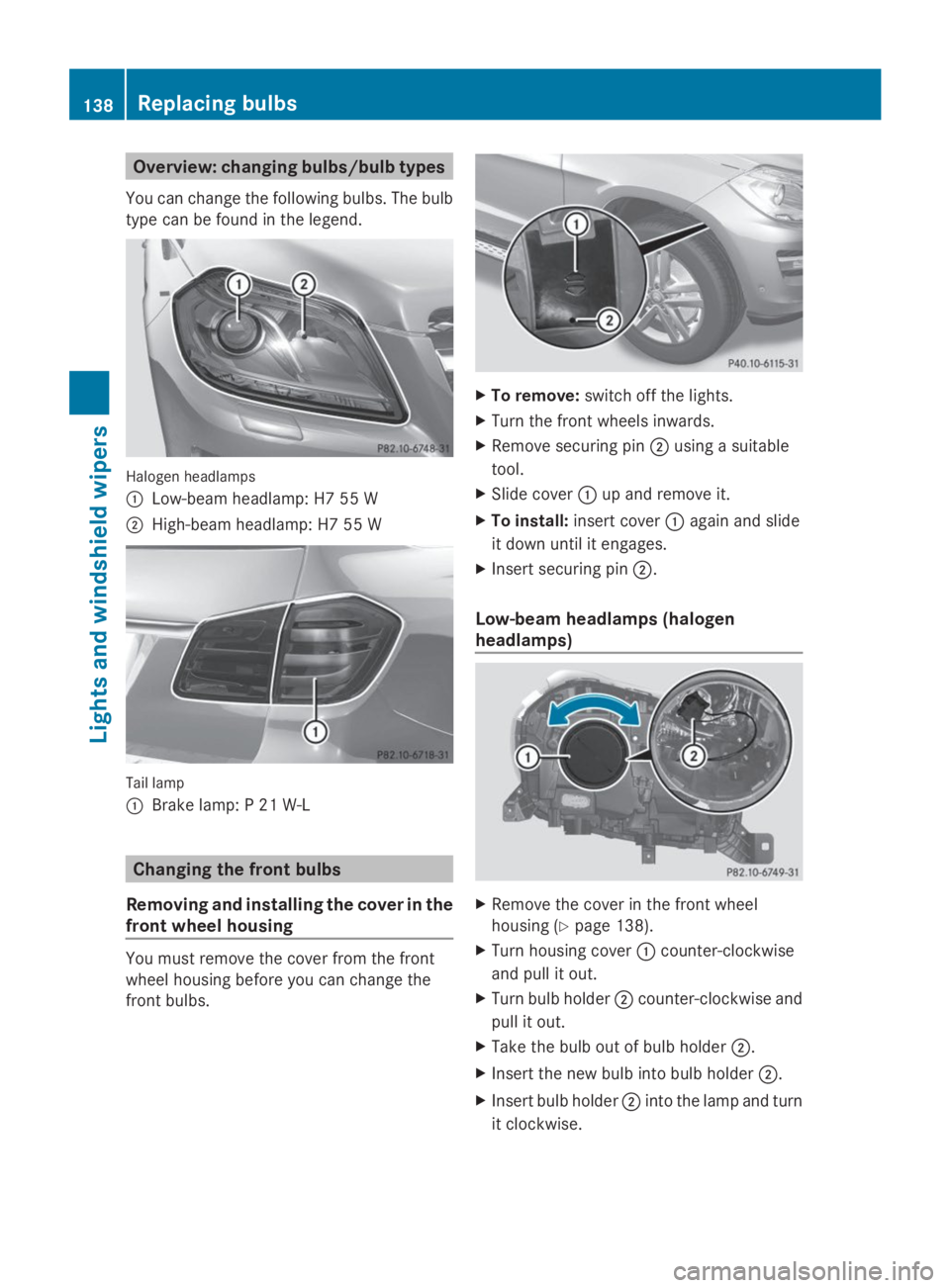
Overview: changing bulbs/bulb types
You can change the following bulbs. The bulb
type can be found in the legend.
Halogen headlamps
CLow-beam headlamp: H7 55 W
DHigh-beam headlamp: H7 55 W
Tail lamp
CBrake lamp: P 21 W-L
Changing the front bulbs
Removing and installing the cover in the
front wheel housing
You must remove the cover from the front
wheel housing before you can change the
front bulbs.
XTo remove:switch off the lights.
XTurn the front wheels inwards.
XRemove securing pinDusing a suitable
tool.
XSlide coverCup and remove it.
XTo install:insert coverCagain and slide
it down until it engages.
XInsert securing pinD.
Low-beam headlamps (halogen
headlamps)
XRemove the cover in the front wheel
housing (Ypage 138).
XTurn housing coverCcounter-clockwise
and pull it out.
XTurn bulb holderDcounter-clockwise and
pull it out.
XTake the bulb out of bulb holderD.
XInsert the new bulb into bulb holderD.
XInsert bulb holderDinto the lamp and turn
it clockwise.
138Replacing bulbs
Lights and windshield wipers
Page 141 of 462
XAlign housing coverCand turn it
clockwise until it engages.
XReplace the cover in the front wheel
housing (Ypage 138).
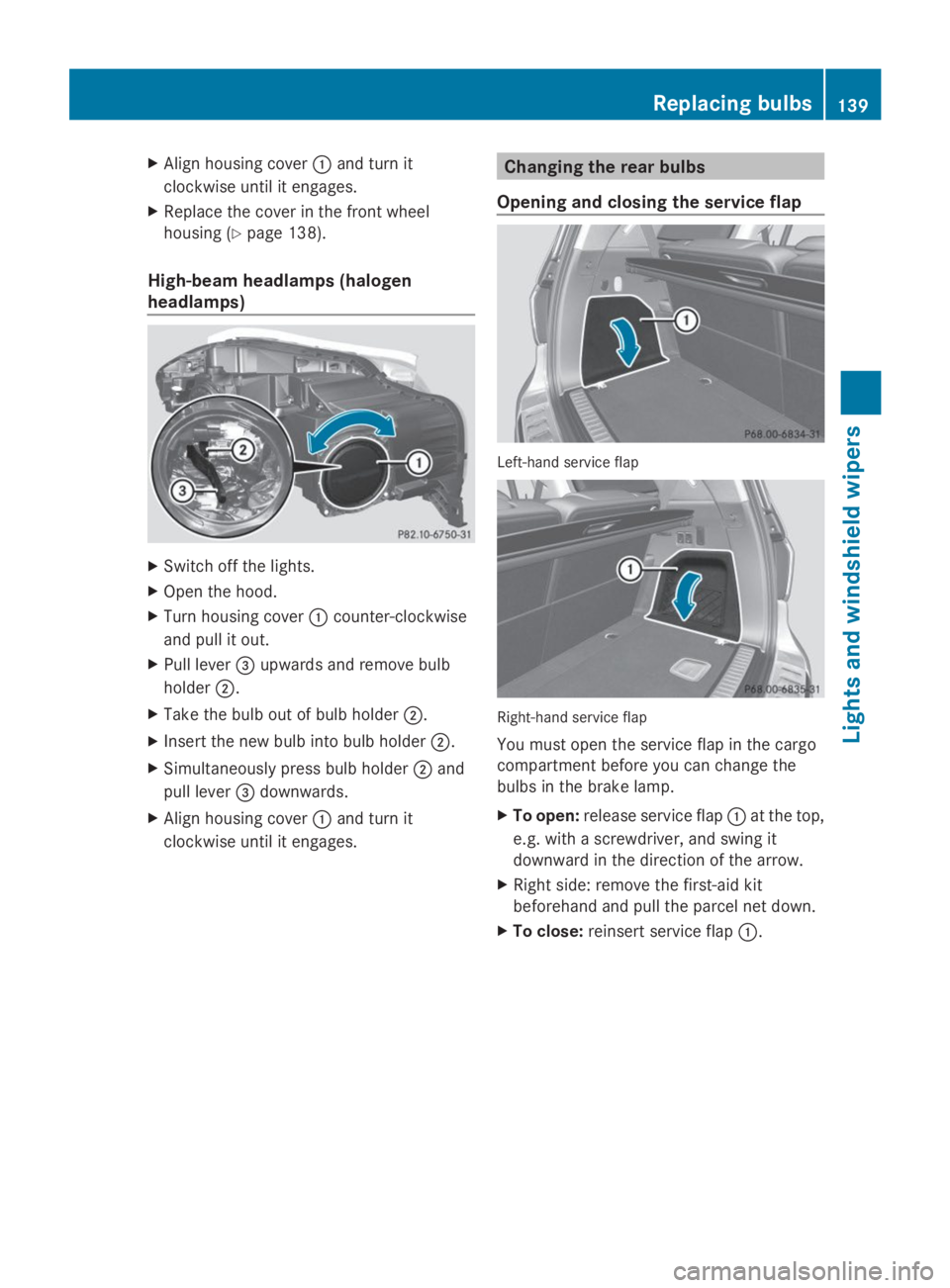
High-beam headlamps (halogen
headlamps)
XSwitch off the lights.
XOpen the hood.
XTurn housing coverCcounter-clockwise
and pull it out.
XPull lever
Page 142 of 462
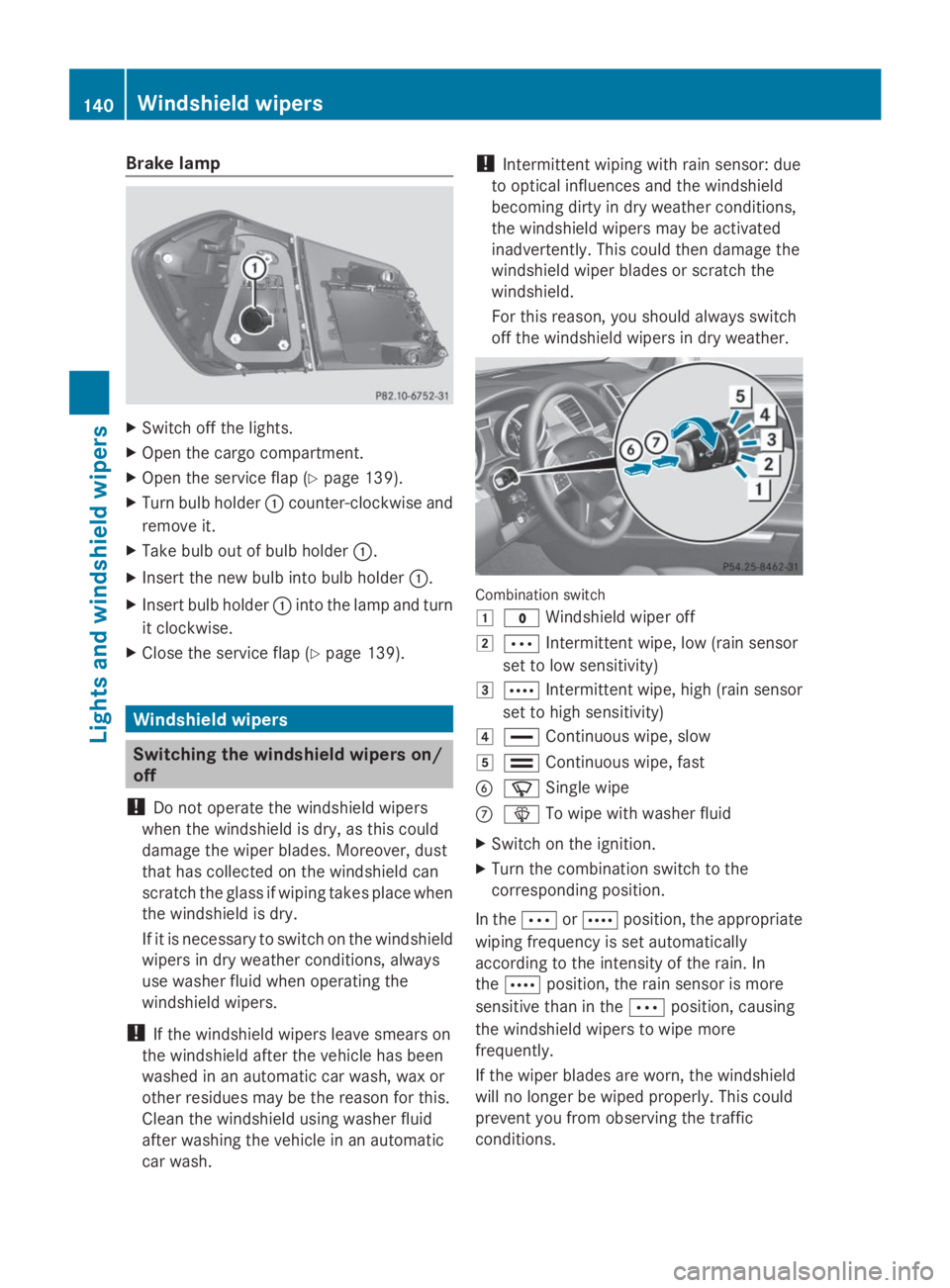
Brake lamp
XSwitch off the lights.
XOpen the cargo compartment.
XOpen the service flap (Ypage 139).
XTurn bulb holderCcounter-clockwise and
remove it.
XTake bulb out of bulb holderC.
XInsert the new bulb into bulb holderC.
XInsert bulb holderCinto the lamp and turn
it clockwise.
XClose the service flap (Ypage 139).
Windshield wipers
Switching the windshield wipers on/
off
!Do not operate the windshield wipers
when the windshield is dry, as this could
damage the wiper blades. Moreover, dust
that has collected on the windshield can
scratch the glass if wiping takes place when
the windshield is dry.
If it is necessary to switch on the windshield
wipers in dry weather conditions, always
use washer fluid when operating the
windshield wipers.
!If the windshield wipers leave smears on
the windshield after the vehicle has been
washed in an automatic car wash, wax or
other residues may be the reason for this.
Clean the windshield using washer fluid
after washing the vehicle in an automatic
car wash.
!Intermittent wiping with rain sensor: due
to optical influences and the windshield
becoming dirty in dry weather conditions,
the windshield wipers may be activated
inadvertently. This could then damage the
windshield wiper blades or scratch the
windshield.
For this reason, you should always switch
off the windshield wipers in dry weather.
Combination switch
G?Windshield wiper off
HbIntermittent wipe, low (rain sensor
set to low sensitivity)
IcIntermittent wipe, high (rain sensor
set to high sensitivity)
J
Page 144 of 462
Installing the wiper blades
XPosition new wiper bladeCin the retainer
on the wiper arm and slide it into place in
the direction of the arrow.
The wiper blade audibly engages.
XMake sure that the wiper blade is seated
correctly.
XFold the wiper arm back onto the
windshield.
Replacing the rear window wiper blade
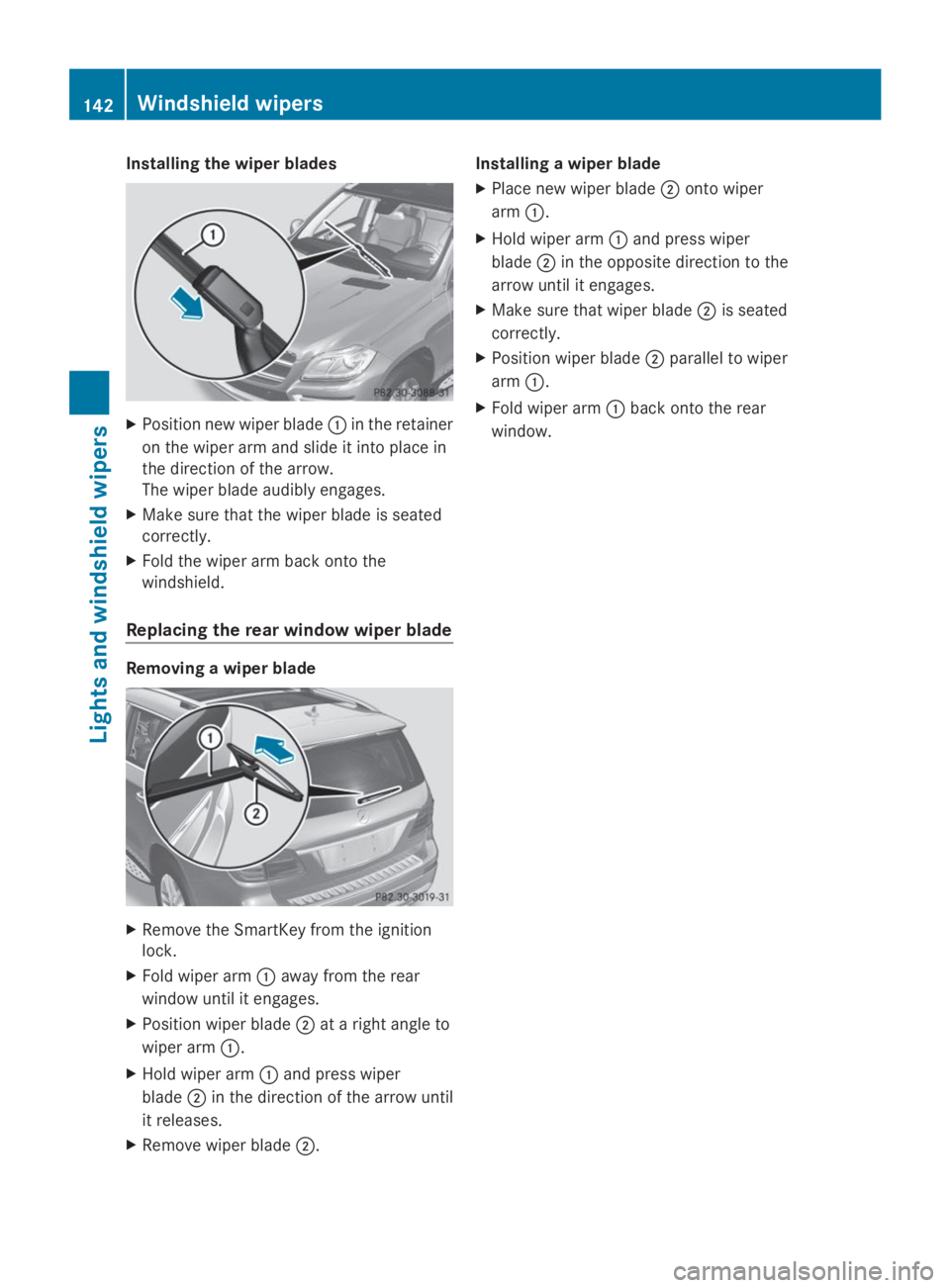
Removing a wiper blade
XRemove the SmartKey from the ignition
lock.
XFold wiper armCaway from the rear
window until it engages.
XPosition wiper bladeDat a right angle to
wiper armC.
XHold wiper armCand press wiper
bladeDin the direction of the arrow until
it releases.
XRemove wiper bladeD.
Installing a wiper blade
XPlace new wiper bladeDonto wiper
armC.
XHold wiper armCand press wiper
bladeDin the opposite direction to the
arrow until it engages.
XMake sure that wiper bladeDis seated
correctly.
XPosition wiper bladeDparallel to wiper
armC.
XFold wiper armCback onto the rear
window.
142Windshield wipers
Lights and windshield wipers
Page 145 of 462
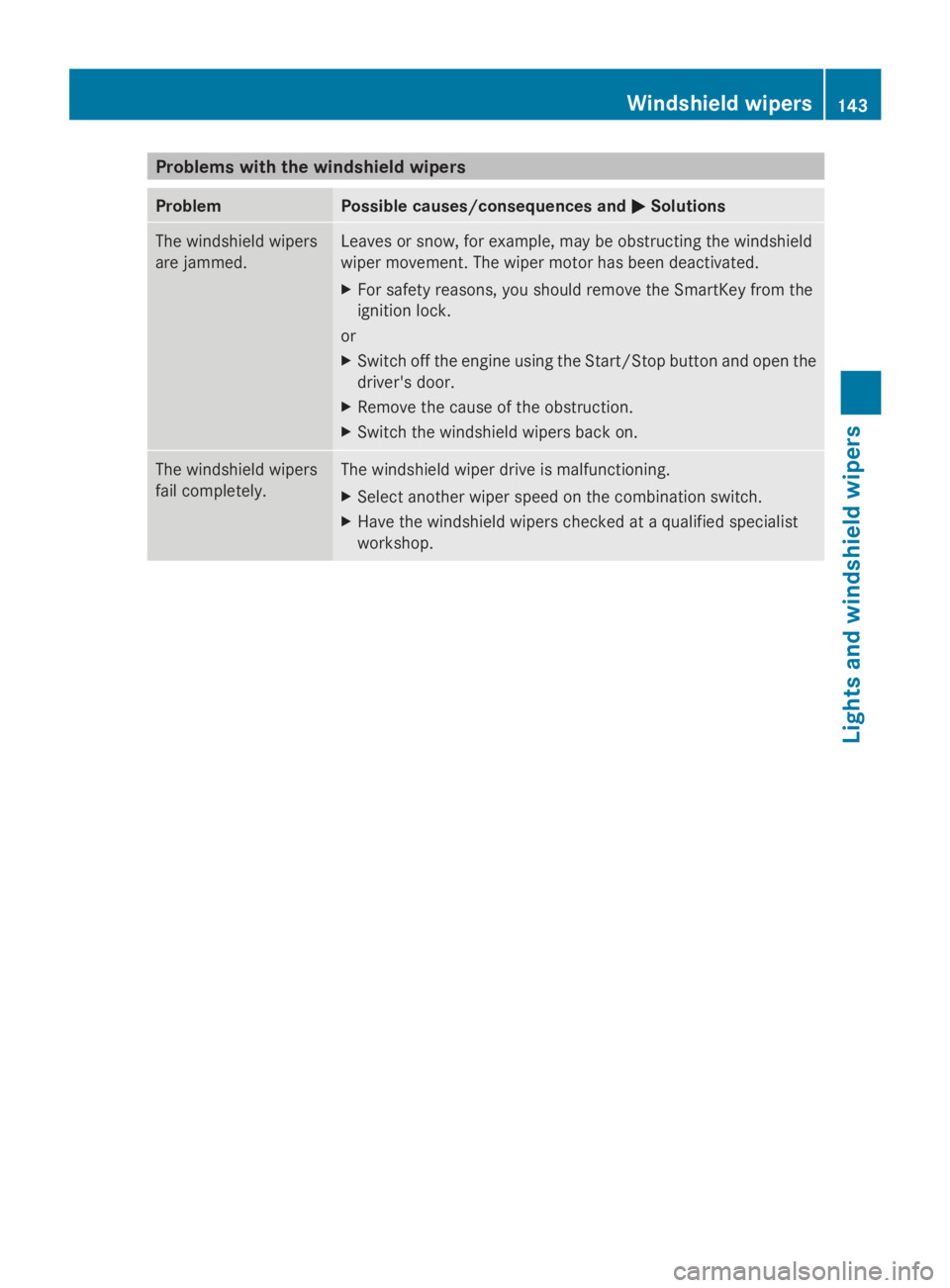
Problems with the windshield wipers
ProblemPossible causes/consequences andPPSolutions
The windshield wipers
are jammed.
Leaves or snow, for example, may be obstructing the windshield
wiper movement. The wiper motor has been deactivated.
XFor safety reasons, you should remove the SmartKey from the
ignition lock.
or
XSwitch off the engine using the Start/Stop button and open the
driver's door.
XRemove the cause of the obstruction.
XSwitch the windshield wipers back on.
The windshield wipers
fail completely.
The windshield wiper drive is malfunctioning.
XSelect another wiper speed on the combination switch.
XHave the windshield wipers checked at a qualified specialist
workshop.
Windshield wipers143
Lights and windshield wipers
Z