2014 MERCEDES-BENZ GL engine overheat
[x] Cancel search: engine overheatPage 372 of 462
Useful information
iThis Operator's Manual describes all
models and all standard and optional
equipment of your vehicle available at the
time of publication of the Operator's
Manual. Country-specific differences are
possible. Please note that your vehicle may
not be equipped with all features
described. This also applies to safety-
related systems and functions.
iRead the information on qualified
specialist workshops: (Ypage 28).
Engine compartment
Hood
Important safety notes
GWARNING
If the hood is unlatched, it may open up when
the vehicle is in motion and block your view.
There is a risk of an accident.
Never unlatch the hood while driving.
GWARNING
When opening and closing the hood, it may
suddenly fall into the closed position. There is
a risk of injury to persons within range of
movement of the hood.
Open and close the hood only when no one is
within its range of movement.
GWARNING
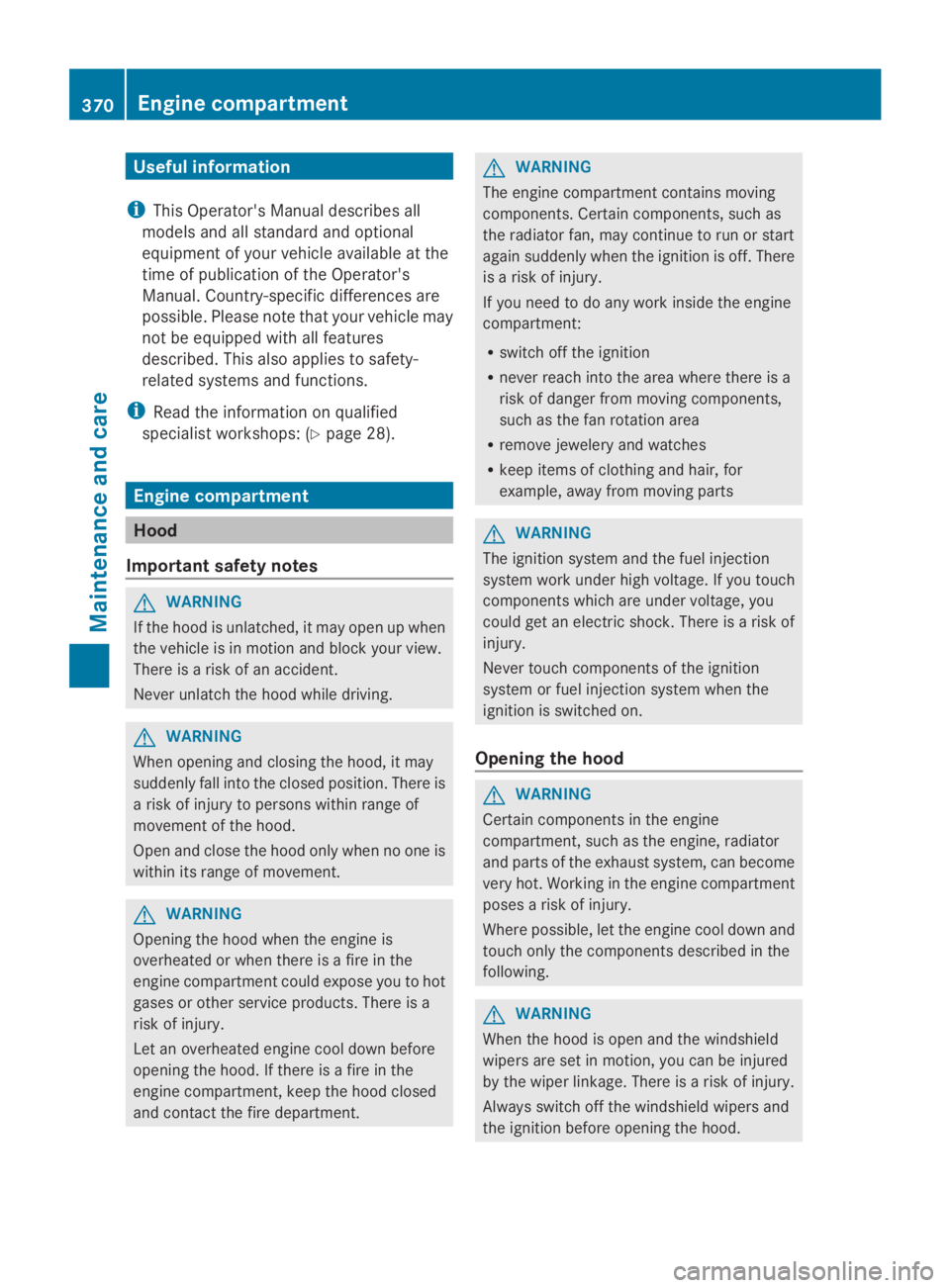
Opening the hood when the engine is
overheated or when there is a fire in the
engine compartment could expose you to hot
gases or other service products. There is a
risk of injury.
Let an overheated engine cool down before
opening the hood. If there is a fire in the
engine compartment, keep the hood closed
and contact the fire department.
GWARNING
The engine compartment contains moving
components. Certain components, such as
the radiator fan, may continue to run or start
again suddenly when the ignition is off. There
is a risk of injury.
If you need to do any work inside the engine
compartment:
Rswitch off the ignition
Rnever reach into the area where there is a
risk of danger from moving components,
such as the fan rotation area
Rremove jewelery and watches
Rkeep items of clothing and hair, for
example, away from moving parts
GWARNING
The ignition system and the fuel injection
system work under high voltage. If you touch
components which are under voltage, you
could get an electric shock. There is a risk of
injury.
Never touch components of the ignition
system or fuel injection system when the
ignition is switched on.
Opening the hood
GWARNING
Certain components in the engine
compartment, such as the engine, radiator
and parts of the exhaust system, can become
very hot. Working in the engine compartment
poses a risk of injury.
Where possible, let the engine cool down and
touch only the components described in the
following.
GWARNING
When the hood is open and the windshield
wipers are set in motion, you can be injured
by the wiper linkage. There is a risk of injury.
Always switch off the windshield wipers and
the ignition before opening the hood.
370Engine compartment
Maintenance and care
Page 449 of 462
RGasoline with metalliferous additives
RDiesel
Do not mix such fuels with the fuel
recommended for your vehicle. Do not use
additives. This can otherwise lead to engine
damage. This does not include cleaning
additives for the removal and prevention of
residue build-up. gasoline may only be
mixed with cleaning additives
recommended by Mercedes-Benz; see
"Additives". You can obtain further
information from any authorized Mercedes-
Benz Center.
!To ensure the longevity and full
performance of the engine, only premium-
grade unleaded gasoline must be used.
If standard unleaded gasoline is
unavailable and you have to refuel with
unleaded gasoline of a lower grade,
observe the following precautions:
ROnly fill the fuel tank to half full with
regular unleaded gasoline and fill the rest
with premium-grade unleaded gasoline
as soon as possible.
RDo not drive at the maximum speed.
RAvoid sudden acceleration and engine
speeds over 3,000 rpm.
Using mixtures of methanol and ethanol is not
permitted. E10 fuel or E15 fuel (unleaded
gasoline with 10% or 15% ethanol) can be
used.
You will usually find information about the fuel
grade on the pump. If you cannot find the
label on the pump, ask the staff for
assistance.
iFor further information, consult a
qualified specialist workshop or visit
http://www.mbusa.com (USA only).
All other models: as a temporary measure, if
the recommended fuel is not available, you
may also use regular unleaded gasoline with
an octane rating of 87 RON/91 MON. This
may reduce engine performance and increase
fuel consumption. Avoid driving at full throttle
and sudden acceleration. Never refuel using
fuel with a lower octane rating.
Information on refueling (Ypage 183).
Additives
!Operating the engine with fuel additives
added later can lead to engine failure. Do
not mix fuel additives with fuel. This does
not include additives for the removal and
prevention of residue buildup. gasoline
must only be mixed with additives
recommended by Mercedes-Benz. Comply
with the instructions for use on the product
label. More information about
recommended additives can be obtained
from any authorized Mercedes-Benz
Center.
Mercedes-Benz recommends that you use
branded fuels that have additives.
The quality of the fuel available in some
countries may not be sufficient. Residue
could build up in the injection system as a
result. In such cases, and in consultation with
an authorized Mercedes-Benz Center, the
gasoline may be mixed with the cleaning
additive recommended by Mercedes-Benz.
You must observe the notes and mixing ratios
specified on the container.
Diesel
Fuel grade
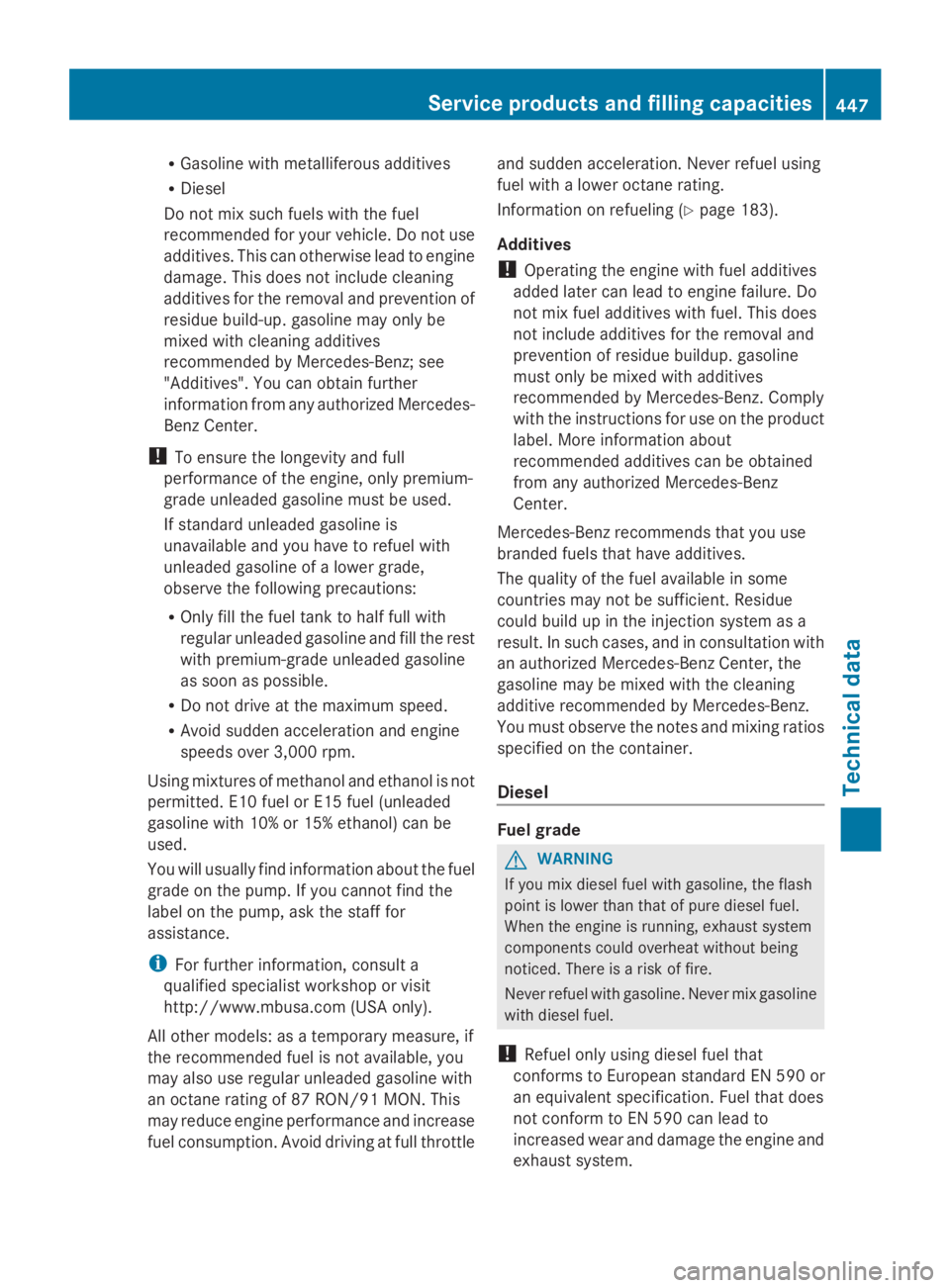
GWARNING
If you mix diesel fuel with gasoline, the flash
point is lower than that of pure diesel fuel.
When the engine is running, exhaust system
components could overheat without being
noticed. There is a risk of fire.
Never refuel with gasoline. Never mix gasoline
with diesel fuel.
!Refuel only using diesel fuel that
conforms to European standard EN 590 or
an equivalent specification. Fuel that does
not conform to EN 590 can lead to
increased wear and damage the engine and
exhaust system.
Service products and filling capacities447
Technical data
Z
Page 453 of 462
Further information on coolants can be
found in the Mercedes-Benz Specifications
for Service Products, MB Specifications for
Service Products 310.1, e.g. on the
Internet at
http://bevo.mercedes-benz.com. Or
contact a qualified specialist workshop.
!Always use a suitable coolant mixture,
even in countries where high temperatures
prevail.
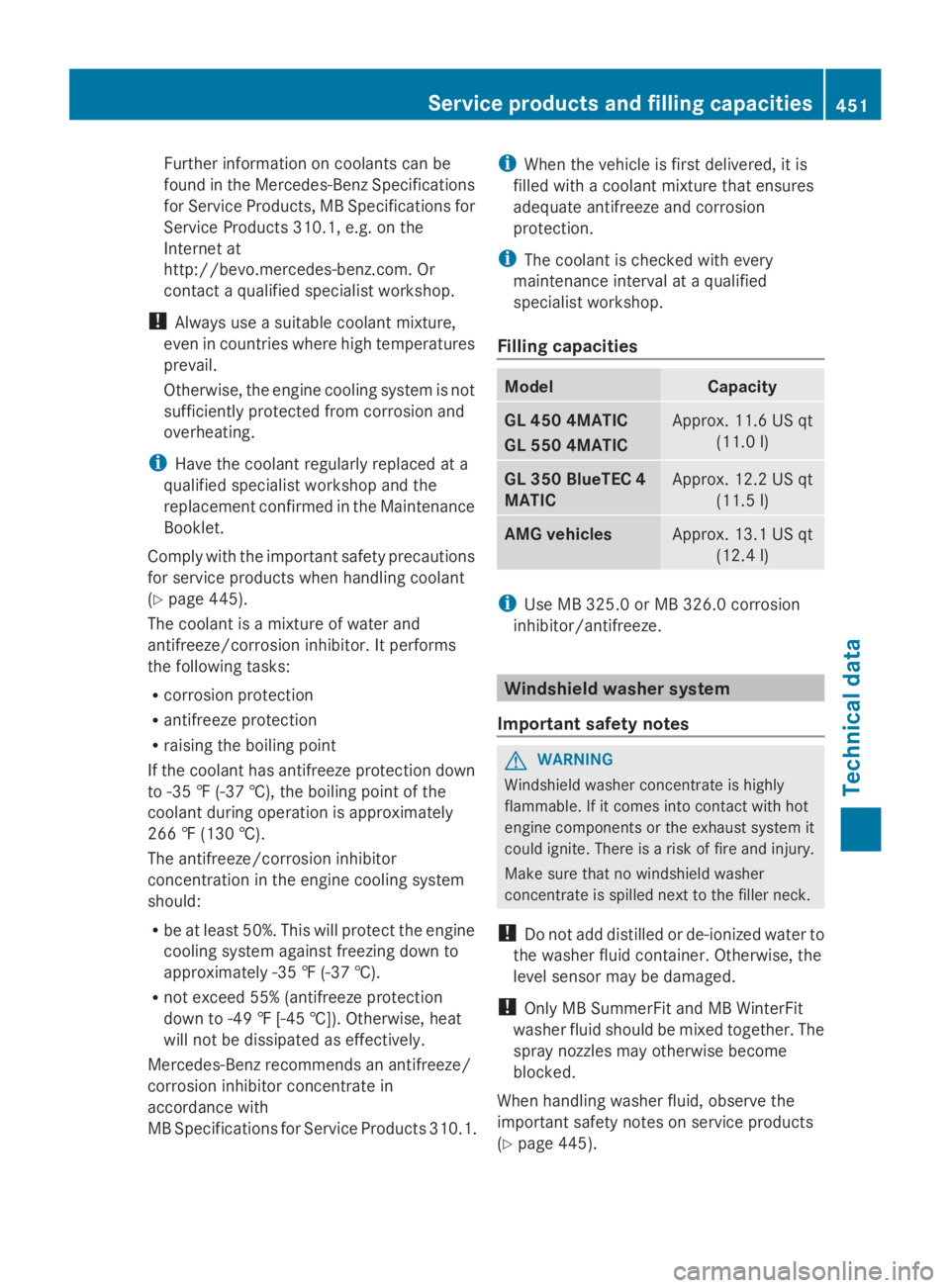
Otherwise, the engine cooling system is not
sufficiently protected from corrosion and
overheating.
iHave the coolant regularly replaced at a
qualified specialist workshop and the
replacement confirmed in the Maintenance
Booklet.
Comply with the important safety precautions
for service products when handling coolant
(Ypage 445).
The coolant is a mixture of water and
antifreeze/corrosion inhibitor. It performs
the following tasks:
Rcorrosion protection
Rantifreeze protection
Rraising the boiling point
If the coolant has antifreeze protection down
to -35 ‡ (-37†),the boiling point of the
coolant during operation is approximately
266‡ (130 †).
The antifreeze/corrosion inhibitor
concentration in the engine cooling system
should:
Rbe at least 50%. This will protect the engine
cooling system against freezing down to
approximately -35‡ (-37 †).
Rnot exceed 55% (antifreeze protection
down to -49‡ [-45 †]). Otherwise, heat
will not be dissipated as effectively.
Mercedes-Benz recommends an antifreeze/
corrosion inhibitor concentrate in
accordance with
MB Specifications for Service Products 310.1.
iWhen the vehicle is first delivered, it is
filled with a coolant mixture that ensures
adequate antifreeze and corrosion
protection.
iThe coolant is checked with every
maintenance interval at a qualified
specialist workshop.
Filling capacities
ModelCapacity
GL 450 4MATIC
GL 550 4MATIC
Approx. 11.6 US qt
(11.0 l)
GL 350 BlueTEC 4
MATIC
Approx. 12.2 US qt
(11.5 l)
AMG vehiclesApprox. 13.1 US qt
(12.4 l)
iUse MB 325.0 or MB 326.0 corrosion
inhibitor/antifreeze.
Windshield washer system
Important safety notes
GWARNING
Windshield washer concentrate is highly
flammable. If it comes into contact with hot
engine components or the exhaust system it
could ignite. There is a risk of fire and injury.
Make sure that no windshield washer
concentrate is spilled next to the filler neck.
!Do not add distilled or de-ionized water to
the washer fluid container. Otherwise, the
level sensor may be damaged.
!Only MB SummerFit and MB WinterFit
washer fluid should be mixed together. The
spray nozzles may otherwise become
blocked.
When handling washer fluid, observe the
important safety notes on service products
(Ypage 445).
Service products and filling capacities451
Technical data
Z