2014 MERCEDES-BENZ G-Class Low range
[x] Cancel search: Low rangePage 148 of 354

Selector lever
005D
Park position
005E Reverse gear
005C Neutral
005B Drive
When you select a transmission position, the
selector lever subsequently returns to its
original position.
The current transmission position P,R, Nor
D appears in the transmission position
display in the multifunction display.
Transmission position and drive
program display !
If the transmission position display in the
multifunction display is not working, you
should pull away carefully to check whether
the desired transmission position is
engaged. Select transmission position D.
Do not restrict the shift range. 0043
Transmission position
0044 Drive program
Current transmission position 0043and current
drive program 0044appear in the multifunction
display. The current position of the selector lever is
shown by the indicators next to the selector
lever.
The indicators light up when the SmartKey is
inserted into the ignition lock. The indicators
go out when the SmartKey is removed from
the ignition lock.
When the selector lever is in position
D, you
can influence the gearshifts made by the
automatic transmission by:
R restricting the shift range
R changing gear yourself
Engaging park position P X
When the vehicle is stationary, depress the
brake pedal and keep it depressed.
X Press the Pbutton in the center console.
i If you depress the brake pedal and push
the selector lever forwards or back to the
first point of resistance, park position Pis
disengaged. The transmission shifts to
neutral N.
Park position Pis automatically engaged:
R if you remove the SmartKey from the
ignition lock
R if you open the driver's door while traveling
at low speed in transmission position Dor
R
R if DISTRONIC PLUS (Y page 176) brakes
your vehicle until it is stationary and at least
one of the following conditions is fulfilled:
- the engine is switched off.
- the driver's door is open and the seat belt
is not fastened.
- there is a system malfunction.
- the power supply is insufficient.
Engaging reverse gear R !
Only shift the automatic transmission to
R when the vehicle is stationary. 146
Automatic transmissionDriving and parking
Page 150 of 354

Transmission positions
0045
Park position
Do not shift the transmission into
position P(Y page 145) unless the
vehicle is stationary. The parking
lock should not be used as a brake
when parking. In addition to
engaging the parking lock, you
must always apply the parking
brake to secure the vehicle.
i The SmartKey can only be
removed if the transmission is in
position P. When there is no
SmartKey in the ignition lock, the
selector lever is locked in
position P.
Have the vehicle electronics
checked immediately at a qualified
specialist workshop. 0046
Reverse gear
Only shift the transmission to R
when the vehicle is stationary. 0044
Neutral
No power is transmitted from the
engine to the drive wheels.
Releasing the brakes will allow you
to move the vehicle freely, e.g. to
push it or tow it.
Do not shift the transmission to
N
while driving. Otherwise, the
automatic transmission could be
damaged.
If ESP ®
is deactivated or faulty:
only shift the transmission to
position Nif the vehicle is in danger
of skidding, e.g. on icy roads.
If you want to engage the transfer
case, shift briefly into N
(Y page 194).
! Rolling in neutral Ncan damage
the drive train. 003A
Drive
The automatic transmission
changes gear automatically. All
forward gears are available.
Changing gear
The automatic transmission shifts to the
individual gears automatically when it is in
transmission position D. This automatic
gearshifting behavior is determined by:
R a shift range restriction, if selected
R the position of the transfer case ( HIGH
RANGE orLOW RANGE)
R the position of the accelerator pedal
R the road speed 148
Automatic transmissionDriving an
d parking
Page 151 of 354
Driving tips
Accelerator pedal position Your style of driving influences how the
automatic transmission shifts gear:
R little throttle: early upshifts
R more throttle: late upshifts
Kickdown Use kickdown for maximum acceleration:
X Depress the accelerator pedal beyond the
pressure point.
The automatic transmission shifts to a
lower gear depending on the engine speed.
X Ease off the accelerator pedal once the
desired speed is reached.
The automatic transmission shifts back up.
Rocking the vehicle free Rocking the vehicle free by shifting back and
forth between transmission positions Dand
R can help to free a vehicle that has become
stuck in mud or snow. The vehicle's engine
management restricts switching between
transmission positions Dand Rto speeds up
to a maximum of 5 mph (9 km/h). To shift
back and forth between transmission
positions Dand R, move the selector lever
forwards and backwards past the point of
resistance.
Towing a trailer X
Drive in the middle of the engine speed
range on uphill gradients.
X Limit shift range to 3or 2depending on the
uphill or downhill gradient ( Ypage 150),
even if cruise control or SPEEDTRONIC is
activated.
X Shift the transfer case into low-range
driving position LOW RANGEon extreme
uphill gradients or steep downhill gradients
(Y page 194). Program selector button
General notes The program selector button allows you to
choose between drive programs with
different driving characteristics.
i
In AMG vehicles, drive program Eis called
drive program C.
Drive programs E
Economy
C Controlled
Efficiency Comfortable, economical
driving
S
Sport Sporty driving style
M
Manual Manual gear shifting
i
When the engine is started, the automatic
transmission always switches to automatic
drive program E(drive program Cin AMG
vehicles).
i For further information on the automatic
drive program, see (Y page 150).
i Only change from automatic drive
program Eor Sto manual drive program
M when the vehicle is stationary.
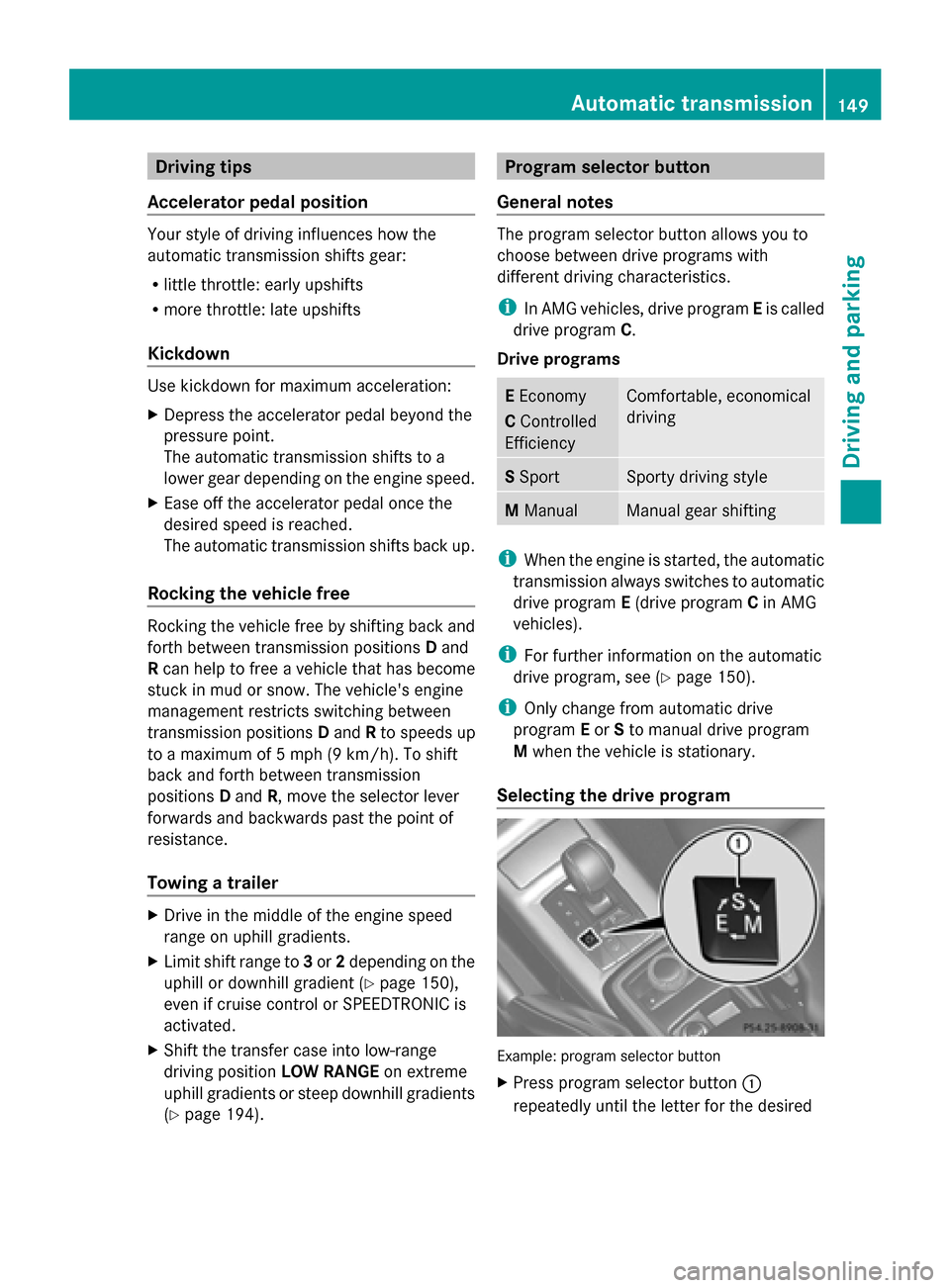
Selecting the drive program Example: program selector button
X
Press program selector button 0043
repeatedly until the letter for the desired Automatic transmission
149Driving and parking Z
Page 152 of 354

gearshift program appears in the
multifunction display.
i Only change from automatic drive
program Eor Sto manual drive program
M when the vehicle is stationary. Steering wheel paddle shifters
In the automatic drive program, you can
restrict or derestrict the shift range by using
steering wheel paddle shifters 0043and 0044
(Y page 150).
In the manual drive program you can change
gears manually using steering wheel paddle
shifters 0043and 0044(Y page 151).
i You can only change gear with the
steering wheel paddle shifters when the
transmission is in position D.Automatic drive program
Drive program E(drive program Con AMG
vehicles) is characterized by the following:
R comfort-oriented engine and transmission
settings
R optimal fuel consumption resulting from
the automatic transmission shifting up
sooner
R the vehicle pulling away more gently in
forward and reverse gears, unless the
accelerator pedal is depressed fully R
increased sensitivity. This improves driving
stability on slippery road surfaces, for
example
R the automatic transmission shifting up
sooner. This results in the vehicle being
driven at lower engine speeds and the
wheels being less likely to spin
Drive program Sis characterized by the
following:
R sporty engine and transmission settings
R the vehicle pulling away in first gear
R the automatic transmission shifting up
later
R the fuel consumption possibly being higher
as a result of the later automatic
transmission shift points Shift ranges
Introduction When the automatic transmission is in
position
D, it is possible to restrict or
derestrict the shift range.
The shift range selected is shown in the
multifunction display. The automatic
transmission shifts only as far as the selected
gear.
Driving situations 0040
You can use the engine's braking
effect.
0038
The braking effect of the engine can
be utilized on downhill gradients or
when driving:
R
on steep mountain roads
R in mountainous terrain
R in arduous conditions 0037
The braking effect of the engine can
be utilized on extremely steep
downhill gradients and long
downhill stretches.150
Automatic transmissionDriving and parking
Page 153 of 354

Restricting the shift range
X
Pull the left-hand steering wheel paddle
shifter (Y page 150).
The automatic transmission shifts down
one gear and restricts the shift range to the
relevant gear.
i If the engine exceeds the maximum
engine speed when shifting down, the
automatic transmission protects against
engine damage by not shifting down.
i If the maximum engine speed for the shift
range is reached and you continue to
accelerate, the automatic transmission
shifts up in order to prevent the engine
from overrevving, even if the shift range is
restricted.
Derestricting the shift range X
Pull the right-hand steering wheel paddle
shifter (Y page 150).
The automatic transmission shifts up one
gear and restricts the shift range to the
relevant gear.
Clearing the shift range restriction X
Pull and hold the right-hand steering wheel
paddle shifter (Y page 150) untilDis shown
again in the multifunction display.
The automatic transmission shifts from the
current shift range directly to D.
Selecting the ideal shift range X
Pull the left-hand steering wheel paddle
shifter (Y page 150) and hold it in position.
The automatic transmission shifts to the
gear which allows optimum acceleration
and deceleration. To do this, the automatic
transmission shifts down one or more
gears.
i The automatic transmission cannot shift
down beyond second gear. To shift to first
gear, you have to pull the left steering
wheel paddle shifter. Manual drive program
Introduction In drive program
M, you can change gear
manually using the steering wheel paddle
shifters. For this, the transmission must be in
position D. The gear currently selected and
engaged is shown in the multifunction
display.
Manual drive program Mdiffers from drive
programs Eand Swith regard to spontaneity,
responsiveness and smoothness of gear
changes.
Switching on the manual drive program X
Press the program selector button
(Y page 149) repeatedly until Mappears in
the multifunction display.
Upshifting (except AMG vehicles) X
Pull the right-hand paddle (Y page 150).
The automatic transmission shifts up to the
next gear.
Shifting up (AMG vehicles) !
In manual drive program M, the automatic
transmission does not shift up
automatically even when the engine
limiting speed for the current gear is
reached. When the engine limiting speed is
reached, the fuel supply is cut to prevent
the engine from overrevving. Always make
sure that the engine speed does not reach
the red area of the tachometer. There is
otherwise a risk of engine damage.
X Pull the right-hand paddle (Y page 150).
The automatic transmission shifts up to the
next gear.
Before the engine speed reaches the red area,
an upshift indicator will be shown in the
multifunction display.
X If the color in the speedometer
multifunction display changes to red and Automatic transmission
151Driving and parking Z
Page 164 of 354

If you brake the vehicle with the parking
brake, the brake lamps will not light up.
If you drive on wet roads or dirt-covered
surfaces, road salt and/or dirt could get into
the parking brake.
In order to prevent corrosion and a reduction
in the braking power of the parking brake,
observe the following:
R pull the parking brake upwards with the
release button depressed from time to time
before beginning the journey
(Y page 157).
R drive for approximately 110 yds (100 m)at
a maximum speed of 12 mph (20 km/h). Driving on wet roads
Hydroplaning If water has accumulated to a certain depth
on the road surface, there is a danger of
hydroplaning occurring, even if:
R you drive at low speeds.
R the tires have adequate tread depth.
For this reason, in the event of heavy rain or
in conditions in which hydroplaning may
occur, you must drive in the following
manner:
R lower your speed.
R avoid ruts.
R brake carefully.
Driving on flooded roads !
Do not drive through flooded areas.
Check the depth of any water before driving
through it. Drive slowly through standing
water. Otherwise, water may enter the
vehicle interior or the engine compartment.
This can damage the electronic
components in the engine or the automatic
transmission. Water can also be drawn in
by the engine's air suction nozzles and this
can cause engine damage. If you have to drive on stretches of road on
which water has collected, please bear in
mind that:
R the maximum permissible still water depth
depends on the vehicle equipment
R you should drive no faster than at walking
pace
Off-road fording !
Under no circumstances should you
accelerate before entering the water. The
bow wave could cause water to enter and
damage the engine and other assemblies.
! Do not open any of the vehicle's doors
while fording. Otherwise, water could get
into the vehicle interior and damage the
vehicle's electronics and interior
equipment. 0043
Fording depth, 24 in (60 cm)
i You may only drive through fresh water.
R Observe the safety notes (Y page 164) and
the general notes (Y page 164) on off-road
driving.
R Establish how deep the water is and the
characteristics of the body of water before
fording.
R Switch off the air-conditioning system.
R Shift the transfer case to LOW
RANGE(Y page 193).
R Engage the differential locks, if necessary
(Y page 196).
R Restrict the shift range to 1or
2(Y page 150). 162
Driving tipsDriving and parking
Page 166 of 354

Never activate the LOW off-road gear while
driving on a slippery road surface.
Drive particularly carefully on slippery road
surfaces. Avoid sudden acceleration, steering
and braking maneuvers. Do not use cruise
control.
If the vehicle threatens to skid or cannot be
stopped when moving at low speed:
X Shift the transmission to position N.
X Try to bring the vehicle under control using
corrective steering.
i For more information on driving with
snow chains, see (Y page 315).Off-road driving
Important safety notes G
WARNING
Do not load items on the basic carrier bars. It
may cause instability during some maneuvers
which could result in an accident.
Drive slowly in unknown terrain. This will
make it easier to recognize unexpected
obstacles and avoid damage to the vehicle.
To help avoid the vehicle rolling over, never
turn it around on steep inclines. If the vehicle
cannot complete the attempted climb, back it
down in reverse gear.
Do not drive along the side of a slope. The
vehicle might otherwise rollover. If in doing so
the vehicle begins to show a tendency to roll,
immediately steer into a line of gravity
(straight up or downhill).
Never let the vehicle roll backwards in idle.
You may lose control of the vehicle if you use
only the service brake. For information on
driving downhill, see "Driving downhill".
When driving off-road, sand, mud and water,
possibly mixed with oil, for example, could get
into the brakes. This could result in a reduced
braking effect or in total brake failure and also
in increased wear and tear. The braking
characteristics change depending on the material ingressing the brakes. Clean the
brakes after driving off-road. If you detect a
reduced braking effect or grinding noises,
have the brake system checked in a qualified
specialist workshop as soon as possible.
Adapt your driving style to the different
braking characteristics.
Driving off-road increases the likelihood of
damage to the vehicle, which, in turn, can lead
to failure of the mechanical assembly or
systems. Adapt your driving style to suit the
terrain conditions. Drive carefully. Have
damage to the vehicle rectified immediately
at a qualified specialist workshop.
General notes H
Environmental note
Protection of the environment is of primary
importance. Treat nature with respect.
Observe all prohibiting signs.
Read this section carefully before driving your
vehicle off-road. Practice by driving over more
gentle off-road terrain first.
Familiarize yourself with the characteristics
of your vehicle and the gear shift operation
before driving through difficult terrain.
The following driving systems are specially
adapted to off-road driving:
R 4ETS (Y page 62)
R Transfer case (Y page 193)
R Differential locks (Y page 195)
Observe the following notes:
R stop your vehicle and, if necessary, shift the
transfer case to LOW
RANGE(Y page 194) before driving off-
road.
R AMG vehicles: to shift the transfer case to
LOW RANGE, deactivate the ECO start/
stop function (Y page 142).
R engage the differential locks, if necessary
(Y page 196).
i ABS, 4ETS, ESP ®
and BAS are deactivated
when the differential locks are activated. 164
Driving tipsDriving and parking
Page 168 of 354

Checklist after driving off-road
Driving over rough terrain places greater
demands on your vehicle than driving on
normal roads. After driving off-road, check
the vehicle. This allows you to detect damage
promptly and reduce the risk of an accident
to yourself and other road users.
X Shift the transfer case to HIGH
RANGE(Y page 194).
X Disengage the differential locks
(Y page 198).
X Clean the headlamps and rear lights and
check for damage.
X Clean the front and rear license plates.
X Clean the wheels and tires with a water jet
and remove any foreign objects.
X Clean the wheels, tires, wheel housings and
the vehicle underside with a water jet;
check for any foreign objects and damage.
X Check whether twigs or other parts of
plants have become trapped. These
increase the risk of fire and can damage
fuel pipes, brake hoses or the rubber
bellows of the axle joints and propeller
shafts.
X After the trip, examine without fail the
entire undercarriage, wheels, tires, brakes,
bodywork structure, steering, chassis and
exhaust system for damage.
X After driving for extended periods across
sand, mud, gravel, water or in similarly dirty
conditions, have the brake discs, wheels,
brake pads/linings and axle joints checked
and cleaned.
X If you notice strong vibrations after off-road
driving, check for foreign objects in the
wheels and drive train and, if necessary,
remove them.
Foreign objects can disturb the balance
and cause vibrations.
X Test the brakes. Driving on sand Observe the following rules when driving on
sand:
R Shift the transfer case to LOW
RANGE(Y page 194).
R Avoid high engine speeds.
R Limit the shift range of the automatic
transmission according to the off-road
conditions.
R Drive quickly to overcome the rolling
resistance. Otherwise the vehicle's wheels
could become stuck in loose ground.
R Drive in the tracks of other vehicles if
possible. When doing so, make sure that:
- the tire ruts are not too deep.
- the sand is sufficiently firm.
- your vehicle has sufficient ground
clearance
Tire ruts and gravel roads !
Check that the ruts are not too deep and
that your vehicle has sufficient clearance.
Otherwise, your vehicle could be damaged
or bottom out and get stuck.
Observe the following rules when driving
along ruts in off-road terrain or on roads with
loose gravel:
R Shift the transfer case to LOW
RANGE(Y page 194).
R Avoid high engine speeds.
R Observe the safety notes (Y page 164) and
the general notes (Y page 164) on off-road
driving.
R Restrict the shift range of the automatic
transmission to 1(Ypage 150).
R Drive slowly.
R Where ruts are too deep, drive with the
wheels of one side on the center grassy
area, if possible. 166
Driving tipsDriving and parking