2014 MERCEDES-BENZ CLA-Class lock
[x] Cancel search: lockPage 21 of 358

Top Tether
............................................ 61
Towing Important safety guidelines ........... 307
Installing the towing eye ................ 308
Removing the towing eye ............... 309
Towing a trailer
ESP ®
(Electronic Stability Pro-
gram) .............................................. .71
Towing away
With both axles on the ground ....... 309
With front axle raised ..................... 309
Tow-starting
Emergency engine starting ............ 310
Important safety notes .................. 307
Installing the towing eye ................ 308
Removing the towing eye ............... 309
Transmission
see Automatic transmission
Transmission position display ......... 147
Transporting the vehicle .................. 309
Trim pieces (cleaning instruc-
tions) .................................................. 293
Trip computer (on-board com-
puter) .................................................. 199
Trip meter see Trip odometer
Trip odometer
Calling up ....................................... 199
Resetting (on-board computer) ...... 200
Trunk
Emergency release .......................... 86
Emergency release button ............... 86
Important safety notes .................... 84
Opening/closing (manually from
outside) ............................................ 84
Opening (automatically from out-
side) ................................................. 85
Opening automatically from
inside .............................................. .85
Trunk emergency release button ....... 86
Trunk lid Display message ............................ 241
Opening dimensions ...................... 353
Trunk load (maximum) ...................... 353
Turn signals Changing bulbs (front) ................... 117
Changing bulbs (rear ).................... 117 Display message ............................ 226
Switching on/of f........................... 110
Type identification plate
see Vehicle identification plate U
Unlocking Emergency unlocking ....................... 83
From inside the vehicle (central
unlocking button) ............................. 82 V
Vanity mirror (in the sun visor) ........ 264
Vehicle Correct use ...................................... 26
Equipment ....................................... 22
Individual settings .......................... 207
Limited Warranty ............................. 27
Loading .......................................... 324
Locking (in an emergency) ............... 83
Locking (SmartKey ).......................... 76
Lowering ........................................ 340
Maintenance .................................... 23
Parking for a long period ................ 160
Pulling away ................................... 142
Raising ........................................... 337
Reporting problems ......................... 26
Securing from rolling away ............ 337
Towing away .................................. 307
Tow-starting ................................... 307
Transporting .................................. 309
Unlocking (in an emergency) ........... 83
Unlocking (SmartKey )...................... 76
Vehicle data ................................... 353
Vehicle data ....................................... 353
Vehicle dimensions ........................... 353
Vehicle emergency locking ................ 83
Vehicle identification number see VIN
Vehicle identification plate .............. 346
Vehicle maintenance see ASSYST PLUS
Vehicle tool kit .................................. 296
Video (DVD) ........................................ 203
VIN ...................................................... 346 Index
19
Page 32 of 358

Cockpit
Function Page
0043
Steering wheel paddle
shifters
151
0044
Combination switch 110
0087
Instrument cluster 31
0085
Horn
0083
DIRECT SELECT lever 146
0084
PARKTRONIC warning dis-
play
178
006B
Overhead control panel 36 Function Page
006C
Climate control systems 124
006D
Ignition lock 141
006E
Adjusts the steering wheel 102
006F
Cruise control lever 166
0070
Electric parking brake 158
0071
Light switch 108
0072
Diagnostics connection 25
0073
Opens the hood 28230
CockpitAt a glance
Page 39 of 358
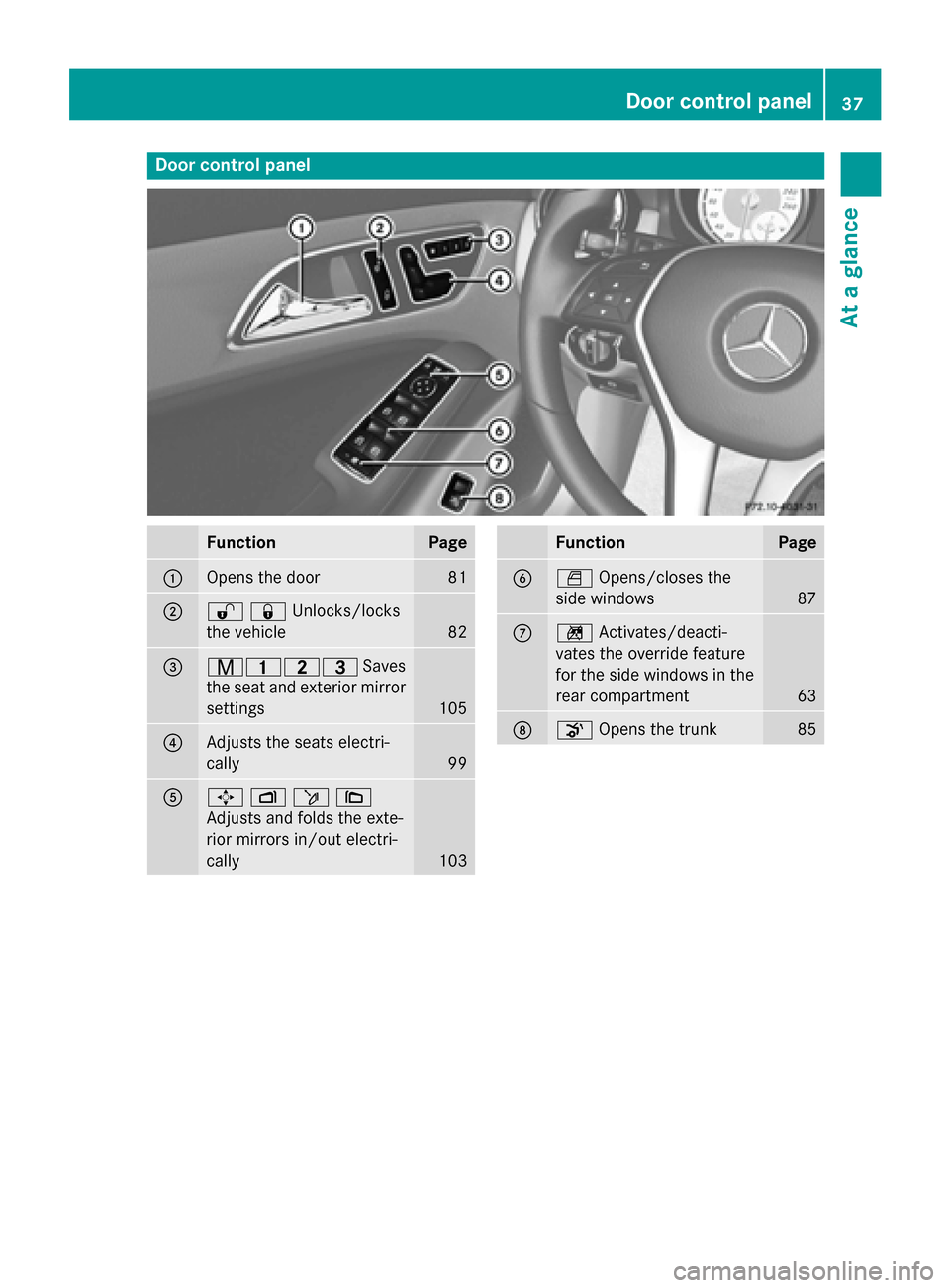
Door control panel
Function Page
0043
Opens the door 81
0044
00360037Unlocks/locks
the vehicle
82
0087
008D003700380040
Saves
the seat and exterior mirror settings 105
0085
Adjusts the seats electri-
cally
99
0083
0062
007000F50071
Adjusts and folds the exte-
rior mirrors in/out electri-
cally 103 Function Page
0084
0062
Opens/closes the
side windows 87
006B
0089
Activates/deacti-
vates the override feature
for the side windows in the
rear compartment 63
006C
008A
Opens the trunk 85Door control panel
37At a glance
Page 41 of 358
Useful information
..............................40
Panic alarm .......................................... 40
Occupant safety .................................. 40
Children in the vehicle ........................56
Driving safety systems .......................63
Theft deterrent locking system .........72 39Safety
Page 42 of 358

Useful information
i This Operator's manual describes all
models and all standard and optional equip- ment of your vehicle available at the time of
publication of the Operator's manual.
Country-specific differences are possible.
Please note that your vehicle may not be
equipped with all features described. This
also applies to safety-related systems and
functions.
i Read the information on qualified special-
ist workshops (Y page 26). Panic alarm
X
To activate: press0033button 0043for at
least one second.
An alarm sounds and the exterior lighting
flashes.
X To deactivate: press0033button 0043
again.
or
X Insert the SmartKey into the ignition lock. Occupant safety
Important safety notes
G
WARNING
Modifications to the restraint systems could
result in them not functioning properly any
more. The restraint systems could then no
longer protect vehicle occupants as they are designed to do and could fail in the event of an
accident or activate unexpectedly, for exam-
ple. There is an increased risk of injury.
Never modify parts of the restraint systems.
Do not attempt to modify the wiring as well as
electronic components or their software.
If it is necessary to modify an air bag system to accommodate a person with disabilities, con-tact an authorized Mercedes-Benz center.
USA only: for further information contact our
Customer Assistance Center at
1-800-FOR-MERCedes (1800-367-6372).
In this section, you will learn the most impor- tant facts about the restraint system compo-
nents of the vehicle.
The restraint system consists of:
R Seat belts
R Child restraint systems
R LATCH-type (ISOFIX) child seat securing
system
Additional protection is provided by:
R SRS (Supplemental Restraint System)
R Air bag system components with:
- PASSENGER AIR BAG OFF indicator lamp
- Front-passenger seat with Occupant
Classification System (OCS)
Although the systems are independent, their
protective functions work in conjunction with each other. Not all air bags are always
deployed in an accident.
i For information on infants and children
traveling with you in the vehicle restraint
systems for infants and children, see "Chil-
dren in the vehicle" (Y page 56). SRS (Supplemental Restraint System)
Introduction Supplemental Restraint System (SRS) with:
R The 0075 SRS warning lamp
R Air bags
R Air bag control unit (with crash sensors) 40
Occupant safetySafety
Page 51 of 358

indicator lamp not illuminate or go out while
the restraint is installed, please check
installation. Periodically check the
00730074 indicator lamp while driving to
make sure that the 00730074indicator
lamp is illuminated. If the 00730074indi-
cator lamp goes out or remains out, do not transport a child on the front-passenger
seat until the system has been repaired.
A child in a rear-facing child restraint on the
front-passenger seat will be seriously
injured or even killed if the front-passenger front air bag inflates.
R If you place a child in a forward-facing child
restraint on the front-passenger seat:
- move the seat as far back as possible
- use the proper child restraint recommen-
ded for the age, size and weight of the
child
- secure child restraint with the vehicle's
seat belt according to the child seat man-
ufacturer's instructions
R For children larger than the typical 12-
month-old child, the front-passenger front
air bag may or may not be activated. G
WARNING
If the red 0075SRS warning lamp in the
instrument cluster and the 00730074indica-
tor lamp light up simultaneously, the OCS is
malfunctioning. The front passenger front air
bag will be deactivated in this case. Have the system checked by qualified technicians as
soon as possible. Contact an authorized
Mercedes-Benz Center.
Only have the seat repaired or replaced at an
authorized Mercedes-Benz Center.
In order to ensure proper operation of the air
bag system and OCS:
R Sit with the seat belt properly fastened in a
position that is as upright as possible with
your back against the seat backrest.
R When seated, a passenger should not posi-
tion him/herself in such a way as to cause the passenger's weight to be lifted from the seat cushion as this may result in the OCS
being unable to correctly approximate the
passenger's weight category.
R Read and observe all warnings in this chap-
ter. 0043
PASSENGER AIR BAG OFF indicator lamp
If the SmartKey is removed from the ignition
lock or is in position 0, PASSENGER AIR BAG
OFF indicator lamp 0043does not light up.
The Occupant Classification System (OCS)
categorizes the occupant on the front-
passenger seat using a weight sensor.
The front-passenger front air bag is deactiva-
ted automatically for certain weight catego-
ries.
The PASSENGER AIR BAG OFF indicator lamp
shows you the current status.
The system does not deactivate:
R the side impact air bag
R the window curtain air bag
R the Emergency Tensioning Devices
To be classified correctly, the front passenger
must sit:
R with the seat belt fastened correctly
R in a position that is as upright as possible
with their back against the seat backrest
R with their feet on the floor
The OCS weight sensor reading is affected if
the occupant's weight is transferred, e.g. by
leaning on the armrest.
If the front-passenger seat, the seat cover or the seat cushion are damaged, have the nec- Occupant safety
49Safety Z
Page 52 of 358

essary repair work carried out at a qualified
specialist workshop.
For safety reasons, Mercedes-Benz recom-
mends that you only use seat accessories
that have been approved by Mercedes-Benz.
Both the driver and the front passenger
should always observe the PASSENGER AIR
BAG OFF indicator lamp as an indication of
whether or not the front passenger is posi-
tioned correctly. Observe also the air bag dis- play messages that can be displayed in the
instrument cluster (Y page 225).
If the driver's air bag deploys, this does not
mean that the front-passenger front air bag
will also deploy.
The OCS may have detected that the seat:
R is empty or occupied by the weight of a
typical child up to twelve months old,
seated in a child restraint system.
R is occupied by a small individual, such as a
young teenager or a small adult.
R is occupied by a child in a child restraint
system whose weight is greater than that of
a typical twelve month old child.
These are examples of when the OCS deacti- vates the front-passenger front air bag. Deac-
tivation takes place although the collision ful- fills the criteria for deploying the driver's air
bag.
For further information, see "Air bag display
messages" (Y page 225).
System self-test G
WARNING
If the 00730074indicator lamp does not illu-
minate, the system is not functioning. You
must contact an authorized Mercedes-Benz
Center before seating any child on the front
passenger seat. G
WARNING
Never place anything between seat cushion
and child seat (e.g. a pillow), since it reduces the effectiveness of the OCS. The underside
and rear side child restraint system must be placed entirely on the seat cushion and the
backrest of the front-passenger seat back-
rest.
If necessary, adjust the tilt of the passenger
seat backrest.
An incorrectly mounted child seat could cause injuries to the child in case of an accident,
instead of increasing protection for the child.
Follow the manufacturer's instructions for
installation of child restraint systems.
The PASSENGER AIR BAG OFF indicator lamp
lights up:
R if you turn the SmartKey in the ignition lock
to position 1or 2
R if an adult is seated properly on the front-
passenger seat and the OCS classifies the
occupant as an adult
The PASSENGER AIR BAG OFF indicator lamp
goes out again after approximately six sec-
onds.
If the seat is not occupied and the OCS
detects that the front-passenger seat is
empty, the PASSENGER AIR BAG OFF indica- tor lamp will continue to light up. The
PASSENGER AIR BAG OFF indicator lamp will
not go out.
For further information, see "Problems with
the Occupant Classification System"
(Y page 51). 50
Occupant safetySafety
Page 58 of 358
The front seat belts and the outer seat belts in
the rear are equipped with Emergency Ten-
sioning Devices and seat belt force limiters.
The ETDs tighten the seat belts in an accident, pulling them close against the body.
The ETDs do not correct incorrect seat posi-
tions or incorrectly fastened seat belts.
The ETDs do not pull vehicle occupants back
towards the backrest.
The ETDs can only be activated when:
R the ignition is switched on
R the restraint systems are operational; see
"0075 SRS warning lamp" (Y page 41)
R the belt tongue has engaged in the belt
buckle of the respective front seat
The ETDs on the outside seats in the rear
compartment are triggered independently of
the lock status of the seat belts.
The ETDs are triggered depending on the type
and severity of an accident:
R in the event of a head-on or rear-end colli-
sion if the vehicle decelerates or acceler-
ates rapidly in a longitudinal direction dur-
ing the initial stages of the impact.
R in the event of a side impact if the vehicle
decelerates or accelerates rapidly in a lat-
eral direction on the side opposite to the
impact.
R in certain situations where the vehicle rolls
over if the system determines that it can
provide additional protection.
If the ETDs are deployed, you will hear a bang,
and a small amount of powder may also be
released. Only in rare cases will the bang
affect your hearing. The powder that is
released generally does not constitute a
health hazard and does not indicate that there is a fire in the vehicle. The dust might cause
some temporary breathing difficulty for peo-
ple with asthma or other breathing trouble. To avoid this, you may wish to get out of the
vehicle as soon as it is safe to do so. You can
also open the window to allow fresh air to
enter the vehicle interior. The 0075SRS warn-
ing lamp lights up. If the seat belt is also equipped with a seat
belt force limiter and this is triggered, the
force exerted by the seat belt on the vehicle
occupant is reduced.
The seat belt force limiters for the front seats
are synchronized with the front air bags,
which absorb part of the deceleration force.
This results in the force exerted on the occu- pant being distributed over a greater area. Children in the vehicle
Child restraint systems
Important safety notes G
WARNING
According to accident statistics, children are
safer when properly restrained in the rear
seating positions than in the front seating
position. Thus, we strongly recommend that
children be placed in the rear seats whenever possible. Regardless of seating position, chil- dren 12 years old and under must be seated
and properly secured in an appropriate infant
restraint, toddler restraint, or booster seat
recommended for the size and weight of the
child.
The infant or child restraint must be properly
secured with the vehicle's seat belt, the seat
belt and top tether strap, or lower anchors and
top tether strap, fully in accordance with the
child seat manufacturer's instructions.
Occupants, especially children, should always
sit as upright as possible, wear the seat belt
properly and use an appropriately sized infant
restraint, toddler restraint, or booster seat
recommended for the size and weight of the
child.
Children can be killed or seriously injured by
an inflating air bag. Note the following impor-
tant information when circumstances require you to place a child in the front passenger
seat:
R Your vehicle is equipped with air bag tech-
nology designed to deactivate the front 56
Children in the vehicleSafety